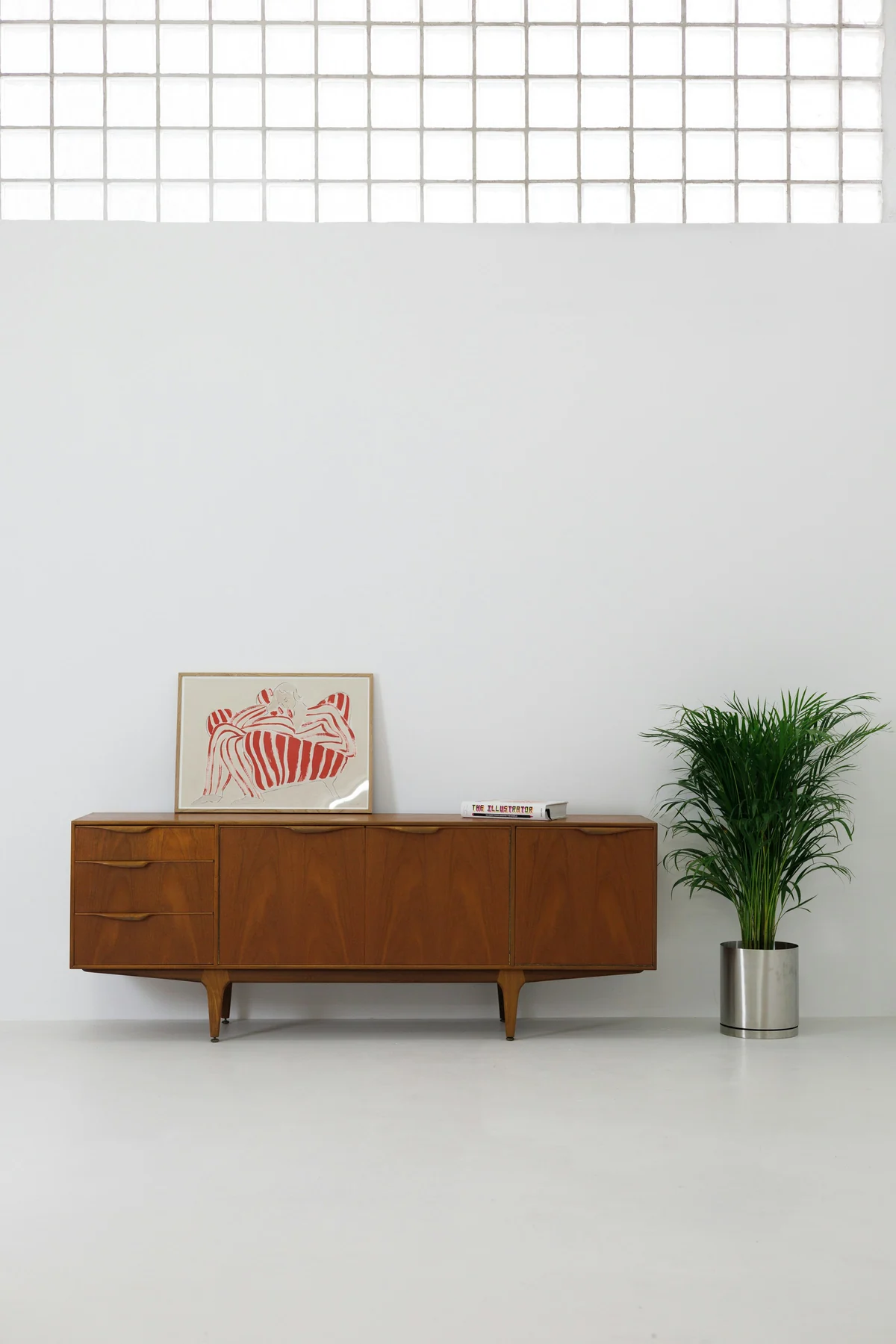
Define the storage job before choosing a name
Begin with what must be stored, how often it is used and who needs to reach it. Stacks of linen, heavy records, tall bottles, fragile glass, cutlery and children's clothing place different demands on shelf spacing, drawer depth, doors, visibility, bending and stability. Then define the job of the top: serving, display, a lamp, a television or nothing at all.
Write the storage brief
- ContentsQuantity, largest dimensions, approximate combined weight, fragility and whether objects must stand, hang or lie flat.
- AccessDaily, weekly or occasional use; one visible shelf, separated drawers or one deep volume.
- UsersReach, grip, bending, mobility, children, pets and anyone likely to climb or pull on the furniture.
- Top surfaceServing, display, equipment or a clear lid that must open without first moving other objects.
- Room stateClosed, normally open, user standing or seated, nearby doors open and the route still functioning.
Useful distinction
A beautiful form can be the wrong storage tool
A lift-top chest may hold a large volume but require its whole top to be cleared. A shallow sideboard may offer an excellent serving surface but fail to hold the records or dishes it was bought for. Choose the operation before the label.
Understand chest, cabinet, sideboard, credenza and buffet
The Getty Art & Architecture Thesaurus describes a sideboard as case furniture, often on legs, with cupboard storage beneath and a traditional dining-room role in serving, storage and display. It also records how the form changed over time, which is one reason a single modern silhouette cannot police the name.[1]
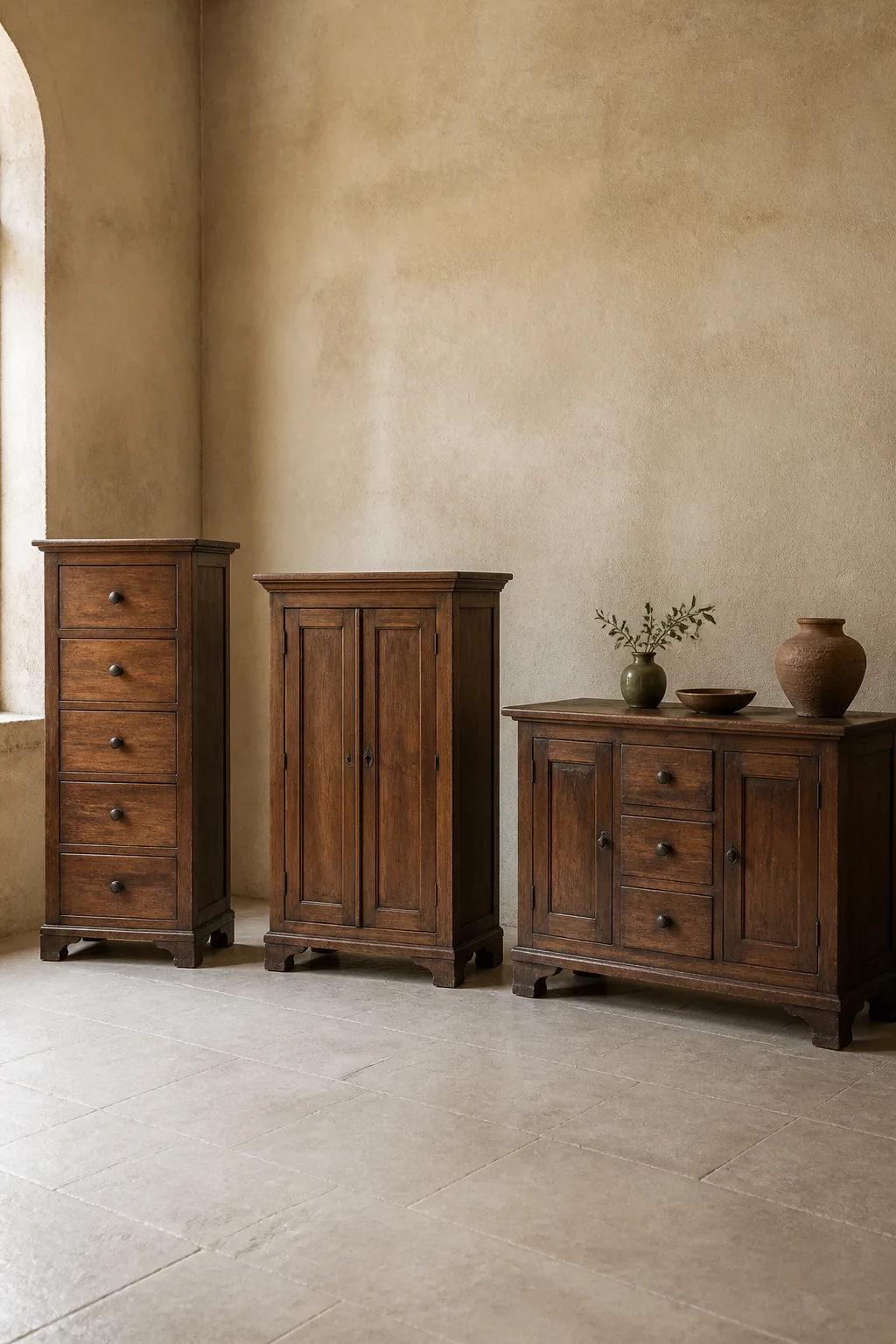
Getty defines a cabinet as case furniture with shelves, small drawers or compartments behind one or more doors, intended for storage and sometimes display. That is a useful form description, not proof that the shelves suit the buyer's objects or that the doors work correctly.[2]
| Listing term | Observable form to expect | Verify before choosing |
|---|---|---|
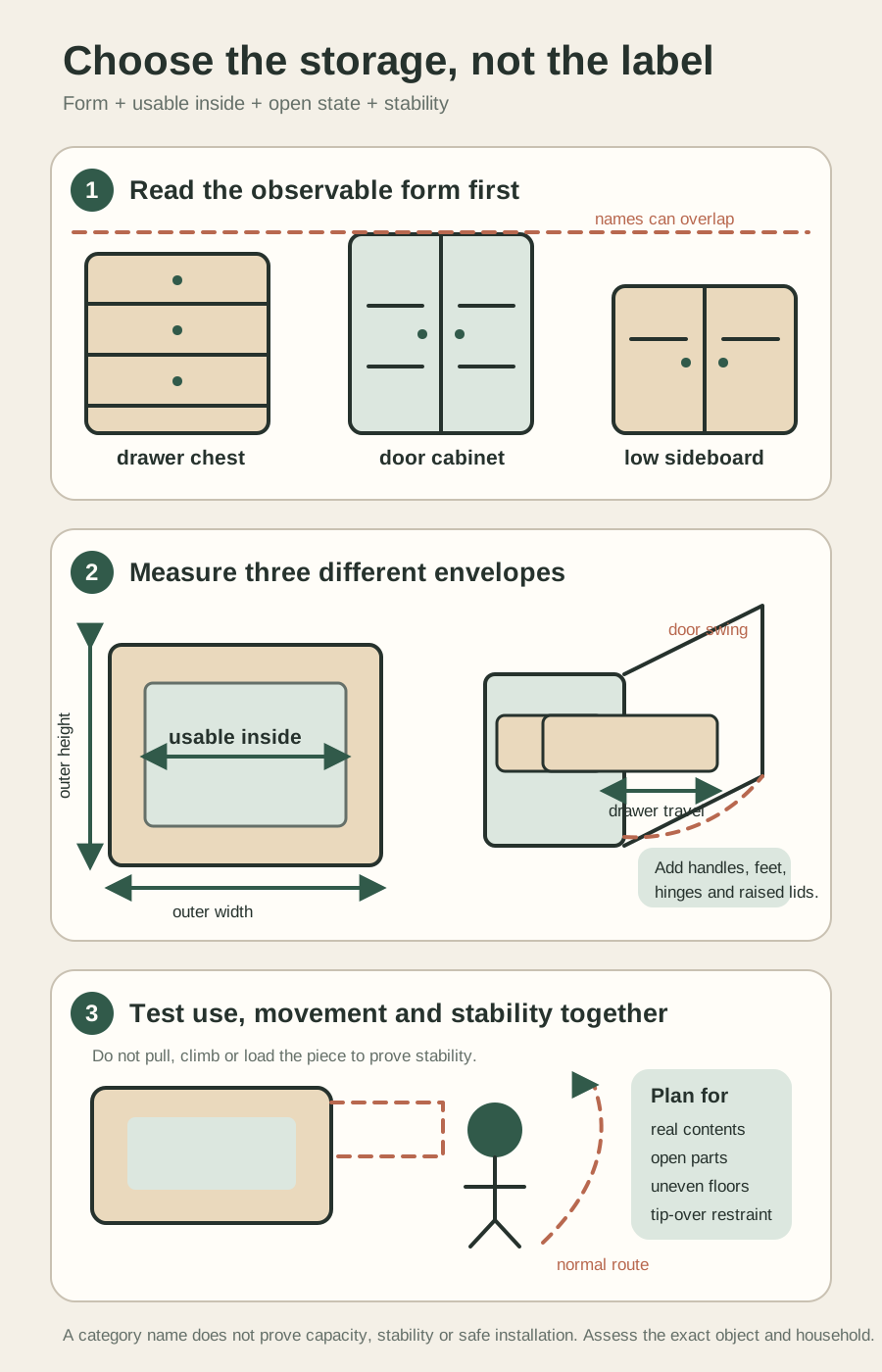
| Chest of drawers | A case organised mainly as stacked pull-out drawers | Clear drawer interiors, full travel, stops, user reach and stability |
| Lift-top chest or coffer | One deep box reached through a hinged or removable top | Clear inner volume, lid support, hand clearance and what must leave the top |
| Cabinet | Doors enclosing shelves, compartments and sometimes drawers | Door swing, shelf spacing, usable depth, hinges and approach |
| Sideboard | Usually a relatively low case with storage below a useful top | Top task, interior organisation, projections and room/open footprint |
| Credenza or buffet | Often a sideboard-like dining or living-room storage case | The same exact doors, drawers, shelves, dimensions and construction as any other case |
Getty places credenzas inside the sideboard family and describes a particular historical dining-room form. Contemporary sellers may use credenza, buffet and sideboard more broadly. Preserve a defensible historic term when evidence supports it, but do not let that term substitute for measuring the exact case and openings.[3]
Naming boundary
The title helps you search; the object decides whether it works
A seller label does not prove period, origin, maker, capacity, condition or safe use. Record observable doors, drawers, shelves, lid, base and proportions first; research attribution as a separate task.
Measure exterior, usable interior and open envelopes
Ask for centimetres and photographs showing every tape endpoint. Maximum exterior measurements decide wall and route fit. Clear interior measurements describe what can actually be stored after sides, back, runners, hinges and shelf thickness are deducted. Open measurements add every drawer, door, fall front or lid that enters the room. Keep all three records separate.
| Decision | Measure on the exact piece | Do not hide |
|---|---|---|
| Wall placement | Maximum width, depth and height | Handles, mouldings, rear projections, splayed feet, uneven top and skirting gap |
| Cupboard capacity | Clear width, depth and height of every bay and shelf position | Door thickness, hinges, catches, fixed dividers and shelf supports |
| Drawer capacity | Clear internal width, depth and height plus usable opening | Sides, bottom, back, runners, stops and any drawer that does not travel fully |
| Open room fit | Maximum door swing, drawer projection, fall-front reach and raised-lid height | Handles, keys, the user's body and combinations needed in normal use |
| Top task | Clear top width and depth at the usable height | Gallery, raised edge, fragile finish, lid seam and objects that must move |
| Delivery | Protected maximum case and every genuinely removable component | Fixed cornice, base, glass, stone, hardware and reassembly method |
Measure the smallest useful opening as well as the largest outer point. A deep-looking cabinet can lose capacity to a thick back; a broad drawer can offer a narrow clear opening; a low case can project farther than expected once a door and the person using it share the floor.
Map doors, drawers, lids and the user in the room
Mark the closed case at full size, then add one normally operated part and the person using it. Repeat for each drawer, door, lid or pull-out surface. If ordinary use genuinely requires two parts open together, map that combination—but do not create it merely for a buyer test when stability is uncertain. Include nearby room doors, curtains, radiators, sockets and the route past the furniture.
Use the drawers, doors and locks Guide for the full operating sequence and evidence needed to separate a stiff drawer, tilted case, failed lock and damaged runner. An open-state plan describes space; it does not diagnose the mechanism.
Safe evidence
Observe normal operation; do not force a demonstration
Ask the seller to operate one part at a time on a level surface. Keep resistance, movement, missing stops or an unstable case unresolved until appropriate assessment—never pull harder, hang on a door or load an open drawer to prove a point.
Test the real contents and access pattern
Make paper or cardboard profiles for the largest objects and arrange them within the seller's clear interior dimensions. For stacks or groups, include the way hands must enter, lift and turn the contents—not only their packed volume. If the intended load is heavy or concentrated, keep shelf and drawer capacity unknown until the construction and support are appropriately assessed.
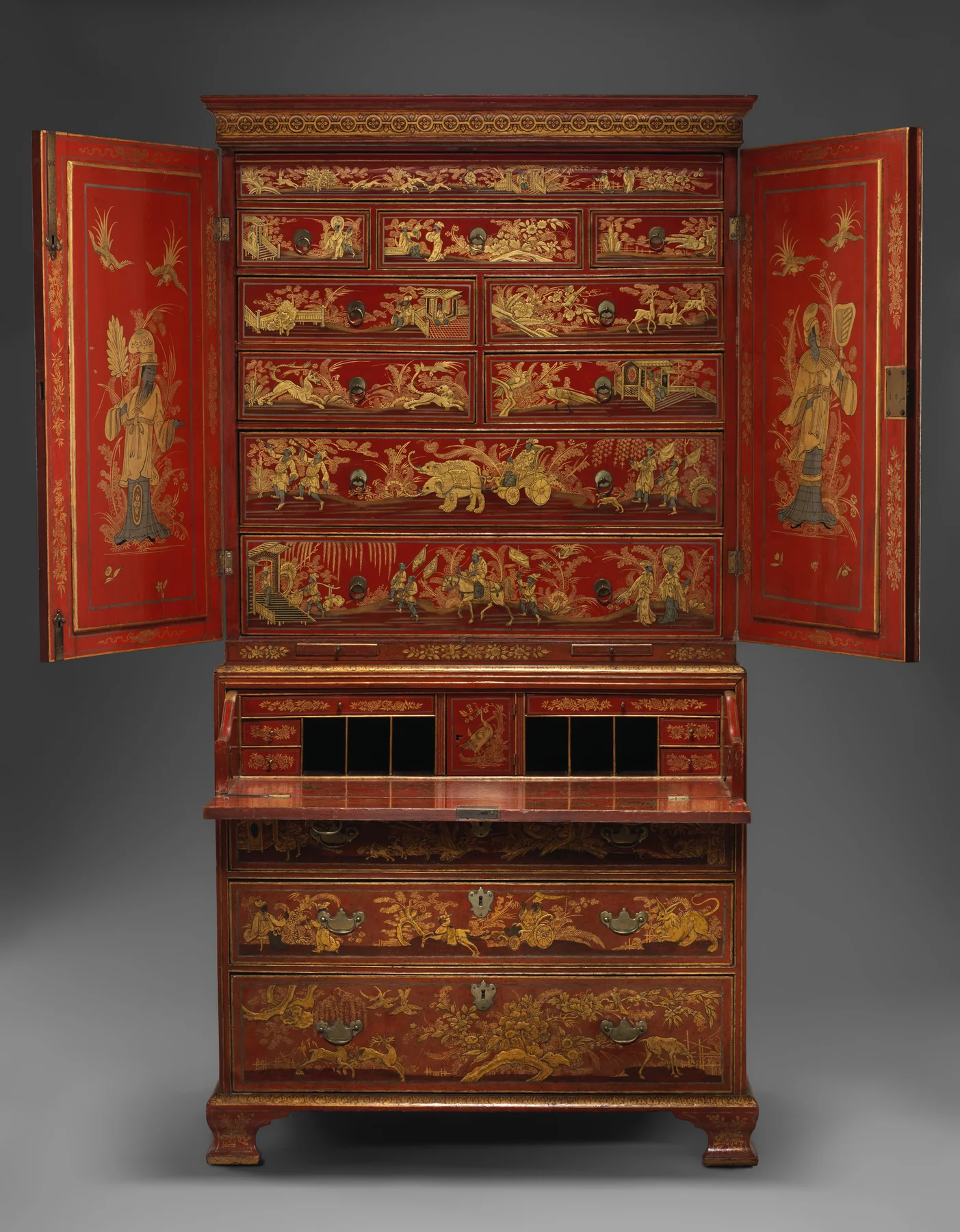
Build a contents record
- Largest objectWidth, depth, height and the orientation in which it must pass the opening.
- Whole groupQuantity, stack height, approximate combined weight and space for safe handling.
- Access frequencyDaily objects within comfortable reach; occasional objects where extra steps are acceptable.
- EnvironmentLight, ventilation, dust, moisture, heat and any sensitivity of both contents and furniture.
- Top useEvery object that remains above, its position and whether it blocks a lid or creates top-heavy loading.
- Unknown capacityAny shelf, drawer, hinge or support whose safe load cannot be established from buyer evidence.
| Operation | Often useful for | Practical drawback to test |
|---|---|---|
| Shallow drawer | Cutlery, papers, accessories and small separated objects | Clear height, stops, full opening and visibility at the back |
| Deep drawer | Folded textiles and larger contained groups | Weight, reach, tipping influence and items becoming buried |
| Shelved cupboard | Mixed-height objects and adjustable groupings | Door opening, shelf support, usable depth and dark corners |
| Lift-top volume | Bulky occasional contents | Clearing the top, holding the lid and reaching the bottom |
| Open top | Serving, display or equipment | Finish sensitivity, cable/heat needs and load concentration |
Test the approach, reach and route with the user
The U.S. Access Board notes that clear floor space at a storage cabinet and a connected approach route are separate parts of usability. Those standards apply in defined public settings, not as universal private-home dimensions; the useful buyer method is to rehearse the exact user, opening and route together.[6]
Rehearse ordinary access
- ApproachReach the furniture with the intended chair or mobility device and without closing a needed room door.
- OperateReach the handle, key or edge and open the part without trapping hands or blocking the user's position.
- RetrieveSee and lift the real contents without an unacceptable bend, reach, twist or obstruction.
- Close and leaveReturn the part normally and rejoin the route while nearby furniture remains in its ordinary state.
Access boundary
A room test is not an accessibility certification
For a specific access, care or workplace need, test with the person who will use the furniture and obtain the professional or regulatory assessment appropriate to that setting.
Treat stability and tip-over as a household decision
Health Canada warns that furniture can become unstable through top-heavy design, an uneven surface, heavy objects and open drawers, and that climbing or pulling creates particular danger for children. Its advice applies to new and used furniture. A piece that looks steady in one closed photograph is not proven safe in the buyer's room.[4]
Record the stability plan
- Base and floorAll feet or plinth areas present, the intended floor level, and no hidden rocking or damaged support.
- Open partsNormal one-at-a-time use, any interlock or stop, and no assumption that several open drawers remain safe.
- ContentsHeavier objects planned low, no unassessed concentrated load and nothing attractive to children placed high.
- HouseholdChildren, pets, climbing, pulling, support-seeking and any foreseeable misuse included honestly.
- RestraintAn appropriate solution for the exact furniture, wall, fixings, local guidance and historic fabric.
- Ongoing checkA plan to keep the piece level, secure and reviewed when it moves or its contents change.
Historic furniture may have no surviving installation instruction and may be harmed by an improvised fixing. That does not remove the tip-over risk. Have an appropriate furniture or installation professional resolve the exact piece, wall and household, including a minimally damaging method where preservation matters.
Stop boundary
Do not prove stability by creating the hazard
Do not climb, lean, pull downward, open several uncertain drawers, load an open part or invite a seller to perform a tip test. Keep stability unresolved until suitable evidence and a safe placement/restraint plan exist.
Inspect the case, then plan empty protected movement
Look at the whole case from front, sides, back, top and underside where safely visible. Record leaning, racking, loose joints, splits, detached backs, altered feet, repairs, water evidence and missing hardware. Operate one part at a time on a level surface; a case that moves as a drawer opens needs assessment, not a stronger pull.
The Canadian Conservation Institute advises checking furniture for damage and loose joints before movement, removing contents and genuinely removable drawers, shelves or doors, securing parts that cannot be removed and transporting cabinets empty and upright with cushioning. Apply this as a conservative planning boundary, not a universal dismantling instruction for the exact object.[5]
Use the condition Guide and the photograph-request Guide to preserve the relationship between a defect and the complete case. Then use the delivery-route Guide for the protected case, component inventory, doors, lifts, turns and carrier handoff.
Handling boundary
A removable-looking seam is not a removal instruction
Confirm how every shelf, door, base, cornice, top or internal part releases and returns without forcing old joinery. Let the carrier and appropriate furniture specialist own methods beyond ordinary removal.
Request the missing evidence, then decide
Ask for the complete storage record
- Whole objectFront, both sides, back, top, base and the piece standing closed on a level surface.
- ExteriorMaximum width, depth and height with every fixed projection identified.
- InteriorClear dimensions for each drawer, shelf or bay and every included shelf or fitting.
- Open statesDoor swing, drawer travel, lid height, normal operating sequence and the user position.
- ConditionMovement, lean, repairs, altered supports, damaged runners or hinges and missing stops, keys or hardware.
- Stability informationKnown instructions, restraint hardware or assessment—without a request to perform a hazardous test.
- Delivery configurationContents removed, genuine removable parts, protected case dimensions and agreed handling ownership.
Adaptable message
Ask about the exact case
Hello—I'm checking whether this piece suits specific contents and a known wall. Please confirm the maximum exterior dimensions including handles, feet and rear projections; clear dimensions of every drawer, shelf and bay; full drawer travel, door swing or lid height; included shelves, keys and fittings; and any movement, lean, repair, altered support, missing stop or seller-known stability concern. Please show each part operating normally one at a time on a level surface, without a pull or load test, and identify genuine removable delivery components. Thank you.
| Decision | Use it when | Keep explicit |
|---|---|---|
| Buy | Contents, access, top task, open room state, stability plan and delivery all work | Exact dimensions, parts, condition, placement and handoff |
| Clarify | One missing interior, movement, repair or component fact could change the answer | The bounded question and evidence needed |
| Mock up | Dimensions are known but the user's access or room route remains uncertain | Full-size closed and open plan with the intended user |
| Professional review | Stability, load, restraint, repair or handling exceeds safe buyer evidence | Who owns the assessment, exact scope and likely cost |
| Decline | Use depends on forcing a part, unsafe testing, unknown heavy loading or an unresolved tip-over plan | The condition that makes the risk unacceptable |
The useful answer is not the most prestigious name. It is the form whose real interior, movements, user access, stability and route make sense for the intended household—and whose remaining unknowns are small enough to accept.