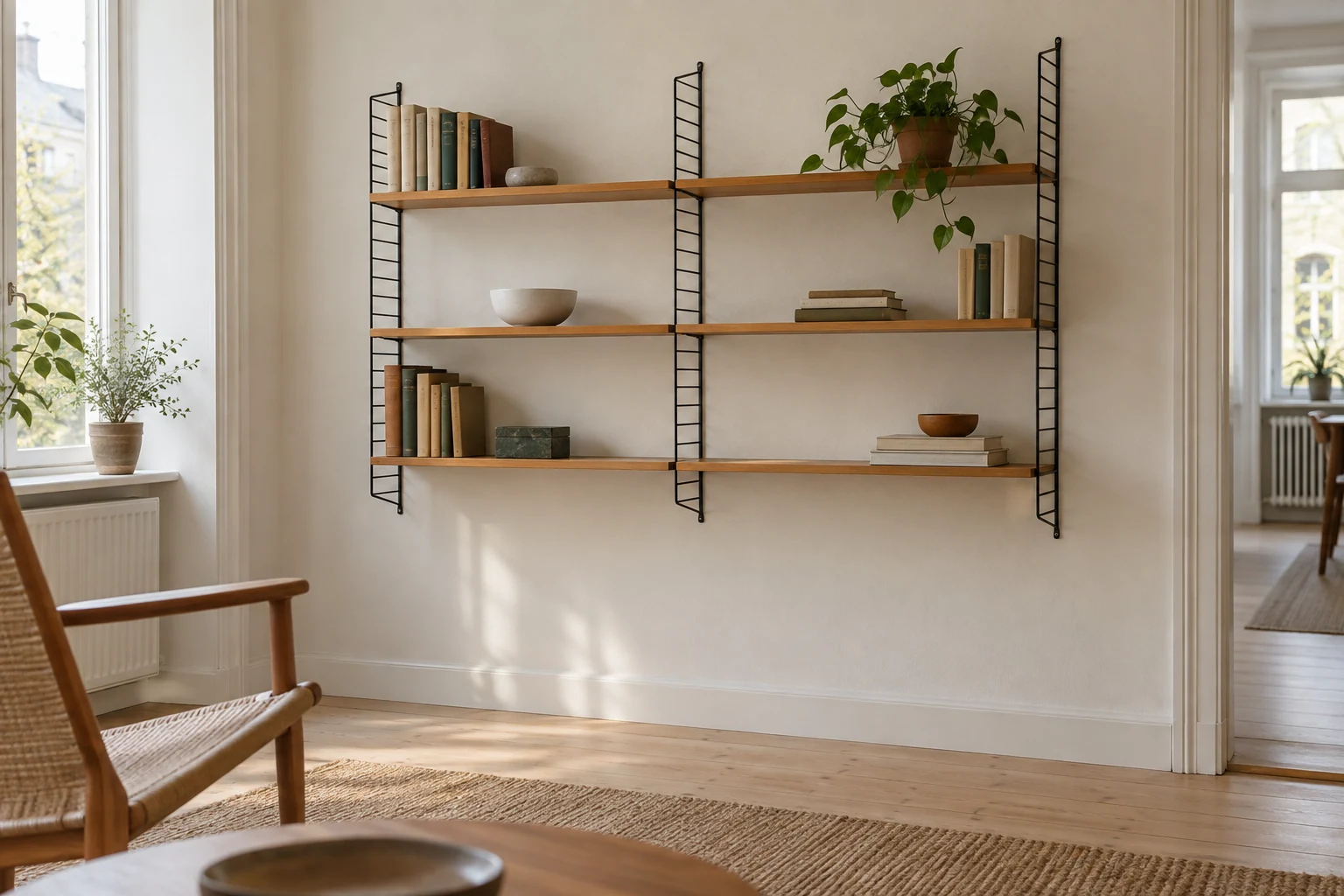
A light-looking shelf can hide a complicated offer
The appeal of String is how little of the wall it seems to occupy. Thin side panels and slim shelves can make a book collection feel less bulky than it would in a solid cabinet. That same simplicity can make an incomplete bundle look deceptively ready to use.
A seller may show the system on the wall, then offer only some of the shelves. Another may have combined parts collected over several years. Start by establishing the exact sale: the pictured arrangement, a stated subset, or loose components awaiting assembly.
Ask for the outer dimensions and a counted photograph of the included pieces, with existing fittings left attached. Keep the shelf widths, panel depths and fitting types together in the record. Six good-looking boards are not six usable shelves unless their supports and panel relationships are resolved.
The broader wall-system Guide covers mounting, condition and dismantling in detail. The String-specific questions here are the series, generation and whether the included components can make your chosen arrangement.
Pocket is a date clue, not a generic name
String Furniture dates String Pocket to 2005 and describes it as a complete package of two wall panels and three shelves. The company distinguishes it from String System. That gives you a useful test of an advertisement: a set described as “1960s String Pocket” has a naming or dating conflict to resolve.[1]
It might be an older String arrangement given the wrong name. It might be a later Pocket set given an optimistic date. Ask for measurements, labels and the seller’s evidence rather than choosing the most attractive explanation. A familiar wire outline does not decide the issue.
Also distinguish a complete original configuration from a later combination. Different colours do not automatically mean incompatible parts, and matching colours do not establish a common production period. Document what belongs together before comparing the price with a dated set.
The maker’s FAQ says Pocket panels and shelves are not sold individually. Do not assume a current retail spare shelf will be available simply because the brand is still trading. Confirm the exact replacement route for the series you have found.[2]
Three panels or four?
Suppose an offer contains three matching wall panels and six shelves. In a suitable two-bay arrangement, the bays can share the middle panel, with three shelves in each bay. If you want one bay above a desk and the other across the room, each needs its own pair of end panels: four panels in total.
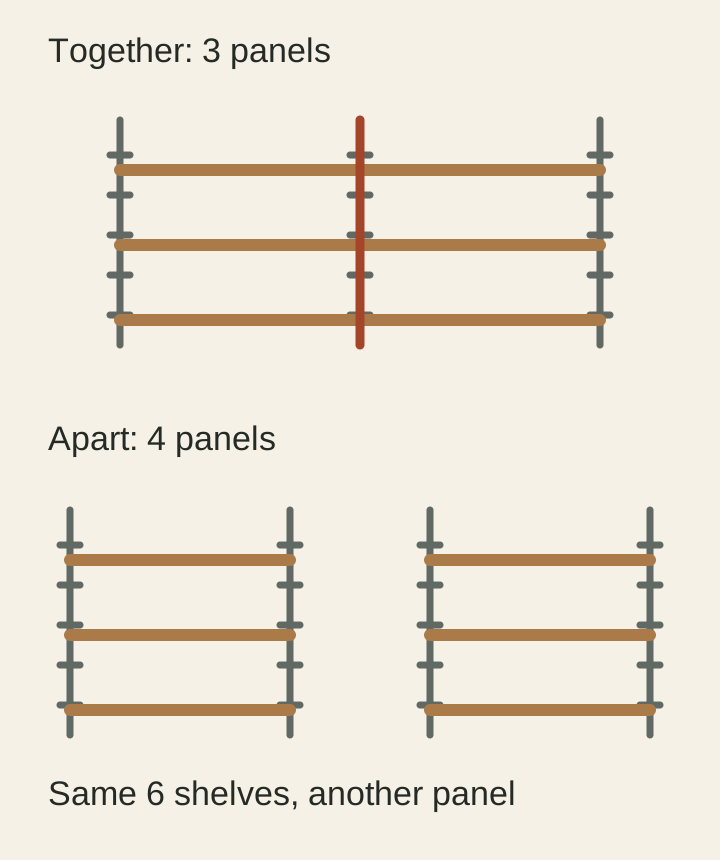
This is a counting example, not proof that a particular group is compatible or safe to install. The shelf widths, panel geometry, depth and fittings still have to match. If a fourth matching old panel is necessary, establish that you can obtain it before buying the first three.
Draw every proposed bay and mark each included panel on the drawing. A cabinet or desk element adds its own attachment and operating requirements. It cannot be counted as just another board because it fits between two vertical lines.
Depth is about books as well as brackets

Current String System wooden-shelf specifications describe compatibility with wire and Plex panels of the same depth. For example, the current 58 × 20 cm shelf is specified for matching-depth panels. That is a scoped current-product statement, not a guarantee for an unidentified bundle of older parts.[3]
Measure the offered shelf and panel separately and ask for a side view of their relationship. Do not round an awkward measurement to the nearest familiar catalogue size. A cut-down shelf or altered fitting needs its own explanation.
Then measure the books or objects you intend to store. A shallow shelf can be excellent for small paperbacks and frustrating for large art books. Check usable depth and height between your planned levels, leaving room to lift out a book without disturbing the shelf above it.
Keep load and installation questions separate from those dimensions. A current shelf rating cannot establish the capacity of an old, altered shelf on an unknown wall. Give the installer the proposed contents and the actual components rather than borrowing a number from a different product.
What the 2005 parts limit means
In its FAQ, checked on 8 September 2026, String Furniture says it does not provide spare parts for products produced earlier than 2005. For products from 2005 onwards, it directs owners to a dealer or its spare-parts service. That is a service boundary; it does not establish that every older part is incompatible with every newer one.[2]
For a buyer, the consequence is practical. A complete older set you can use in its present arrangement may be a straightforward purchase. A cheaper set missing a proprietary fitting may require a specialist search with an uncertain outcome. Decide whether you want that project before making it yours.
| Missing or uncertain item | Useful next step |
|---|---|
| One panel needed to separate the bays | Find an identified, suitable panel and confirm its condition and complete cost. |
| Shelf support or cabinet fitting | Identify the exact component and a confirmed replacement route; avoid a lookalike chosen only by appearance. |
| Origin of a loose mixed set | Ask for measurements and connection views, then have the intended combination reviewed. |
Do not confuse missing furniture components with new wall fixings. The installer must choose the fixing method for your wall and assess the final arrangement. A bag of screws from the previous home does not settle either question.
Agree the set that will arrive
Before collection, attach the counted inventory to the agreement and name who will remove the shelving. Record the installed arrangement before dismantling, label the parts and keep their existing fittings associated with them. Long panels and shelf edges deserve protection in transport.
A few marks on a complete, coherent set may be easier to live with than an immaculate photograph followed by weeks searching for one fitting. Choose the arrangement you can actually bring into use, with the work and missing pieces made explicit.
A message for the seller
Could you confirm the String series and the evidence for its date, and show every included panel, shelf, cabinet and fitting? Please give the width and depth of each shelf type and the full dimensions of each panel type, note any alterations, and say which parts have been used together. My intended layout is [drawing]. Please identify anything it would still need and who will dismantle and pack the set.