
Sort the books before browsing the furniture
Choose a few representative groups from your collection: everyday paperbacks, hardbacks, tall reference books and the largest albums. Measure each group’s run along a shelf, plus its tallest height and greatest front-to-back depth in the intended position. Keep slipcases and dust jackets on if that is how the books will be stored.
The US National Archives recommends storing small and medium books upright with similarly sized neighbours, and large volumes such as atlases flat. This gives you a practical starting arrangement: ordinary rows and a separate home for the books that do not behave like ordinary rows.[1]
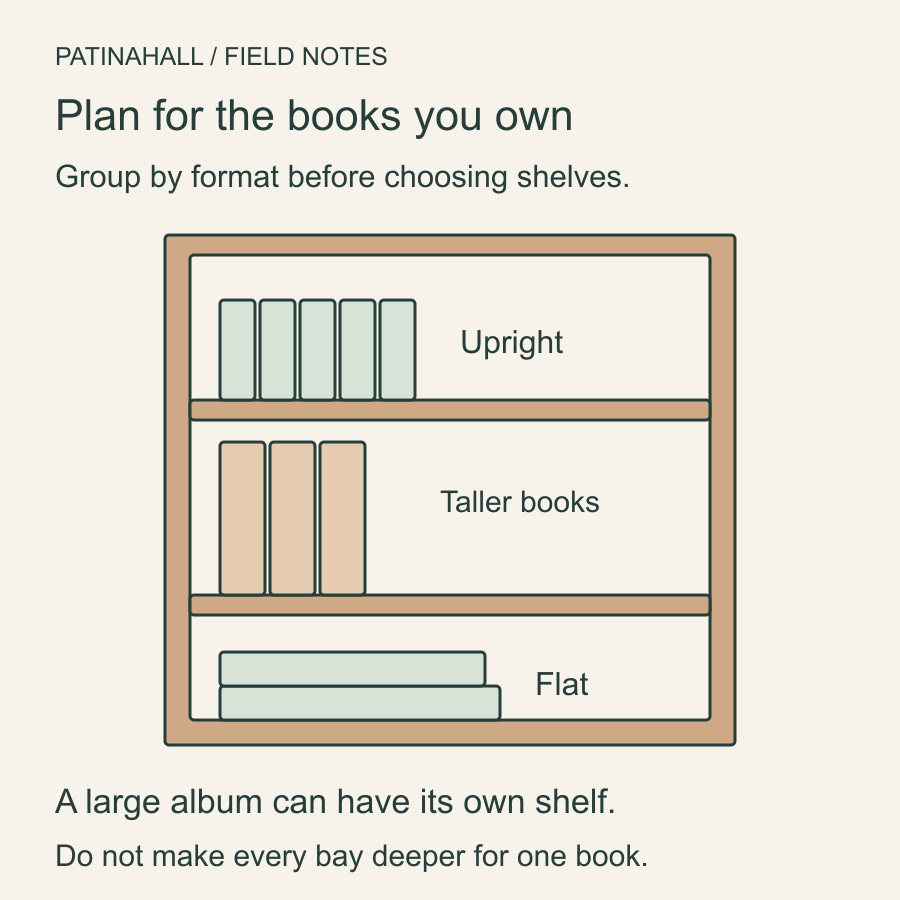
Decide which books need to be within easy reach. Cookbooks used daily, novels you browse and albums brought out occasionally need not occupy equivalent positions. A lower shelf can suit a large flat volume, provided the shelf supports it and you can lift it comfortably. Leave an accessible place for the books you are currently using.
Resist buying enough depth for the single biggest book on every level. One awkward album might need a different bay or a separate suitable surface. Giving it its own place can let the rest of the bookcase be shallower and easier to use.
Turn the collection into usable shelf length
Add your measured runs, then choose how much extra space you want for browsing, bookends and future additions. That allowance belongs to your collection; it is not a universal percentage. A collection that grows every month needs a different plan from a settled set of reference books.
| Measurement | Example |
|---|---|
| Present upright-book runs | 165 cm |
| Chosen allowance for access and future books | 30 cm |
| Planned requirement | 195 cm |
| Three shelves at 68 cm clear width | 204 cm before bookends or other obstructions |
| Apparent spare space | 9 cm, which still needs checking bay by bay |
Now check the distribution. If one shelf is too low for your hardbacks, its full width cannot count towards that group. If bookends occupy 4 cm on each of three shelves, the example loses 12 cm and falls short of the 195 cm plan. Total shelf length is useful only after each run has somewhere to go.
Ask how adjustable shelves actually are. Record the available positions, the size of each interval and whether every support is present. Do not assume that a cabinet with visible holes can be rearranged freely: a fixed shelf, door hinge or missing pin may limit the useful arrangement.
Measure usable depth with the doors shut
For an open bookcase, measure from the usable front edge to the inner back or obstruction. For a glazed cabinet, close the doors and include the space taken by their frames, hinges and catches. The cabinet’s external depth may include an overhanging top and a thick back that contribute nothing to storage.
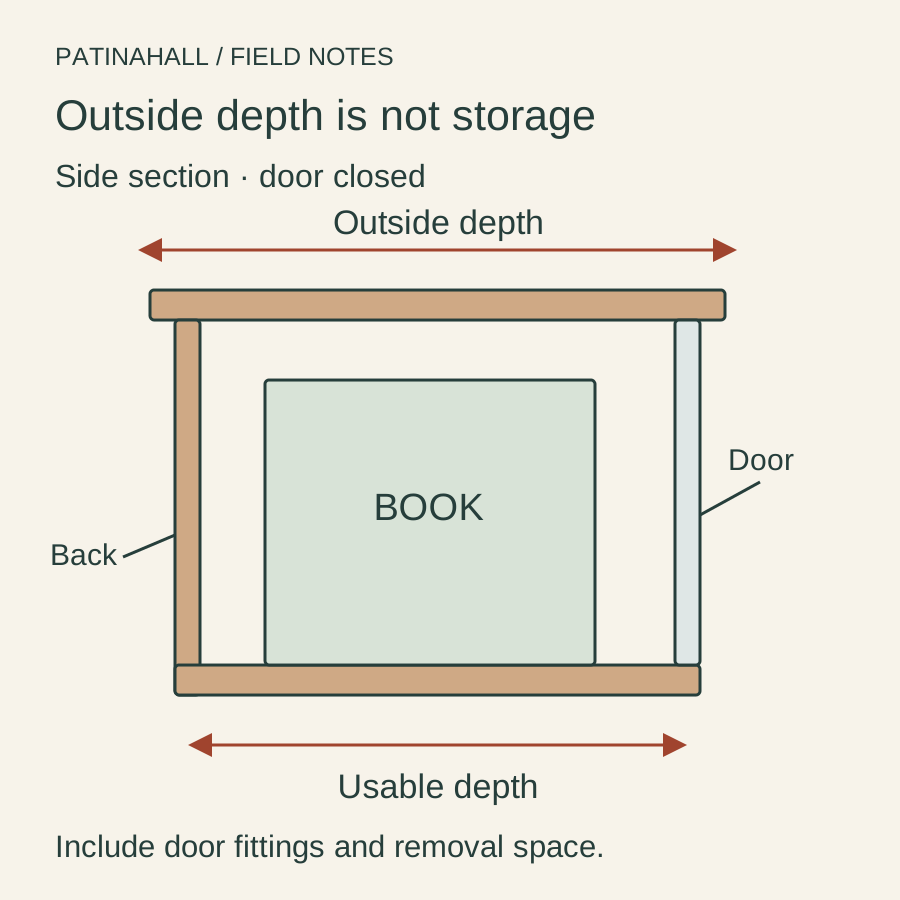
For example, a cabinet advertised as 32 cm deep might have only 26 cm between its inner back and closed door. A book 28 cm deep will not fit upright in that space as planned. Turning it flat changes the required height and footprint; it is not a free solution if the neighbouring books or door opening prevent removal.
CCI advises against tightly packed rows and recommends grasping books around the middle of the spine rather than pulling their tops. It also advises leaving books clear of the back where feasible. Plan enough room to take out the actual book without scraping its jacket or tugging its binding.[2]
Deep shelves invite a second row. Before counting it as extra capacity, decide whether you can see and retrieve those books without unloading the front row. For something you use often, a shallower visible row can be more useful than double the nominal space.
Look beneath the shelf before believing the capacity
Shelf dimensions answer the space question. They do not provide a safe weight limit. Ask for any documented load information and find out whether it applies to the actual shelves and supports still present. “Solid wood”, “original” and “held books for years” are descriptions or history, not interchangeable load ratings.
Request empty-shelf views from the front and below, the supports at both ends, the back, base and any joints or repairs. Ask whether a shelf bows, a support is loose or missing, or the case moves out of square. A dark line in a photograph may be a shadow; an identified bow is an observation whose cause and consequence still need assessment.
If a heavy collection depends on a long shelf of unknown capacity, have a furniture specialist assess the intended load and any proposed work before buying. Do not ask the seller to demonstrate strength by loading a doubtful shelf, and do not assume that turning a bowed board over repairs the underlying problem.
A later shelf can be a useful, honestly described replacement. Check its fit, support, material and effect on the storage plan. The important buying question is whether the present assembly can do the job, alongside whatever originality matters to you.
Place the whole bookcase, including its fixing plan
CPSC’s Anchor It! guidance calls for securing furniture according to the manufacturer’s instructions. Resolve a suitable anchoring arrangement for the exact bookcase and wall before loading it, especially where children could climb or pull on it. If the original instructions are missing or the back is altered, ask an appropriate installer or furniture specialist to assess the attachment.[3]
An anchor does not strengthen a shelf or establish a load limit. Keep those checks separate. Include skirting boards, an uneven floor and the route of doors in the room survey; the case must stand in its intended supported position, rather than lean forwards to clear a moulding.
CCI’s wooden-furniture guidance warns against unsuitable humidity conditions and proximity to heat sources. Book conservation adds a related concern: light and damp can damage the contents as well as the furniture. Avoid choosing a position simply because an empty strip of wall happens to be beside a radiator or in strong direct sun.[4]
Check the journey into that position while the case is empty. A tall bookcase may fit upright in a corner yet need extra room to turn through a doorway. Agree any removal of shelves or separate sections with the seller and carrier; do not assume a glued case is flat-pack furniture.
If the piece hangs from rails or relies on a modular wall structure, use our wall-system Guide for that installation decision. This article concerns choosing a freestanding bookcase.
Match the furniture to the books’ significance
CCI prefers suitable metal shelving for preservation, while noting that historic wooden shelving can present relatively low risk to books where air exchange is high. A vintage wooden bookcase is therefore a context to assess, not automatic proof that books will be harmed or perfectly protected.[2]
For ordinary reading copies, practical access, sound shelves and an appropriate room may be your main concerns. For rare, fragile or valuable books, ask a book conservator about the actual enclosure, shelf surfaces and environment before buying furniture around them. Do not line the cabinet with an unknown adhesive film or freshly coat it as a guessed preservation treatment.
A glass door can be useful for a tidy display and reduced everyday dust, but it is not a climate-control system. Ask about damp storage, persistent odour or visible growth before introducing books. Those concerns need their own assessment; a fresh polish and an attractive photograph cannot explain them.
Send the seller a bookcase brief
Message to copy
My upright books need [total run] with groups up to [height × depth]; I also have [large flat volumes and dimensions]. Please confirm each shelf’s clear width, height and closed-door depth, adjustment positions and included supports. Could you show the empty shelves, supports, back, base and repairs, and identify bowing, movement or any documented load and fixing instructions? Please leave unknowns explicit and do not load or alter the case for the photographs.
Choose the bookcase when every group has an accessible place, the shelves have a credible support plan and the furniture can be secured in the chosen room. You need not fill it on arrival. Space for the next book—and space to remove the one you want—is part of useful capacity.