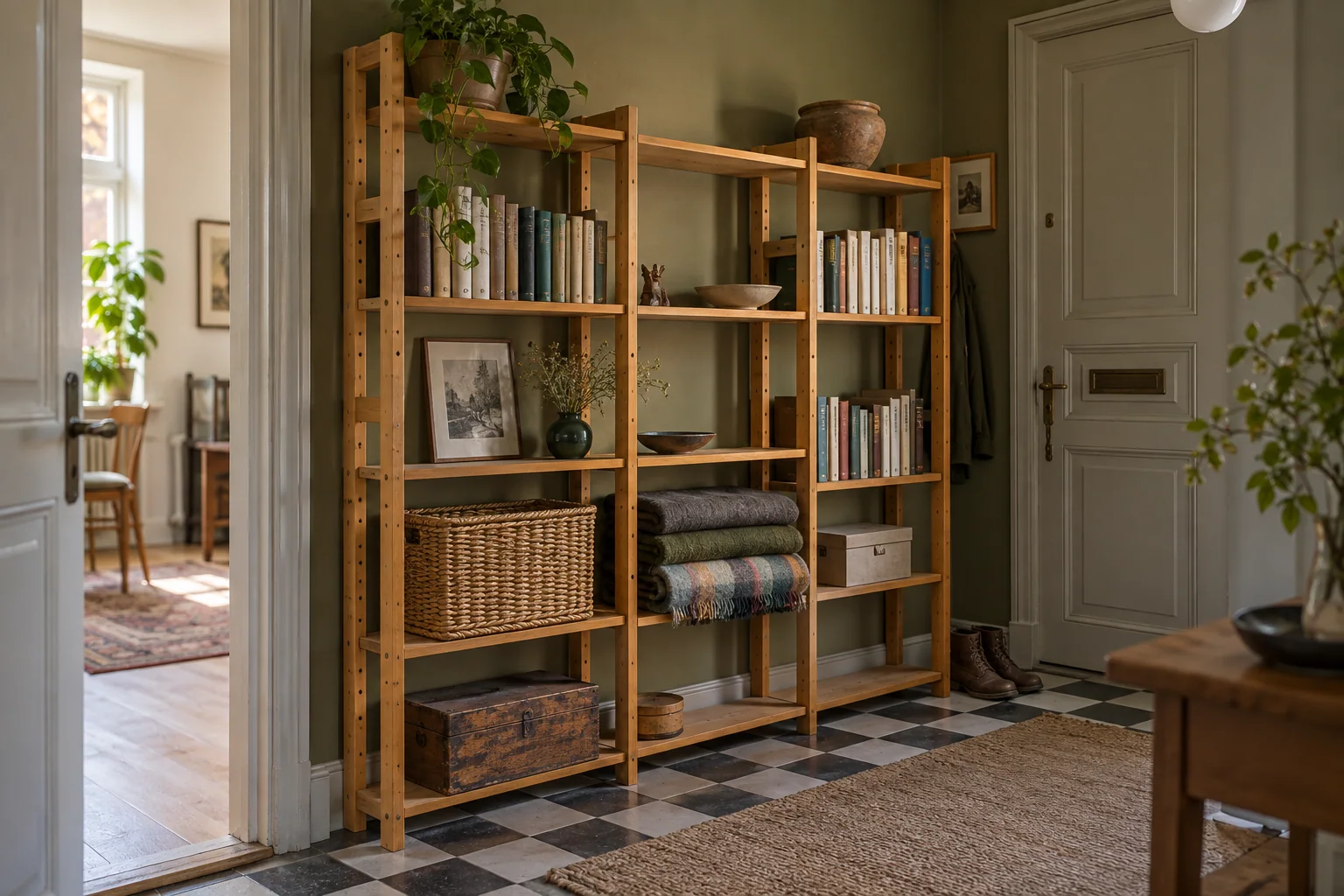
Choose the bookcase you need to finish
Pine shelving has a particular second-hand advantage: a modest kit can become everyday storage without needing an immaculate furniture finish. Start with your contents and room. Record the widest books, the depth of storage boxes and where a door or radiator limits the footprint. Decide whether you need open shelves, a desk surface or closed storage.
A listing described as “three metres of Lundia” may contain several shelf widths and depths. That total does not establish whether it forms three useful bays in your room. Sketch the intended composition and mark the exact shelves and side frames that would occupy each position. Keep spare components separate from the price of the useful arrangement.
An old-model shelf has its own detail
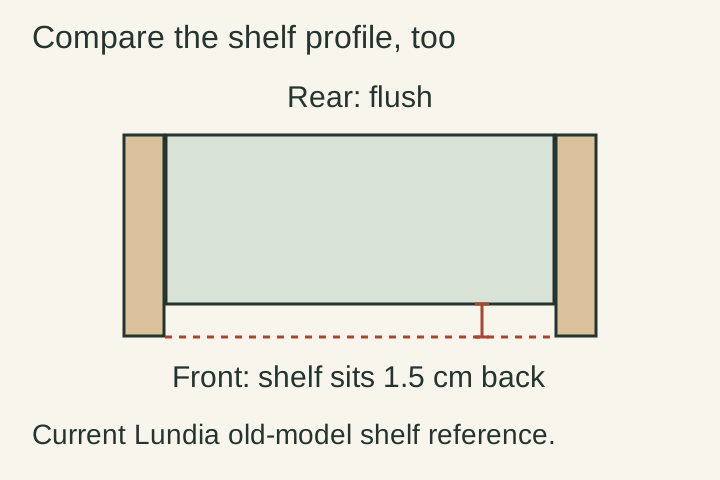
Lundia’s current “Recht schap (oud model)” page describes a traditional solid-wood shelf that runs flush with the side frame at the rear and sits 1.5 cm back at the front. It also lists four long and two short shelf pins with that specific product. These are useful comparison details for that shelf, not a universal hardware count for every Lundia component.[1]
Ask the seller for a side view showing the front and rear relationship to the upright, together with a photograph of the underside and loose fittings. Match both dimensions and profile when seeking a replacement. Two pieces of pine that are nominally the same width can still leave you with the wrong front alignment or connection.
| Sort by | Why it matters |
|---|---|
| Shelf width, depth and profile | Determines which bay and shelf type it can complete. |
| Side-frame height and depth | Sets the structure and the usable room footprint. |
| Pin type and other fittings | Connects the identified parts without improvised substitutions. |
| Bracing and stabilising components | Belongs to the specified assembled configuration, not an optional cosmetic extra. |
| Doors, drawers and accessories | May need parts absent from an otherwise complete open shelf kit. |
Parts availability is a question you can ask
Lundia directs Original owners to its shops and webshop for parts. Use that route with a counted list and clear photographs. Confirm which current part fits your actual older component, its lead time and the delivery cost before buying the kit. A product being listed online does not guarantee that your particular finish or size is immediately available.[2]
For example, suppose the sale contains enough shelves for two bays but one side frame is too deep for the rest. The useful purchase is not “almost three bays”. It is a two-bay proposal with a specific unresolved frame question. Ask whether a matching replacement exists; do not shorten or drill the mismatched frame as a first response.
Let honest pine wear stay a small problem
Compare the side frames on a flat surface where practical and inspect shelf ends, holes and earlier repairs. Large splits at a connection, enlarged holes and visibly bowed components matter more than differences in honey-coloured ageing. A shelf stained by a plant may still be useful; a damaged connection cannot be made complete with a nicer finish.
Ask for the appropriate assembly and stabilising requirements for your arrangement and wall. A freestanding-looking photograph does not establish whether wall restraint or other support was originally required. Keep heavy contents out until the identified system is correctly assembled for its intended use.
Before collection, label the parts by type and preserve the inventory in a photograph. Bag each kind of fitting separately. A cheap dismantled kit becomes unnecessarily frustrating when the one small part needed for the first shelf disappears into a mixed bag of screws.
Make one completion request
Message to adapt
Please identify this Lundia Original shelf profile and the side frames from the attached dimensions and photographs. This is my proposed arrangement and the parts included in the sale. Which fittings, bracing or other components are missing, and what would compatible replacements and delivery cost?
Choose the kit you can finish with known parts. Variations in colour can make an older pine system feel settled in a room; uncertainty about the connections is less charming once the books are waiting on the floor.