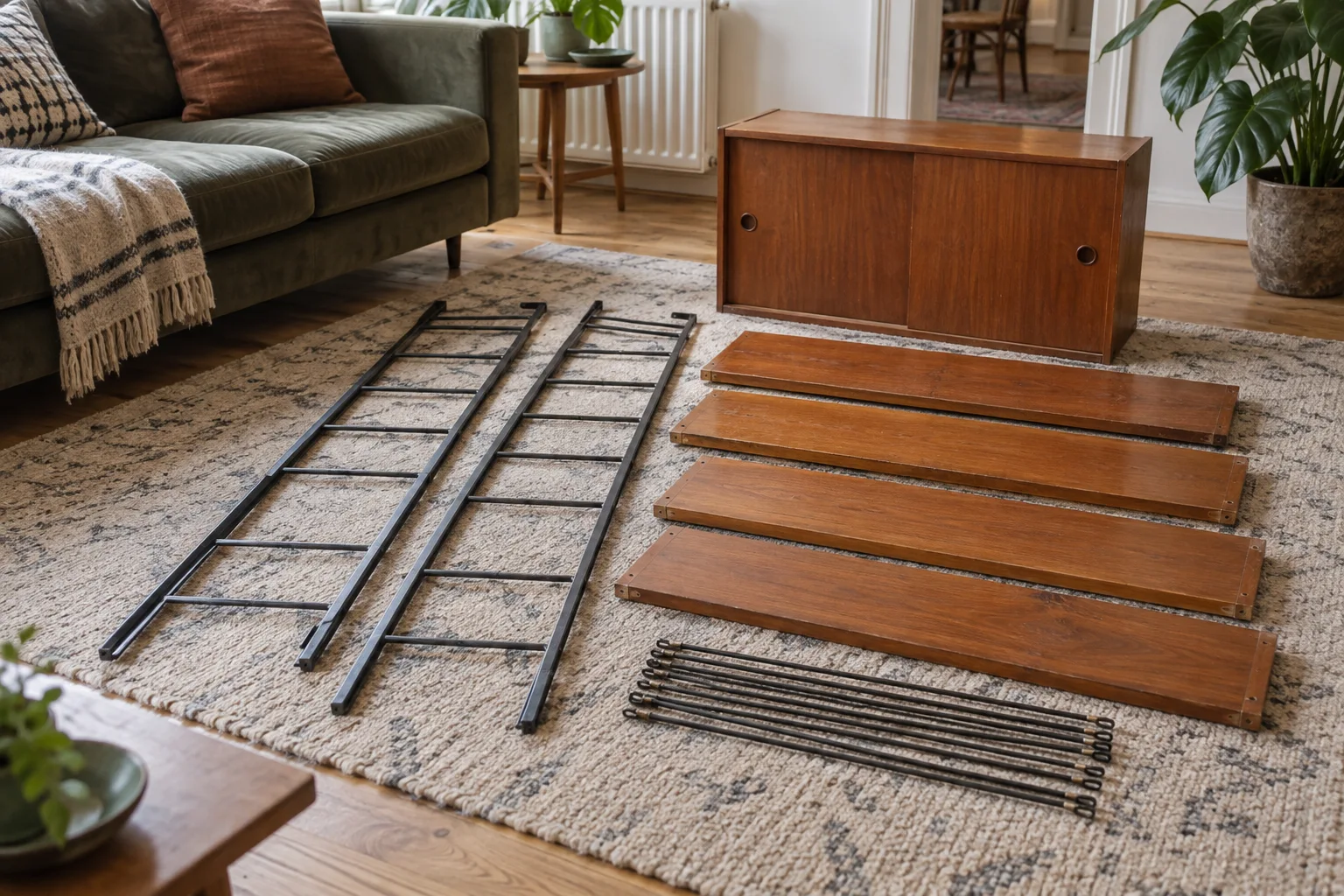
Start with the arrangement, not the pile
Ladderax is appealing because storage can feel less like a solid wall of cupboards. Open ladders, shelves at different heights and a cabinet placed where you need it can make a wall work around your belongings. But a seller’s successful arrangement may not be the one your room needs.
Sketch the intended bays. Mark the window, skirting, sockets and the objects you want to store. A record cabinet needs different internal clearance from a shelf of paperback books. A desk element needs room for your knees and a chair, as well as space to open its drawer.
Identify the system before adding parts from other listings. “Ladderax style” and a different manufacturer’s ladder shelving are not promises of compatibility. Even within a system, compare the ladder type, rung arrangement, shelf span and connection details.
Give every component a place on the drawing
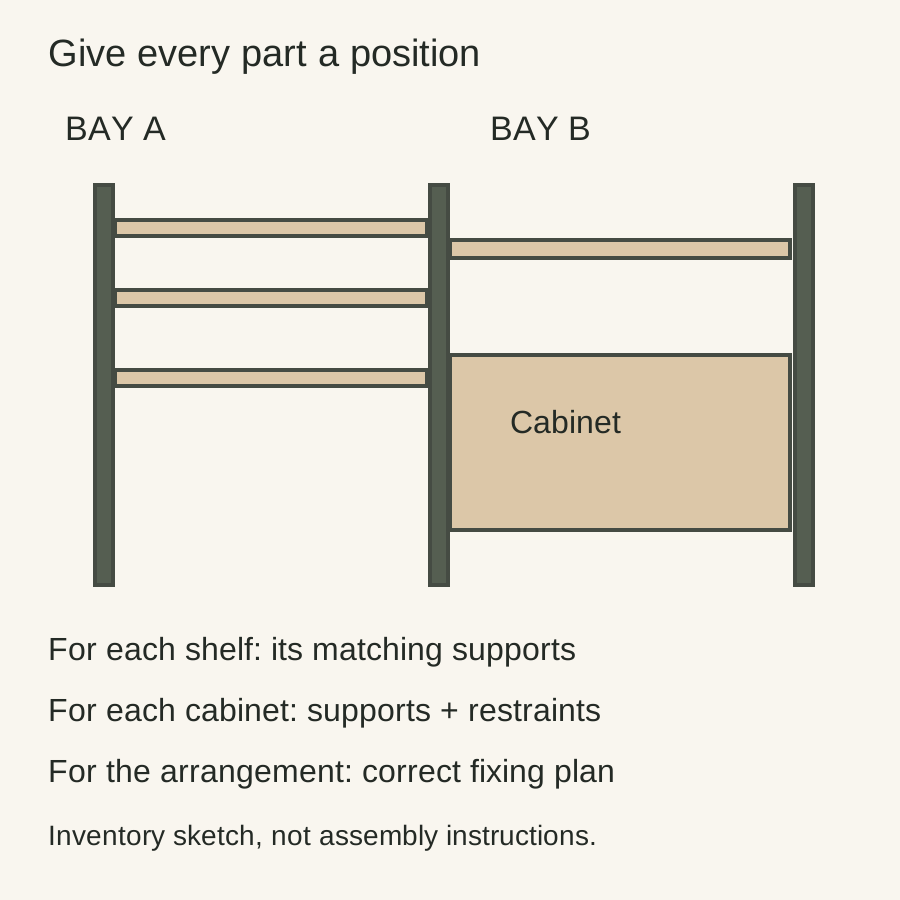
| Position or part | What to record |
|---|---|
| Uprights | Identifier, height, depth, material and whether a boundary is shared or doubled. |
| Each shelf | Bay, width, depth, condition and its complete set of matching supports. |
| Each cabinet | Bay, dimensions, support fittings, restraint fittings, doors, internal shelves and keys. |
| Bracing / fixing | The parts and instruction sheet required for this ladder type and arrangement. |
| Loose components | Labelled bags of rods, clamps and fittings, with each counted against its destination. |
Do the count on the drawing first, then against an empty assembly or the laid-out parts. Avoid a universal formula such as “two bays means three ladders”: configurations and end arrangements differ. The useful result is a named home for every supplied part and an explicit missing-parts list.
Ask for the loose rods together beside a ruler, with their ends visible. Similar-looking lengths and hook shapes can be confusing once mixed into one bag. A picture of a box full of metal is not a count.
For example, if three shelves in your proposed bay each require a confirmed pair of rods, that bay accounts for six rods. Supports and restraints for a cabinet are additional entries. Repeat the sum for each bay and match the result to the labelled parts photograph; do not borrow a cabinet fitting to make the shelf count come out right.
The cabinet fittings are not decorative extras
A surviving Staples instruction sheet reproduced by a parts seller distinguishes hook clamps for cabinets on metal ladders from round-head clamps on wooden ladders. It describes them as preventing forward tipping and stiffening the assembly. That is why a cabinet resting on supports should not be assumed complete without its restraint fittings.[1]
Use the sheet to identify the missing question, not as permission to improvise an installation from a photograph. Obtain the complete applicable instructions and have the actual components and setting checked. A freestanding-looking ladder, a leaning ladder and a room-divider arrangement should not inherit each other’s fixing assumptions.
An arrangement can appear steady while empty and behave differently when a drawer opens or books are loaded. Do not test an uncertain system by loading it or deliberately rocking it. Resolve missing restraints, bent rods, split connections or an unknown fixing plan before use.
Price the missing pieces before reserving the big ones
For each missing component, obtain an exact proposed replacement, confirmation of fit, quantity, delivered price and availability. A marketplace result labelled “Ladderax rod” is only a lead. A made-to-order replacement also needs an agreed specification and delivery date.
Suppose the inexpensive set lacks the fittings for the cabinet you most want to use. Compare it with a complete set after adding replacement work, transport and any assembly help. The cost of spare shelves you will never use is not a saving. It may be better to buy fewer complete bays.
Seller request
Please label the intended bays and confirm each upright, shelf, cabinet, support rod and restraint against that drawing. Which exact assembly instructions apply? Please photograph the loose fittings separately, state any missing or replacement components, and include the fittings and labelled packing in the sale.
Make collection part of the inventory
Photograph the arrangement before dismantling, label loose parts without sticking tape to vulnerable finishes, and have cabinets and fittings packed as identifiable groups. Agree who dismantles it and who takes responsibility for reassembly. The smallest bag is often the one most easily left on the seller’s floor.
Buy when the drawing, inventory and installation plan agree. That preserves the pleasure of an adaptable system: moving a shelf later should mean a considered rearrangement, not discovering that its support belongs to a different bay.
For planning the whole installation, use the vintage wall-system Guide.