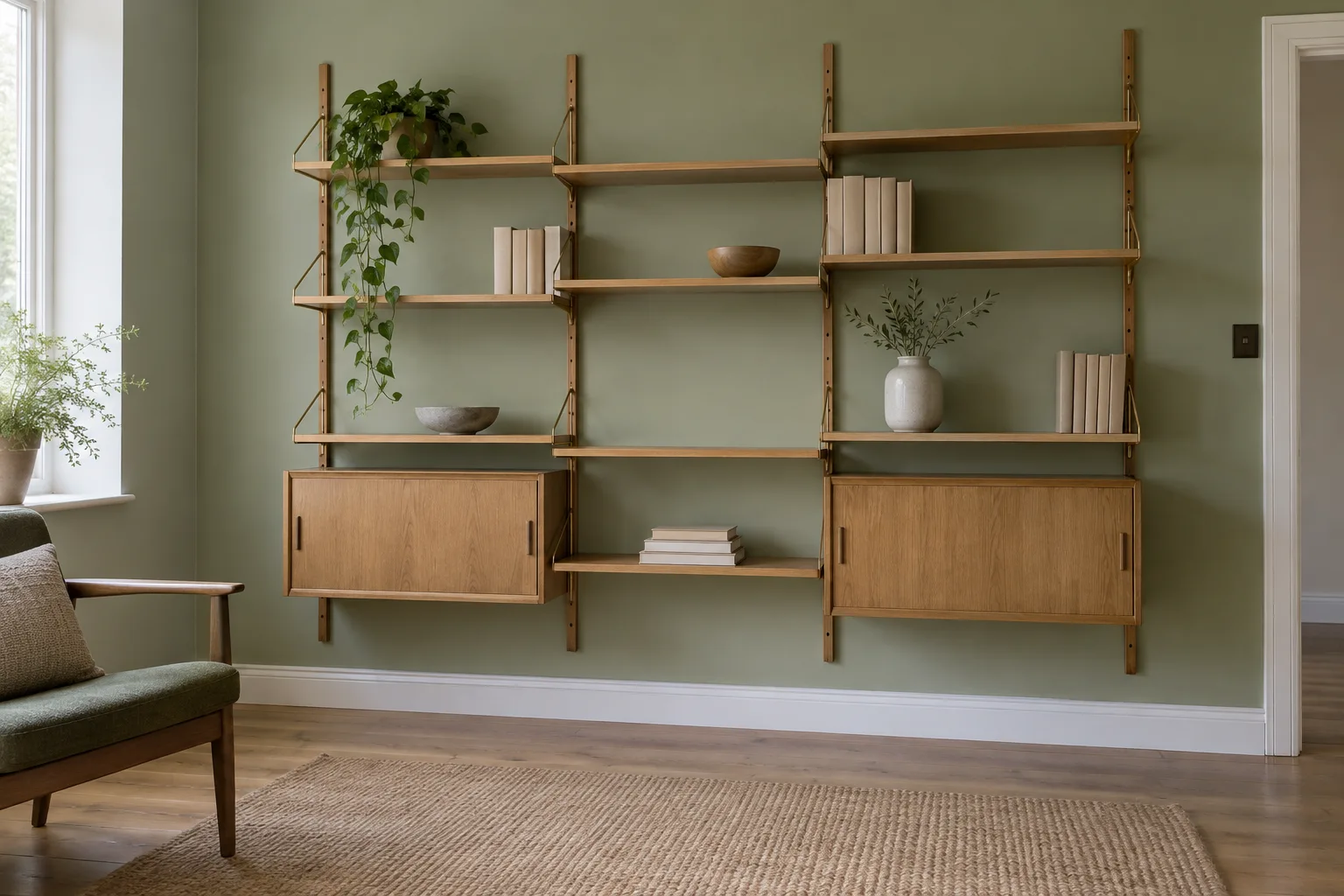
Start with the support, not the colour of the wood
The floating arrangement is the pleasure: books above, closed storage below and floor still visible underneath. In listings, however, “Cado”, “Cadovius” and “Royal System” can become loose labels for any handsome wooden wall unit. The distinction matters when a component is missing.
dk3 dates Royal System to 1948 and its own relaunch to 2010; the current system uses metal hangers. Its Cado account dates that design to 1960 and identifies wooden brackets. Those are useful first distinctions, but they are not proof that an unidentified bracket fits a particular older rail.[1][2]
| Reference | Support arrangement described by dk3 | What still needs checking |
|---|---|---|
| Royal System | Brass or stainless-steel hangers. | Exact rails, hanger geometry, shelf fittings and generation. |
| System Cado | Wooden brackets. | Exact bracket and rail arrangement, cabinet attachments and generation. |
Ask for complete side and rear views of a support, the relevant part of its rail and the shelf or cabinet it carries. A front photograph conceals those relationships. Matching timber colour or the approximate shelf width is not enough to establish mechanical compatibility.
Give every component a job in the proposed layout
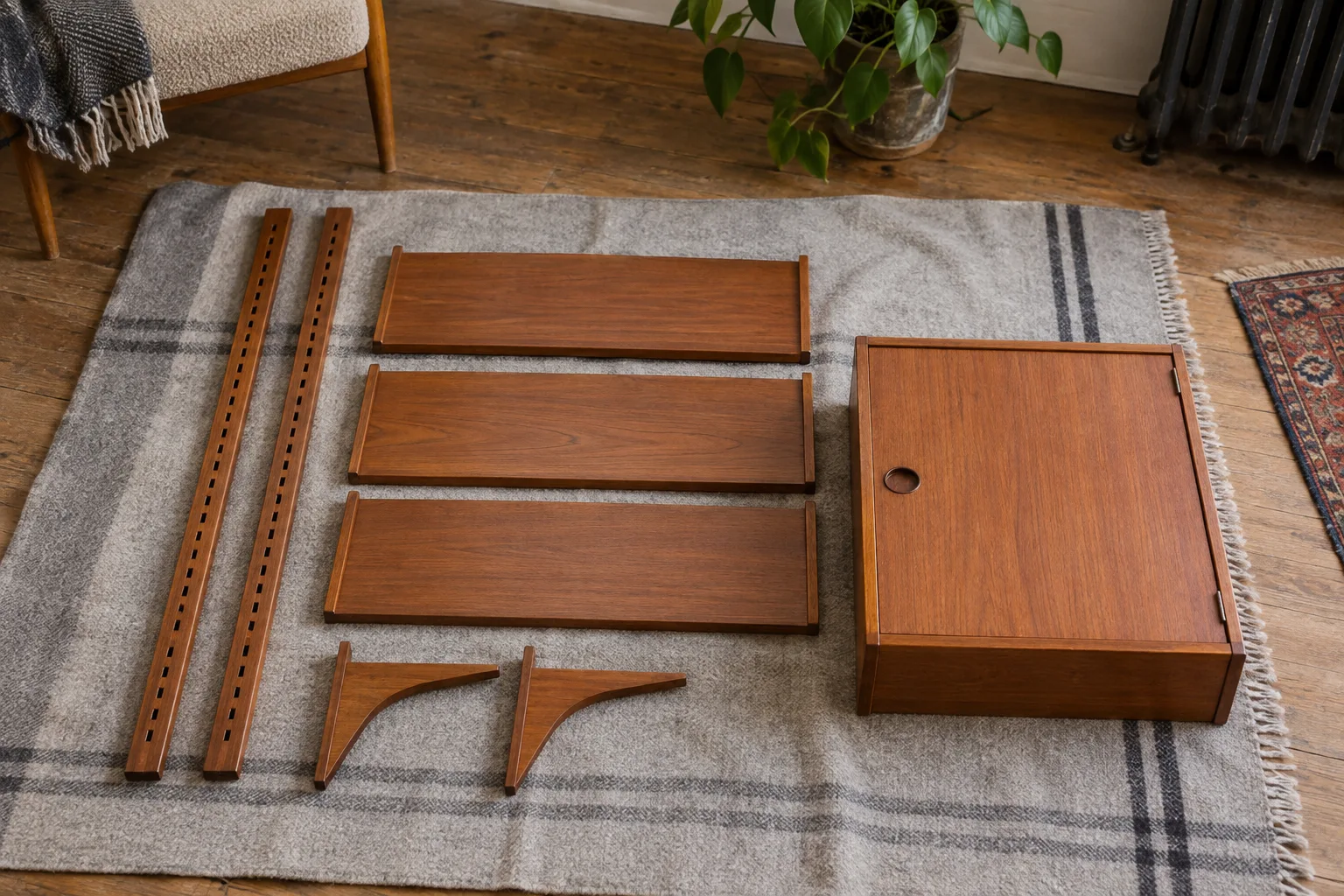
Draw the arrangement you want, including empty wall above switches, sockets and skirting. Number each bay and write what it will contain: shallow shelves for small books, deeper shelves for larger objects, a drawer unit or a closed cupboard. Then ask the seller to match the offered parts to that drawing.
For every shelf or cabinet, record its actual width and depth, which support pieces belong to it and whether those pieces are included. Count rails and their usable lengths separately. “Three bays of shelving” is an arrangement in a photograph; it is not a complete packing list.
Ask for the smaller fittings to be laid out and photographed beside the component they serve. The purpose is to preserve the set’s own relationships during dismantling, not to identify a mystery fastener by optimism. Keep rail and cabinet identifiers in removable packaging labels rather than writing on original surfaces.
A useful inventory has a final column called “unresolved”. Put the unidentified bracket, missing cabinet hanger or shortened rail there. It prevents the number of attractive boards from distracting you from the single component that could stop your preferred arrangement being assembled.
“Still in production” does not mean “parts available for this one”
Both current dk3 system pages state that new parts do not fit old parts made before 1985. That rules out an easy assumption about a 1960s unit. It does not make every post-1985 combination compatible, and it does not establish the date of an unmarked component. Send the actual measurements and photographs to the supplier before ordering.[1][2]
Imagine buying an older set because it is missing just two hangers. If the replacements you had in mind are current dk3 parts, you have not yet solved that shortage. Price the set only after a suitable source has identified compatible older parts or a specialist has proposed a specific acceptable solution. This is a hypothetical buying scenario, not a claim about any offered unit.
Compare three real options: a complete older arrangement, an incomplete one with confirmed replacements, or a complete later system with the appearance and service support you want. Include shipping for separate parts, repair work, installation and the possibility that the available layout differs from your first drawing.
Avoid quietly drilling rails or altering supports to make an uncertain combination fit. Such work changes the original parts and the way they carry weight. If a specialist proposes a modification, ask for its exact purpose, assessment and consequences before buying the set on that basis.
The wall and the removal plan belong in the purchase
dk3 recommends professional installation for its current systems. An older unit needs an assessment of its actual wall, fixings, components and intended contents. A current product load figure cannot be transferred to a decades-old shelf with unknown supports or a different wall.[1][2]
If the unit is still fitted, agree who will dismantle it and document the arrangement first. Photograph concealed fittings when they become safely accessible. Protect long rails from bending and keep hardware with its component. If already dismantled, ask for an earlier installed photograph alongside today’s complete inventory.
An enquiry for seller and installer
Please identify the system and any production evidence, list every rail, shelf, cabinet and support, and show the attachment details. Which pieces are missing, shortened or repaired? Can the proposed arrangement be installed on my wall with the intended contents, and what is included in removal, packing and installation?
Buy the composition that can be built from identified parts. A slightly smaller complete wall unit may give you more useful storage, sooner, than a spectacular photograph whose missing fittings are still somebody else’s guess.