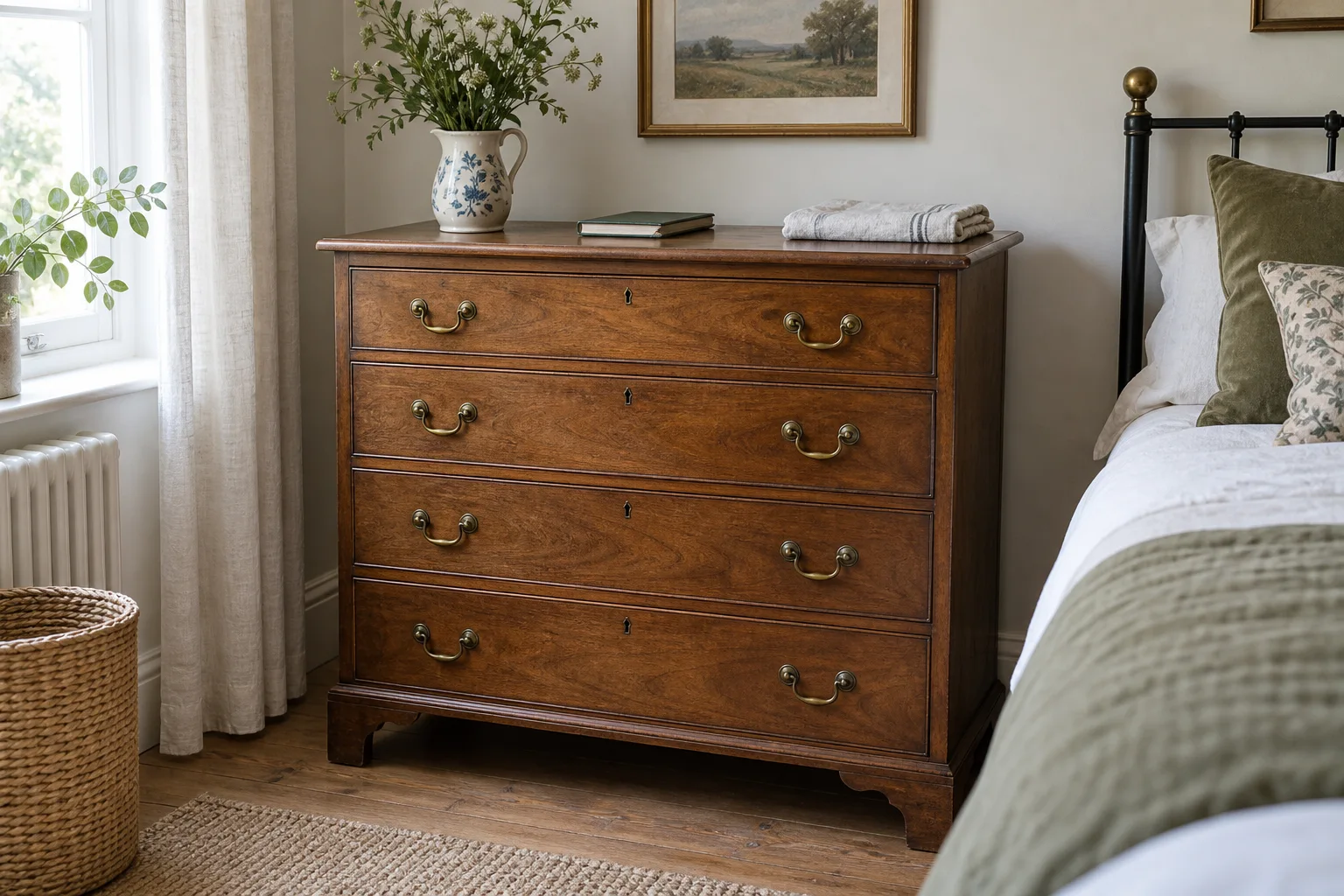
One handle, several different measurements
One missing pull can make an otherwise useful chest look unfinished. Search results will happily offer hundreds of similar brass curves. The quickest way to reduce that pile is to leave the style words until you know how the surviving handle meets the drawer.
For a handle attached at two points, the centre-to-centre measurement runs between the centres of its fixings. Overall width runs between its outermost edges. Projection is how far it stands out from the drawer face. Record each with units and a photograph showing the measuring points.
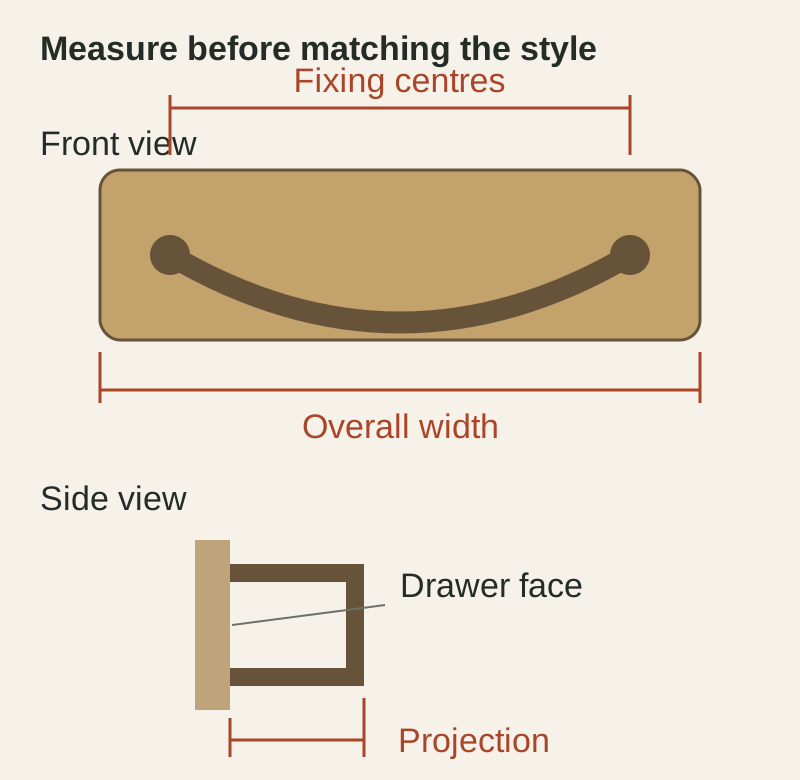
A supplier example makes the difference concrete. House of Antique Hardware lists a Sunburst pull with 5-inch fixing centres, 6⅛-inch overall width and 1¾-inch projection. It also specifies an #8-32 screw. “A five-inch handle” would hide three of those distinctions. The example explains the order information; it is not a recommendation for your drawer.[1]
Measure the panel thickness and note whether the screw enters from inside, whether the handle carries a fixed threaded post, or whether another arrangement is present. Do not force an unfamiliar thread into an old fitting. Ask the supplier to confirm diameter, thread and suitable fastener length from a clear record or the intact original.
Make a small record before taking anything apart
Photograph the whole chest, the relevant drawer and the front and back of an accessible matching fitting. Keep scale in the detail photograph but do not place adhesive tape on a delicate finish. Record whether every handle has the same dimensions: the small top drawers may use a different size from the lower ones.
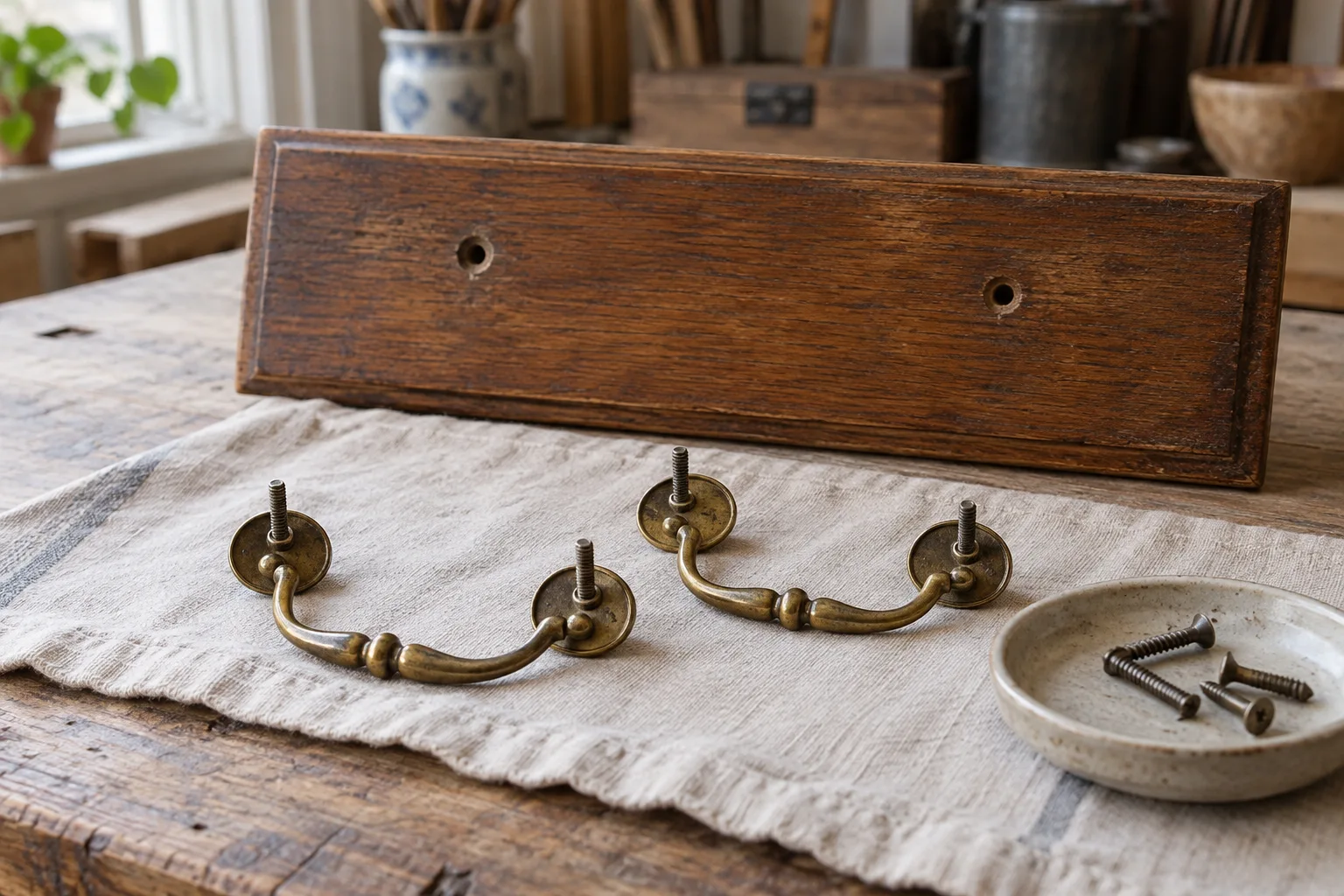
If a sound matching handle can be removed without forcing a fastener or stressing the wood, keep it and its screws together in a labelled container. Record the drawer and orientation. Leave stuck, damaged or inaccessible fittings for a repairer rather than turning a missing handle into a broken surviving one.
| Record | Why the supplier needs it |
|---|---|
| Centres and fixing arrangement | The replacement must meet the existing holes. |
| Overall width and height | The shape must fit its panel and any old outline. |
| Projection and moving parts | The grip needs room to work without meeting neighbouring details. |
| Panel thickness and thread | The fastener must engage correctly without damaging the front. |
| Front, back and side photographs | Similar faces can conceal different attachments. |
Look at the surface beneath an existing backplate only when it is safely accessible. A smaller replacement may expose an old outline or unused hole. Covering it with a larger plate is a visible design choice, not a reason to conceal the change from a later buyer.
Decide what sort of match you need
For a maker-specific piece, start with its confirmed model and the original part dimensions. Ask the maker, a specialist repairer or a dealer in reclaimed fittings whether the exact component is identifiable. For an unmarked chest, search by the measurements and attachment plus a useful description such as bail pull, knob or recessed grip.
Separate three offers: an old matching fitting, a modern reproduction and a newly made sympathetic replacement. Any might solve the practical problem. Their age, material, finish and relationship to the original should remain clear. A modern replacement need not pretend to be an old part to be useful.
Compare a candidate before modifying the furniture. Confirm the return conditions, lay the replacement beside the original if available and verify the fixing points without drilling. Check whether it clears the drawer above and allows a comfortable grip. Similar overall width alone is not enough.
For several missing fittings, request the whole quantity at once. Buying one promising handle and discovering that five more are unavailable changes the design decision. If you replace a complete set for consistency, retain the surviving originals with the furniture and record the work.
Keys and working hardware need a different conversation
A decorative key silhouette says little about whether it operates a lock. The House of Antique Hardware barrel-key listing gives separate barrel and bit dimensions and says compatibility cannot be assured without trying the key. Treat that as uncertainty to resolve with a locksmith, not an invitation to force a collection of similar keys.[2]
Show the lock in its location, the accessible keyhole and any surviving original key. Tell the locksmith whether the drawer is open or locked and whether the lock has worked during your ownership. Do not dismantle an inaccessible lock or enlarge its opening to accommodate a newly bought key.
For a hinge, shelf support, catch or wall-system bracket, describe the work the part must do and the complete assembly. Matching a diameter or a silhouette does not establish load capacity or compatibility. Ask the relevant specialist to identify the fitting and its installation requirements before putting the furniture back into use.
Send this with the photographs
I need this quantity of fittings for this piece. The fixing arrangement, centres, overall dimensions, projection, panel thickness and any known thread are recorded here. Please confirm whether your part fits without altering the furniture, which fasteners it needs, and whether it is old stock, a reproduction or a new replacement.
The satisfying finish is a drawer that opens normally and still belongs to the chest. A few precise measurements at the beginning are usually more useful than another evening scrolling through handles that almost match.