Pastoe is the maker; Braakman is one part of its history
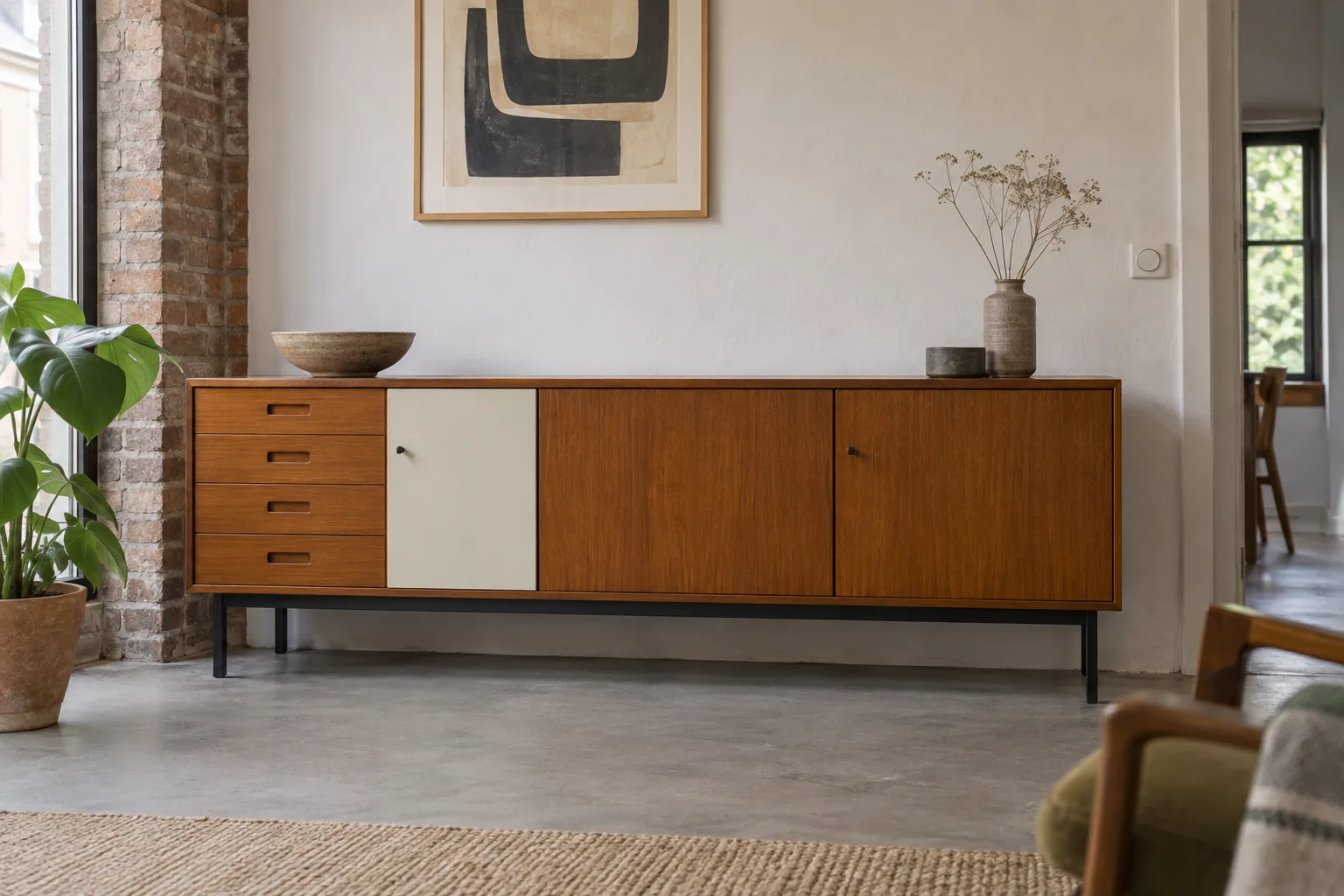
The attraction is often the composition: a quiet wooden rectangle, a contrasting door and a light base that keeps the whole thing from feeling bulky. It is tempting to stop there. But the arrangement behind those rectangles is what determines whether you have a useful dining cabinet, a place for paperwork or an awkward collection of small compartments.
Pastoe’s own history records the 1955 Made to Measure system, Braakman’s Kubus in 1967 and the A’dammer cabinet by Aldo van den Nieuwelaar in 1978. Its Braakman profile also identifies the U+N series. These references show why the company name cannot supply a designer and model automatically.[1][2]
Treat “Japanese series”, “Made to Measure” and a short model code as claims to investigate separately. Ask which contemporary catalogue, maker record or documented example supports the description. Similar black grips or a thin metal base may lead you towards a candidate, but they do not complete the comparison.
Save the full listing and note the features you can see: door widths, drawer positions, panel colours, leg or base arrangement and overall dimensions. A small sketch forces you to notice differences that disappear when you compare only the nicest photograph from each listing.
What a CU01 description can teach you
3812 Gallery’s CU01 record describes a particular teak-veneered cabinet with a white drop-front compartment at the left, four drawers below, a larger door at the right and additional internal storage. It records black plastic grips, a black metal frame and a Pastoe tag inside a drawer. These are the gallery’s observations about that example, not a factory specification for every cabinet with the same general appearance.[3]
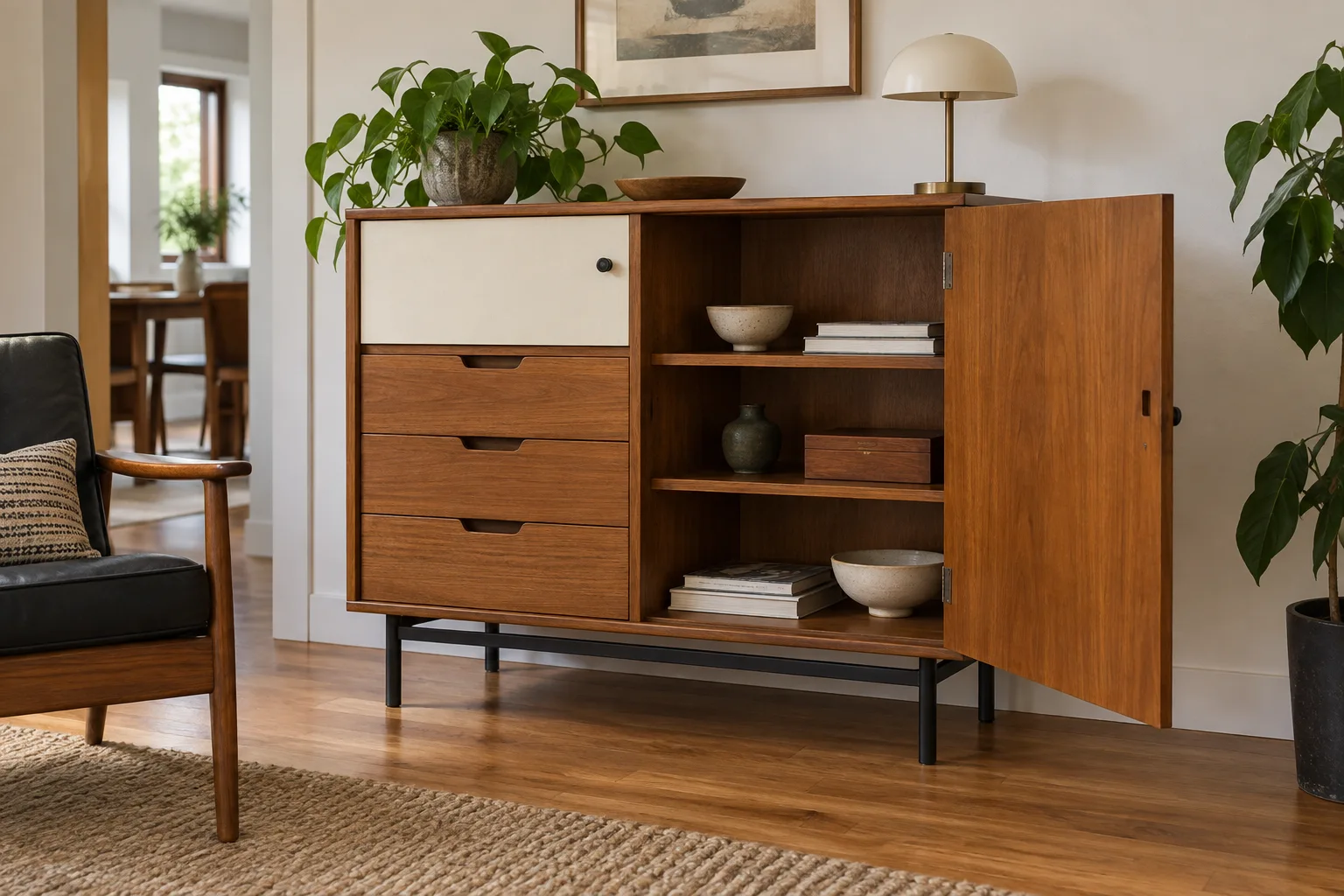
Use the record to make your next enquiry precise. If a candidate is advertised as CU01, ask to see the small compartment open, the drawers and the entire right-hand interior. Compare those views with the documented arrangement. A similar front with a different interior may be a different model, an alteration or an incomplete comparison; the answer needs evidence.
A label belongs in that investigation, but show where it is attached. A photograph of a tag alone cannot connect every door, drawer or base to the same history. If the seller reports a replacement component, record it in the description rather than quietly treating the whole cabinet as untouched.
Do not assume a pale or contrasting door has been painted recently simply because the rest is wood. Equally, one documented contrasting panel is not proof that any painted panel is original. Ask for the evidence for this cabinet and any account of refinishing.
Make room for the doors, not just the case
Mark the cabinet’s outside footprint, then add the travel of each opening part. A wide side-hinged door may meet a dining chair or an adjacent wall. A drop front occupies space in front of the cabinet; the person reaching into it needs space too. Include a nearby plug and skirting board when you decide how closely it can stand to the wall.
Ask how the drop front is supported and whether its fittings have been repaired or replaced. Do not lean on it or assume it is a desk because it lowers to a horizontal position. If the seller calls a compartment a work surface, ask for the model’s documented use and the condition of its supports.
Choose a few awkward belongings before viewing: a tall bottle, a wide serving plate, a file box. Measure the useful opening and interior depth rather than the outer case. A fixed partition or concealed drawer can reduce usable space exactly where you hoped to put the largest object.
| View | What it helps establish |
|---|---|
| Entire front, closed | The model candidate and overall composition. |
| All doors open | Access, partitions and surviving interior fittings. |
| Drawers and accessible fittings | Known replacements, liners, guides and repair scope. |
| Whole base and rear | Support arrangement, alterations and how it meets the room. |
Decide which changes you can live with
A damaged black grip can be more noticeable than a small mark on the side. A missing fitted drawer can matter more than a replaced shelf. List these separately and ask a suitable restorer what can be repaired, what needs a matching component and what would be an openly modern replacement.
Compare the purchase price with those agreed tasks and delivery. Avoid budgeting from the phrase “easy restoration”. A repaired cabinet can be a very good buy when its work is explained; a pristine-looking front can be a poor buy when its opening parts or support remain uncertain.
Ask for the cabinet behind the name
Which model reference supports this attribution? Please show the entire front, open interior, drawers, base, rear and maker marks. What has been repainted, replaced or repaired, which fitted parts are missing, and can you demonstrate each opening part without forcing it?
Choose the arrangement you will use with the doors open and enjoy with them closed. Once the model and alterations are understood, the cabinet can be valued as the piece it is today, rather than as a collection of promising words in a listing.