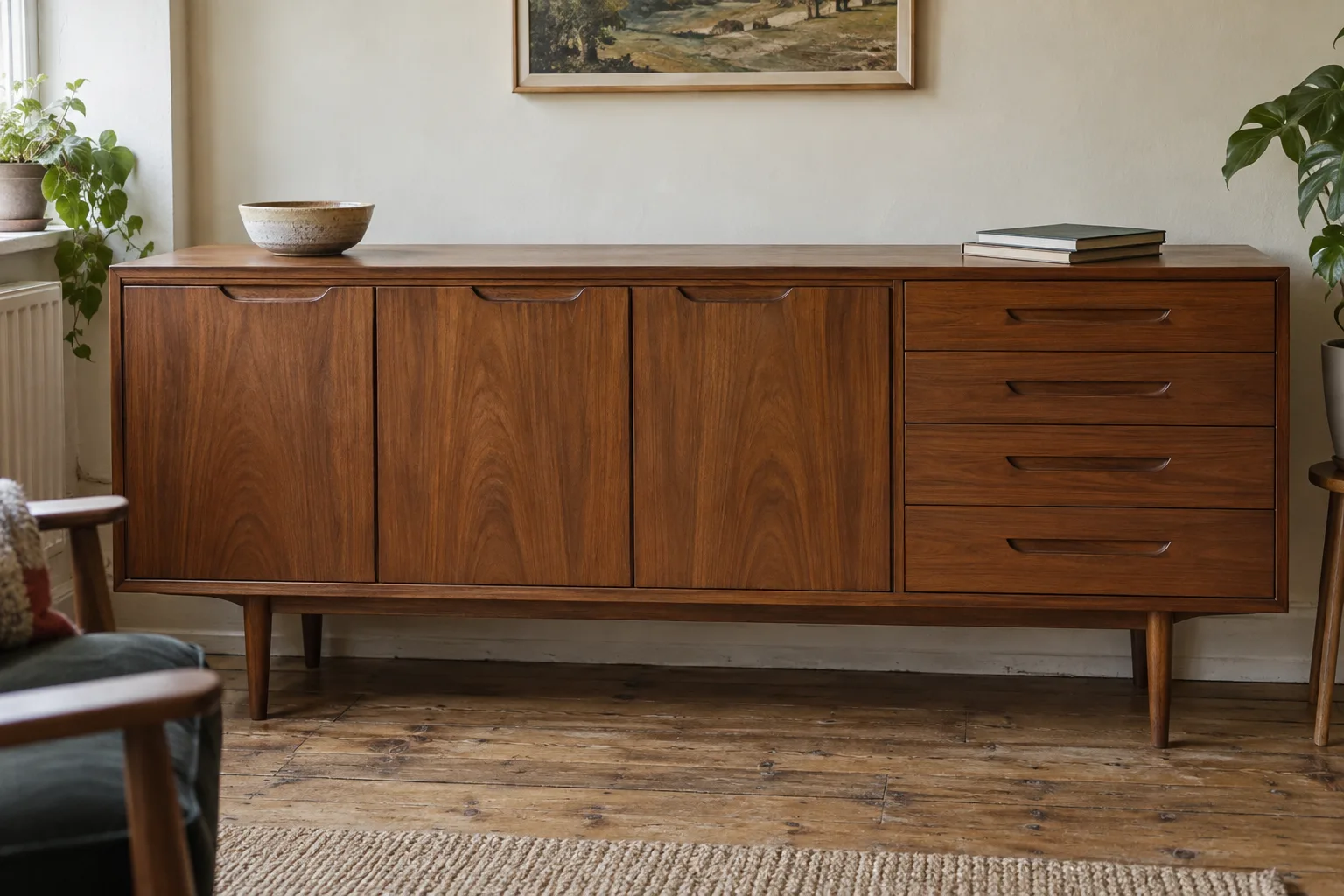
Give the piece a better address than “G Plan”
The name is a useful starting point because it leads to a substantial archive. It becomes less useful when every brown cabinet in a search result receives the same description. Before searching, note what you actually have: a tall or low case, the number and position of doors and drawers, the base, the handles and any upper section. A quick sketch can be more useful than another photograph of the grain.
Buckinghamshire New University’s High Wycombe Furniture Archive includes E. Gomme photographs, sales catalogues, model folders and drawings. Search with the furniture type and a candidate range, then keep the archive’s own reference number. It gives you a way back to the document after a search engine has rearranged its results.[1]
Ask the seller for a straight-on view with every drawer and door closed, then an open view showing the interior. Compare both sides of the piece if they differ. A cabinet whose outer silhouette looks right may have a different internal arrangement, and a photograph full of plants and records can conceal precisely the detail that distinguishes it.
Search terms should get narrower as you learn: “G Plan sideboard”, then “G Plan Fresco sideboard”, then the possible model number and archive reference. Keep an alternative open until the details agree. Finding twenty listings that repeat one attribution is much less useful than finding the original record behind it.
Three range names that lead to different evidence
Fresco, Quadrille and G Plan Danish are not interchangeable names for the same teak furniture. G Plan’s retrospective dates Quadrille to 1965 and Fresco’s introduction to 1966. It describes the Quadrille dressing table as a piece that could also work as a desk, with a detachable mirror. A mirrorless example therefore needs investigation before you decide it is an incomplete desk or an untouched original.[2]
| Search lead | What the reference establishes | What to compare |
|---|---|---|
| Quadrille dressing table | G Plan’s account: 1965 range; dressing-table and desk use. | The complete drawer groups, open centre, base and mirror fittings. |
| Fresco dining range, GBX01_15 | Archive record dated 1970: sideboard 4074, table 4384 and chair 4534. | The particular furniture model rather than the entire room set. |
| Danish Design, GBX01_01 | Archive record dated 1965–1966: sideboard 4060, table 4399 and chair 4527. | The documented configuration and attribution, not merely a Scandinavian outline. |
The two archive records identify different designers: Victor Bramwell Wilkins for the Fresco group and Ib Kofod-Larsen for the Danish Design group. They also identify E. Gomme as manufacturer. That combination of maker, designer, range and model is far more informative than the broad word “Danish” in a listing.[3][4]
A range can contain several cabinets, tables and chairs. Matching one handle does not make two cabinets the same model. Equally, a genuine replacement handle does not settle the identity of the case it is attached to. Use the outline and layout to choose the document, then use the smaller details to challenge the match.
For the design background, the Library’s Fresco sideboard story explains the range’s sculpted fronts and everyday storage. Return to the archive comparison when identifying an offered example.
Try it on a “Kofod-Larsen Fresco” claim
Imagine a listing described as “1960s Kofod-Larsen Fresco”, with no model number. This is a worked research problem, not an examination of a particular item. The wording combines several claims that need separate support. Ask which record supports the designer and which supports the range.
Open the archive result for GBX01_15, “G-Plan Fresco Dining Range”. Its metadata names Wilkins, lists the sideboard as 4074 and dates the photograph to 1970. The note refers to a November 1970 launch for the pictured models. If the offered cabinet really matches 4074, those facts give you a reason to question both the claimed designer and a confident 1960s production date.[3]
Now compare GBX01_01, “G-Plan Danish Design dining group”. It names Kofod-Larsen and a different sideboard, 4060; its dating is supported by a February 1966 advertisement. A match to that record would lead to a different description. Neither record makes a match for you: check the whole cabinet against the actual photograph and model information.[4]
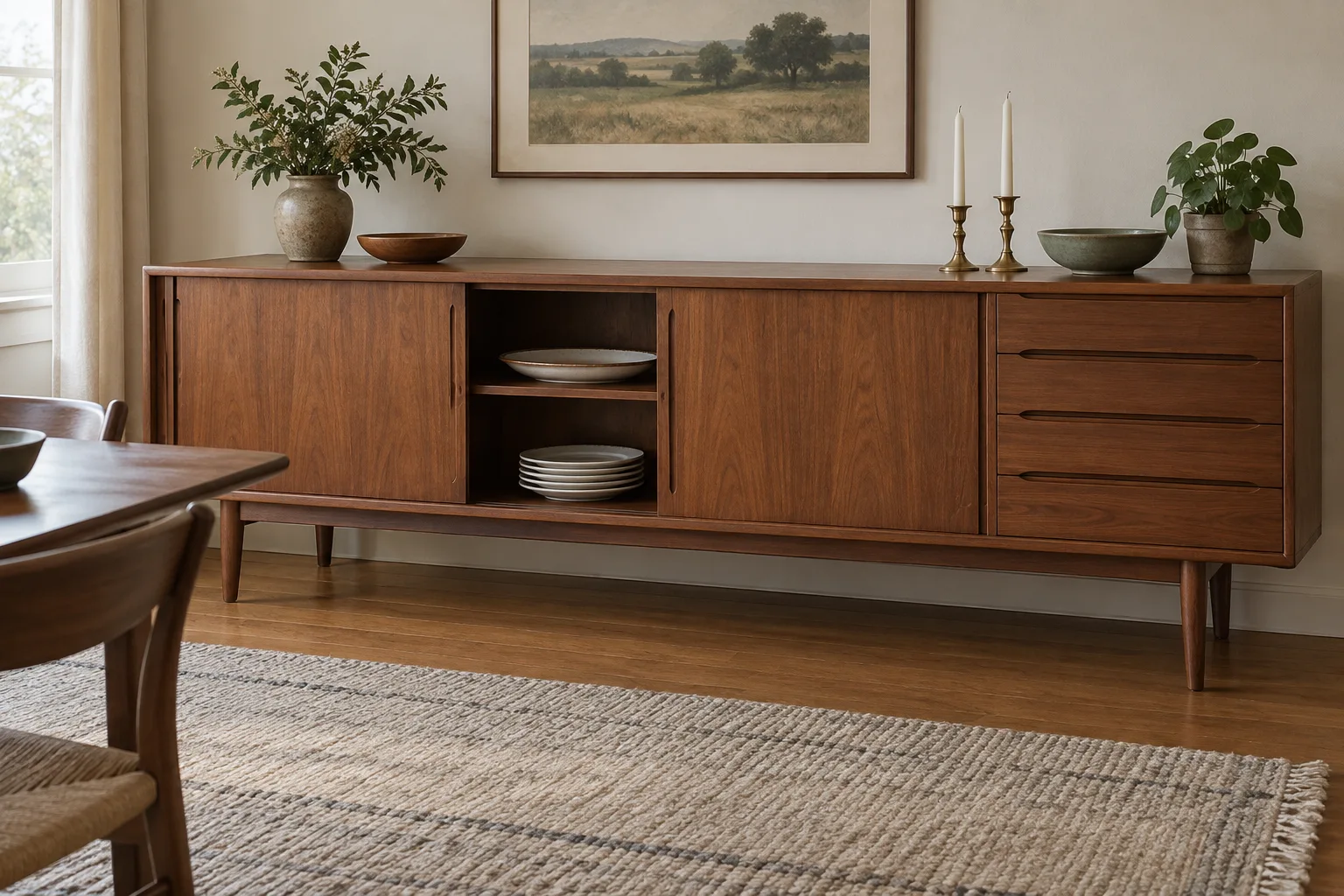
Keep a short note beside the saved listing: “Possible 4074; front arrangement agrees; base not yet shown; seller asked for model evidence.” That is a useful intermediate result. It tells you exactly which photograph to request rather than turning an incomplete comparison into a confident name.
If the archive is temporarily unavailable, search its exact title and image reference, or use the university collection description to locate the record again. Preserve the reference in your notes. A cropped image copied into another shop’s listing loses the information that makes the original useful.
A design date is not a production date
There may be several dates in the same record: when the design appeared, when a photograph was taken, when an advertisement ran and when the archive digitised it. Only some of those help date the furniture. An upload in 2008 says nothing about when a sideboard was made.
A dated catalogue can show that a model existed by that point. It cannot, by itself, tell you when a particular example left the factory or how long that model remained available. An original purchase invoice may help narrow the history, provided it can be connected to this piece. A family recollection is worth recording as a recollection.
Photograph a label before cleaning around it. Keep the full wording, its location and a wider view showing the drawer or case it belongs to. Avoid assigning an exact year from a logo chart alone: the label’s context, the model and any replaced parts still matter.
Changes can explain a near-match. A dressing-table mirror may have gone, a damaged base may have been replaced, or a top may have been refinished. Ask about these possibilities directly. A useful altered piece can still be worth buying; the description and price should reflect what survives.
Stop when the answer is useful for the purchase
Decide which part of the identity matters to you. If you want a particular designer or original configuration, an unresolved attribution deserves more research before payment. If you mainly want an attractive cabinet for daily use, a supported maker and clear account of its condition may answer your question, even if the exact production year stays open.
A request to send
Could you show the whole front and base, the open interior, all labels and the exact width, depth and height? Which catalogue or model record supports the range and designer in the listing, and have the handles, base, mirror or finish been changed?
Keep the final description modest and specific: maker, supported range or model, documented period and known changes. Then move on to the buying questions that research cannot answer for you: whether the drawers work, your belongings fit and the cabinet can reach its new room. The pleasure of finding its history should help you choose the furniture, not postpone using it indefinitely.