Three names, three starting points
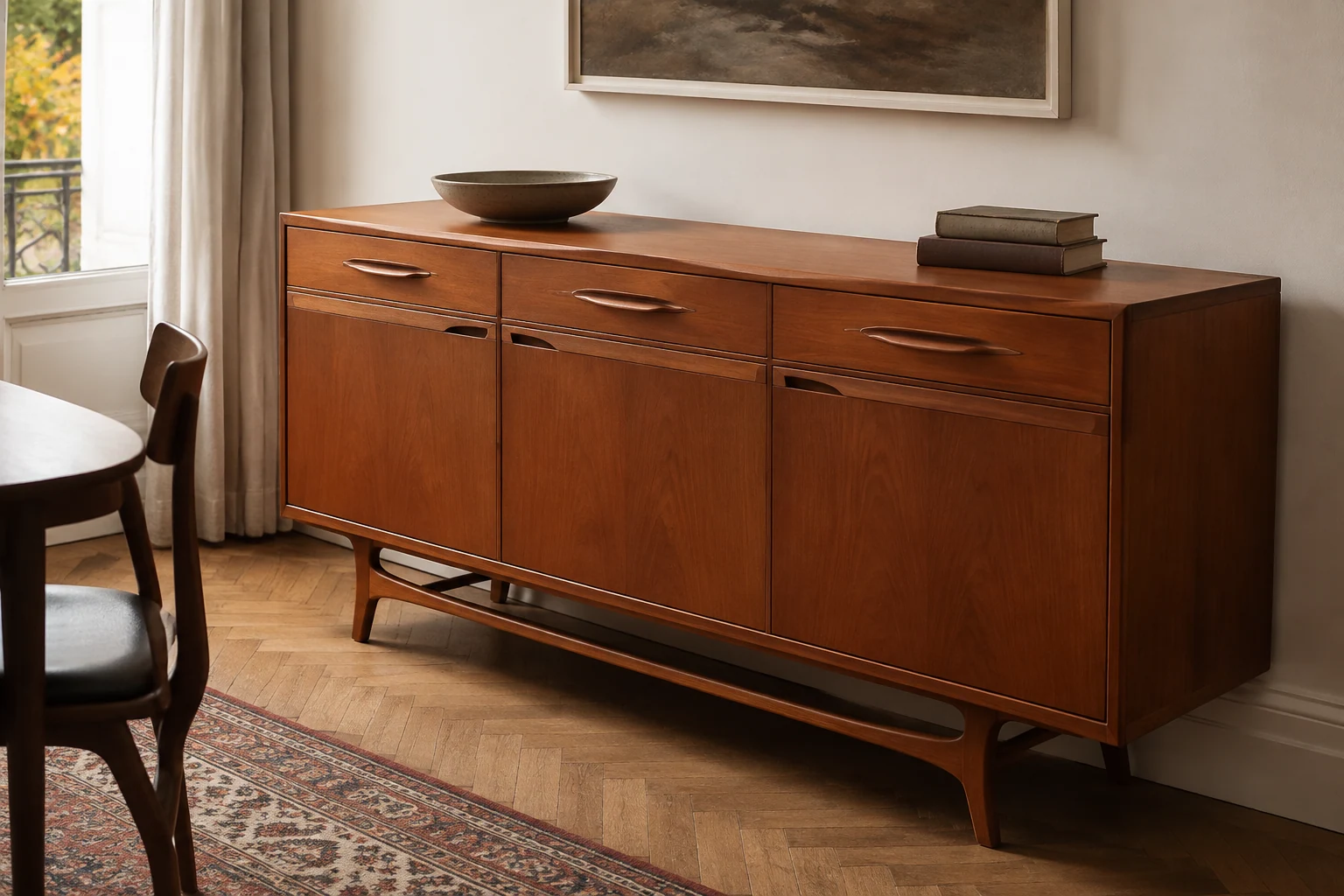
The pleasure of a sideboard is partly its quietness. It holds a room together with one long horizontal line, then rewards a closer look with a handle, a door panel or a matched run of grain. Begin with the front you actually like. You will see it much more often than its label.
- G Plan Fresco: start with the shaped grips and the rhythm of drawers and doors. Then find the model; a compact cabinet and the familiar long sideboard divide storage differently.
- Nathan: compare the framed door panels, cupboard divisions and the complete cabinet profile. Ask whether a low unit was always offered alone or once sat beneath a dresser top.
- McIntosh: follow the sculpted handles across the front, then look inside. A cutlery drawer, a shaped shelf or a differently arranged cupboard can make two similar-looking cabinets work quite differently.
For a documented Fresco starting point, the High Wycombe Furniture Archive identifies the 4072 in a 1969 new-model folder. It records a five-foot width and a November 1969 launch. That connects a particular shape and number to a contemporary record; it does not date every cabinet advertised as Fresco.[1]
Nathan’s later Classic Teak catalogue shows why a maker name is not a period stamp: the family continued to include sideboard bases, storage units and separate upper sections. Use the layout to formulate questions, and find period evidence for an older example rather than assigning the whole family one date.[2]
For the design background, see the Library story on G Plan Fresco sideboards.
A smaller room changes the shortlist
Do not dismiss a maker because the first cabinet you saw was enormous. Compare models at the width your wall can accommodate, allowing the neighbouring doorway, chair and skirting to keep doing their jobs.
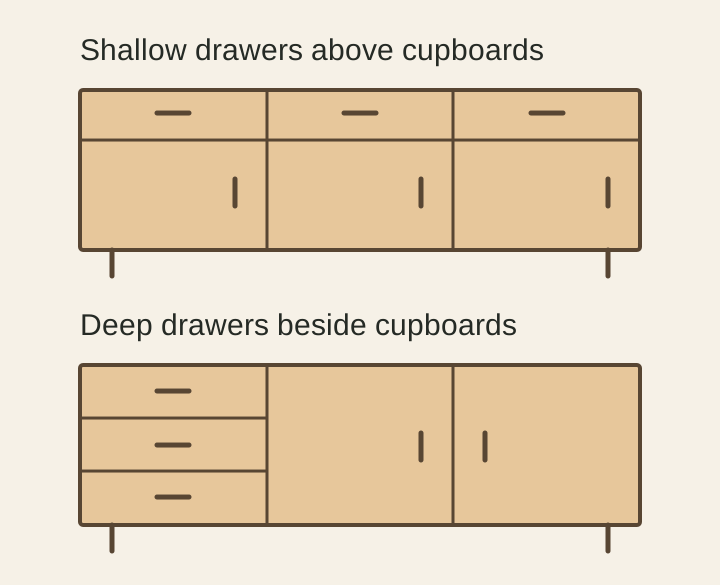
The five-foot Fresco 4072 is about 152.4 cm wide. In a separate example, Wilson55 catalogued a short McIntosh Dunvegan at 152 cm wide, 48 cm deep and 74.5 cm high. The auction description records three drawers beside a two-door cupboard with a shaped shelf. These are dimensions of that offered piece, not a promise about every Dunvegan.[3]
The useful comparison is now between two cabinets of almost the same width. Which has the better drawer arrangement for your belongings? Which leaves more comfortable circulation? A long Dunvegan or another Fresco model belongs on a different shortlist, however attractive its photograph.
Shop with your largest awkward object
Measure the thing that usually refuses to fit: the serving platter, tall vase, board-game box or amplifier. Ask for the clear opening and interior depth around hinges, rails and dividers. The outside depth of a cabinet is not the depth of its usable shelf.
A cutlery drawer can be a lovely surviving detail and an inconvenient place for a laptop. A fixed divider can keep crockery organised and stop a wide stack of records fitting. Find out what is removable without alteration and what belongs to the construction. Decide whether the original arrangement works before planning to cut it apart.
If the sideboard will hold equipment, request photographs of the actual back, cable openings and ventilation arrangements. A previous owner’s cut-out is a change to evaluate, not proof that the cabinet suits your equipment. Our TV-sideboard Guide covers that separate setup.
The details that change the deal
One light mark on the top may be easy to live with. A missing shaped handle can be much harder to ignore because the handles organise the entire front. Request a straight-on view, then compare every pull, door gap and lower support. Replacement parts may be perfectly usable; you want to know what you are buying.
Teak-coloured furniture is not automatically solid teak throughout. Nathan’s own catalogue discusses veneers. A veneer is a real construction choice, not a reason by itself to downgrade a cabinet. Lifting edges, missing corners and sanding that has cut through the surface are different questions, and a restorer needs clear photographs before quoting.[2]
Ask what “restored” meant here: cleaning, a new finish, veneer repair, new feet, shortened legs, replacement back or structural work. Look at the base from the side as well as the front. An attractive change may suit your home while making a period catalogue comparison less straightforward.
For unresolved movement, damaged joints or a suspect base, get the proposed work assessed before use or collection. Do not ask a seller to load or force a fragile cabinet to prove it is sound.
Compare two complete offers
A cheaper listing can still be the sensible choice. Give it an honest total before deciding. In this illustrative example, a €450 cabinet needs €140 delivery and a quoted €180 repair: €770 altogether. Another is €750 with €80 delivery and no identified immediate work: €830. The difference is €60, not the €300 gap between their asking prices.
Those numbers are an example, not market valuations. They show why the repair scope matters. If the first estimate covers only the top and leaves a loose base unpriced, the comparison is unfinished. Equally, “fully restored” on the second listing deserves an explanation, not an automatic premium.
For price research, compare the same model and size in similar condition, and keep dealer asking prices separate from auction results. Record fees and delivery when using a sold example. A famous name cannot make an unsuitable layout, uncertain repair or awkward route disappear.
A message that makes comparison possible
Ask the seller
Could you confirm the maker and model as far as documented, and send the front, back, base, label and open interiors? Please measure the full width/depth/height and the clear space in the largest cupboard. Are any handles, feet, shelves, backs or finishes replaced or altered? What work does “restored” include, and what defects or movement remain? Please also quote delivery for the actual access route.
Once those answers are beside each other, choose the cabinet whose proportions you enjoy and whose compromises you understand. A useful, well-described Nathan need not lose to a Fresco simply because the latter was the name you knew first.