Write the comparison question before opening more tabs
A price comparison is useful only when it serves a decision. Are you deciding whether one chair is sensibly priced for use, choosing between two sideboards, setting an auction limit or deciding whether professional valuation work is justified? Write that question and the maximum total commitment you could accept. The same object can sit in different markets and support different conclusions without one number being universally correct.
Keep asking price and value separate. An independent seller may price for a particular retail service, warranty position, location, presentation or waiting time. An auction result records competition at one event. A private sale may never disclose its result. Your task is to understand which evidence informs this purchase—not to declare that one seller is objectively right or wrong from a screenshot.
Decision boundary
This Guide builds a buying comparison, not a valuation
Do not use the worksheet for insurance, tax, probate, matrimonial, lending, donation, litigation or another purpose that requires a defined basis, date, scope and professional accountability. Ask an appropriately qualified personal-property valuer for that work.
Record the exact target without upgrading its claims
Build the target record
- Identity and claim levelWrite the exact maker, designer, model, date and provenance wording, including qualifiers such as attributed to, style of, later production or unknown.
- Form and dimensionsRecord the type, variant, maximum dimensions, configuration and whether measurements describe this exact object.
- Materials and constructionKeep seller-reported material, observed construction and professionally confirmed facts separate.
- Condition and interventionLocate wear, losses, repairs, refinishing, replacement parts, movement and consequential unknowns.
- Completeness and quantityList every cushion, shelf, key, fitting, leaf, cable, matching object or other part included in the price.
- Market and dateRecord seller or auction, city/country, currency, sale date or access date and whether the number is still current.
Do not silently convert resemblance into identity. A chair in the same family but a different size, licensed production period, upholstery state or base can still be informative, but only if you name the difference. When the current object's attribution is unconfirmed, compare at the supported claim level and treat any famous-name premium as unresolved.
Use the marks and labels Guide and the condition Guide to improve the object record. Neither a label photograph nor an attractive surface authenticates the piece or predicts its price.
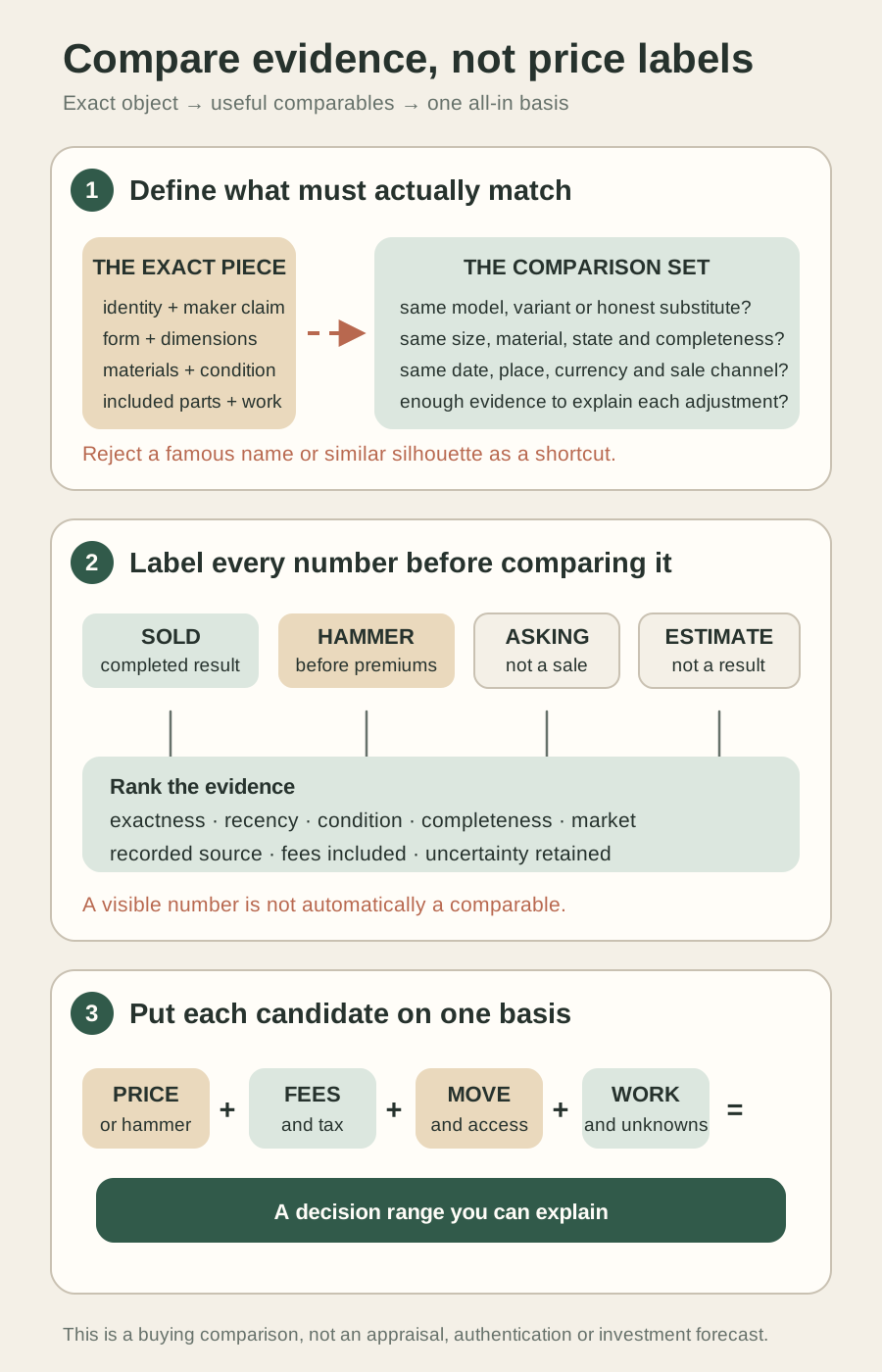
Separate asking, estimate, hammer and completed cost
Christie's glossary defines an estimate as an expected auction range excluding premium and taxes, a hammer price as the final accepted bid before the buyer's premium, and price realised as hammer plus buyer's premium, with taxes potentially additional. Those definitions are scoped to Christie's, but they demonstrate why copying different price fields into one column creates a false comparison.[2]
| Number | What it records | Do not assume |
|---|---|---|
| Current asking price | The amount a seller currently requests, sometimes with services or room to negotiate | That a buyer has paid it or that all extras are included |
| Auction estimate | The auction house's pre-sale expectation under its stated terms | That it is a limit, a guarantee or the buyer's final invoice |
| Hammer price | The accepted bid at that sale | That premium, tax, shipping and other charges are included |
| Price realised or purchase price | A stated sold amount that may include specified auction charges | That every tax, transport cost, discount or later adjustment is visible |
| Unsold, withdrawn or expired listing | A market event or offer that did not produce a visible completed result | That the last displayed price was accepted or rejected for one knowable reason |
Evidence rule
Never mix price types without a visible conversion
Keep the original number, currency, source, date and label. Add a separate normalised field only when you can explain what was included and which assumptions remain.
Build a small comparison sheet you can audit
Capture every candidate the same way
- Stable sourceSave the exact page, catalogue entry or result and its access date; do not rely on a cropped search snippet.
- Object matchSummarise identity, variant, dimensions, materials, condition, intervention and included parts.
- Transaction fieldRecord asking, estimate, hammer or sold price exactly as the source describes it.
- Market contextRecord date, place, seller or auction, currency, sale method and whether the object sold alone or in a group.
- Missing evidenceList unavailable condition reports, fees, result status, provenance, restoration or other facts rather than inventing them.
| Rank | Use | Typical reason |
|---|---|---|
| A — close | Carries the most weight | Same supported identity/variant, similar condition and completeness, recent relevant market, documented result |
| B — useful with adjustment | Supports a direction or range | One or two material differences can be described and bounded |
| C — context only | Shows that a broader market exists | Different variant, state, location, sale method or incomplete evidence |
| Reject | Do not calculate from it | Unknown result, unsupported identity, incompatible object, duplicate record or unexplained price |
Avoid averaging every result. A mean can look precise while hiding that the records describe different objects and transactions. Start with the closest evidence, explain the differences and retain a range wide enough to show uncertainty. If no close comparison survives, the honest result is that public evidence is insufficient.
Adjust only what you can explain
RICS' current arts and antiques guidance describes market comparison as the normally preferred approach when useful comparables exist, while requiring pertinent sales data to be collected, verified and analysed. It also warns that prior sales data can have limited reliability and that sale method, commissions, purchase costs, market conditions and provenance may matter.[1]

| Difference | Useful treatment | Weak treatment |
|---|---|---|
| Date and market | Keep actual dates and note credible market movement or lack of current evidence | Apply a guessed annual appreciation rate |
| Currency | Record source currency and a dated conversion separately | Overwrite the original number with today's rate |
| Condition and restoration | Describe exact differences and use a scoped professional work estimate when material | Deduct a generic percentage for every repair |
| Completeness | Price missing or extra parts from credible exact evidence where possible | Assume a replacement is available because another listing has one |
| Retail versus auction | Compare the services, terms, fees and timing that differ | Treat hammer and dealer asking price as interchangeable |
| Provenance or attribution | Keep the supported claim and documentation with each object | Transfer another object's history or expert conclusion |
False precision
A transparent range is stronger than an invented exact adjustment
When you cannot support the size of a difference, describe its direction and consequence or leave the candidate as context only. Do not manufacture a percentage to make the spreadsheet balance.
Compare the all-in commitment, not the headline
| Field | Record | Do not hide |
|---|---|---|
| Purchase | Agreed price or maximum hammer in original currency | Premium, platform fee, tax or payment charge |
| Collection and delivery | Packing, carrier, insurance, stairs, storage and final placement | An unquoted difficult route or separate top/base handling |
| Immediate work | Structural, electrical, upholstery, finish or missing-part work needed before intended use | A cosmetic allowance standing in for an unresolved professional scope |
| Accepted uncertainty | A deliberate allowance or a reason to stop | Hidden condition, identity, tax or delivery risk reduced to zero |
| Use and timing | When the piece becomes usable and what remains unavailable | Storage, delay, substitute furniture or lost use where consequential |
Do not automatically prefer the lowest total. A better-documented, sounder object with responsible delivery can be the more predictable purchase; a project piece can be the right choice when its work and delay are genuinely wanted. The comparison should expose that decision rather than reward whichever uncertainty was left unpriced.
Use the online-auction Guide to calculate a maximum hammer bid, or the cross-border Guide when export, customs, tax and international custody change the total.
Read the pattern without pretending to predict
RICS consumer guidance recommends reading the catalogue description and estimate, asking questions, requesting a condition report and further photographs when the lot cannot be viewed, and deciding a maximum bid. That supports disciplined evidence gathering; it does not turn an auctioneer's opinion or past result into a guarantee for another object.[3]
Look for a band in which the strongest comparables cluster, then ask why the target might sit lower, within or above it. Test alternative explanations: better documented attribution, rarer variant, stronger condition, more complete set, recent professional work, a stronger retail service—or simply an ambitious ask. Keep explanations as hypotheses until the target evidence supports them.
One spectacular result is not a trend, and one unsold lot is not proof that demand disappeared. Duplicate syndicated listings, relisted auction lots and results copied without fees can make the evidence set look larger than it is. Retain the original source and deduplicate the underlying object.
Stop condition
No close evidence is a finding
Do not widen the object definition until an answer appears. If the purchase depends on a consequential attribution or value conclusion and public comparables remain weak, pause for qualified advice or buy only at the supported claim level.
Know when to use a qualified valuer
Professional valuation is not simply a more confident internet search. It begins with a defined client, purpose, basis and valuation date; appropriate inspection and research; market selection; assumptions and limitations; and a signed accountable conclusion. The right specialist also depends on the furniture, market and jurisdiction.
Pause for professional work when
- The purpose is formalInsurance, tax, estate, finance, donation, dispute or court use requires more than a buyer comparison.
- Attribution controls the decisionThe price depends on resolving maker, date, provenance, authenticity or a rare variant beyond the available evidence.
- The market is thin or opaqueFew relevant results exist, prices are private or the object trades through specialist channels you cannot evaluate.
- The consequence is highA mistake would materially affect the household's finances, collection, insurance or legal position.
Ask the valuer to state the purpose, basis, date, scope, inspection status, assumptions and relevant market in writing. A seller's sales estimate, an auction estimate and an independent valuation may all be professionally prepared while answering different questions.
Send one complete price-evidence request
Message to copy
Ask for the facts that change comparability
Hello—I'm comparing this piece with a small set of documented examples. Could you confirm the exact maker/model/date wording and its basis; maximum dimensions; materials; every included part; current condition, repairs, refinishing and replacement parts; and whether the published price includes tax, packing, delivery or another service? If you refer to a prior sale or valuation, could you identify its date, market, price type and whether fees were included, without sharing private information? I am not asking you to authenticate or value the piece from photographs; I want to keep this object's supported facts and total purchase terms separate from the comparables. Thank you.
Continue when the target record is coherent, the strongest comparables genuinely resemble the supported object and transaction, adjustments are visible, and the all-in commitment suits your use and tolerance for uncertainty. Pause when a missing fact changes the comparison class or professional scope. Decline when the case depends on unlabeled prices, transferred provenance or a hoped-for future value rather than the exact purchase in front of you.