
Draw the complete route before buying
Name every place and party
- Seller and object locationConfirm where the furniture physically is, who owns/offers it and whether another warehouse or consignor controls release.
- Country of exportIdentify the jurisdiction from which it actually leaves, not only the seller's registered address or website domain.
- Transit and consolidationAsk whether the carrier changes country, warehouse, mode, crate or custodian before import.
- Country and point of importConfirm who acts as importer, where customs clearance occurs and which broker or carrier files the declaration.
- Final deliverySeparate port/terminal or kerbside delivery from access, unpacking, assembly and placement in the room.
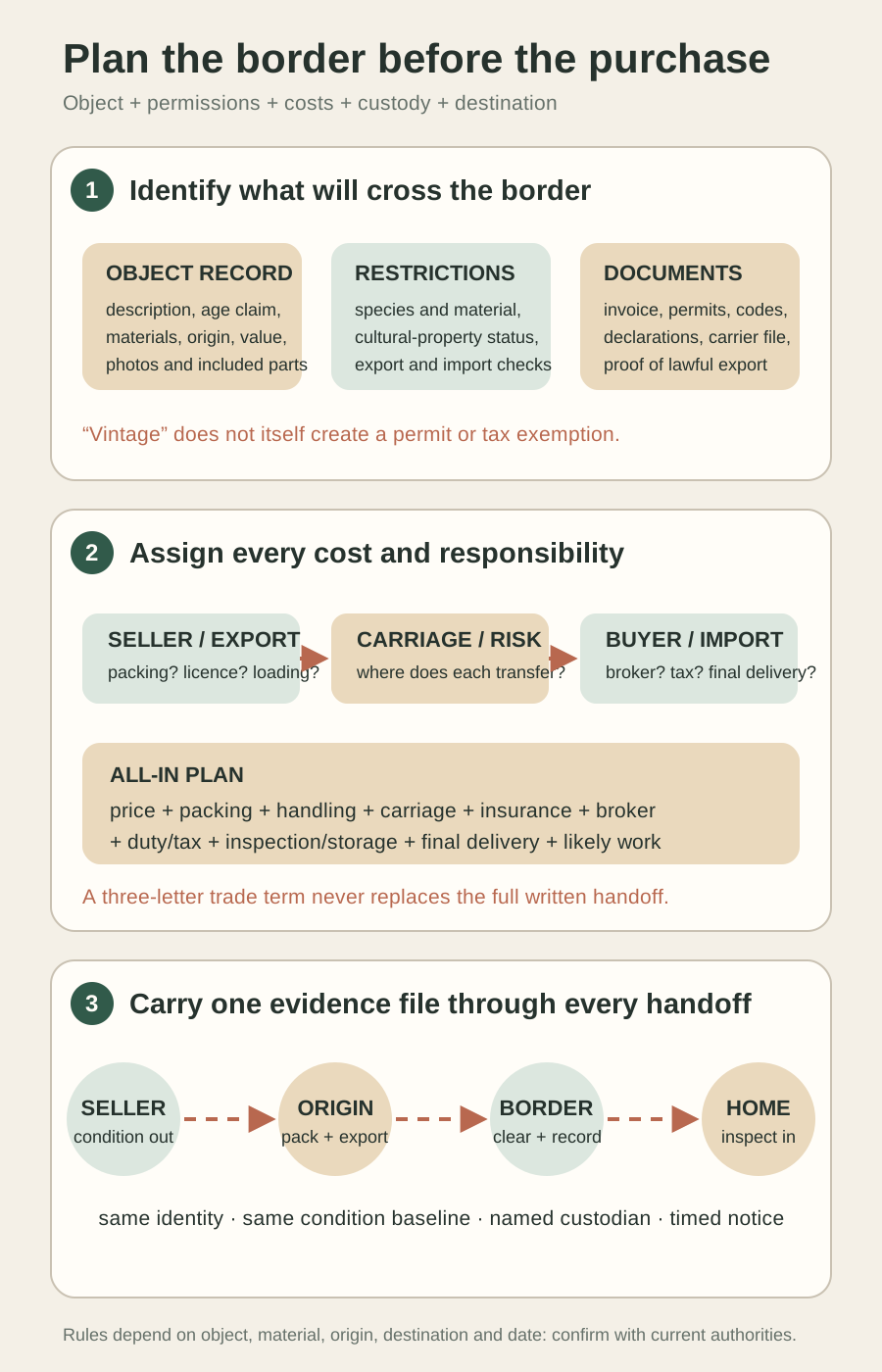
A quote from country A to country B can still omit origin collection, export handling, port charges, destination clearance, storage, local tax or room placement. Ask for start and end points, service exclusions, assumed dimensions/weight and quote validity. Keep a second plan for what happens if a permit, inspection or missed handoff delays the route.
Sequence rule
Check whether the object can lawfully move before making payment non-refundable
Do not rely on a seller's earlier international shipment, another buyer's experience or a carrier's generic booking screen. The exact material, origin, destination, purpose and current date control the question.
Build the object and material record
| Field | Record | Keep uncertain |
|---|---|---|
| Object | Functional description, quantity, dimensions, components and intended personal/commercial use | A broad label such as chair, antique or design object |
| Age and manufacture | Supported date/period, maker and country of manufacture where documented | Seller estimate or style attribution as reported |
| Materials | Each wood, veneer, leather/skin, shell, ivory/bone, horn, feather, textile, metal and composite claimed or observed | Species or material not established by records or suitable assessment |
| Origin and ownership | Invoice, provenance supplied, current owner/seller and lawful export evidence where relevant | Gaps or undocumented earlier movement |
| Value fields | Purchase price, currency, separately charged services and the basis requested by the broker | Customs value treatment until the responsible adviser confirms it |
| Condition and packing | Current state, repairs, detachable parts, package count and protected dimensions/weight | Final crate or carrier method before specialist confirmation |
Do not identify rosewood, mahogany, ivory, tortoiseshell or another consequential material from colour, grain, age or seller folklore. Preserve the seller's wording and basis. When material identity changes whether trade is permitted, ask a suitable specialist and the relevant authorities what evidence they require before shipment.
Use the material-construction Guide and marks and labels Guide to formulate questions. Their observations cannot create a customs classification, species determination or export permission.
Check wildlife and material controls with current authorities
CITES defines permits and certificates as official trade-control documents for specimens of listed species and records national trade through its Parties. Furniture can contain regulated plant or animal material even when the complete object is old. The exact species, Appendix annotation, source, age, prior documents, purpose, countries and national implementation can affect the outcome.[2]
Ask the origin and destination authorities
- Is the species or material identified enough?Provide records and photographs but ask what level of identification or specialist evidence the authority accepts.
- Which CITES listing and annotation applies now?Confirm whether the finished object or quantity is covered and whether national rules are stricter.
- Which permit or certificate is needed?Separate export, re-export and import documents and confirm who can apply, original-document handling and validity dates.
- Does an exemption genuinely apply?Ask about documented pre-Convention, antique, personal/household effect or finished-product treatment without assuming the label is self-proving.
- Which border point and inspection process is required?Confirm designated ports, advance notice, document validation and what the carrier must present.
Environment and Climate Change Canada's current guidance provides a clear jurisdictional example: identify whether an item contains a protected species, obtain required CITES permits before import or export and have them validated at exit and entry; it warns that permits are not issued retroactively. Use the equivalent current authorities for the actual route.[6]
Permit boundary
Do not ship first and solve the document later
A carrier booking, seller declaration or old invoice does not replace an official permit or certificate when one is required. Stop before payment or dispatch if legal movement depends on a species, age or exemption claim that cannot be supported in time.
Check cultural-property and export controls separately
UNESCO's Database of National Cultural Heritage Laws provides current and historical national legislation, official links and some certificate examples for import, export and transfer of cultural property. It exists because national definitions and controls differ; the database is a research gateway, not clearance for an exact object.[1]
Ask the competent authority in the actual export country whether the furniture's category, age, value, origin, maker, historical importance or time in the country triggers a licence, certificate, temporary restriction or proof requirement. Ask the destination authority whether import restrictions, stolen-property databases, sanctions or special declarations apply. A piece can be ordinary usable furniture to its owner and still fall within a legal cultural-property category.
| Question | Responsible confirmation | Evidence to retain |
|---|---|---|
| May it be exported? | Competent authority in the country of actual export | Licence/certificate or written basis that none is required |
| May it be imported? | Destination customs/cultural authority or qualified adviser | Import authorisation/declaration and supporting provenance |
| Is ownership/lawful movement supported? | Seller plus appropriate provenance or legal specialist where consequential | Invoice, ownership history and prior export/import records |
| Does a tax/tariff category apply? | Customs broker or authority for the exact destination | Commodity classification, value basis and filed declaration |
Age boundary
Old enough for one definition is not exempt everywhere
Do not let ‘antique’, ‘over 100 years old’ or another threshold migrate between customs, cultural-property, CITES, tax and seller-description contexts. Ask what the term means in the exact rule being applied.
Allocate sale, carriage and risk in writing
The International Chamber of Commerce explains that Incoterms rules can allocate selected seller and buyer obligations, costs and the point of risk transfer in a sale contract, including carriage, insurance and customs formalities. It also distinguishes the sale contract from the carrier contract. The rules principally reflect business-to-business practice and do not replace consumer law, title, payment, product condition or the complete contract.[3]
| Stage | Confirm the owner | Confirm the evidence |
|---|---|---|
| Export packing and loading | Seller, specialist packer or buyer's carrier | Packing scope, condition baseline, package count and collection receipt |
| Export clearance and permits | Named seller/buyer representative with authority to file | Documents, fees, validation and release |
| Main carriage | Contracting shipper and named carrier | Mode, route, custody, timetable and exclusions |
| Risk and insurance | Party carrying risk at each point and policy/cover claimant | Value, covered events, exclusions, deductible and claim process |
| Import clearance and charges | Importer of record or local representative | Classification, declared value, duty/tax, broker and inspection |
| Destination delivery | Terminal carrier, local specialist or installer | Handoff, access, unpacking, assembly and final condition check |
If a contract uses an Incoterms rule, include the named place and version and ask both parties to explain the route in ordinary language. Then compare it with the carrier and insurance contracts. A risk transfer at one point does not automatically mean the same person arranged adequate insurance or can file the claim.
Calculate the landed cost with current quotes
European Commission customs guidance provides a bounded example: goods entering the EU customs territory from outside it must complete import formalities before they can circulate freely. This is not a universal route or charge; it demonstrates why the seller's invoice and a carrier quote do not settle the buyer's border cost.[4]
European Commission VAT guidance separately shows that the place of taxation for imported distance sales can depend on where transport ends and how the sale is structured. Use current advice for the exact transaction rather than applying a remembered rate or an assumed antique exemption.[5]
Build three cost scenarios
- Quoted caseUse current written seller, packer, carrier, broker and destination quotes with validity dates and assumptions.
- Delay caseAdd realistic storage, demurrage/handling where relevant, rebooking and broker work if a document or inspection delays release.
- Condition caseAdd arrival assessment, immediate furniture work and loss of use without presuming insurance will reimburse it.
| Before border | At border | After border |
|---|---|---|
| Purchase price and seller charges | Broker and declaration | Terminal or warehouse handling |
| Origin collection, packing and crate | Duty, import tax and authority fees | Local carrier, access and placement |
| Export permit, handling and storage | Inspection, examination or storage | Unpacking, crate disposal and assembly |
| Main carriage and insurance | Currency/payment and security charges | Arrival assessment and immediate work |
Tax boundary
Use current advice for the exact declaration
Do not publish or rely on a remembered rate. Classification, origin, value basis, seller status, sale structure, destination and law change the result. Ask the responsible broker or authority to state assumptions and exclusions in writing.
Plan packing, insurance and custody as one system
Give the international furniture carrier the exact object's condition, maximum and protected dimensions, actual or documented weight, materials, detachable-part status, old repairs and access at both ends. Ask who designs and inspects the packing, whether treatment/marking requirements apply to wood packaging, how loose parts remain identified and which orientation or stacking is prohibited.

Read insurance beyond the headline
- Insured interest and claimantConfirm who has the right and obligation to claim at each custody stage.
- Value basisAsk whether cover uses invoice value, declared value, repair, replacement or another defined basis and which costs are excluded.
- Covered routeInclude origin collection, storage, main carriage, customs hold, local delivery and unpacking if required.
- Packing and condition requirementsKnow whether approved packing, survey, photographs, signatures or exception notes are conditions of cover.
- Exclusions and deadlinesRead inherent vice, wear, restoration, sets/pairs, delay, concealed damage, deductible and notice requirements.
Use the delivery-route Guide for openings, turns, stairs, lifts and protected envelopes at both properties. Customs release at a terminal is not delivery into the intended room.
Carry the file through every handoff
| Handoff | Record before release | Record after receipt |
|---|---|---|
| Seller to packer/carrier | Exact object, parts count, condition, documents and collector authority | Package count, labels, external state and custody receipt |
| Origin/export | Permit/certificate originals, declaration and validated departure process | Export release and carrier transport document |
| Main carriage/transit | Container/package identity, seals where applicable and named custodian | Event, location, delay/damage notice and authorised transfer |
| Import/customs | Entry documents, broker authority, classification/value support and permits | Assessment, payment, inspection record and release |
| Local delivery/home | Release authority, package state, access and unpacking method | Arrival condition, part count, discrepancy and timed notices |
Keep original files and reference numbers. Send only the documents each party legitimately needs through verified channels, especially identity or payment material. If an authority retains or endorses an original permit, record that event and preserve the permitted copies rather than assuming a scan can travel in its place.
Delay boundary
A delay changes cost and custody, not just the calendar
Ask who currently holds the object, under which conditions, which storage or inspection charges are accruing, whether insurance remains active and which party must act next. Do not pressure a carrier or broker to bypass a required control.
Send one complete cross-border request
Message to copy
Ask seller, carrier and broker to share one route
Hello—I'm considering this piece for delivery from [exact origin] to [exact destination]. Could the seller confirm the exact object, materials/species claims and their basis, supported age/origin, ownership/provenance supplied, current condition, repairs, included parts, dimensions, weight status and whether any export, cultural-property or CITES document is known? Could the carrier/broker then state who owns packing, loading, export clearance, permits, main carriage, insurance/risk, import clearance, duty/tax, inspection/storage and final room delivery; the named locations and handoffs; required documents; quote assumptions/validity; and delay/damage process? Please keep unknown material or legal status explicit. I will confirm current requirements with the competent origin and destination authorities before payment or dispatch. Thank you.
Continue when the exact object can lawfully travel, every material and document question has a responsible owner, landed cost and delay exposure are acceptable, and the carrier accepts the condition and route. Pause when classification, permit, tax, insurance or custody changes. Decline when the purchase depends on retroactive documents, an assumed antique exemption, an unnamed importer or an international quote that ends before the real destination.