Read the exact sale contract before choosing a lot
An online auction is not one universal buying format. The auction house may act as agent for a seller, own a lot, host a timed sale or transmit bids into a live room. A bid may become binding immediately. Catalogue descriptions, condition information, guarantees, withdrawals, bidding errors, currency displays, payment methods and remedies all depend on the current conditions for the sale site and lot.
Locate the terms that control your decision
- Auction and seller roleIdentify the auction entity, sale location, whether it acts as agent and any disclosed interest or guarantee symbol.
- Registration and biddingConfirm identity checks, deposits, approval time, bidding methods, increments, extensions and account limits.
- Buyer chargesFind premium tiers, platform or overhead charges, taxes, royalties and payment fees that can apply to this lot.
- Lot investigationRead cataloguing practice, condition-report status, inspection responsibility, guarantee and exclusion wording.
- After the saleRecord payment due date, release conditions, packing/collection options, storage start, export process and claim deadlines.
Sotheby's current global buyer guide, for example, tells bidders to read the buyer conditions, investigate lots before bidding and expect buyer premiums and other possible charges beyond hammer. That is evidence of one auction model, not a rule for every house; always use the exact terms linked to the sale you enter.[3]
Contract boundary
A familiar platform does not make the terms familiar
Recheck the auction entity, sale location, currency and current conditions even if you have used the brand before. Do not copy a premium rate, return expectation or bidding rule from another sale.
Build the current lot file before discussing price
RICS consumer guidance recommends reading the catalogue description and estimate, asking questions, checking damage and restoration, and requesting a formal condition report and further photographs when an internet buyer cannot view the lot. It also recommends deciding a maximum bid before bidding.[1]
Keep these records together
- Catalogue entryLot number, complete description, qualified attribution wording, estimate, measurements, provenance, included parts and symbols.
- Current amendmentsSaleroom notice, online correction, estimate change, withdrawal status and answers issued after the catalogue.
- Condition evidenceReport, photographs, video or viewing notes that locate wear, repair, loss, movement, replacements and unknown areas.
- Practical evidenceExact dimensions, weight status, disassembly state, lot location, collection access and packing restrictions.
- Question recordDated written questions and specialist/department replies, retaining uncertainty rather than paraphrasing it away.
Use the photograph Guide and condition Guide to identify missing views and decision-changing evidence. Do not ask staff to load, force, energise, dismantle or otherwise endanger a lot for a remote inspection.
Read catalogue language and symbols literally
| Catalogue element | Useful question | Do not infer |
|---|---|---|
| Maker/designer heading | What does the auction's cataloguing practice promise for this exact wording? | That every name placement is an unqualified authentication |
| Attributed to, workshop of, style of or after | What relationship is actually being stated and what evidence supports it? | That visual similarity can upgrade the qualifier |
| Circa, period or later date | How broad is the date claim and which components may be later? | That every part shares one manufacture date |
| Provenance | Which ownership steps and documents belong to this lot? | That a provenance note proves condition, authenticity or lawful export by itself |
| Lot symbol | Which guarantee, interest, tax, royalty, export or material note does it invoke? | That a symbol is decorative or identical across auction houses |
| Estimate | Is it current, in which currency and what does the auction say it excludes? | That it is a reserve, final cost or value guarantee |
Christie's glossary distinguishes estimate, hammer price, buyer's premium, price realised, reserve, max bid and lot symbols. In its terminology, an estimate excludes premium and taxes, hammer excludes buyer's premium, and price realised includes hammer plus premium while taxes may still apply. Use the definitions supplied by your auction; do not merge the fields.[2]
Description boundary
A condition report is evidence under stated terms, not a warranty you invent
Read who prepared it, what it covers, whether images form part of it and which inspections remain the bidder's responsibility. Ask for consequential missing facts or decline; do not treat silence as confirmation.
Set the all-in ceiling before calculating a bid
Choose the maximum total amount you could commit to this exact lot after comparing it with realistic alternatives. The figure belongs to your use, finances, evidence tolerance and opportunity cost—not to the auction estimate or somebody else's result. Include a currency-conversion basis and date when the invoice currency differs from your budget.
| Commitment | Obtain before bidding | If unresolved |
|---|---|---|
| Hammer-linked charges | Premium tiers and any platform/overhead charge applied to your likely hammer band | Use the auction's calculator cautiously or request a written example |
| Taxes and royalties | Lot symbols, sale location, destination and which amounts are taxable | Keep a conservative allowance or stop for specialist advice |
| Payment and currency | Accepted method, fee, due date and conversion exposure | Do not assume the screen conversion fixes the invoice |
| Packing, collection and storage | Lot location, release, quote, free period if any and storage charges | Price a responsible independent route before bidding |
| Shipping, export and import | Carrier scope, insurance/declared value, permits, tax and final delivery | Use the cross-border professional handoff |
| Immediate work | Condition-led structural, electrical, upholstery or conservation scope | Do not replace a consequential unknown with the cheapest imagined fix |
Use the price-comparison Guide to build the alternative range. A memorable past result can help only when its object, condition, date, market and price type are genuinely comparable.
Calculate the maximum hammer bid backwards
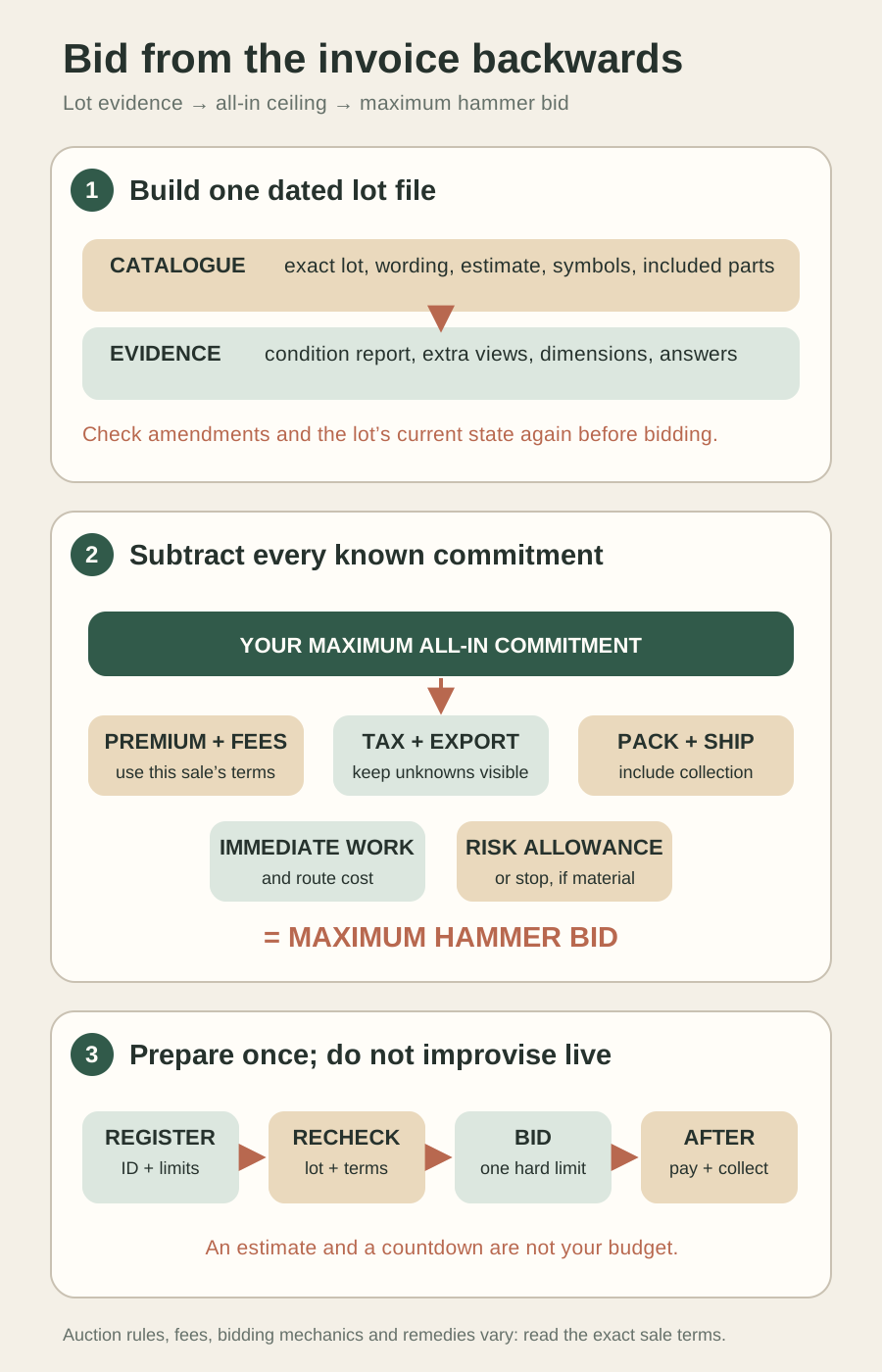
Start with the all-in ceiling. For a proposed hammer amount, calculate the exact premium and other hammer-linked charges under the sale tiers, then add taxes, payment, packing, collection, storage, shipping, permits and immediate work. Reduce the hammer until the complete commitment fits. When a percentage or tax applies in bands or to premium as well as hammer, use the auction's own terms or a written invoice illustration—not mental subtraction.
Write the bid sheet
- All-in ceilingThe maximum total commitment in the currency you actually budget.
- Maximum hammerThe remaining bid after every known and accepted non-hammer amount is calculated.
- Increment consequenceThe next permitted bid may jump above your maximum; your limit is not rounded up to stay involved.
- Unknown-cost ruleState a bounded allowance, obtain the missing quote or do not bid. Blank does not mean zero.
- Exchange-rate ruleRecord which rate/date or conservative buffer you used and remember the invoice provider may differ.
Hard limit
The maximum hammer bid is not a target
It is the last acceptable bid under the evidence and costs recorded now. Winning below it is useful; losing above it means another bidder accepted a commitment outside yours. Do not add the delivery budget during the countdown.
Choose and test the bidding method
| Method | Confirm | Discipline |
|---|---|---|
| Timed online max bid | Automatic increments, reserve behaviour, extension rule, time zone and confirmation | Enter the hard maximum only when the lot and terms are final |
| Live online bid | Stream delay, bid button behaviour, room priority, increment and connection fallback | Do not chase a missed click or rely on the video as the legal event |
| Absentee/commission bid | Deadline, lot identity, currency and how the auctioneer executes it | Retain accepted written confirmation |
| Telephone bid | Call arrangement, language, fallback bid and which instruction binds | Speak amounts clearly and stop at the recorded maximum |
Register early enough to resolve identification, deposit, spending limit or bidding approval without urgency. Secure your account, verify the official domain/app and know how to contact the auction house through its published channel. A technical rehearsal can establish buttons and time display; it does not authorise a test bid.
Account boundary
A bid from your account may bind you
Do not share credentials, leave a logged-in bidding device unattended or assume support can cancel an accidental bid. Read the exact error and cancellation terms before the sale.
Make the final pre-bid check
- Confirm the lot is still offered and the number, description, images and location match your file.
- Read every amendment, saleroom notice, condition update, estimate revision and new answer issued since your review.
- Confirm the current buyer terms, premium/tax calculator inputs, invoice currency and maximum hammer sheet.
- Check registration approval, bidding method, device power, connection, clock and the auction's official support contact.
- Place or decline the bid. Do not reinterpret an unanswered condition, export or cost question because the lot is about to close.
If live competition passes the maximum, stop. If the lot remains below it, you still do not need to bid early or repeatedly unless the chosen method requires an action. The correct tactic depends on the auction mechanics; the invariant is that neither excitement nor apparent bargain changes the all-in limit.
Auction pause
The countdown does not improve the evidence
A newly noticed crack, missing part, qualifier, symbol, fee or export issue remains consequential at ten seconds. Let the lot go when there is no responsible time to resolve it.
Own the post-sale plan before you win
Christie's current payment and shipping page illustrates the post-sale chain: invoice charges can extend beyond hammer, shipping may require a bespoke quote, collection needs release arrangements, international movement may need export or CITES permits, and storage charges can begin after a stated period. Use the exact auction's current version of each fact.[4]
Prepare the win file
- Invoice checkMatch lot, hammer, premium, tax and other charges against the saved terms before paying by the approved method.
- Payment and releaseRecord due date, cleared-funds requirement, collection authority and any identity documents without sending them to an unverified address.
- Packing and collectionGive the carrier the lot location, condition, dimensions, material, access and collection deadline; name who inspects before packing.
- Storage and delayKnow when charges or risk terms change and who must be notified if a permit or carrier delays collection.
- Arrival and claimPreserve package, condition and unpacking evidence and use the correct notice route within the relevant deadline.
Use the cross-border Guide before bidding when the lot must cross a border. A permit delay after the hammer may not cancel the buyer's payment or storage obligations.
Send one complete auction request
Message to copy
Resolve the lot and invoice before bidding
Hello—I'm considering lot [number]. Could you confirm the current catalogue description and any amendments or symbols; provide the condition report, current whole/detail images and exact dimensions; identify repairs, replacements, movement, missing parts and uninspected areas; and state whether the lot has changed since imaging? Please also point me to the exact buyer conditions and confirm the premium/tax fields, invoice currency, accepted payment, lot location, packing/collection options, storage deadline, export or CITES note and relevant condition/damage notice process. Please do not load, force, energise or dismantle the furniture for evidence. I will calculate my maximum hammer bid from the complete commitment. Thank you.
Bid when the lot file, terms and full cost are coherent, the maximum hammer is written and the post-sale route is ready. Pause when a material condition, cataloguing, fee, tax, export or collection fact is unresolved. Decline when winning depends on ignoring a qualifier, inventing a cheap repair, treating the estimate as value or finding transport after the hammer.