Start with the exact claim
“Solid wood furniture” can be too broad. A sideboard may have solid wooden legs and handles, veneered doors and top, a plywood back and different materials inside the drawers. A table may have a veneered top on a stable panel with solid edging and legs.
Ask:
- Which parts are solid wood?
- Which surfaces are veneered?
- What is beneath the veneer, if known?
- Is any surface laminate, melamine or another decorative sheet?
- Are the back, drawer bottoms or internal shelves made differently?
The answer should describe the parts rather than apply one material word to the complete object.
Understand the three terms
Solid wood
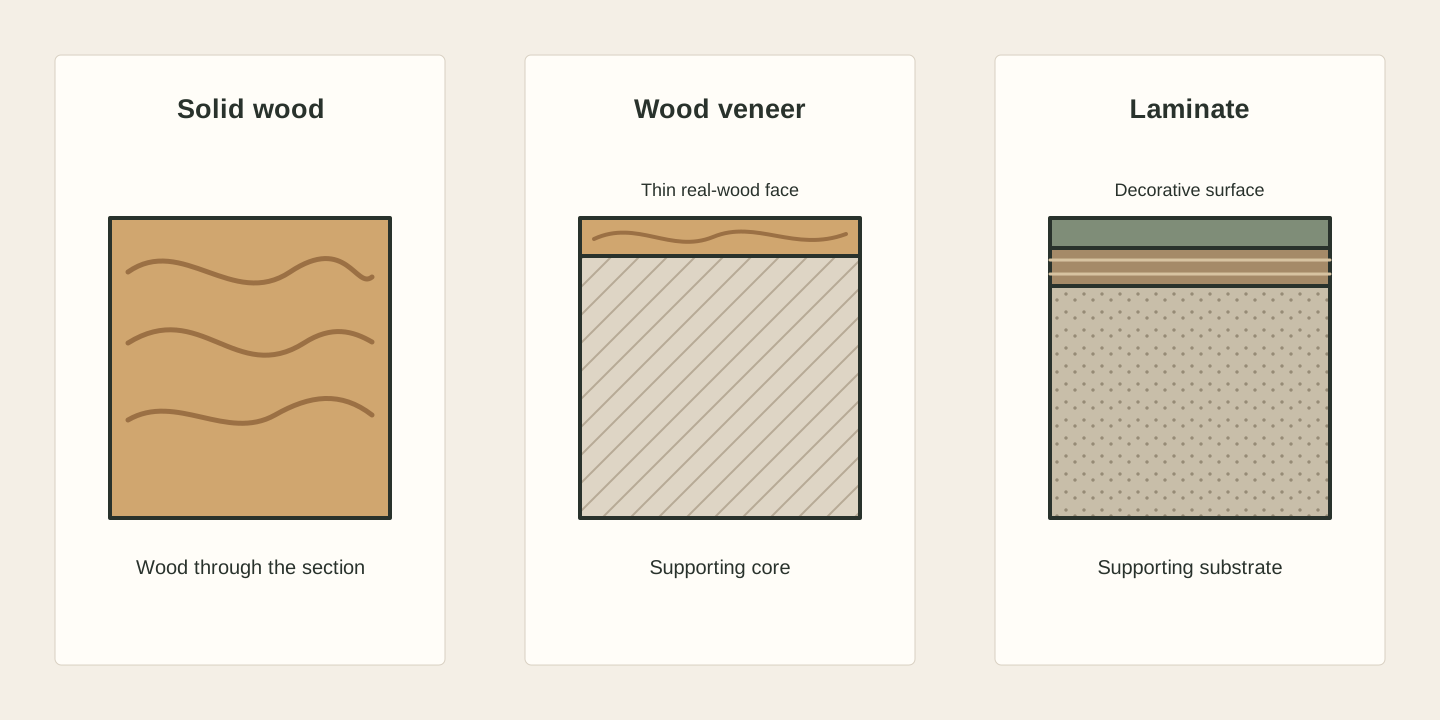
A solid wooden component is cut from timber rather than built from a thin decorative face bonded to another core. Its grain belongs to the material through its thickness, although finishes, edge profiles and joined boards may make this difficult to read from a photograph.[1]
Solid wood can still be assembled from several boards, shaped parts or glued components. “Solid” does not mean that the object was carved from one piece.
Wood veneer
Veneer is a thin layer of real wood applied to another material. It may cover plywood, blockboard, particleboard, fibreboard or a different solid wood.[2]
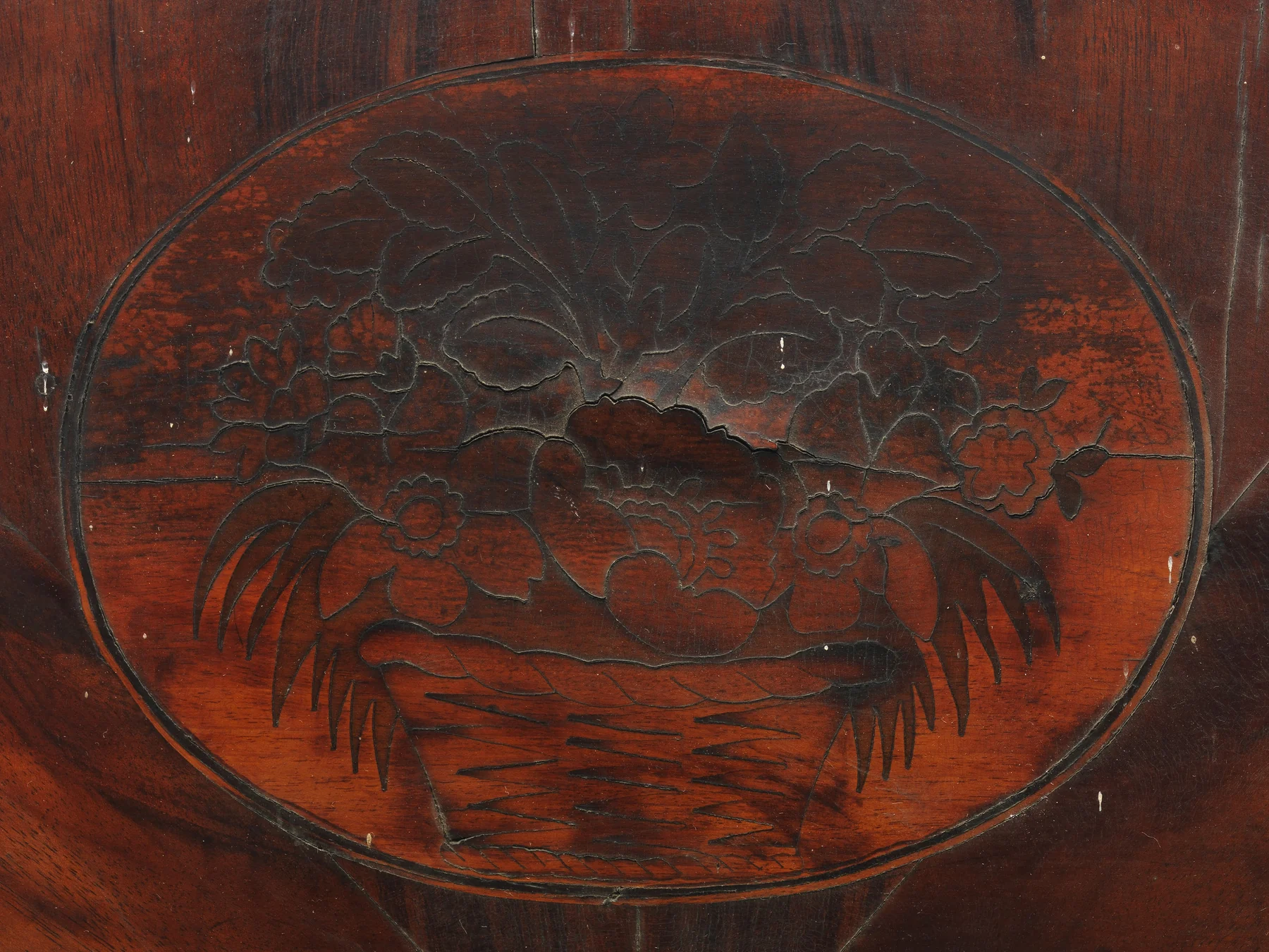
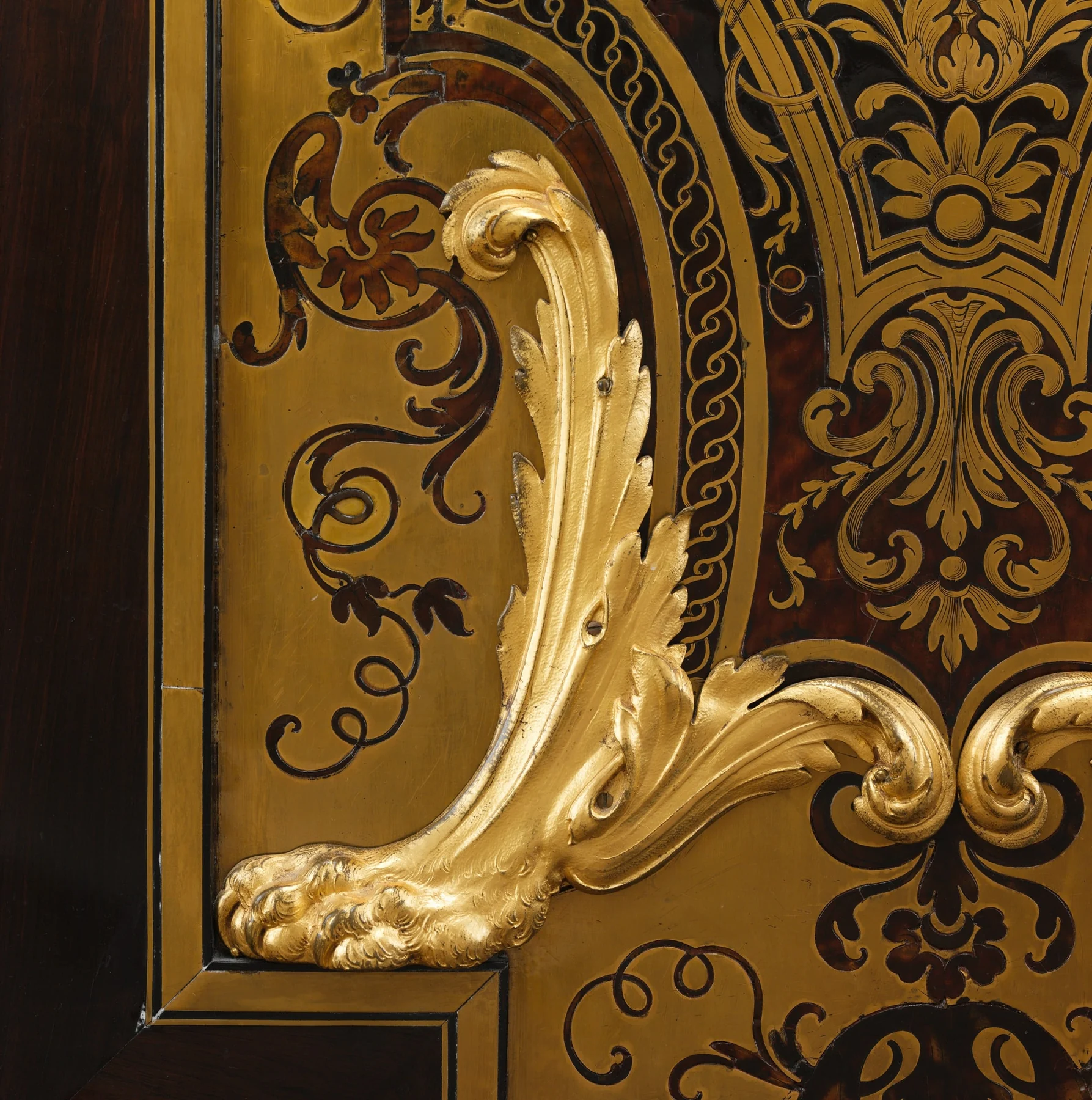
Documented eighteenth-century furniture used veneer across structural carcasses and arranged leaves into deliberate patterns. Veneer should not be treated as a synonym for cheap or false.[4]
Laminate
Laminate is a manufactured decorative surface bonded to a base. Other furniture described casually as laminate may use melamine-faced board or another synthetic decorative surface.
High-pressure laminate, for example, is made from layers of resin-impregnated paper consolidated under heat and pressure. Unlike wood veneer, the visible design is not a sliced wooden face.[5]
Look at the edge—but do not rely on it alone
An exposed edge can be useful. On solid wood, end grain or a continuous change in grain direction may be visible where a top meets its edge. On a veneered panel, a thin face layer or a different core may appear at an existing chip, underside or unfinished edge. Laminate may show a distinct decorative skin above paper layers or a panel core.
An edge is not conclusive by itself. A veneered top may have solid wooden lipping that hides the core, laminate can have matching edge banding, and paint or a heavy finish may conceal the material. Ask for several views rather than one extreme close-up.
Compare the surface with the underside and back
The underside often explains the front. Request clear photographs of:
- the underside of a tabletop;
- the back of a cabinet or sideboard;
- the inside and outer edge of a door;
- drawer sides and drawer bottoms;
- shelf edges;
- existing chips, losses or cable openings;
- places where a fitting has already been removed during legitimate restoration.
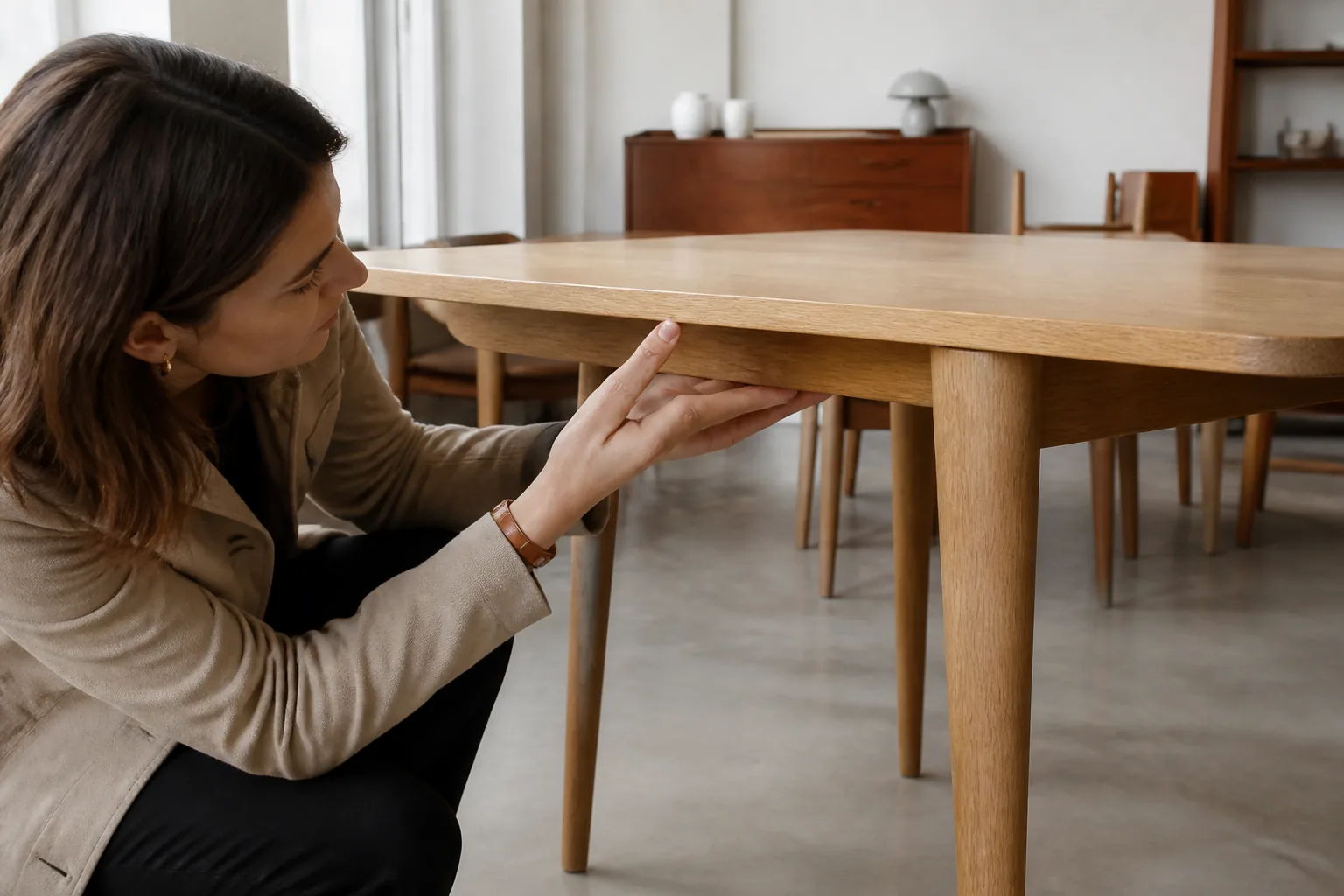
Look for changes in colour, grain, texture and construction between the decorative face and the supporting material. Do not ask the seller to create a chip, scrape a finish, remove original hardware or sand an area; use surfaces that are already visible.
Read grain patterns carefully
Grain can offer clues, but it can also mislead. A laminate can reproduce convincing grain and may include embossed texture; a plain piece of real wood may show little dramatic figure.
Adjacent veneer leaves can be arranged in repeated, mirrored or book-matched patterns. That repetition may be part of the original design rather than evidence of a printed surface.[4]
Useful questions include:
- Does the pattern continue naturally around an edge?
- Is the same figure mirrored across two doors or panels?
- Does the underside use a different but understandable construction?
- Is the pattern exactly repeated at regular intervals?
- Does an existing loss reveal a separate face layer?
No single pattern proves the answer. Use grain together with edges, construction and the seller's description.
Do not turn the materials into a quality ladder
Solid wood is not automatically superior, and veneer is not automatically a defect. Judge construction in relation to the intended design, period and maker, condition of the surface and core, joinery, edge treatment, repair possibilities, use, price and accuracy of the description.
A stable veneered panel may be entirely appropriate for a broad tabletop or cabinet face. A laminate surface may be original, durable and central to a twentieth-century design. A solid wooden component may still be split, distorted or poorly repaired.
The useful question is not simply “Is it solid?” but “What is it, where is it used and what condition is it in?”
Describe mixed construction precisely
A broad claim hides the parts that matter. Compare these two descriptions:
Too broad
Solid teak sideboard.
More useful
Teak-veneered top, doors and case sides on a panel core, with solid teak legs and handles. The back appears to be plywood. No laminate has been identified from the available photographs.
The second description separates what is visible from what remains uncertain. When the core cannot be established without damaging the piece, say so: “teak veneer over an unidentified panel core” is more honest than guessing.
A useful request to send the seller
Message to copy
Could you confirm which parts are solid wood, which are veneered and what the core or substrate is, if known? Is any surface laminate, melamine or another decorative sheet? Could you send clear photographs of the top, edges, underside, back, drawer parts and any existing chip or exposed edge that already shows the construction? Please do not scratch, sand or dismantle the piece to provide the photographs.
What photographs can and cannot establish
Photographs may support a construction description when several areas agree. They may show a face layer, an exposed core, continuous end grain or a manufactured surface.
They may not establish:
- the exact timber species;
- the full core construction;
- whether a hidden surface was replaced;
- the quality of an adhesive bond;
- how far lifting or separation continues beneath the face;
- whether every component uses the same material.
Surface distortion in veneered work can have several causes, and a listing photograph is not a substitute for a physical diagnosis. When evidence is incomplete, keep the wording narrow.[3]