
First decide what ‘good’ means for this piece
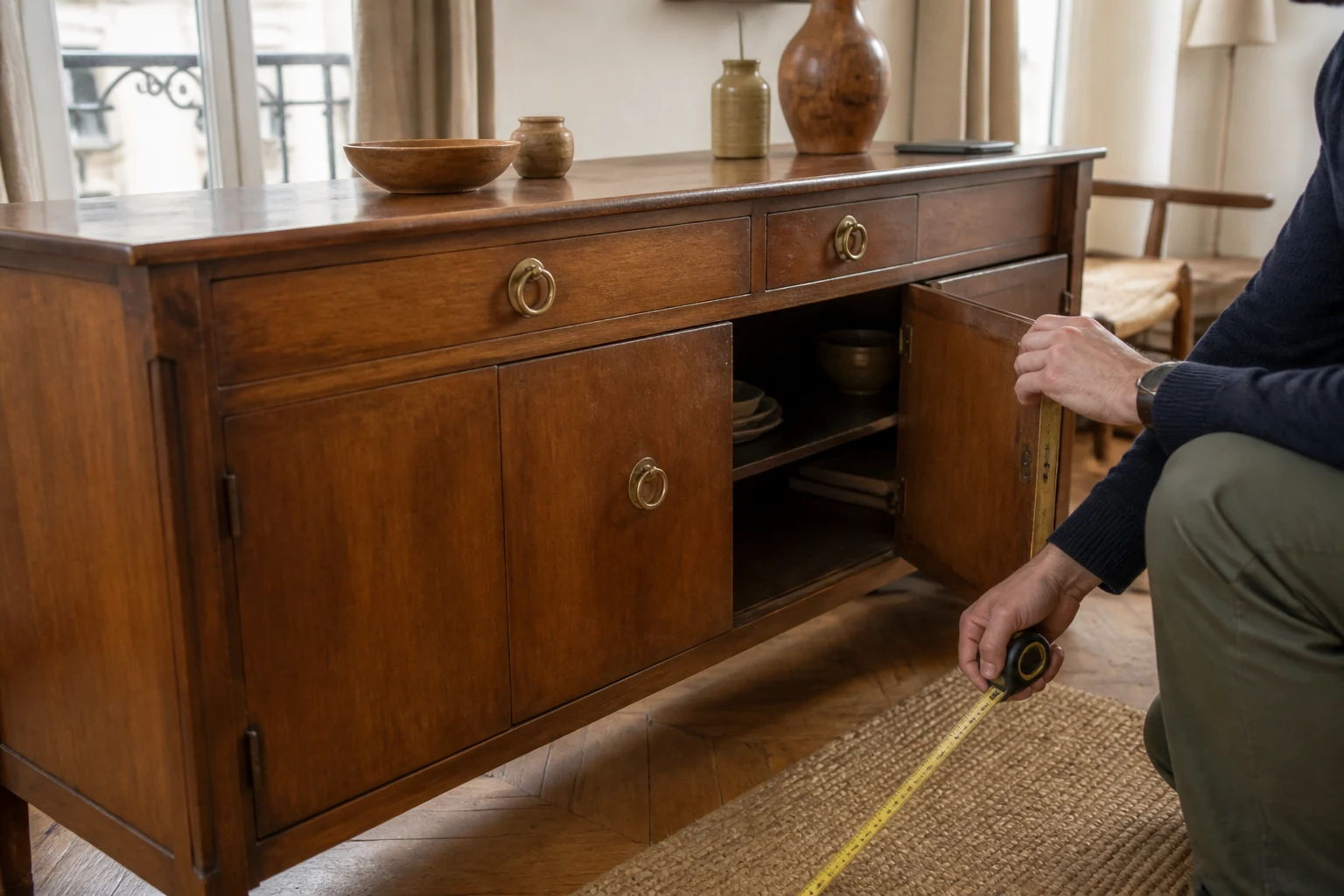
Begin with the life the object needs to live, not the story you hope it has. A dining chair used every evening needs dependable joints, a comfortable seat height and serviceable upholstery. An occasional chair in a quiet corner may allow more fragility. A sideboard must fit the route, hold the intended objects and open without colliding with a wall.
Write down the few things that would make you regret the purchase. This turns an attractive listing into a decision with boundaries. Style, period and attribution can still matter; they simply do not replace fit, function and present condition.
Set your decision boundary
- JobWhat must the piece do, how often will it be used and by whom?
- FitWhat are the maximum object dimensions and the narrowest point on the delivery route?
- ToleranceWhich marks of age do you enjoy, and which repairs or future work would be unwelcome?
- EvidenceWhich claim or missing view would materially change the price you would pay or your decision to continue?
Expect age, not surprises
Vintage is not a softer word for perfect. Fading, small scuffs, softened edges, old screw holes, a carefully repaired joint or replaced handles can all belong to a useful and appealing object. The important question is whether the exact condition is visible, described honestly and acceptable for your intended use, price and appetite for future work.
| What you see | How to treat it | Useful next question |
|---|---|---|
| Ordinary age and use | Even wear, small marks, fading and finish variation may be part of the piece's character when they are stable and visible. | Does any of it affect function, cleaning or where I can place the piece? |
| Disclosed intervention | Refinishing, replaced hardware, new upholstery and old repairs are changes to understand—not automatic reasons to reject a piece. | What was changed, what is original and is the work stable now? |
| Active problem | Loose load-bearing joints, spreading cracks, movement, damp, pests or questionable electrics can affect use, cost or safety. | Does this need professional assessment or work before use? |
| Unknown from the evidence | A missing underside, vague repair history or untested function is a decision gap, even when no defect has been proved. | Can the seller clarify it, or am I comfortable pricing in the uncertainty? |
A realistic standard
Character is welcome; vagueness is not.
Do not reject a good vintage piece merely because it has lived. Equally, do not let words such as patina, original or as found turn a safety issue, active deterioration or missing fact into something romantic.
For a closer inspection sequence, use the condition guide. If the piece is wired, treat the lighting guide as a viewing checklist, not permission to test or repair uncertain electrics yourself.
Build a small evidence set
You do not need a forensic dossier for every modest cabinet. You do need enough evidence for the parts of the decision that matter. Ask for one useful view or answer at a time, and explain what you are trying to establish. A precise request is easier for a good seller to answer than ‘Can you send more photos?’

Evidence worth gathering
- The whole objectFront, back, both sides and an honest sense of scale and colour.
- Vulnerable areasFeet, joints, corners, edges, hinges, drawer runners, upholstery and any disclosed damage.
- Construction cluesUnderside, interior, back, joins, edges and hardware when material or age is part of the claim.
- Exact measurementsMaximum width, depth and height, including handles, overhangs and parts that do not detach.
- Work and replacementsWhat has been repaired, refinished, reupholstered or replaced, and what remains uncertain.
- The offer itselfExactly what is included, current availability, location and the seller responsible for the sale.
The photograph guide shows which distances answer which questions. If a listing leans on solid wood, veneer or laminate, use the construction guide to ask for edges, reverses and joins rather than guessing from the front surface.
Maker, period and provenance are factual claims only when the evidence supports them. Labels can be moved, stories can become simplified and attractive objects are sometimes honestly unattributed. A piece does not need an invented identity to be worth owning.
Measure the piece, the route and the room
A listed width and height are only the beginning. Confirm whether dimensions include handles, projecting tops, feet and non-removable fittings. Then measure doors, lifts, stair turns, landings and the final position. Leave room for hands, packaging and the angle needed to turn the object.
For large furniture, work through the full delivery-route guide before agreeing collection or delivery. The narrowest point and tightest turn usually decide—not the largest room.
Before arranging transport
Ask what can actually be removed.
Do not assume legs, doors, shelves or a top detach because a similar modern piece does. Ask the seller which parts are removable, who should remove them and whether doing so changes the safe handling plan.
Price the whole decision, not only the object
The asking price is only one line in the decision. A low-priced chair that immediately needs upholstery, joint work and specialist delivery can cost more than a sounder example. A more expensive piece with clear evidence and known work may carry less uncertainty. Neither route is automatically better; compare them honestly.
- The seller's current price, currency and exactly what is included.
- Collection, packing, delivery, stairs, lifting help and any access constraints.
- Immediate professional work needed for safe or intended use.
- Missing parts, consumables or replacements you already know you will want.
- An uncertainty margin for an important question that cannot be answered before purchase.
- Your own time and tolerance for arranging work after the piece arrives.
Do not subtract imaginary restoration costs merely to force a bargain, and do not assume every intervention adds value. The useful number is what this exact piece is worth to you in its disclosed state, with the work and logistics you can realistically accept.
Send one clear message
Good questions are specific, limited and tied to a decision. Start with the missing facts that could make you stop. If the answer keeps the piece in contention, ask the next layer. This is kinder to the seller and more useful than requesting dozens of photographs before checking basic fit.
Message to adapt
A calm first note
Hello—I'm considering this piece for regular use in [room]. Could you confirm the maximum dimensions including handles or overhangs, whether any parts detach for delivery, and whether the joints, doors or drawers have any current movement or functional issue? I can see [visible wear or repair]; has anything else been repaired, refinished or replaced? A clear photograph of [one decision-changing area] would help me decide whether to continue. Thank you.
A careful answer can include uncertainty. ‘I do not know whether the handles are original’ is more useful than confident speculation. If an important answer stays vague, decide whether you can inspect in person, obtain professional advice, reduce the uncertainty in another way or simply pass.
Pause before you continue to the seller
Your final four checks
- Fit and useThe dimensions, route and current function suit the job you chose.
- ConditionOrdinary wear, interventions, active problems and unknowns are separated rather than blurred together.
- Story and evidenceAny maker, period, material or provenance claim is supported—or clearly treated as uncertain.
- HandoffYou know the current price, what is included, who is selling and how purchase, delivery and returns will work.
Use PatinaHall to inspect, compare and get to know the independent seller. When you continue, the seller—not PatinaHall—handles the purchase, payment, delivery and returns. Recheck the seller's current terms and availability before committing.
A sound outcome
Continue, clarify or pass.
The purpose of research is not to talk yourself into every piece. A confident yes, one precise follow-up question and a well-founded no are all successful outcomes.