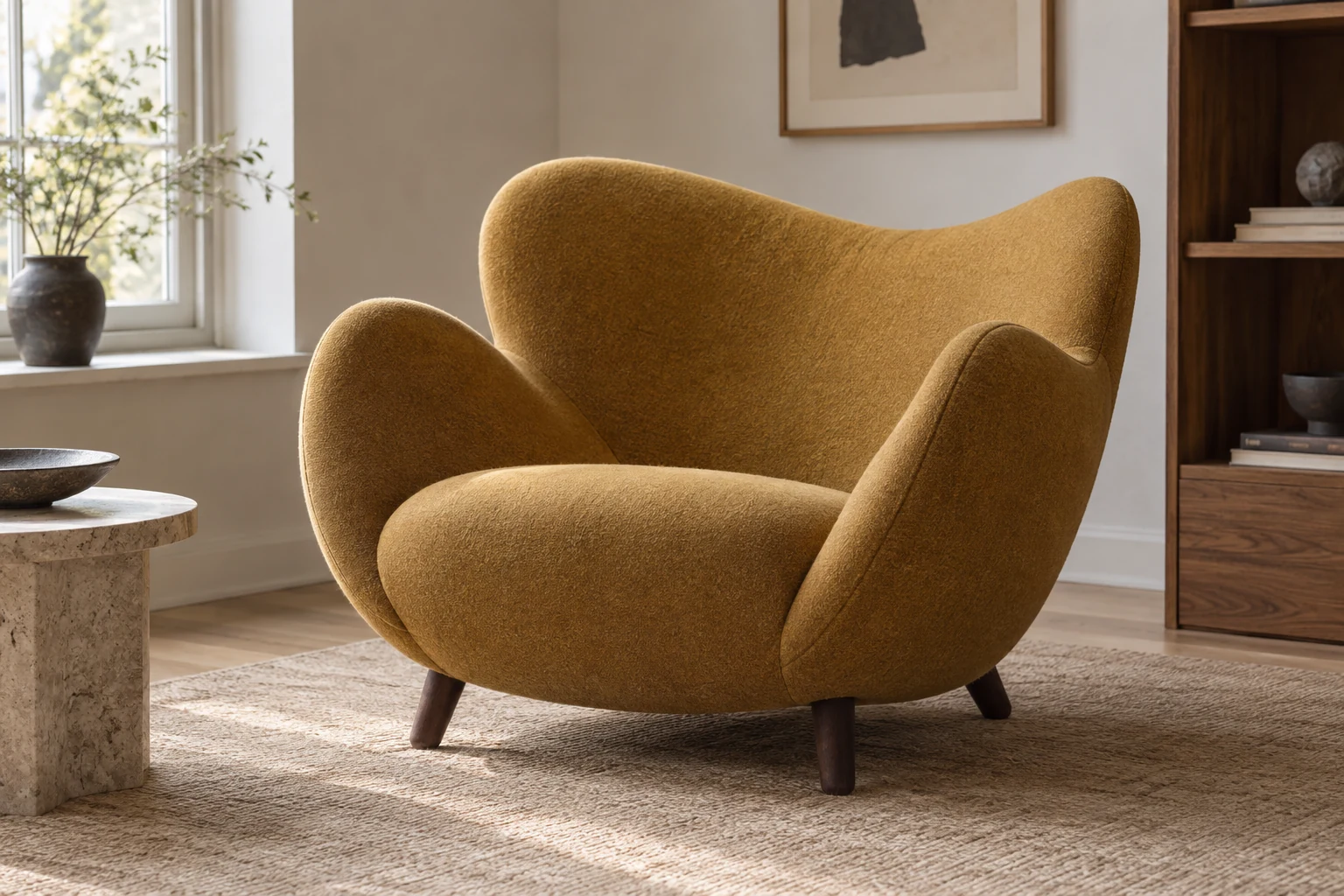
Begin with the job, not an ideal sofa size
Decide who will use the seat, for what and how often. A deep lounge chair for occasional reading, an upright everyday armchair and a sofa used for overnight guests ask different questions even when their outer dimensions are similar.
Write down the room position, usual number of sitters and the functions that must work. Include reading, conversation, television, naps, reclining, swivel movement or a sofa-bed opening only when the exact piece genuinely provides them. This gives every later measurement a purpose.
Define the use before measuring
- PeopleWho will use it regularly, and do children, mobility needs or a preferred sitting posture change the decision?
- FrequencyIs this a daily working seat, occasional extra seating or primarily a visual piece?
- FunctionsMust it recline, swivel, open as a bed, join modules or work with a footstool?
- Room positionWhich wall, window, table, lamp, radiator, door and walking route share the area?
- Tolerance for workMust it be ready for regular use, or can upholstery, support or structural work enter a reviewed plan?
Confirm the exact configuration in the offer
A listing photograph may arrange loose cushions, a footstool or several modules without making ownership clear. Ask the seller to list every included physical part and show them together. Record whether left- and right-hand modules are fixed, reversible or simply posed that way.
For a sofa bed, recliner, swivel chair or adjustable back, ask which positions the seller has operated recently and whether the mechanism has any known stiffness, missing control, repair or restricted movement. An old brochure or model specification does not prove that this exact example still reaches every original position.
Loose cushions are part of the working object. Confirm their quantity, orientation and whether they appear original, replaced or cut to a later shape. A replacement seat cushion can change usable depth, seat height and the way someone meets the back even when the wooden or metal frame is unchanged.
Vintage reality
A familiar model can still have unfamiliar dimensions
Hand-built frames, compressed fillings, replacement cushions, altered feet and repairs can change the exact piece. Use a catalogue specification to form a question, not to replace a current measurement.
Record the outer envelope and the usable seat separately
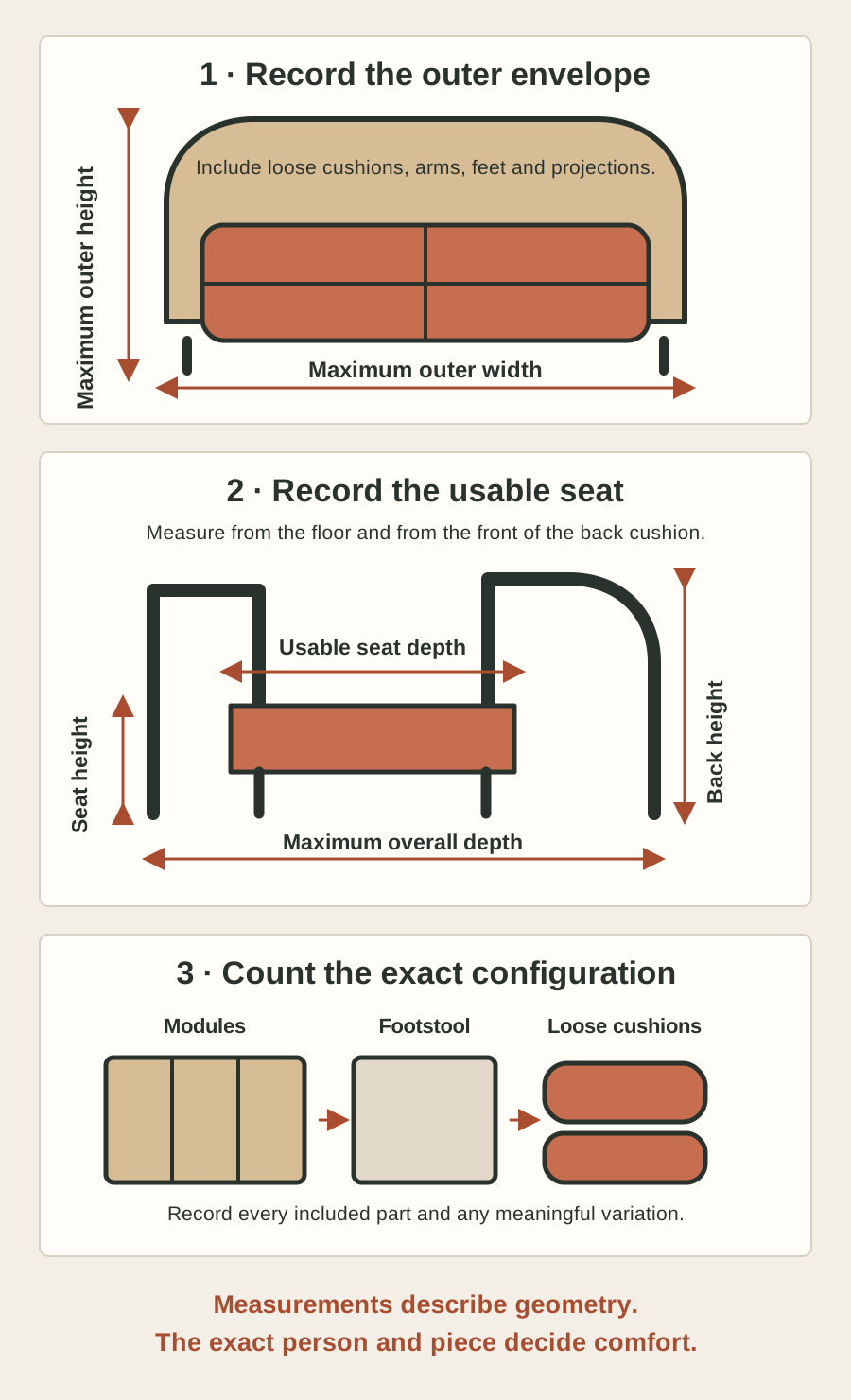
Ask where every measurement begins and ends. Maximum outer dimensions include the widest arms, loose back cushions, feet, handles, controls and any fixed projection. Usable dimensions describe the part a person actually occupies. One set cannot stand in for the other.
| Decision | Measure on the exact piece | Clarify |
|---|---|---|
| Room footprint | Maximum overall width and depth | Loose cushions, splayed feet, controls, arms and projections |
| Height in the room | Maximum overall and arm height | Compressible back cushion, headrest and removable feet |
| Sitting position | Seat height, usable width and usable depth | Where the front of the back cushion begins and how much the seat compresses |
| Body support | Back height above the seat and arm height above the seat | Back angle, loose lumbar cushion and usable arm surface |
| Moving state | Maximum footprint in every working position | Recline, swivel, footrest, sofa-bed, fold or separated modules |
Vintage upholstery may not be perfectly level or symmetrical. Ask the seller to record any meaningful left-to-right variation and to show the tape in enough context that you can see the chosen points. Use the largest relevant outer number for room and route planning; keep the variation visible rather than averaging it away.
Compare comfort with a seat you already know
Do not turn one centimetre figure into a comfort promise. Seat height, usable depth, back angle, arm position, cushion firmness and the sitter's body work together. Soft material also changes while someone sits.
Measure a chair or sofa that already feels comfortable and one that clearly does not. Compare the same points with the candidate, then name the difference: deeper seat, lower front edge, firmer cushion, more reclined back or arms that sit too high for your usual posture. A physical comparison is more useful than a generic ideal.
If trying the piece is possible, sit without forcing a fragile mechanism. Check how easily you stand, where the seat edge meets the legs, whether the back supports the intended posture and whether the arms help. If trying it is impossible, keep comfort as a known uncertainty and decide whether the price, return terms and likely work make that uncertainty acceptable.
Comfort boundary
Measurements narrow risk; they do not fit a body
A seller can report dimensions and their own observations. They cannot promise comfort for another person, and a Guide cannot certify support, structural safety or suitability for a particular medical need.
Map every position the piece will use
Mark the maximum resting footprint on the floor with low-tack tape or paper. Then add the space used by knees, feet, a reclining back, a raised footrest, a turning swivel, an opened sofa bed or modules in the alternative arrangement you actually expect to use.
Open nearby doors and drawers and walk the normal route through the room. Check tables, lamps, sockets, curtains, radiators and windows in their working positions. A sofa can fit neatly against a wall yet block a door when occupied; a recliner can clear the wall while closed and meet a heat source when opened.
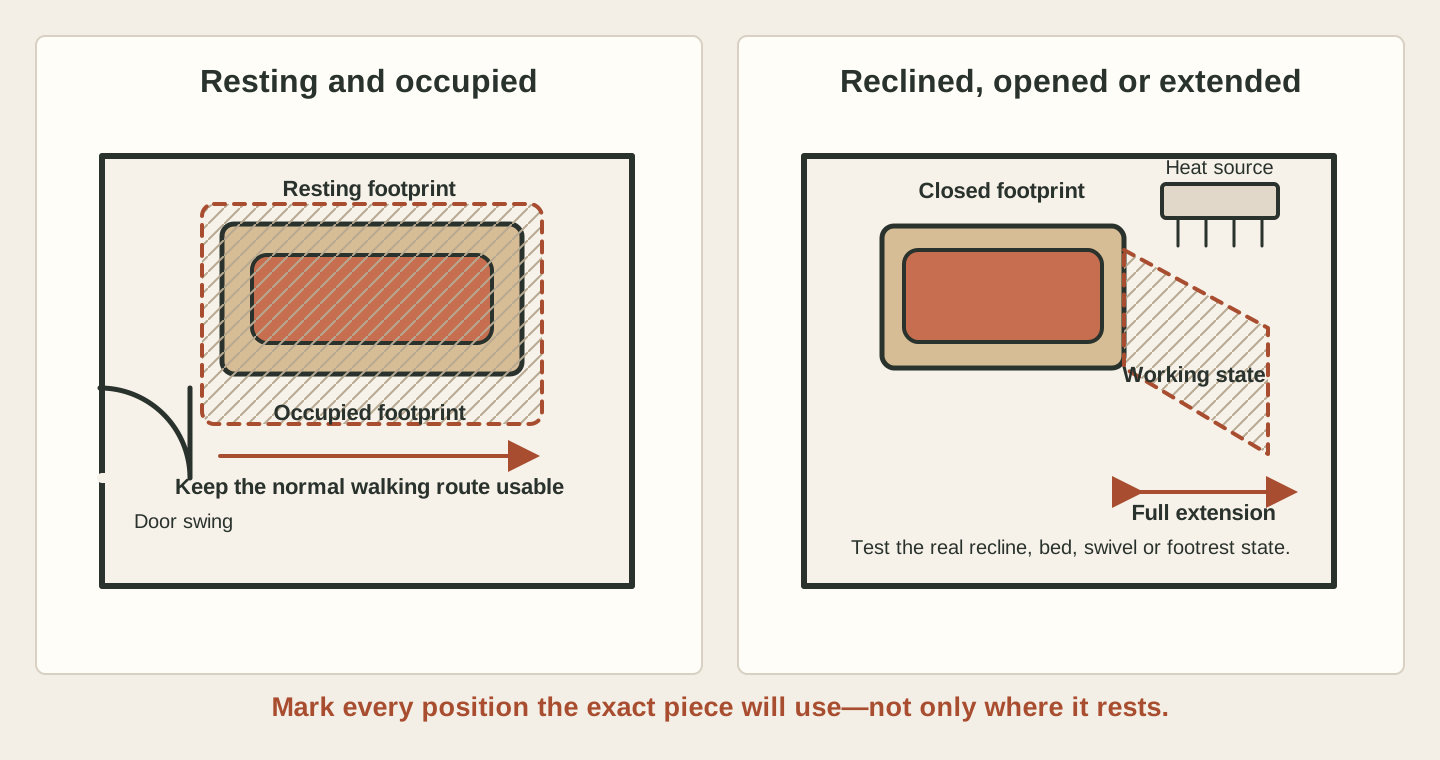
If the piece will float away from a wall, view the back as part of the room and include cable, floor-covering and cleaning access. If it will sit near direct sun or heat, treat placement as a care decision too; fading, brittle upholstery and dry or changing wooden components are not solved by a footprint alone.
Inspect the parts that carry everyday use
Fit matters only if the exact seat can do the intended job. Ask for the complete piece, back, sides, underside, feet and any exposed support. Compare both sides and every module rather than assuming the best-looking cushion represents the whole offer.
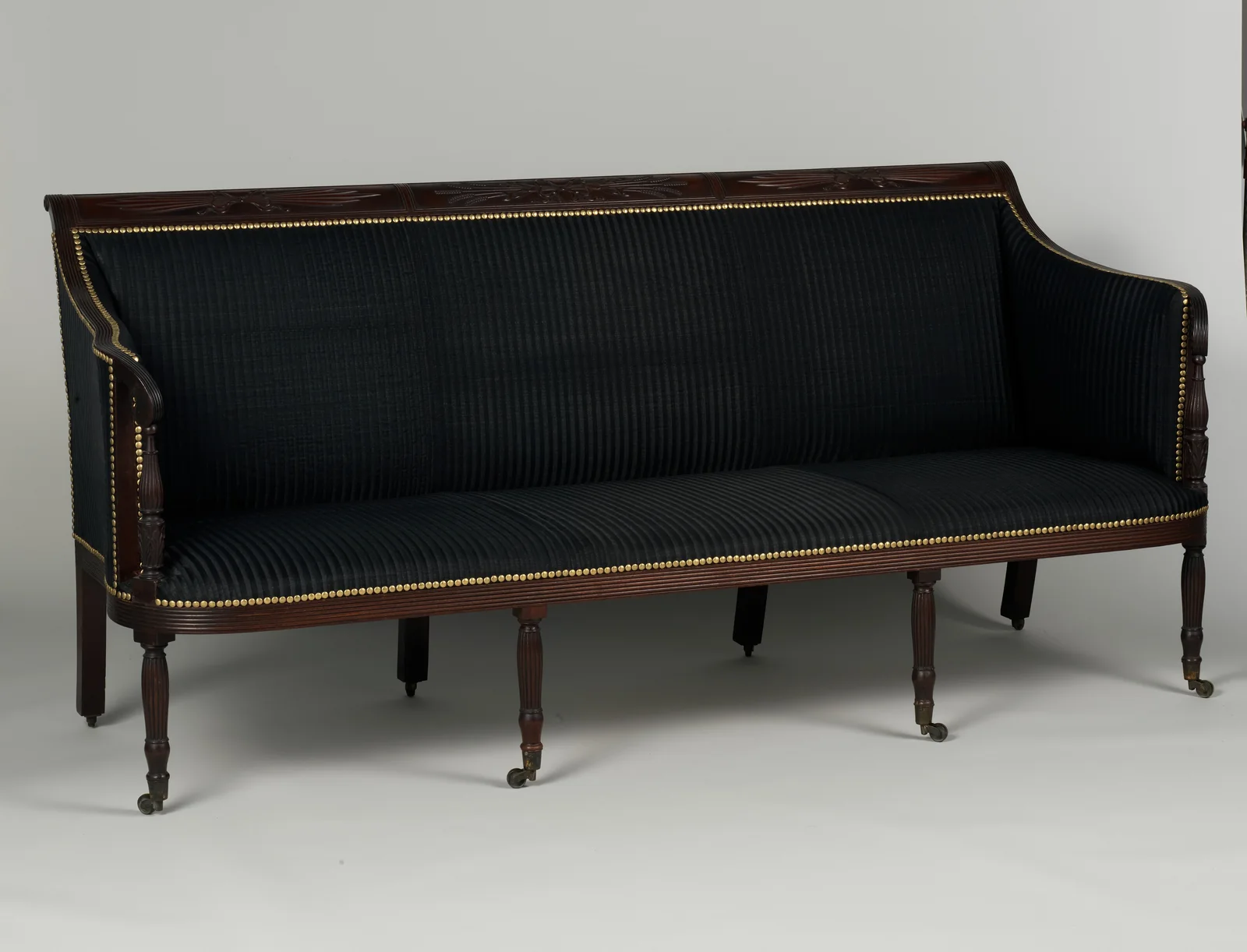
The Met's whole-object record for sofa 42.16 keeps the upholstered sitting area, outer arms and back, wooden frame and repeated floor contacts visible at once. That orientation is useful before requesting details, but this museum view does not reveal hidden support or establish another sofa's condition, comfort or safe use.[1]
Ask what is known
- Frame and feetSeller-known movement, cracks, repairs, added blocks, altered feet, castors or uneven floor contact.
- Seat supportVisible or reported condition of springs, webbing, boards, straps, foam or other layers, while keeping hidden material unknown.
- Covers and cushionsTears, stains, fading, replacement covers, compressed areas, missing fasteners and differences between modules.
- MovementCurrent operation of recline, swivel, fold or bed states without forcing a stiff or fragile part.
- Household limitsOdour, smoke, pet, moisture or storage history only as the seller can honestly report it; photographs cannot settle these facts.
Ordinary fading, softened upholstery and a disclosed old repair may be acceptable. Active movement, failed support, a mechanism that does not hold, persistent dampness or unknown work affecting load-bearing parts needs a separate decision and may require an upholsterer, conservator or suitably experienced furniture professional.
Keep room fit and delivery as two proofs
A successful floor plan does not prove access. Record the exact delivery configuration, including every module and the protected maximum envelope, then use the delivery-route Guide for doors, turns, stairs, lifts, packaging and the carrier handoff.
Do not assume feet, arms, backs or mechanisms detach because screws are visible or another example came apart. Ask the seller which parts they know can be removed safely, who will do it and what the piece measures in that exact state. A modular sofa may simplify one route while creating several heavy or fragile parts that each need their own record.
Two separate decisions
The room and the route can fail independently
Approve the room only after every working position fits. Approve delivery only after the seller or carrier accepts the complete protected route. One yes cannot stand in for the other.
Turn the separate proofs into one buying decision
Do not let one reassuring answer stand in for the others. Use the upholstery Guide to scope the layers and use the restoration-budget Guide to compare the complete commitment rather than the fabric price alone.
| Proof | Ready when | Pause when |
|---|---|---|
| Exact offer | Every module, cushion, fitting and working state is identified | A photographed part may be posed, optional, replaced or absent |
| Fit and use | Outer, usable and working footprints suit the intended people and room | Comfort is untested or one open, occupied or moving state is missing |
| Condition and work | Visible evidence, seller history, important unknowns and a realistic scope agree | Frame, support, mechanism, odour, damp or upholstery layers could change the work |
| Delivery | The seller and carrier agree the exact protected configuration and route | Access depends on unverified dismantling or an unmeasured part |
| Total commitment | Price, collection, professional assessment, work, delay and delivery remain acceptable together | The decision works only if an unknown repair is cheap, immediate or unnecessary |
Buy when all five proofs are adequate for the intended use. Clarify the one missing fact when a bounded answer can change the decision. Pause for an upholsterer, conservator, repair specialist or carrier when the unknown exceeds seller evidence, and decline when the purchase depends on a comfort, condition, safety or cost guarantee nobody can responsibly give.
Send one seat-specific request
Ask the seller to confirm
- Complete offerEvery module, cushion, footstool, control, fitting and loose part included.
- Outer dimensionsMaximum width, depth and height, with projections and meaningful variation.
- Usable seatSeat height, usable width and depth, back and arm measurements and where each point was taken.
- Working statesFull recline, swivel, footrest, bed or alternative module footprint and current operation.
- Known condition and workFrame movement, support, repairs, replacement cushions or covers and facts that remain unknown.
Adaptable message
Ask for the exact piece, not a model average
Hello—I'm considering this [sofa/armchair] for [daily or occasional use]. Could you confirm every included module, cushion and fitting; the maximum outer width, depth and height; seat height, usable width and usable depth; and the full footprint in each reclining, swivelling, bed or alternative module position? Please show where the measurements were taken and note any meaningful variation. Could you also describe seller-known frame movement, support, repairs, replacement upholstery or mechanism issues, and confirm the exact delivery configuration? Thank you.
Request whole, context and close views with the furniture-photograph Guide. If the support or frame remains uncertain, pause before treating attractive upholstery or a familiar maker name as evidence of safe everyday use.