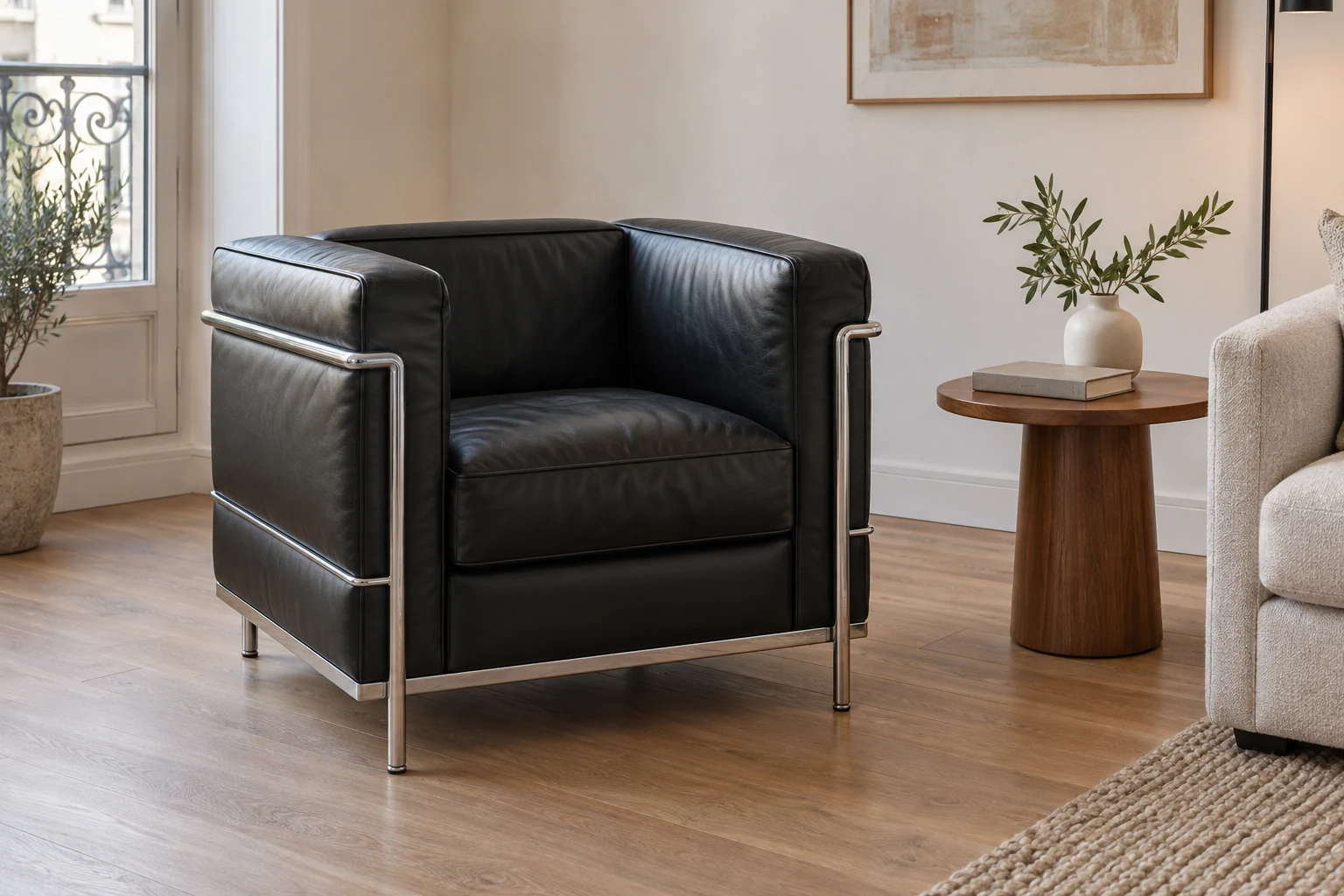
LC2 and LC3 have longer names now
Search listings under LC2 and LC3, but search Cassina documentation under their restored French names too. The armchairs are 2 Fauteuil Grand Confort, petit modèle and 3 Fauteuil Grand Confort, grand modèle. Cassina explains that its naming change restores historical titles and credits the work of Le Corbusier, Pierre Jeanneret and Charlotte Perriand.[1]
“Petit” and “grand” are more helpful to this comparison than the familiar numbers. Cassina’s families also contain sofas, so LC2 does not mean a two-seater and LC3 does not mean a three-seater. Ask the seller to state the exact form, overall dimensions and number of seats.
Current Cassina material describes the cushions and tubular frame as distinct parts of the design. The LC2 armchair is offered with a chromed or painted frame and fabric or leather upholstery. Black leather and bright metal are therefore one familiar appearance, not a definition of every legitimate version.[2]
Record the claimed maker, production period and repairs for the specific chair. A design date is not its manufacturing date. If a seller attributes it to an earlier producer or period, that claim needs its own documents; a current Cassina product page cannot settle it.
A pair of LC3s needs more width
Cassina’s 2021 Dining Products catalogue gives useful armchair footprint references in its LC2/LC3 durable specifications: 76 × 70 cm for LC2 and 99 × 73 cm for LC3. Keep the scope of that reference clear and measure the offered chairs. It is a comparison of overall width and depth, not a universal seat-height chart for every vintage cushion.[4]
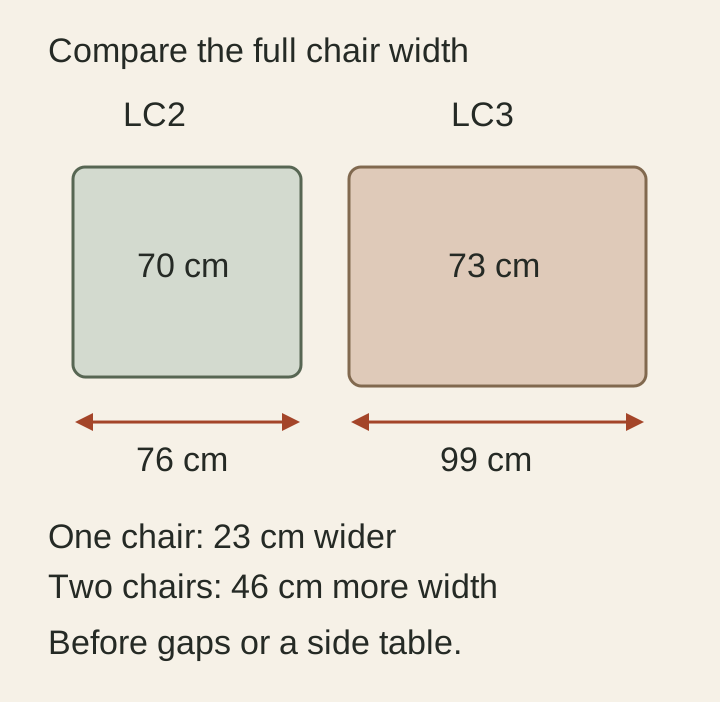
The arithmetic is revealing: 99 − 76 = 23 cm extra width for each chair. A pair adds 46 cm before you leave any gap or place a table between them. The stated depth difference is only 3 cm, so a quick glance at depth can miss the dimension that changes your room most.
Mark out the whole pair on the floor. If you plan a small table between them, add it now. Check the route behind the chairs and space beside the arms. A low back can keep a view across the room open while a broad seat still occupies a substantial strip of floor.
For doorways and the route into the room, use the sofa and armchair measurement Guide. Confirm the delivery dimensions of the assembled chair rather than assuming that removing cushions will make the metal frame narrower.
Choose a sitting position before a leather colour
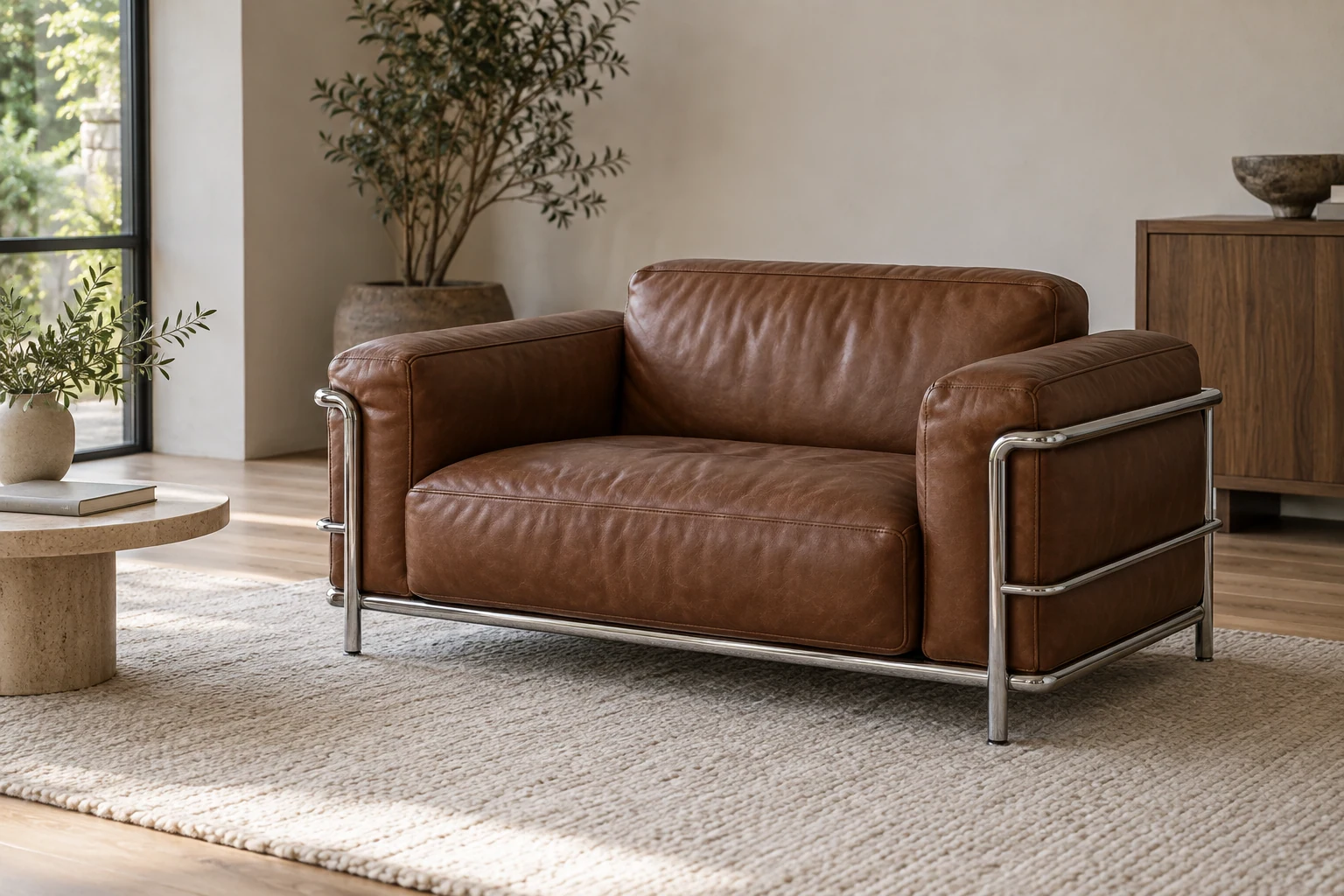
Think about how you spend time in this chair. For conversation beside a sofa, you may prefer the contained feel of the smaller model. For a wider lounge seat, the larger model may be the draw. Those are reasons to try each form, not promises about how an unseen vintage chair will feel.
During a normal seating trial, notice where your feet land, whether the front edge presses behind your knees and where your elbows meet the arms. Stay long enough to feel the cushion settle, then get up as you normally would. A very soft seat can feel welcoming for a moment and still be awkward for your daily use.
Try both chairs if buying a pair. Matching covers can conceal different fillings or repair histories. If one seat sits lower, find out whether that reflects the version, wear or a previous alteration before planning a matching reupholstery job.
Cassina’s current LC3 description includes variable-density polyurethane padding and a polyester layer. That is evidence for the stated current construction, not a diagnosis of an older chair. Ask what filling is actually present and what was changed during any recent upholstery work.[3]
Treat new cushions as a design decision
New covers do not necessarily mean new filling, and new filling does not necessarily reproduce the sitting position you wanted. Ask for the invoice scope: covers, fillings, internal support, frame work and fitting. If the chair was bought already renewed, find out who can explain those decisions.
| Part of the chair | What to settle before ordering |
|---|---|
| Seat cushion | Finished height, firmness, shape and fit on the existing support. |
| Back and arm cushions | How they meet one another and the frame, and whether retained pieces will match. |
| Covering | Fabric or leather specification, seam details, colour and care for the chosen material. |
| Support and frame | Any necessary repair, existing alterations and work excluded from the upholstery price. |
Give the upholsterer the identified version, photographs and access to the actual chair. Do not commission a generic cushion from the outside width of the metal frame. The fit of each piece and the way they meet are part of both appearance and comfort.
A refreshed chair can be an excellent everyday purchase if you like the result and understand the work. If retaining older upholstery matters to you, choose an example that supports that aim. Avoid paying for a newly covered chair and then immediately funding another complete change.
Compare the chair with its remaining work
Inspect the exposed frame, feet and visible support before letting good upholstery settle the whole purchase. Record distortion, corrosion, previous welds or repairs and any unstable movement. Structural uncertainty needs assessment; it should not disappear into a quotation for leather.
Compare purchase, necessary support or frame work, the agreed upholstery scope and delivery. Then return to the room plan and seating trial. The better buy is the version you can use comfortably in the space available, with a complete cost you understand.
A message for the seller
Is this the LC2 or LC3 armchair, and what supports the stated producer and production date? Please send overall dimensions, photographs of marks in place and the visible support, and details of frame repairs or renewed covers and fillings. For a pair, please describe each chair separately. I would also like a normal seating trial before arranging delivery.