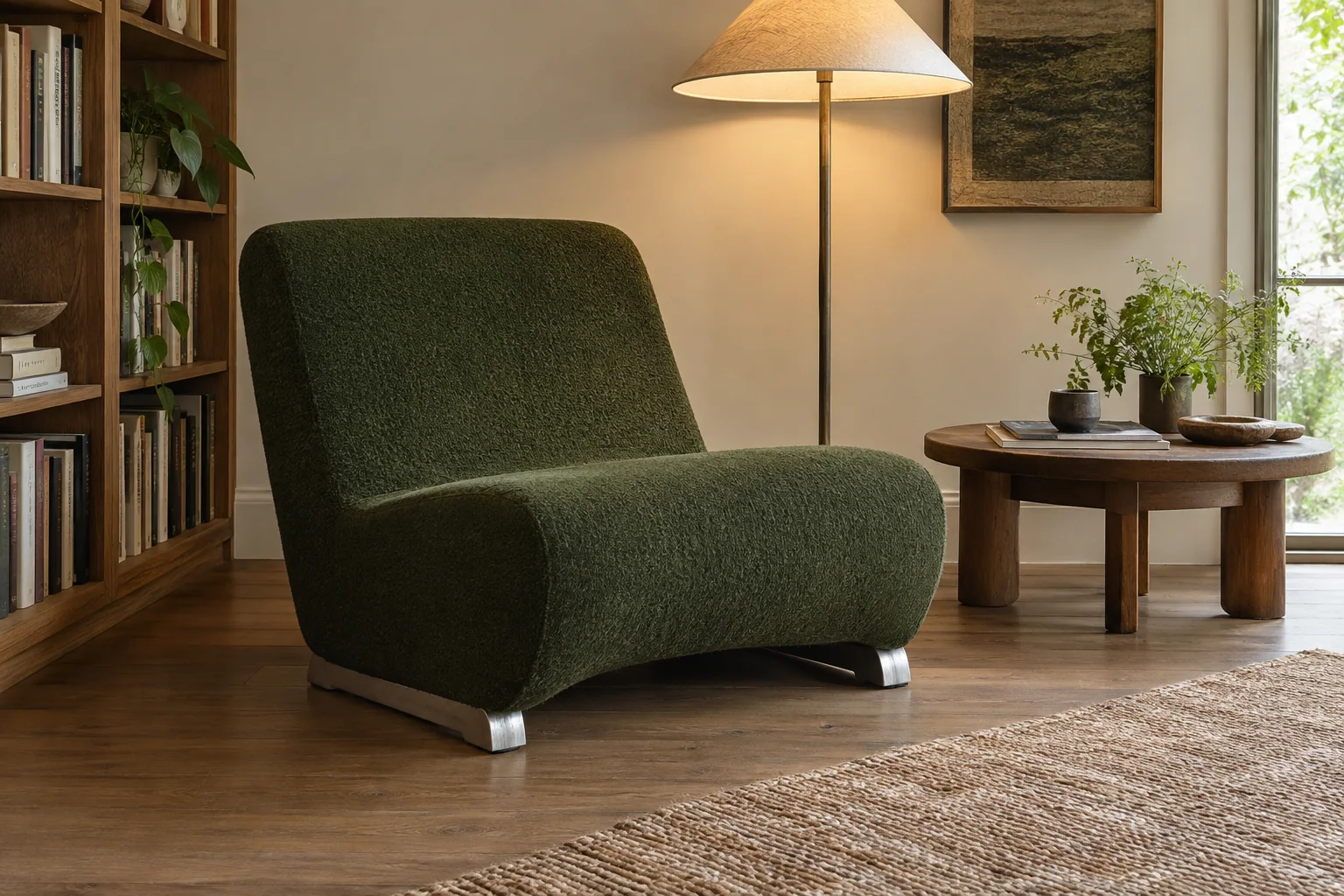
A small footprint does not mean an upright seat
Anonima Castelli identifies Alky as a Giancarlo Piretti design and describes its moulded padding over elastic support, with aluminium-alloy base components. The rounded upholstered body makes the chair read as one soft shape. That visual simplicity can conceal several different repair tasks.[1]
Start with the job you want it to do. A low seat for music or an evening conversation has a different brief from somewhere to answer messages at a desk. Measure its place in the room, then try the intended activity rather than deciding from an attractive three-quarter photograph.
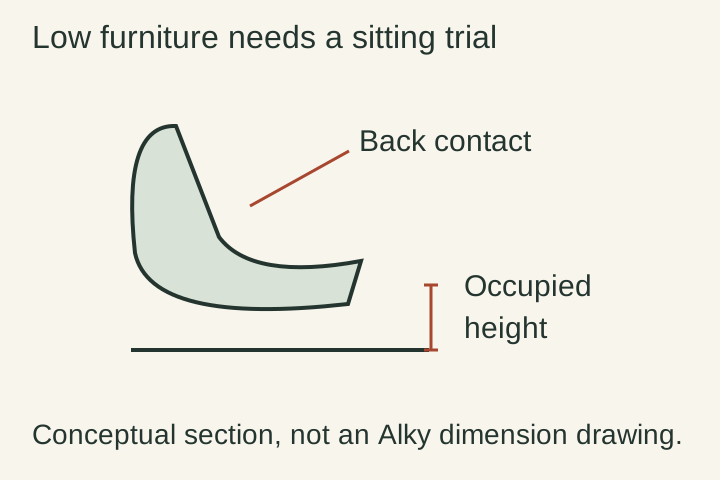
The important height is where you settle
If the chair is structurally sound, sit long enough for the cushion to settle. Notice where your hips are relative to your knees, whether your feet find a comfortable position and where the back meets you. Then stand up in your normal way. An armless outline gives visual openness, but it does not provide the same hand support as an armchair.
Try reaching for a book on a nearby table without twisting far forward. A side table chosen for a taller sofa may feel awkward here. In a small room, check the occupied position as well: your legs and the space needed to rise extend beyond the chair’s neat footprint.
| Measurement or trial | Why it helps |
|---|---|
| Occupied seat height | Shows where you sit after the padding compresses. |
| Usable depth to back contact | Shows whether you can settle back without sliding forward. |
| Reach to the intended side table | Checks the chair as part of the room. |
| Getting up without improvised support | Tests whether the low armless position suits you. |
A new fabric can make an old padding problem look finished
Look at the chair from the side and front before discussing colour. Flattened areas, uneven curves or a conspicuously bulky replacement cover are reasons to ask what was changed. They do not independently prove an incorrect chair; they identify questions about its upholstery history.
Have an upholsterer familiar with the design distinguish the cover, shaped filling and support beneath it. Ask which layers can stay, which need renewal and how the intended contour will be recovered. A quote described only as “fabric plus labour” can leave the most important uncertainty unresolved.
As an illustrative comparison, one chair may have faded cloth over sound support while another has attractive new fabric over collapsed filling. The first may offer a clearer project despite looking less finished. Sit in both where condition permits, and compare the work needed to reach the same usable result.
Check the base without letting the upholstery tell its history
Ask for underside views and any maker information before accepting a production claim. A current Alky page is a reference for the design, not proof of the age of a particular example. Keep photographs of labels and records of upholstery work with the purchase.
Have looseness, distortion or missing pieces in the base assessed before use. A replacement floor protector, a damaged base component and a loose attachment are different jobs. Do not regard a shiny metal surface as evidence that the connection beneath the chair is sound.
Before ordering the cloth
Confirm the frame and base condition, the work needed to the elastic support and padding, and the suitability of the chosen upholstery material. Price transport and return delivery alongside those jobs.
An Alky succeeds when its low, rounded form feels inviting in daily use. Choose the example that fits your body and can be restored to a clearly agreed result, then enjoy deciding whether the room needs green, orange or something quieter.