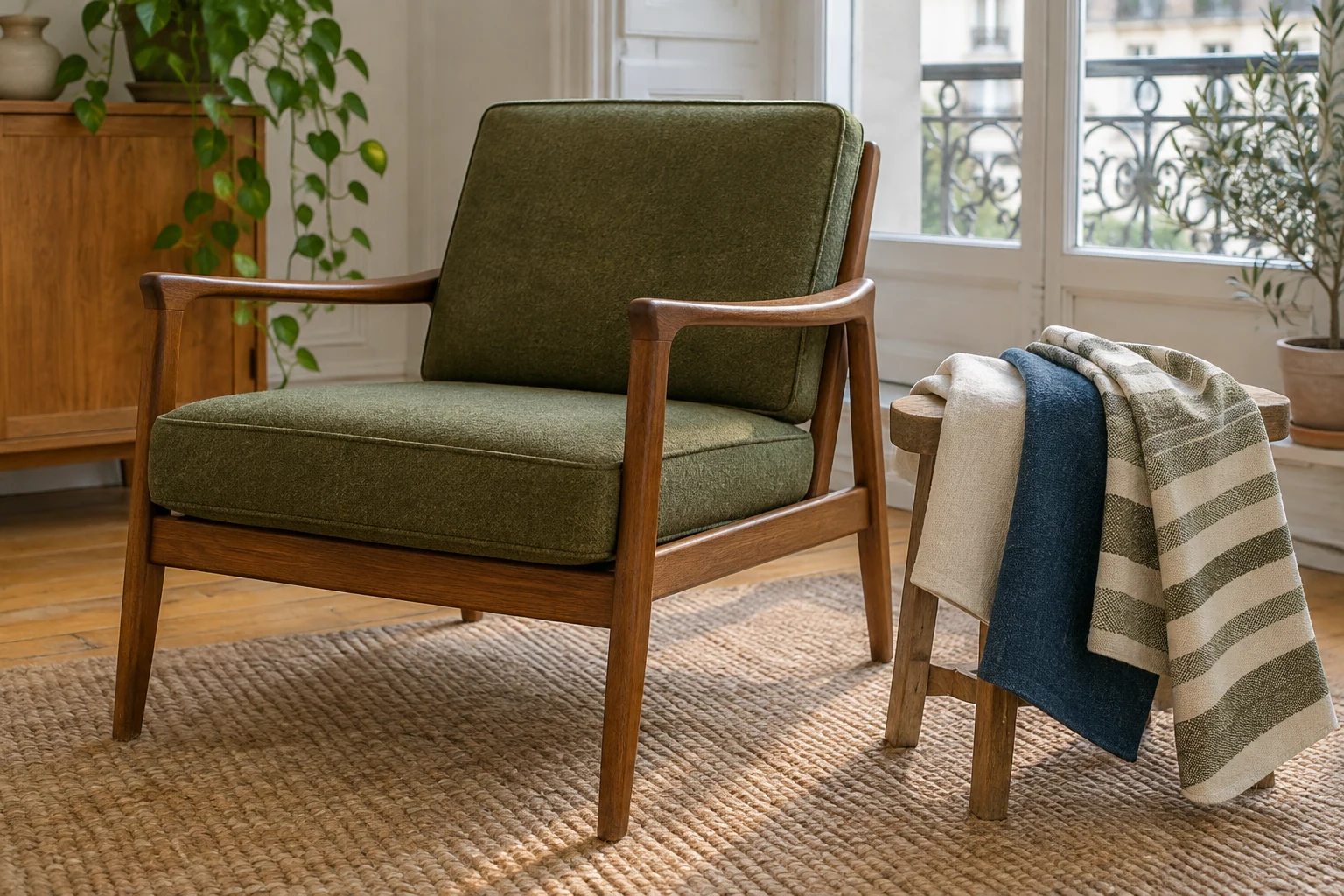
What do you want to keep about this chair?
Imagine the chair in a fabric you like. Is it the right width for the corner? Do the arms suit how you sit? Is the frame something you enjoy looking at? If the answer is yes, the upholstery may be the change that makes a good piece useful again.
If the seat is too deep, the back angle is wrong for you or getting up is awkward, do not assume fresh foam will settle everything. An upholsterer may be able to discuss changes, but those changes need a brief and can alter the chair’s shape. Try a sound example of the model when the one for sale cannot be used normally.
There are two different meanings of “worth it”. For your home, comfort, appearance and keeping a family piece can justify a cost that would not be recovered on resale. For a resale project, you need evidence of likely proceeds as well as costs. An expensive fabric does not automatically make the finished chair worth that much more.
A new cover, new cushions or a rebuild?
A timber chair with two removable cushions can leave much of its structure and finish outside the upholstery job. A fully upholstered armchair hides more of its shape beneath the cover. A wing chair with piping, buttons and shaped panels involves another combination of cutting and finishing. Give the workshop photographs of the actual construction before comparing prices.
| Job | What needs to be agreed |
|---|---|
| Recover the existing upholstery | Whether the existing filling and support are suitable to retain; exactly which surfaces receive new cloth. |
| Replace removable cushions | The finished dimensions, filling, firmness, cover construction and how the cushions stay in place. |
| Rebuild the upholstered body | Removal, inner materials and support, shaping, cloth and trim; separate any timber-frame or finish work. |
If the inside condition is uncertain, use the upholstery inspection Guide to prepare the photographs. A closed underside is an unknown to discuss, not a reason to invent a fixed repair allowance.
Published prices with a visible scope
Checked on 8 September 2026: Studio Kerjeus in Kortrijk, Belgium lists indicative prices for dismantling, rebuilding and upholstering smaller armchairs at €390–€650, with about 5 linear metres of fabric, and larger armchairs such as wing chairs at €590–€1,000, with about 7 metres. Its work prices include VAT and exclude fabric; fabric starts at €50 per linear metre. These are that workshop’s categories, not prices for the chair pictured here.[1]
Made by Lies publishes an indicative armchair range of €500–€1,250 excluding fabric. Its page does not divide that range into the same chair categories. Confirm tax treatment and the exact scope before comparing a proposal with the Belgian example. Neither page establishes a European average.[2]
A number becomes useful when you know what surrounds it. Does the proposal include new filling or retain it? Does “frame work” mean an upholstery support or a cabinetmaker repairing timber joints? Is trim included? The answer can explain much of the difference between two totals.
Put the fabric into the calculation
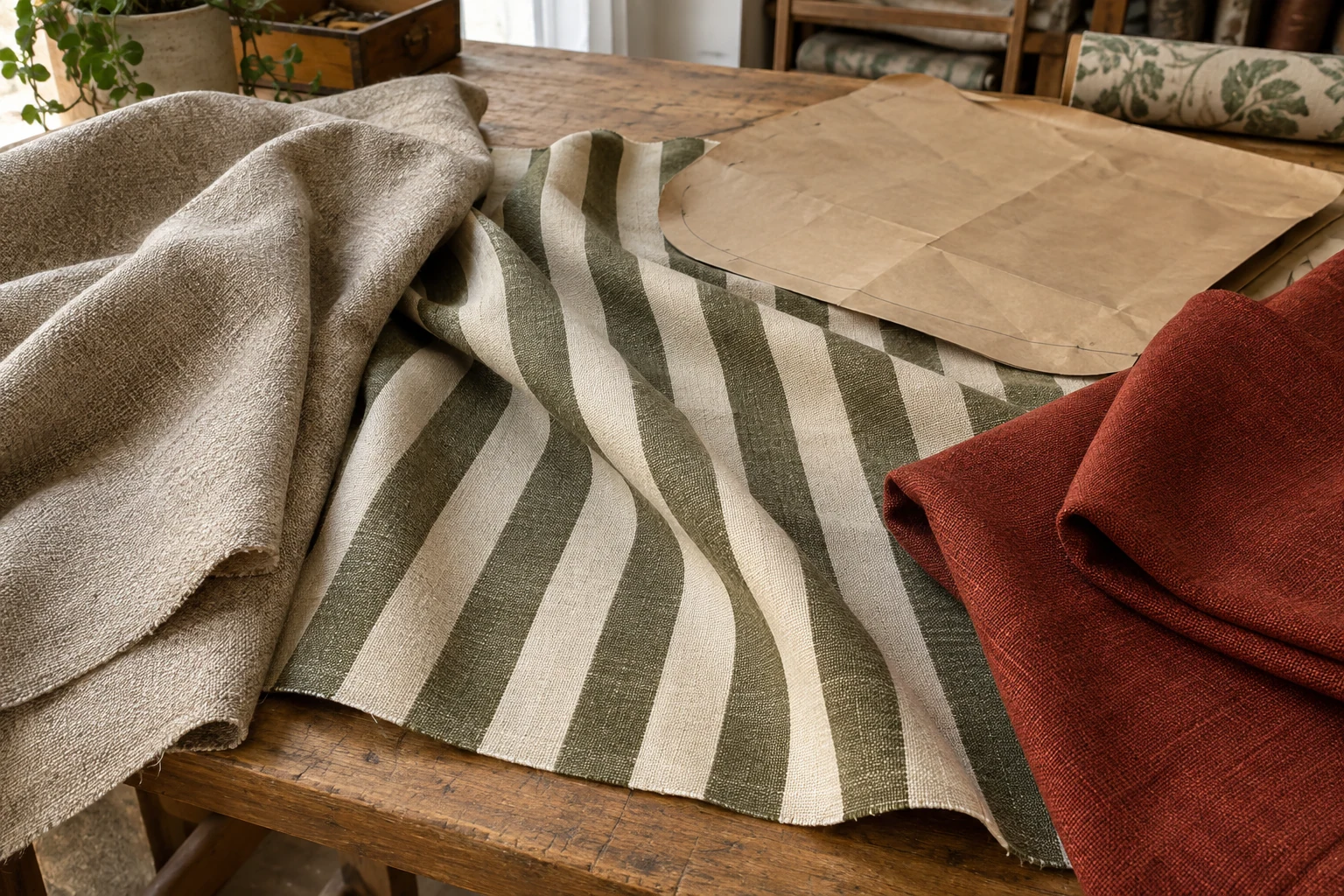
A price per metre is only half the textile decision. Usable width, pattern repeat, pile direction and the way panels need to line up affect the order. Choose the cloth with the upholsterer and get the required quantity before buying it. The fabric-choice Guide explains what to compare beyond appearance.
For illustration, apply the published starting fabric price of €50 per metre to the workshop’s approximate quantities. This gives an upholstery-and-fabric subtotal; it is not an invoice, a guaranteed fabric order or a delivered price.[1]
| Example | Work + fabric | Subtotal |
|---|---|---|
| Smaller armchair | €390–€650 + (5 m × €50) | €640–€900 |
| Larger armchair | €590–€1,000 + (7 m × €50) | €940–€1,350 |
If you instead select a hypothetical €90-per-metre fabric, the same 5-metre order costs €450 rather than €250: €200 more. At 7 metres, the difference is €280. That is arithmetic with an assumed fabric price, not a second workshop quote. A different cutting quantity changes it again.
Before ordering, use the upholstery-fabric Guide to agree the fabric specification, usable width and pattern direction.
Compare the cheap chair with the finished chair
Suppose, purely as a buying example, a smaller armchair costs €250 and you allow €100 for its combined transport. Add the illustrated €640–€900 upholstery-and-fabric subtotal: the planned outlay becomes €990–€1,250 before any extra work or charges the workshop has not included. The €250 and €100 are example inputs, not observed offers.
Now compare that with a ready-to-use chair you would actually buy. Include its delivery too, inspect its condition, and ask whether you prefer its existing fabric. A finished chair can be the better choice even if its listing price initially looks higher. A restoration can still make sense when the frame, proportions or family connection are the reason you want this particular piece.
If you already own the chair, use the money still to be spent. Its original purchase cost is not another bill in the new upholstery decision. If you are comparing selling it with keeping it, use realistic net sale proceeds as part of that comparison rather than an optimistic dealer asking price.
Agree the work that changes the result
Ask for photographs of work on a similar construction and agree the intended silhouette: cushion thickness, seams, piping, buttons and how much timber remains visible. New upholstery can change a chair’s character. “Make it comfortable” leaves too much of that decision to interpretation.
Record who will assess the frame, which inner materials stay, which are replaced and what happens if removal exposes another problem. Obtain the transport and tax position, the expected time without the chair and the point when you must approve a changed price. Do not add a second charge for work already included in the proposal.
A useful enquiry
I am considering reupholstering this [model/type] for everyday use. I want to retain [frame, shape and any original details]. Could you separate the cover and trim, filling/support, any frame work and transport; state VAT and exclusions; and confirm the fabric quantity after I choose a cloth? Please explain what requires an in-person inspection and how additional work would be approved.
For a project with several trades, use the full restoration-budget Guide to coordinate the proposals.
Choose the project you actually want
Proceed when you want the chair itself, the intended upholstery is clear and the remaining spend fits your budget. Keep serviceable original cloth when you enjoy it; replace worn upholstery when the change earns its cost. Pause when you are relying on a new cover to solve an unexplained structural or comfort problem.
The rewarding project is the chair you will use after the last bill is paid. Work backwards from that chair, rather than forwards from the cheapest listing.