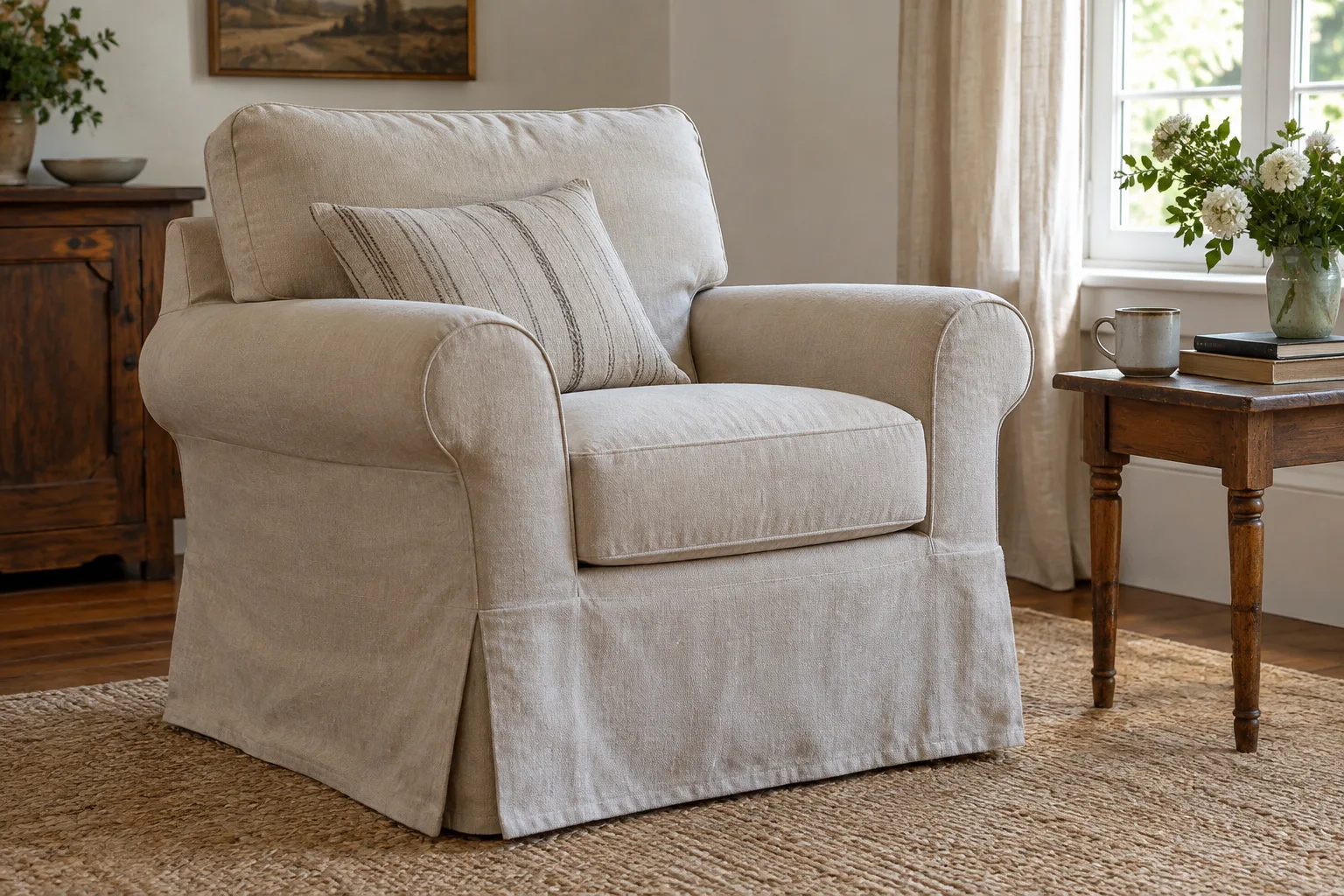
What would be a shame to cover up?
Look at the chair without a throw. It may be the carved arms, slender timber rails, neat line of the back or generous rolled shape that makes it attractive. Write that down before choosing between a cover-maker and an upholsterer. The right route should keep the feature you actually bought.
A loose cover can be a thoughtful solution for a comfortable older chair whose fitted upholstery you want to leave in place. It can also soften details until the chair looks like a different object. Neither result is automatically better; compare a fitted example on a similar form before ordering.
Try the decision on three ordinary chairs
| Chair | Possible route | What to establish |
|---|---|---|
| Soft roll-arm chair with a simple loose cushion | A fitted removable cover may work well. | How the maker controls the arm shape, cushion seams and hem without constant adjustment. |
| Open wooden armchair with separate upholstered panels | Re-cover the intended panels, or use model-specific loose cushions. | Which rails and joints stay visible, and whether existing cushions are removable by design. |
| Deep-buttoned or sharply sculpted armchair | Discuss reupholstery if the exact shape matters. | How the buttoning, tension and internal layers create that shape. |
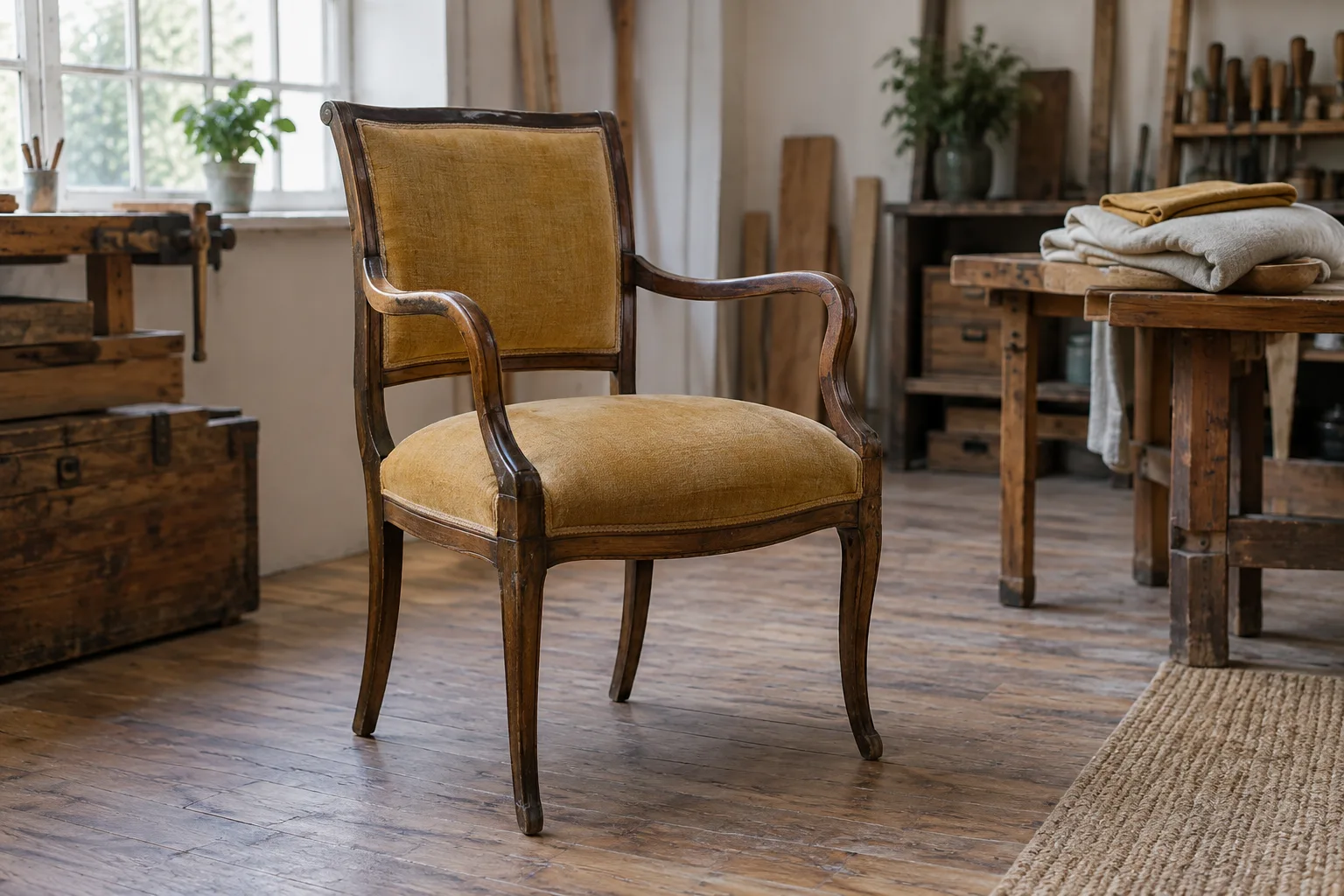
Plumbs offers both made-to-measure covers and reupholstery, and describes fitted covers that sit over existing upholstery. Its examples also distinguish forms such as deep-buttoned chairs and exposed timber. Use those examples to frame an enquiry, not as a rule that every chair of one type must take the same route.[1]
A loose cover does not fix a tired seat
Try the chair only if its condition permits ordinary use. Does it lean, move at a joint, bottom out or leave you constantly rearranging a cushion? Tell the maker about that behaviour before asking for a cosmetic quotation. If the support or frame needs work, decide that work first.
A complete strip is not automatically necessary either. The right professional may be able to replace a removable cushion, repair accessible support or preserve useful layers. Ask them to name what they can retain and what they cannot promise before examination. Keep potentially significant surviving upholstery out of a casual “throw it away” instruction.
For a known maker, check a specific service rather than ordering a generic fit. ercol’s ReCover programme covers a limited model selection and provides a guide for identifying eligible ranges. That makes model identification useful, but does not guarantee a service for every older chair with the name.[2]
Can you actually remove, clean and refit it?
Ask to see how the cover comes off. A zip hidden behind a heavy chair or a tightly fitted arm may be inconvenient even when the cloth itself is washable. Check whether you can do the ordinary removal and refitting without moving the furniture unsafely or straining old components.
Confirm the cleaning instruction for the completed cover, including its trims, lining and closures. Do not infer a machine-washing temperature from the fibre name or a small swatch. Ask about drying, any expected shrinkage and how the maker accounts for it. A cover that technically detaches but rarely gets washed may not solve your practical problem.
Plumbs offers machine-washable choices, but that is a choice within its range, not a property of every made-to-measure cover. Have the exact fabric and completed cover’s care requirements written into the order.[1]
Price two complete routes, not two headline numbers
Ask both providers to include the same known repair and cushion requirements. A low cover quote plus unpriced filling work cannot be compared with a reupholstery quote that already renews those layers. Equally, do not add a separate filling allowance to a proposal that includes it.
| Line | What the answer should make clear |
|---|---|
| Preparation and repair | Which existing layers must work before the new cover is fitted. |
| Fabric and making | Exact textile, quantity, seams, piping, closures and finish. |
| Fitting and transport | Home fitting, workshop collection and return, or components you must send. |
| Cleaning and upkeep | The method, likely effort and any second cover you actually intend to buy. |
| Tax and changes | Complete total, exclusions and approval before additional work. |
For a chair you will keep for years, convenience can justify a higher first price. For an occasional chair with useful original upholstery, preserving what is there may matter more. Choose against your real use, not a promise that one route is always cheaper or more sustainable.
Ask for the chair you want to live with
Message to a cover-maker or upholsterer
I want to keep [the exposed frame, shape or existing upholstery] on this chair and change [appearance, cleaning convenience or comfort]. Please advise whether a fitted removable cover or reupholstery suits its form. State any repair and filling work, exact fabric and quantity, treatment of arms/buttons/seams, removal and cleaning method, fitting/transport, tax and exclusions.
A good loose cover still lets you recognise the chair underneath. Good reupholstery gives you the shape and comfort you agreed. The useful choice is the one whose result and daily routine you can picture before paying.