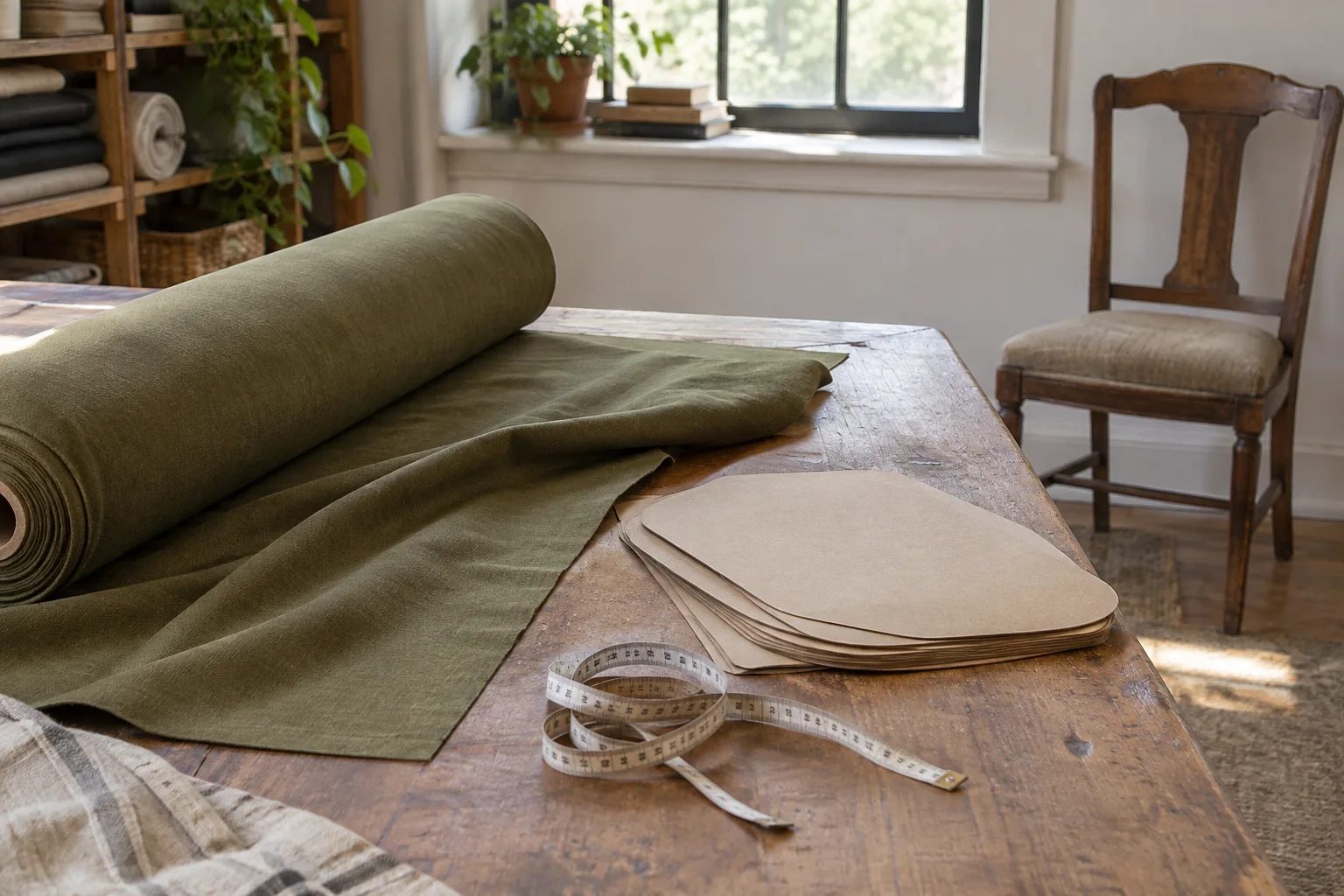
A running metre is a length of this particular roll
One running metre is one metre along the roll, across its available width. Two fabrics sold by the metre may offer different usable widths. Selvedges, flaws and the intended pattern placement can reduce what is actually available for the cutting pieces.
Ask the supplier for the current specification of the exact fabric and colourway. Then ask the upholsterer which width they will use in the plan. Do not substitute a nominal 140 cm width for a confirmed 138 cm usable width; a few centimetres can decide whether two pieces fit side by side.
Four seat panels: a small difference that doubles the length
Here is an illustrative geometry exercise, not a cutting pattern for your chairs. Suppose an upholsterer has already allowed for attachment and produced four rectangular cut pieces, each 65 cm wide and 70 cm long. The assumed fabric has 140 cm usable width, no pattern to match, no directional restriction and no defects.
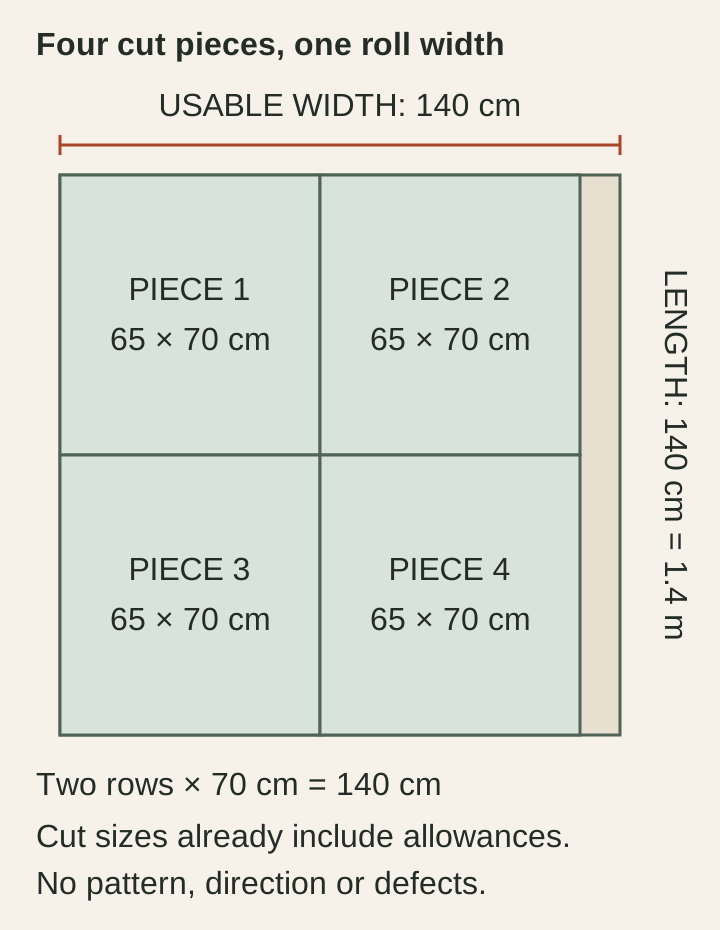
Two 65 cm pieces fit across the width: 65 + 65 = 130 cm. Two rows, each 70 cm long, supply the four panels. The geometric length is therefore 140 cm, or 1.40 running metres, before any separately agreed ordering margin. The unused 10 cm strip is not another seat panel.
Now change only the usable width to 120 cm. Two pieces no longer fit side by side. Keeping their stated orientation, four rows require 4 × 70 = 280 cm, or 2.80 running metres. The seat area has not changed, but the length has doubled.
| Usable width | Pieces across | Rows × row length | Geometric length |
|---|---|---|---|
| 140 cm | 2 | 2 × 70 cm | 1.40 m |
| 120 cm | 1 | 4 × 70 cm | 2.80 m |
The total panel area is 1.82 m². Dividing that by the 1.40 m width gives 1.30 m, which is too short for the stated two-row layout. Area alone ignores the shapes you must cut. This is why “buy the area plus ten per cent” is not a dependable universal rule.
A pattern has to meet somewhere
A repeat describes where the design returns across or along the fabric. Matching neighbouring cushions, centring a motif on a back and keeping a stripe level are separate layout requirements. Decide which relationships matter before asking for the quantity.
Sailrite’s pattern-matching guidance uses the fabric width, repeat measurements and cushion dimensions together. Its calculator also lets the user arrange individual panels. That is the useful habit: map the pieces on the actual textile, rather than adding a generic percentage and hoping the pattern aligns.[2][1]
For a simple illustration, if you deliberately allocate a whole repeat-aligned rectangle to a 70 cm-long panel on a 30 cm vertical repeat, that rectangle would be 90 cm long. Two such rows occupy 180 cm, before aligning the first motif and other allowances. This is one conservative layout choice, not a formula for every pattern: half-drop designs, horizontal matching and a chosen central motif can change it.
Add the pieces you do not see in the front photograph
A sofa can need inner and outer backs, inside and outside arms, seat surfaces, cushion faces, boxing strips, zip sections, piping and other details. The upholsterer decides which pieces use the chosen fabric and which use a different suitable material. Do not invent their dimensions from the sofa’s external width.
Direction also matters. Turning a piece through 90 degrees can save length but change the appearance of a pile, stripe or weave; some textiles and constructions will not suit that rotation. Ask the maker to record the intended orientation. A piece that fits geometrically is not automatically acceptable on the finished chair.
For a set, agree whether all chairs or cushion faces must share one motif position. Ask about the supplier’s cut length, batch availability, defects policy and whether a later top-up is likely to match. A small reserve can be useful, but its amount should follow the job and the supplier’s order increments.
Let one person own the final quantity
Have the upholsterer approve the fabric reference, colourway, usable width, direction, repeat, piece count, allowances and final length in writing. If you are supplying the fabric yourself, clarify what happens if the delivered width or design differs from the sample, and whether unused material returns to you.
Message before ordering
Please confirm the cutting plan for this exact fabric and [piece/set]: usable width, cut-piece dimensions including your allowances, direction, horizontal and vertical repeat, motif positions, piping/boxing requirements and final running metres. Please state any separate ordering reserve and the supplier’s cutting increment. I will order after you approve the fabric reference and quantity.
A useful fabric estimate is one you can explain. You do not need to become an upholsterer; you need to know what the metre figure includes before it becomes an expensive length of the wrong cloth.