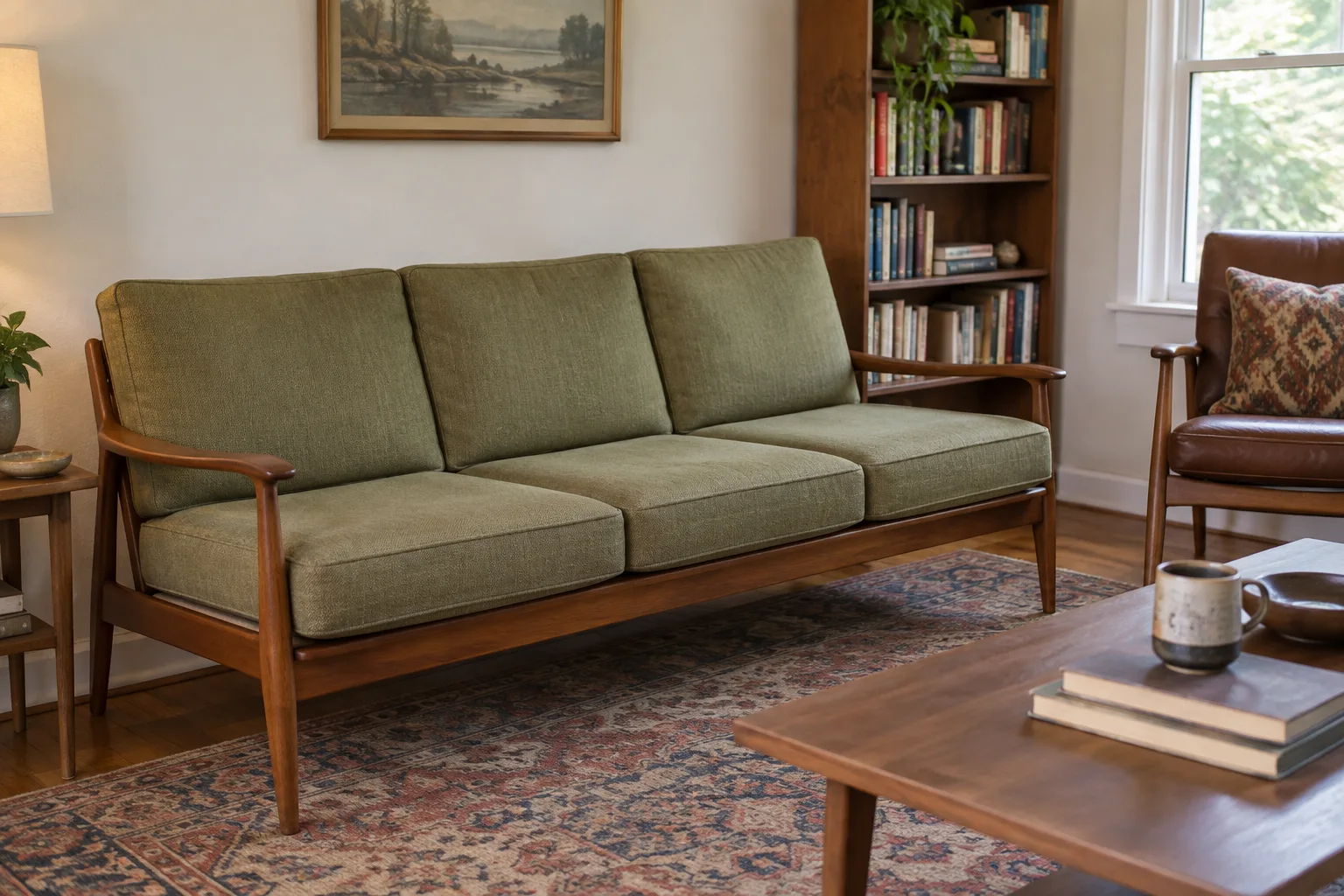
Keep the shape that made you choose the sofa
New cushions can make an old open-frame sofa enjoyable again. They can also change it surprisingly quickly: a deeper seat pad raises you above the arms, an overfilled back pushes you forward, and square new corners can erase a softly tailored outline. Begin with the complete sofa, not a shopping basket of rectangles.
Photograph it with the existing cushions in place. Note which aspects work: the low outline, the height of the arms beside you or the space between the back cushions. Describe the uncomfortable parts separately. “Keep this profile, but stop the seat bottoming out” is a more useful starting point than “make everything thicker”.
First establish that the frame and support are sound. Replacing foam will not repair a failed webbing platform, a broken spring or a loose joint. The sagging-sofa Guide helps separate those questions. If the support needs work, agree its finished position before using the old cushion measurements as an order.
Check for a model-specific service before starting from scratch. ercol’s ReCover service covers a limited range and directs owners towards model identification and a stockist enquiry. That is a useful route where your exact sofa is supported, not evidence that every old ercol takes the same replacement set.[4]
Measure covers with a front, a back and a name
Give every position a reference: seat S1 at the left when viewed from the front, S2 in the middle, and corresponding back cushions B1 and B2. Mark the front on your drawing, not on the fabric. Do not assume that matching-looking seats have identical covers; curved arms, tapered backs and earlier replacements can introduce differences.
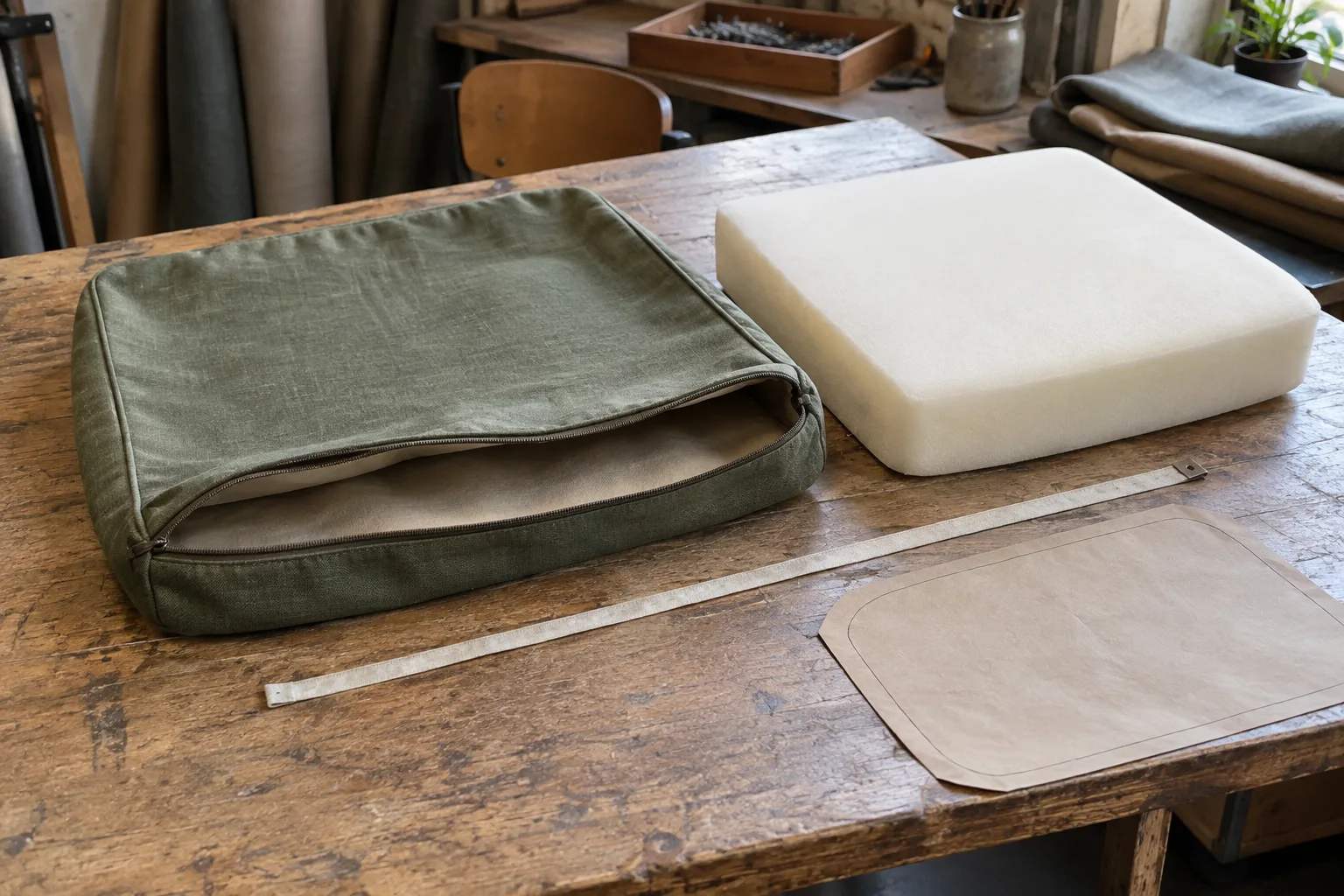
Ask the supplier whether they want the covers sent in, a template or measurements. GB Foam recommends using the cover rather than worn, deformed foam, and measuring seam to seam. Its guidance treats front and rear widths separately and measures thickness at the edge rather than over a domed centre. Confirm how that method applies to your cover construction.[1]
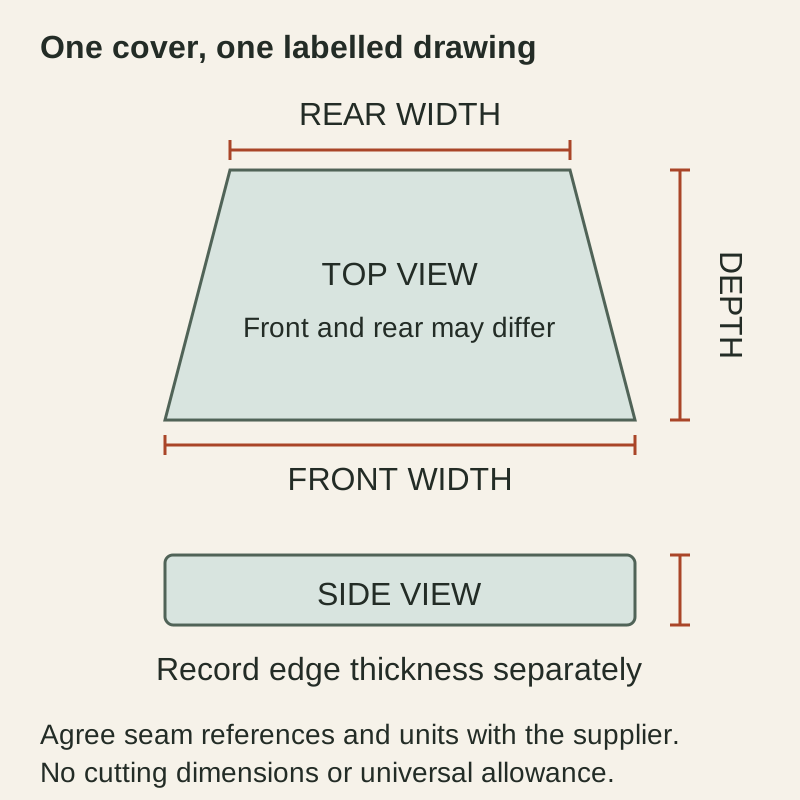
Record front width, rear width, depth and the agreed edge thickness, with units on every dimension. Show curves, cut-outs, zip location, piping and any wedge profile. Seat and back cushions may need different drawings. If the cover has shrunk, stretched or been altered, send that information with the measurements instead of asking new foam to correct the cloth.
Do not add a universal allowance yourself. The supplier needs to reconcile the foam shape, wrap, cover tension and finished size. A dimension for a bare core is not automatically the finished cushion dimension. Ask them to state which they are quoting and to approve the drawing before cutting.
Density does not tell you how firm the seat will feel
A foam’s density describes mass per volume; it does not by itself tell you how hard that foam is to compress. GB Foam’s published sheets provide a useful comparison: GB33M and GB33H share the same density band but have different hardness ranges measured under the same stated test method.[2][3]
| Published grade | Density | Nominal hardness |
|---|---|---|
| GB33M | 31.4–34.7 kg/m³ | 115–155 N |
| GB33H | 31.4–34.7 kg/m³ | 160–220 N |
These figures come from the supplier’s respective technical sheets, both referring to BS EN ISO 2439 Method B:2008. They illustrate the distinction, not a recommendation for your sofa. A hardness figure without its method is a poor basis for comparing suppliers, and a technical sheet is not a sitting trial.[2][3]
Describe the person and use to the upholsterer: upright daily sitting, occasional lounging, difficulty getting up or a preference for a softer back. Discuss the available depth and the support underneath. A small hand sample can help compare materials, but the finished seat thickness, covering and wrap also affect how a cushion feels.
Ask what surrounds the core and how it is held. Wrapping, stockinette, feather or fibre layers can change the outline and fitting process. Request a complete specification for the seat and a separate one for the back, including the intended use of the finished cover-and-filling combination. A fire-test statement about one foam is not a complete specification for the finished sofa.
Approve one finished cushion before the whole set
If the sofa is unusual or the desired feel is uncertain, ask about making one trial cushion. Fit it in the agreed position on the completed support. Look at the front edge, corners, zip and the relation to the arms, then sit in it normally. Check that the cover is neither pulled hard across the seams nor left loose enough to slide around.
Try it with the intended back cushion. A comfortable seat by itself can feel shallow once the back is installed. Note your feet, lower-back contact and the height of the arm beside you. If the result needs changing, record the new specification rather than leaving the adjustment as a verbal request.
Send a complete cushion brief
The attached photos and labelled drawings show the sofa, sound support, current covers and the profile I want to retain. Please confirm the measurement method, proposed seat and back fillings, wrapping and finished dimensions. Identify allowances you will make, cover alterations needed and the cost of approving one cushion before completing the set.
Keep the accepted drawing and material specification with the sofa. If a cushion is lost or needs replacement later, those records are a better starting point than measuring the most worn pad. They also make it easier to repeat a result you already know you enjoy.