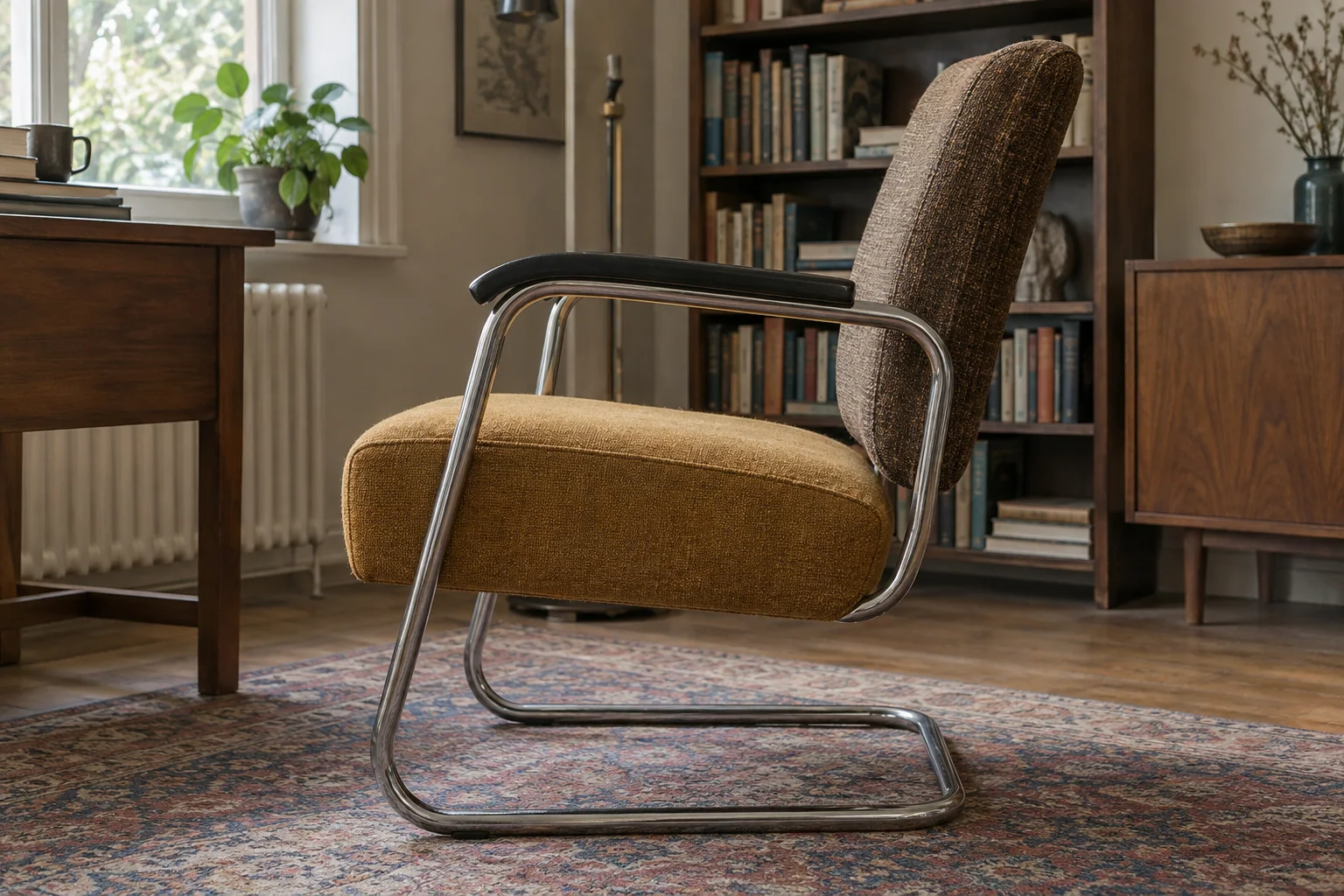
The backs stayed; the seats changed
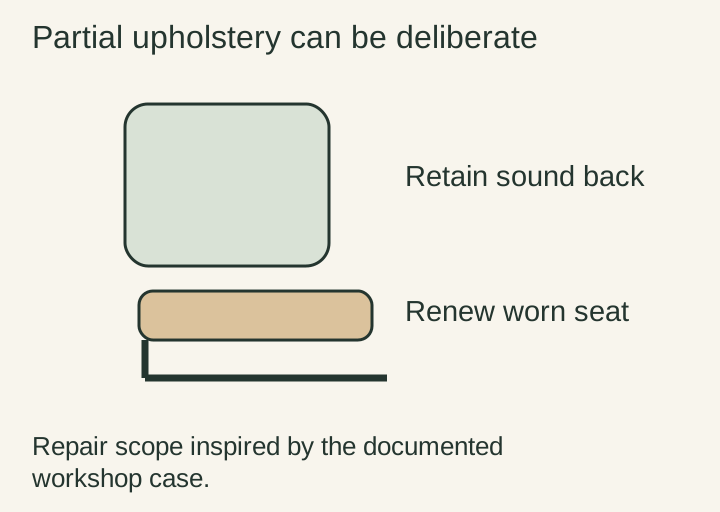
Refresh Your Vintage describes refurbishing a pair of Dutch Originals Gispen 412 chairs after about twenty years of use. The seats were worn, while the backs remained in good condition. The workshop retained those backs and covered the seats in Manchester corduroy with black imitation-leather piping.[1]
That case offers a useful alternative to making every surface look newly matched. It does not supply a universal price or prove that your chair’s back is sound. It does show what to ask an upholsterer: can the serviceable parts remain, and can the new work look intentional beside them?
Ask to see a fabric sample next to the retained back in daylight. Compare texture and contrast as well as colour. A slightly different black can look accidental; a distinct seat fabric can make the difference part of the design. Keep the choice compatible with the intended construction and use.
Seat and back have different jobs
Dutch Originals identifies the 412 as W.H. Gispen’s 1934 design. Its current description distinguishes a seat with steel coil springs and shaped foam from a back using Pantera foam, and lists Bakelite arms. Use that as a current reference when explaining the parts to a specialist; do not assume an older or altered chair retains precisely that filling or frame finish.[2]
| Work area | Option A: necessary work | Option B: full visual renewal |
|---|---|---|
| Seat | Assess support and renew worn material as required. | Same structural assessment; chosen new finish. |
| Back | Keep if sound, comfortable and compatible. | Renew with the seat for a coordinated appearance. |
| Arms and frame | Address defects independently of fabric choice. | The same; upholstery does not repair the frame. |
| Transport and fitting | Include the complete service. | Compare the same delivery scope. |
A seat that has lost support needs a different job from a sound seat with a split cover. Ask the upholsterer to state which condition they found and which parts their quotation includes. A new cover alone may leave the original discomfort in place.
Look beyond the upholstery
The open tubular frame is part of the chair’s appeal and part of the purchase decision. Request views of bends, joints, the underside and the points where upholstered parts attach. Ask about welding, replating, repainting and replaced components.
Unexpected movement, a damaged tube or an uncertain repair calls for a specialist assessment before a sitting test. Normal cantilever movement is not a useful excuse for every movement a seller describes. Likewise, a shiny finish is a condition observation, not evidence of structural soundness.
Check that the arm surfaces are secure and comfortable to touch, with chips or repairs disclosed. Do not assume a similar black replacement is the right part. Have the service provider confirm the proposed component and fitting method for that production.
Choose the amount of change you want to live with
Try a sound example for reading and conversation, including getting in and out. Notice the usable width between the arms and the position of your elbows. A restored chair can be beautifully finished and still be the wrong seat for your body or room.
Compare the purchase price plus necessary repair with an already usable example. Keep optional colour changes on a separate line. If retaining the back produces a comfortable, coherent chair, there is no practical reason to make full reupholstery the default.
A useful quotation request
Please assess the seat support, cover and back separately. Quote the necessary work while retaining any sound upholstery, and a second option for complete renewal. List frame or arm work independently and explain what cannot be assessed from photographs.