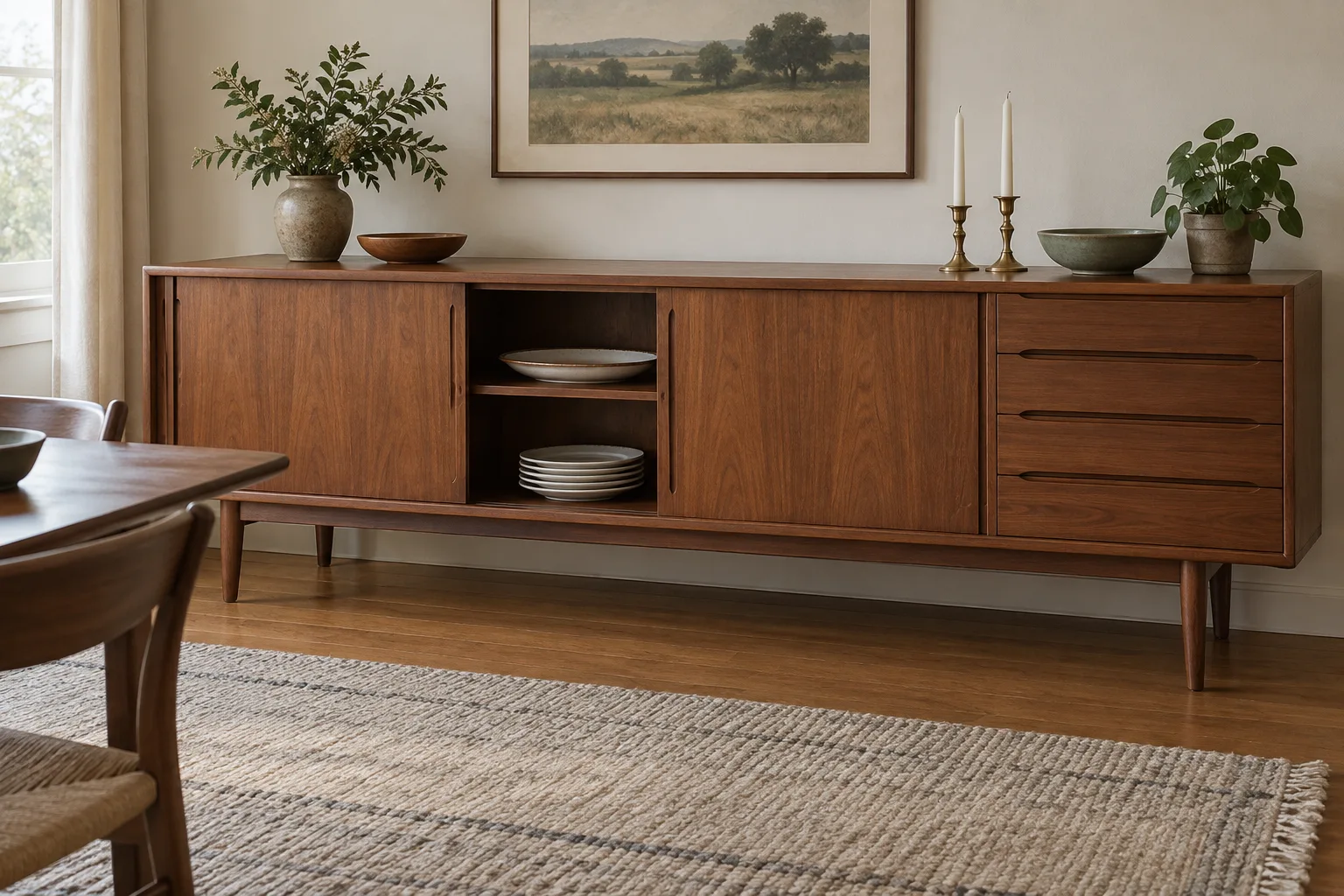
Start with two real examples, not a maker ranking
A long raised sideboard can make a dining room feel lighter; a lower plinth and a broad uninterrupted front can feel calmer. Both are good reasons to like a piece. The next question is what happens when you put your plates, linens and serving dishes inside. The most photogenic cabinet is not automatically the most convenient one.
For a concrete comparison, Møbelfabrik’s sold Model 18 listing describes two sliding doors, four drawers and an inner tray in the top drawer. Its recorded dimensions are 200 cm wide, 47.5 cm deep and 82.5 cm high. These are the dealer’s measurements and description of that example, not a universal specification for every Model 18.[1]
The same dealer’s sold Dyrlund example is recorded at 170 cm wide, 52.5 cm deep and 79.5 cm high. Its description lists two tambour doors, three internal drawers and two adjustable shelves. “Tambour” means the door is made from connected narrow slats that travel around a curve. This listing gives us a useful comparison with a broad flat sliding panel, without claiming that all Dyrlund cabinets share that layout.[2]
| Recorded example | Outside W × D × H | Interior described by the dealer |
|---|---|---|
| Omann Jun Model 18 | 200 × 47.5 × 82.5 cm | Two sliding doors; four side drawers; shelf and inner drawer tray. |
| Dyrlund tambour sideboard | 170 × 52.5 × 79.5 cm | Two tambour doors; three internal drawers; two adjustable shelves. |
The listings are examples to inspect, not available offers or independent authentication. Follow their photographs to understand the arrangements, then get fresh measurements and evidence for whichever cabinet you are considering. Small differences in height or depth can reflect different pieces or measuring methods; they need explanation rather than an immediate verdict.
Bring the awkward platter into the comparison
Choose the hardest thing you need to store: a large oval platter, a tall jug, a stack of table linen or a record box. Write down its dimensions, including projecting handles. A generous outside width does not tell you whether it can pass through the opening or sit between the shelf supports.
With flat sliding doors, one panel normally overlaps another. Ask how much of the interior is exposed at a time, where the panel stops and whether a drawer or tray behind it can extend fully. Do not assume that the full cupboard width becomes one accessible opening. An interior photograph with a door lifted out also does not show ordinary access.
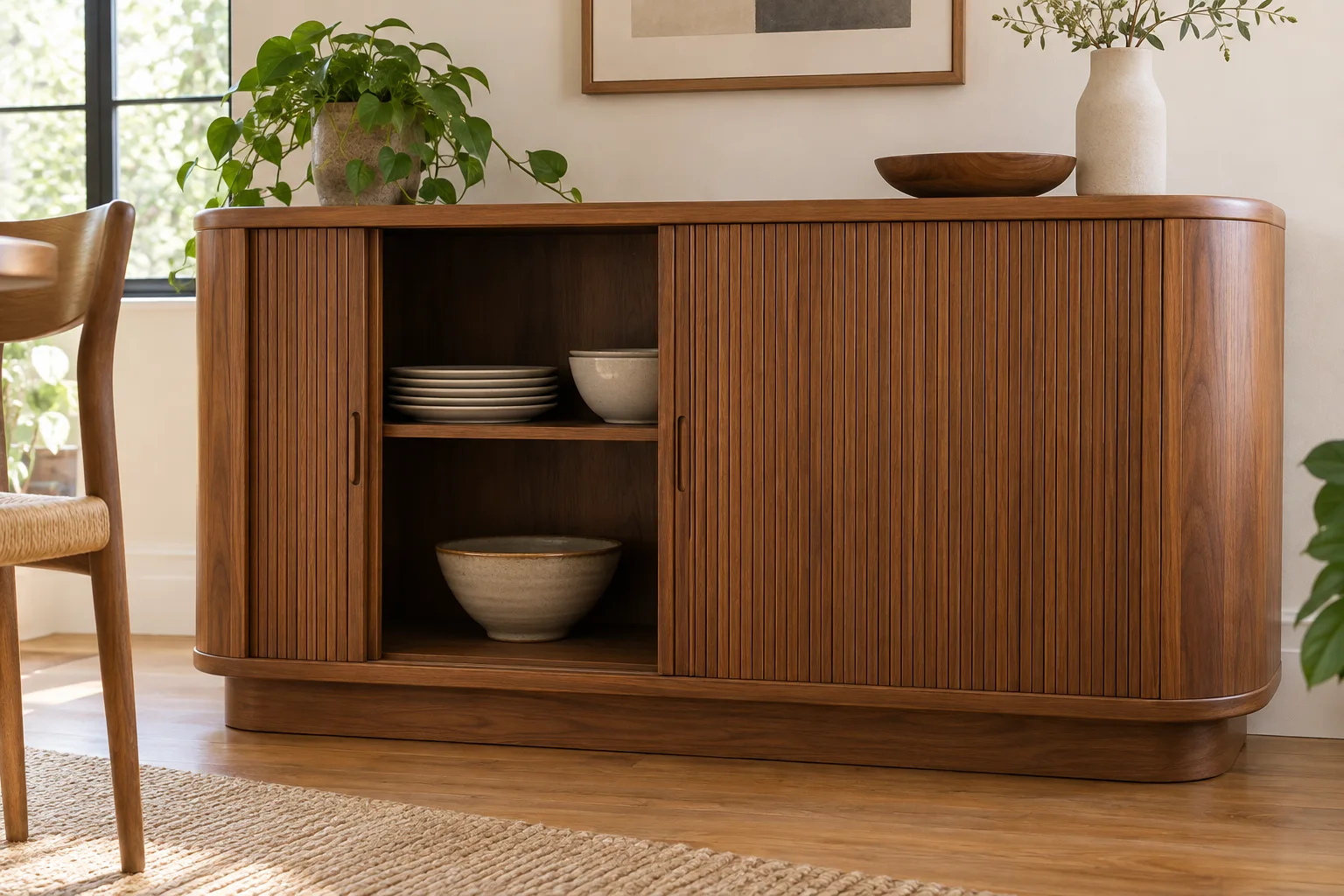
A tambour door can keep the front clear of swinging leaves, but its track and curved return still occupy part of the cabinet. Dyrlund’s own dining-room documentation describes veneered tambour doors and separately identifies a solid-wood front frame. A flowing wood pattern across the front should therefore not be read as proof that every part is solid timber.[3]
Ask the seller to measure the narrowest clear opening with the door normally open, the useful shelf depth and the height above the shelf. Then compare your platter or jug. If the answer is close, an ordinary demonstration with an appropriately sized item is more informative than a photograph with the tape laid across the outside top.
Consider what you reach for every day. Four separate drawers may be pleasant for cutlery and linens, while internal drawers can leave the closed front visually quieter. Neither arrangement wins in the abstract. Choose the one whose most-used storage is easy to reach without moving something else first.
Watch the door, especially at the curve
Request one short video opening and closing each door through its normal travel. Listen and look for a repeated catching point, a panel that needs lifting, or a tambour that moves unevenly. Ask the seller to stop if it resists rather than force it to complete the demonstration. A beautiful closed-door photograph cannot settle this part of the purchase.
For a tambour, ask for clear views of the slats, handles and accessible track. Differences in colour or spacing, loose slats and earlier repairs are worth discussing. Establish what has already been repaired and what still needs attention; do not diagnose the hidden backing or promise an easy fix from a front view.
Flat sliding panels bring their own questions: damaged edges, loose pulls, worn tracks and whether the panels belong to that case. Ask about replacement doors and refinishing, especially when the grain no longer seems to follow the advertised arrangement. Colour alone cannot settle the issue.
Missing shelves and drawer fittings deserve a separate line in the budget. A replacement shelf may be straightforward once its dimensions, supports and intended use are understood; a matching sculpted handle or tambour section can be a different job. Get the actual repair scope before treating either as a small cosmetic expense.
A shorter cabinet can reach further into the room
The two recorded examples make a useful point: the Dyrlund is 30 cm shorter, but 5 cm deeper. If you have a hypothetical 220 cm stretch of usable wall, the 200 cm cabinet leaves 20 cm in total and the 170 cm cabinet leaves 50 cm. Centring them would divide those gaps equally. These are simple layout calculations, not recommended clearances.
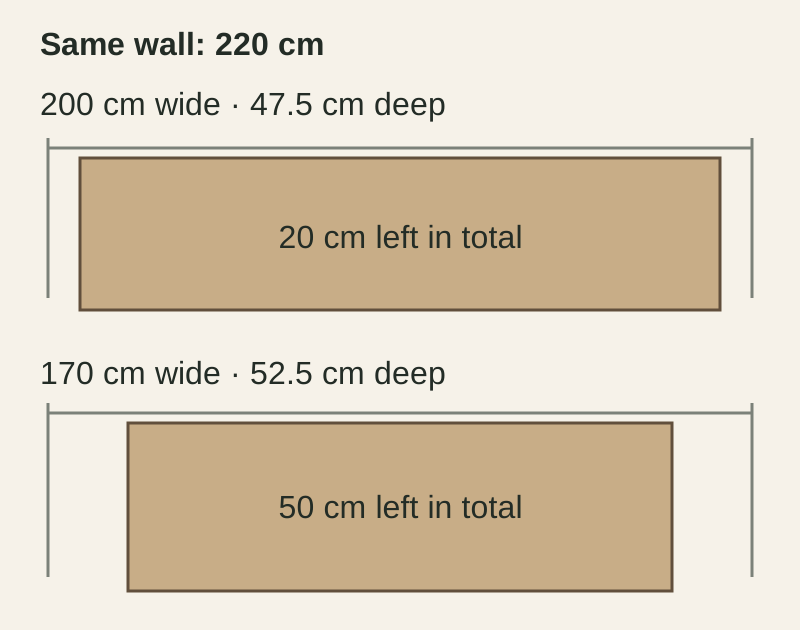
Mark both footprints with paper or removable tape on a suitable floor surface. Walk past, pull out the dining chair and open the doors or drawers in your plan. A deeper cabinet may narrow a route even while leaving more wall exposed at each end. Include the skirting board, plugs and any radiator that changes the actual available space.
There is another reason to measure rather than rely on a catalogue: Dyrlund documents customised cabinet dimensions and layouts. Its examples include a narrower sideboard retaining standard drawers. That shows why an unexpected measurement may warrant a question about production or alteration, rather than an instant claim that the cabinet cannot be Dyrlund.[4]
The top also has a job. Check its height beneath a window and the space needed for the lamp or serving tray you plan to use. If you will see the back from another part of the room, ask for that view before deciding it can stand away from the wall.
Choose the complete purchase
Compare purchase price, agreed door work, missing fittings and delivery on the same basis. A cheaper cabinet awaiting an unidentified tambour repair is not yet a cheaper working sideboard. Conversely, an older repair that works well and is honestly described need not disqualify a piece you want for everyday use.
Ask the seller
Please show both doors moving normally and the complete interior. What are the clear opening and shelf dimensions, which shelves and drawer fittings are included, and what has been repaired or replaced? I would also like the exact outside measurements and any maker or model evidence.
If the broad drawers make the Omann more useful, choose it for that reason. If the compact Dyrlund’s interior and door action suit the room better, that is equally persuasive. The name gets you to the shortlist; the cabinet you can comfortably use is the one worth bringing home.