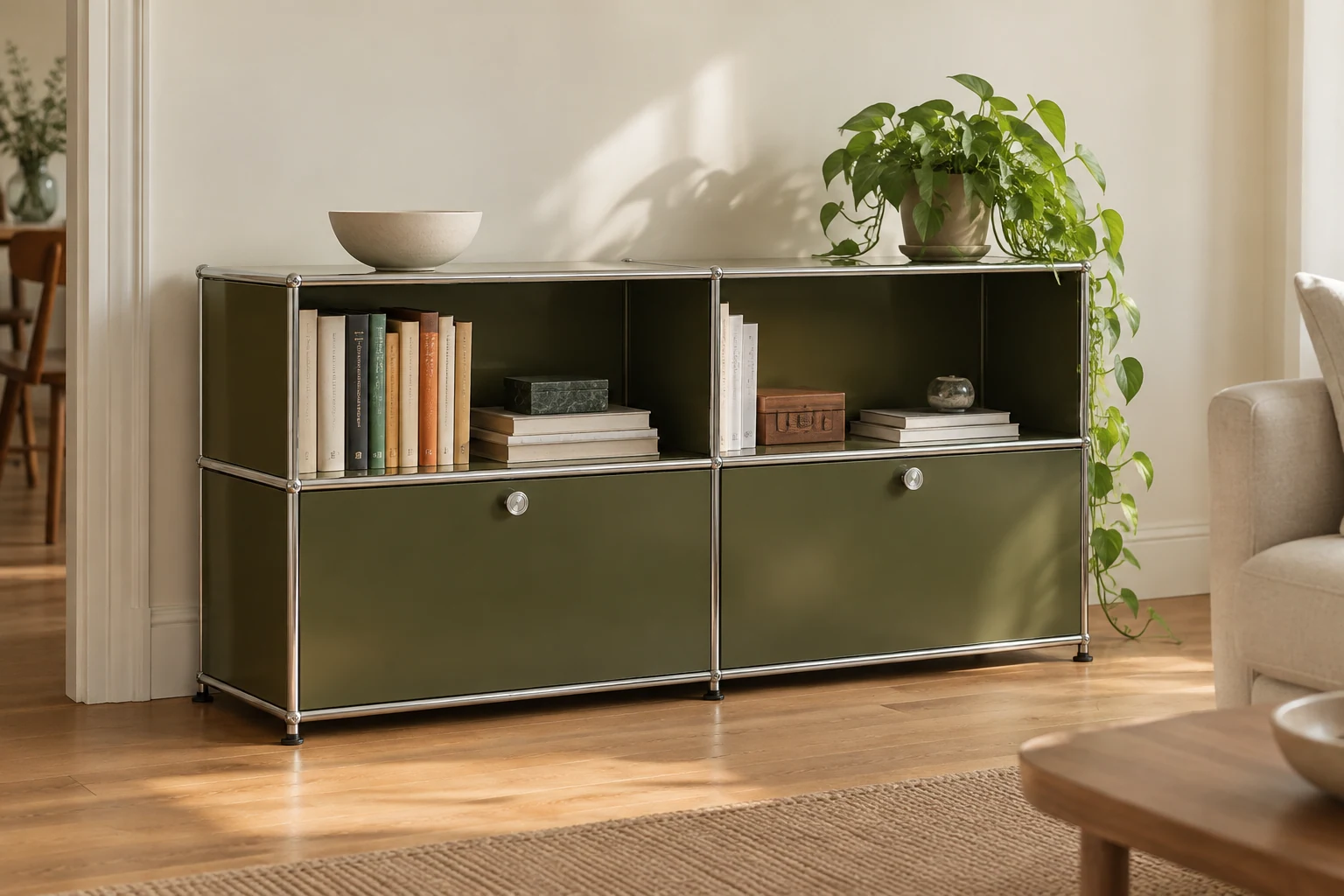
Start with the arrangement you want
An office unit full of filing drawers can look like the beginning of a handsome sideboard. It may be. But first decide whether you want those drawers, need shelves behind doors, or prefer open compartments for records and books. Each choice changes what has to stay, come out or be supplied.
Draw the proposed front on paper and give each compartment a job. Measure the room and your largest intended contents, including the handles and open doors of the cabinet. Ask for both overall dimensions and usable internal space: a nominal module size is not the same thing as a clear opening.
USM describes reconfiguration as a service supported by its ball-and-tube construction and refers owners to showrooms or approved sales partners. Give that partner the current assembly and your proposed drawing, not just the overall width.[1]
If your main question is whether a sideboard is the right sort of storage, start with the cabinet comparison Guide. Here, the question is whether this assembly can become your intended USM cabinet at an acceptable total cost.
Why two bays are not two separate cabinets
Imagine a two-bay unit that you want to divide between two rooms. In the joined arrangement, the bays share the centre frame. Two independent units each need their own complete ends. The parts in the shared frame cannot occupy both rooms at once.
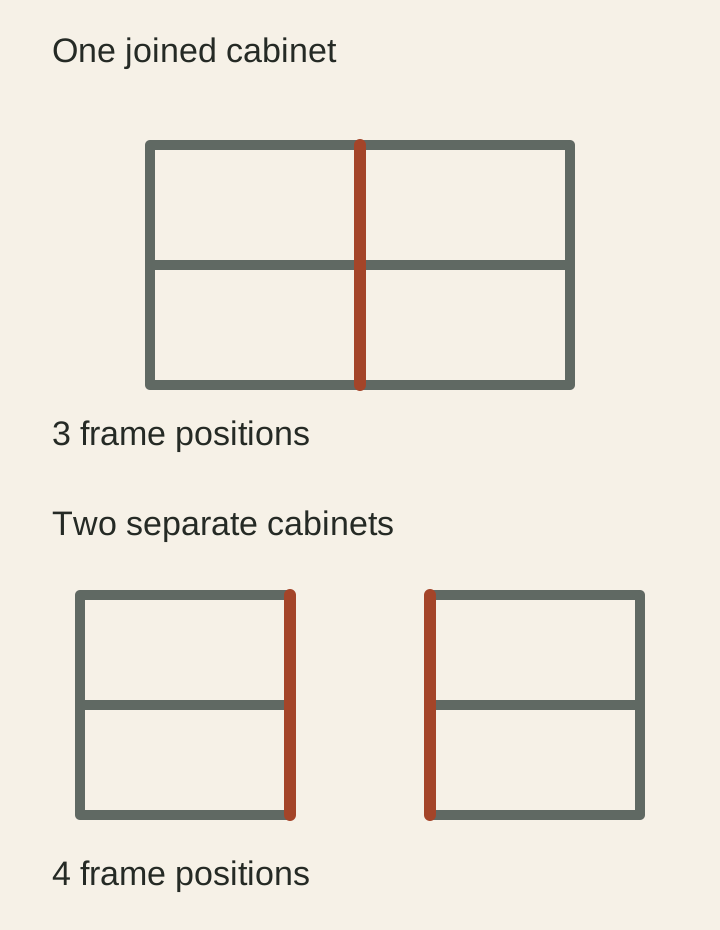
That additional end involves more than a visible upright in a front view. The specialist needs to account for the complete frame, connections, support and any side panels required by the finished design. Changing a closed compartment into a drawer also needs the appropriate assembly, not just a front panel.
Send the existing and proposed arrangements together. Ask which parts can be reused, which are surplus and which must be added. An itemised answer is more useful than a seller’s assurance that “you can make anything with USM”. Keep the surplus parts in the agreement if you expect to receive them.
Separate a working cabinet from a parts pile
Photograph the whole unit from the front, rear and sides, then record each compartment. Check which doors and drawers are included, whether they operate normally, and what comes with them: shelves, keys, internal fittings and feet or castors. Clarify every opening or cable cut-out visible in the offer.
| Offer | What must be settled |
|---|---|
| A complete cabinet you will keep as it is | Actual dimensions, condition, included fittings and a suitable moving plan. |
| A cabinet you will reconfigure | A specialist’s assessment of the current parts and an itemised plan for the finished arrangement. |
| Loose parts from several units | Identification, condition and compatibility of the inventory before assuming it makes a complete cabinet. |
Look separately at ordinary panel scratches, dents that affect a door, damaged connections and improvised alterations. A scuffed cabinet may suit your room very well. A polished one with an unresolved structural change asks a different question. Do not loosen connections or pull on the frame as a buyer’s test.
Request any purchase or service records and photographs of identifying details in place. A familiar chrome grid alone cannot establish that every component is genuine USM. Where the provenance affects the price or the proposed work, ask the service partner to review the exact offer.
Make the storage work in your room
Choose a compartment by what goes into it. Measure your record sleeves, files or equipment, then ask for the clear opening, shelf depth and any obstruction from the door or fittings. Include space to remove the contents without catching the front edge.
At a desk, an open door or extended drawer can block the chair. Behind a sofa, a low unit may need to look finished from the back. Under a window, check the sill, curtains and opening handle. These details can make a nearly suitable configuration less useful than a simpler one already arranged correctly.
If equipment will live inside, give the supplier its ventilation and cable requirements. If you are changing height, supports or the intended load, include that in the assessment. Modularity does not replace a suitable configuration and installation for the actual room.
The displayed price buys the displayed configuration
USM’s UK sample-sale page offers used showroom, exhibition and photography pieces in their displayed colours and configurations. It says reconfiguration can be organised after purchase. The practical point is easy to miss: a reduced price for the pictured unit does not include a different arrangement. The page’s online delivery offer is also London-specific, so check your own location.[2]
Compare the purchase price plus confirmed components, specialist labour and transport to the final destination. Ask whether the work proposal includes collecting the cabinet, dismantling it, packing it, rebuilding it and removing or returning surplus parts. Establish tax treatment and delivery scope before comparing two totals.
For illustration only, suppose cabinet A costs €650, transport €100 and an assessed conversion €350: the total is €1,100. Cabinet B already has the arrangement you want and costs €950 plus €100 transport: €1,050. These are assumed figures, not market prices or a USM quote. Their purpose is to show why the lower asking price can lose its advantage.
Until the conversion has been assessed, the last number in that sum is unknown. Leaving it blank is more honest than adding a small “just in case” allowance and treating the comparison as finished.
Give the specialist both drawings
USM’s circularity account describes combining older furniture with new components. This makes an older cabinet worth considering when your room changes, provided the actual parts and proposed arrangement have been assessed.[4]
Its 2023–24 sustainability report describes an office project with a reported mix of 55% reused or reconfigured USM Haller furniture and 45% new furniture. That is a documented project outcome, not a promised saving or reuse rate for every cabinet.[3]
For a home purchase, you need the same essential distinction: what you have, what you need and the work between them. An honest older cabinet with a clear plan can be a better choice than a beautiful bargain whose missing pieces are still somebody else’s guess.
Send the seller and service partner the same brief
I am considering this exact USM unit [listing and photographs]. Please confirm the overall and internal dimensions, included doors/drawers/shelves/keys/supports, known replacements and any damage or alterations. My intended arrangement is [drawing and contents]. Which parts and work would it need, what would the complete delivered total be, and who would dismantle and reassemble it?