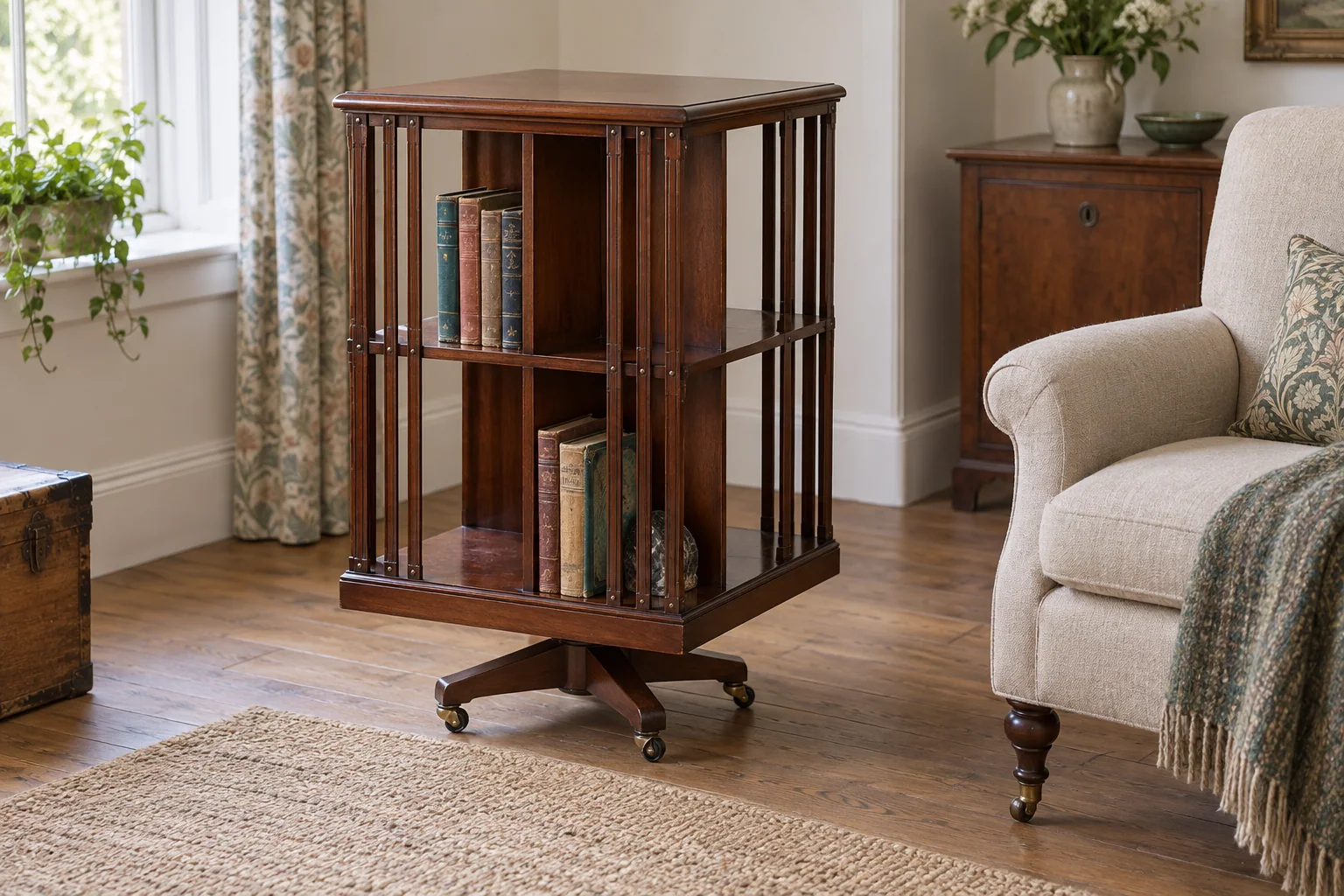
Compact storage with a useful catch
The Smithsonian Libraries and Archives discusses revolving library shelving through an 1894 Library Bureau catalogue, including Danner designs. The old appeal remains easy to understand: bring another face of books towards you without walking around a large case. The turning space is still part of the furniture’s footprint.[1]
London Fine records an offered revolving bookcase at 48 × 48 × 88 cm. Its listed shelf space is 28.5 cm wide, 14.5 cm deep and 28.5 cm high. Those are measurements of one dealer-described Edwardian example, not standard dimensions for the type.[2]
A small novel may work where a large art book does not. Compare your actual books with the useful depth and the route through the slats, including any overhang. The case’s total width cannot tell you the depth of a compartment arranged around its centre.
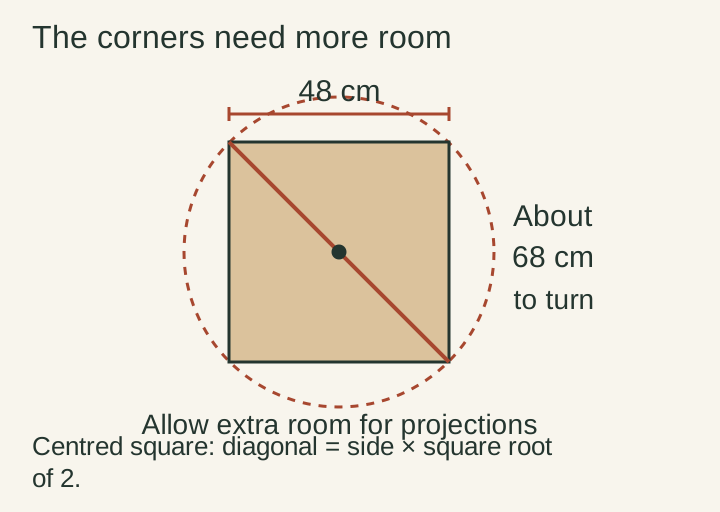
A 48 cm square needs roughly 68 cm to turn
For a square top rotating about its centre, calculate the diagonal: 48 × √2 is about 67.9 cm. So the recorded 48 cm example needs a basic turning circle of roughly 68 cm before allowing for projecting books, fittings or a comfortable margin. That is about 20 cm more than its straight-on width.
| Measurement | What it tells you |
|---|---|
| 48 cm square top | Space occupied when aligned with the wall. |
| About 68 cm diagonal | Basic circle swept by its corners when centred. |
| 14.5 cm recorded shelf depth | Whether the books fit without projecting. |
| Your added margin | Clearance for projections, hands and nearby furniture. |
Measure the actual widest rotating part and the position of the axis on your piece. The square formula is not enough for an off-centre axis, projecting fittings or a different shape. A circle drawn on paper or marked with removable floor guides is a useful way to try the position before collection.
The base should not travel when the books turn
Have the empty case demonstrated on a suitable level surface. Watch the base and central support while the upper case rotates normally. Record scraping, a repeated tight point, wobble or movement at the joints. Do not spin it rapidly or use the loaded case as a stress test.
Ask for underside photographs taken safely, and an account of repairs to the axis, bearings or supporting wood. A stiff turn may involve alignment or damage rather than a simple need for oil. Keep lubricants away until a repairer has identified the mechanism and appropriate treatment.
Inspect retaining slats, shelf supports and castor fixings separately. Missing slats affect how books are retained; loose castors affect how the base stands. A smooth rotation does not cancel either defect.
Make it part of a reading place
Try the case with the chair occupied and pulled slightly forward. Make sure you can reach books without trapping a hand between a rotating corner and an armrest. Keep trailing electrical cords off the rotating part, and leave enough clear surface that turning the case does not become a balancing act.
A famous designer’s name in an auction title needs separate documentary support. Ask what identifies the maker, age and model. The condition and space checks remain necessary even when the attribution is secure.
Before bidding
Please give the widest rotating dimensions, usable shelf openings and depth, and show one full gentle turn with the base visible. What supports the attribution, and what repairs have been made to the mechanism, slats or castors?
Choose the case for the books you want close at hand. With a sound turn and a little clear space, a compact old library can make an ordinary reading chair feel like a favourite place.