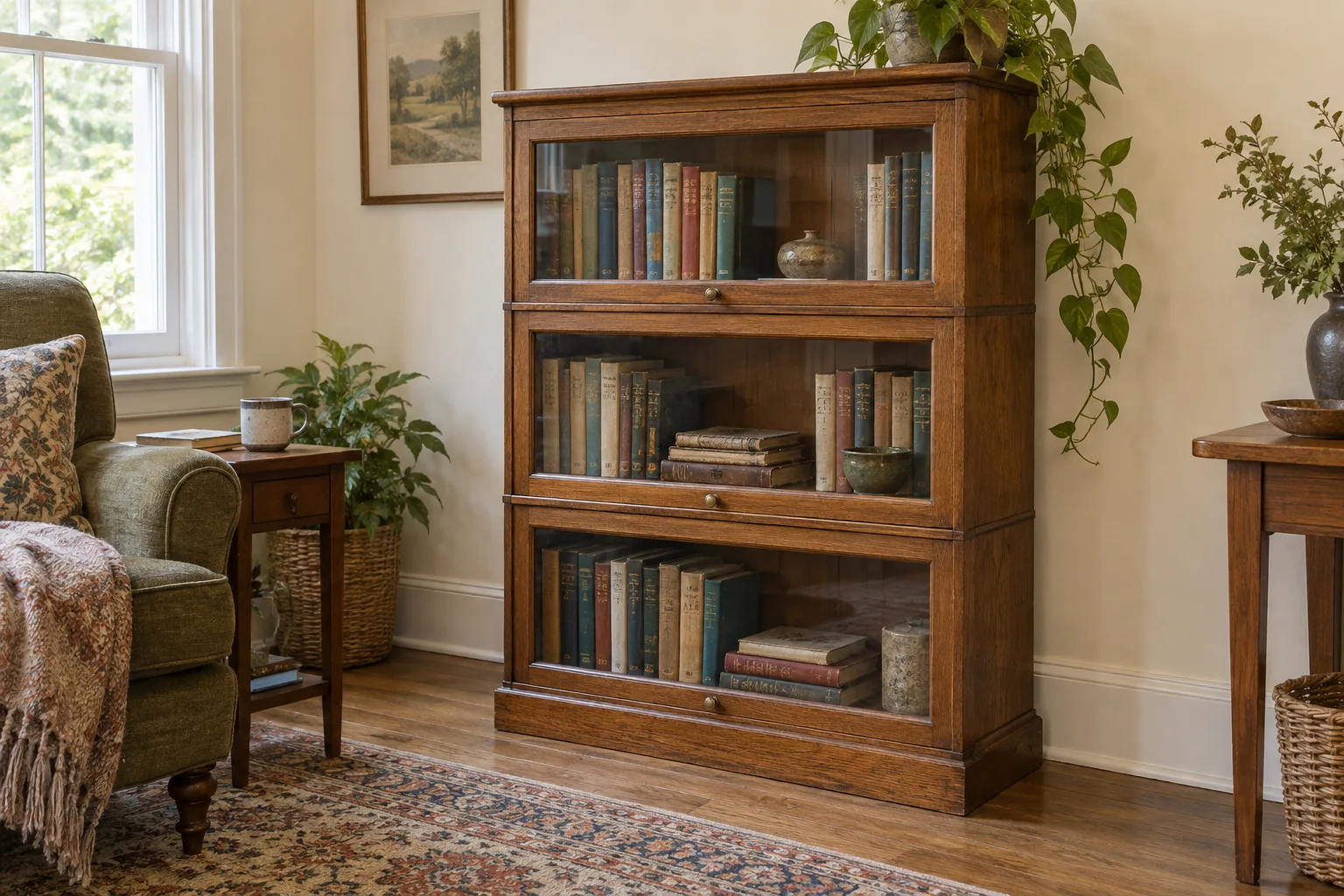
Lift-back or sliding glass?
Part of the pleasure is choosing a book, closing the glass and seeing a tidy row again. Try that action before buying. Does the door lift and move back above the books, slide sideways, or open on hinges? Each movement changes how you reach a volume and what hardware must be sound.
The Smithsonian’s Globe-Wernicke bookcase 2011.12.8a–f has framed doors which lift and slide back, with metal equalising mechanisms. It contains four shelf sections, a cap and a drawer base. Those are facts about one recorded assembly, not a specification for every barrister-style bookcase.[1]
For a different example, Design by Davies describes its Minty bookcase E326 as three stacking sections with sliding glass doors. The listing reports different section heights and depths. It demonstrates why the word “sectional” cannot settle door movement or internal capacity; the dealer’s dating remains its own attribution.[2]
Why D-8½ is not an outside height
On Smithsonian section 2011.12.8c, the label records size D-8½ and grade 598, while the museum measures the section’s outside height as 11 7/16 inches, about 29 cm. The label therefore cannot be read as “this whole box is 8½ inches high”. Nor is 598 a production year.[1]
Transcribe the label exactly and keep it beside measurements of the actual section. Ask a seller to show the label in context, not only a cropped number. Matching names and grades are useful research leads; they do not replace a comparison of width, depth and mating details.
Measure the usable height with the door in its relevant position and the depth with it closed. Take a book of the size you plan to store. A door can close over a row yet make the tallest book awkward to remove.
A cap is not another shelf
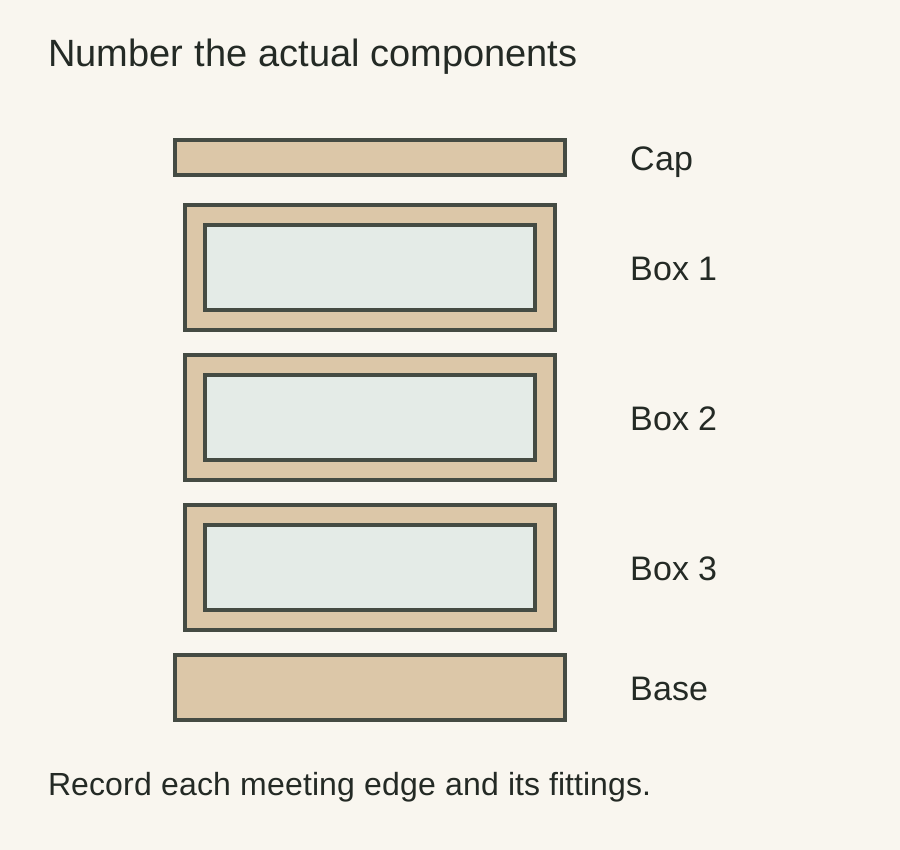
Number the components from bottom to top and make a little drawing. Record the base, each shelf box, the cap and every loose fitting. Ask for the proposed order to be demonstrated rather than assuming the sections can be shuffled without consequence.
| Part | Useful record |
|---|---|
| Base and cap | Dimensions, condition and the section they fit. |
| Each shelf section | Maker marks, outside dimensions, usable opening and door movement. |
| Each meeting edge | Matching profile, locating pieces, catches or other connecting details. |
| Loose hardware | Which component it belongs to, quantity and whether anything is missing. |
If you are buying an extra section remotely, send photographs and dimensions of both meeting faces to a knowledgeable seller or restorer. Equal outside width alone does not prove a fit. Include the finish and door-frame proportions if a visually coherent stack matters to you.
Make the seller’s demonstration gentle
Observe every door operating normally on the assembled, stable case. Does one side lag, does a pane catch, or does the seller have to lift the box to free it? Stop at resistance and ask what work is needed. Forcing old glass or a reluctant linkage is a poor way to finish a viewing.
Ask about chipped glass, repaired frames, replaced backs and missing shelf supports. A later pane can be acceptable when properly specified and disclosed. If replacement is needed, a glazier must establish the glass and fitting details; the outline of another section is not a complete order.
A sectional construction can make transport easier, provided each piece and its hardware stays identified. Agree who will separate the sections, how glass will be protected and how the original order will be recorded. Do not carry a loaded stack as one cabinet.
Plan the stack where it will stand
Check the floor, skirting and intended wall position before deciding how high to go. Stacking fittings and a suitable anti-tip arrangement have different jobs. Have the complete assembly and its wall attachment assessed where instructions or the original fixing arrangement are missing; adding another shelf box changes the result.
Ask before buying a loose section
I want to add this section to the pictured stack. Here are the labels, outside measurements, meeting profiles and connecting fittings on both pieces. Can you demonstrate that they fit in the intended order, identify any missing parts, and explain the effect on the cap, base and stability arrangement?
For a first purchase, a complete case with working doors is often easier to enjoy than an attractive collection of unmatched sections. Leave space for the books you actually read and for the next one you bring home.
For shelf capacity and book access, use choosing a bookcase for your collection.