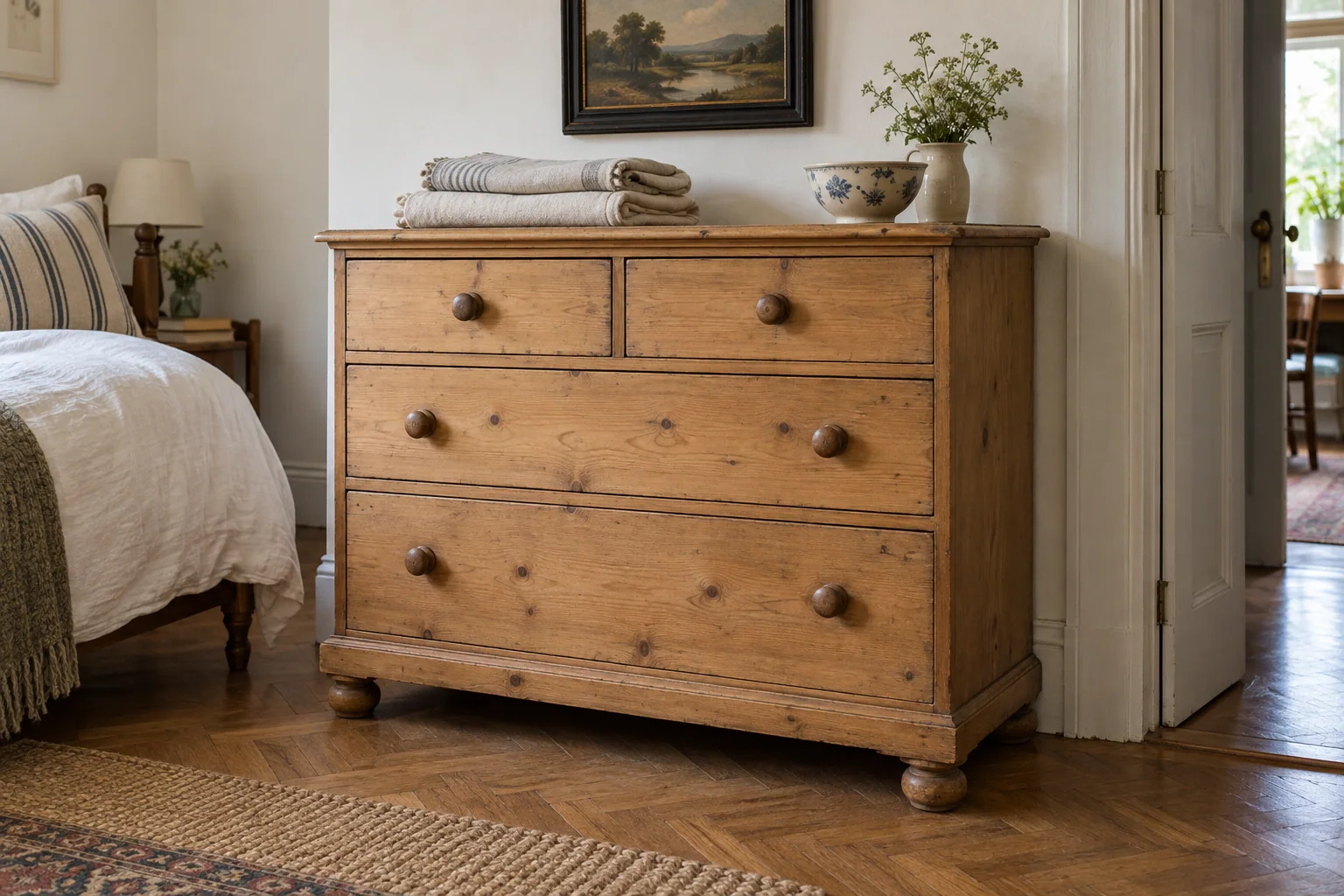
Stripped is a treatment history
Historic New England records a white-pine chest made around 1730–1750 with original red paint beneath a later red coat. It is one documented example of pine furniture designed with a painted surface. It does not date your bedroom chest, but it does challenge the idea that exposed pale wood must reveal how an old pine piece originally looked.[1]
Ask whether the chest was stripped, when and by whom. Remnants around mouldings, hardware or protected areas may be clues, but do not scrape them off to investigate. Removing a finish can also remove evidence. The Canadian Conservation Institute emphasises the historical information carried by furniture finishes and the irreversible nature of their loss.[2]
A stripped chest may still be exactly what you want for a relaxed bedroom. Describe it accurately and judge the present surface for daily use. “Original pine” is too vague to tell you whether the wood, finish, hardware or complete object is original.
Build an account of the whole chest
Request the back, underside, drawer sides and bottoms as well as the front. Look for a coherent relationship between the case, top, feet and drawers. A later replacement runner is a local repair; a case built around unrelated old drawer fronts is a much larger change. Neither should be concealed inside a confident date.
| Clue | Useful next question |
|---|---|
| Dovetailed drawer corners | Do the drawer construction, case and claimed period agree with documented comparisons? |
| Old-looking backboards or hardware | Are they original to this chest, reused or later replacements? |
| A very even stripped colour | What surface treatment produced it, and what finish now protects it? |
| Different wear on feet and case | Were the feet repaired, shortened or replaced? |
| Wormholes or rustic distressing | What evidence supports the age, and has any activity or treatment been assessed? |
Do not turn one nail, a knot or a row of holes into a precise year. If the asking price depends heavily on a period attribution, ask a knowledgeable dealer or specialist to explain the evidence and the unresolved changes. A broad, supported description is better than a narrowly confident guess.
Try the drawer where your jumpers will go
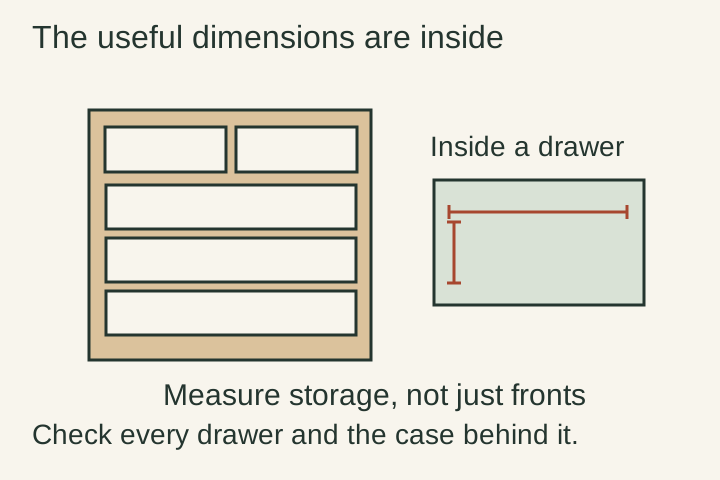
Measure usable internal width, depth and height, including any intrusion from the drawer construction. Open each drawer normally and notice whether it runs evenly or drops at the front. Ask about worn runners, repaired bottoms and altered stops. Do not pull an unfamiliar drawer fully free without the owner showing how it is supported.
For a practical comparison, bring the measurements of a folded stack of clothes. A tall-looking bottom drawer may lose useful depth to a raised bottom or internal repair. Conversely, shallow upper drawers can be excellent for small items even when they add little to the overall capacity.
Look and smell inside the case. A strong musty odour, staining or damaged wood needs its own assessment; a fresh exterior finish does not resolve what you will store clothes beside. Check that the chest stands securely and plan appropriate placement and restraint where needed.
Compare history premiums with repair costs
Consider two hypothetical offers. One is honestly described as an older stripped chest with repaired runners and a recent, documented finish. The other is labelled “Victorian original” but has no underside views and several sticking drawers. The second description is not evidence of a better purchase. Ask for the missing information before paying the historical premium.
Set a total for the purchase, delivery and any necessary drawer or case work. Keep optional refinishing separate. If you like the present colour, confirm the finish and care requirements rather than applying oil or wax as a ritual just because the material is pine.
Message to adapt
What supports the age of this chest, and has it been stripped or rebuilt? Please send the back, underside and drawer construction, with internal drawer dimensions. Which feet, runners, bottoms or handles have been replaced, and do all drawers operate normally?
Choose the chest whose storage and history you understand. Plain pine has enough warmth of its own; it does not need an invented aristocratic past to earn a place in the bedroom.