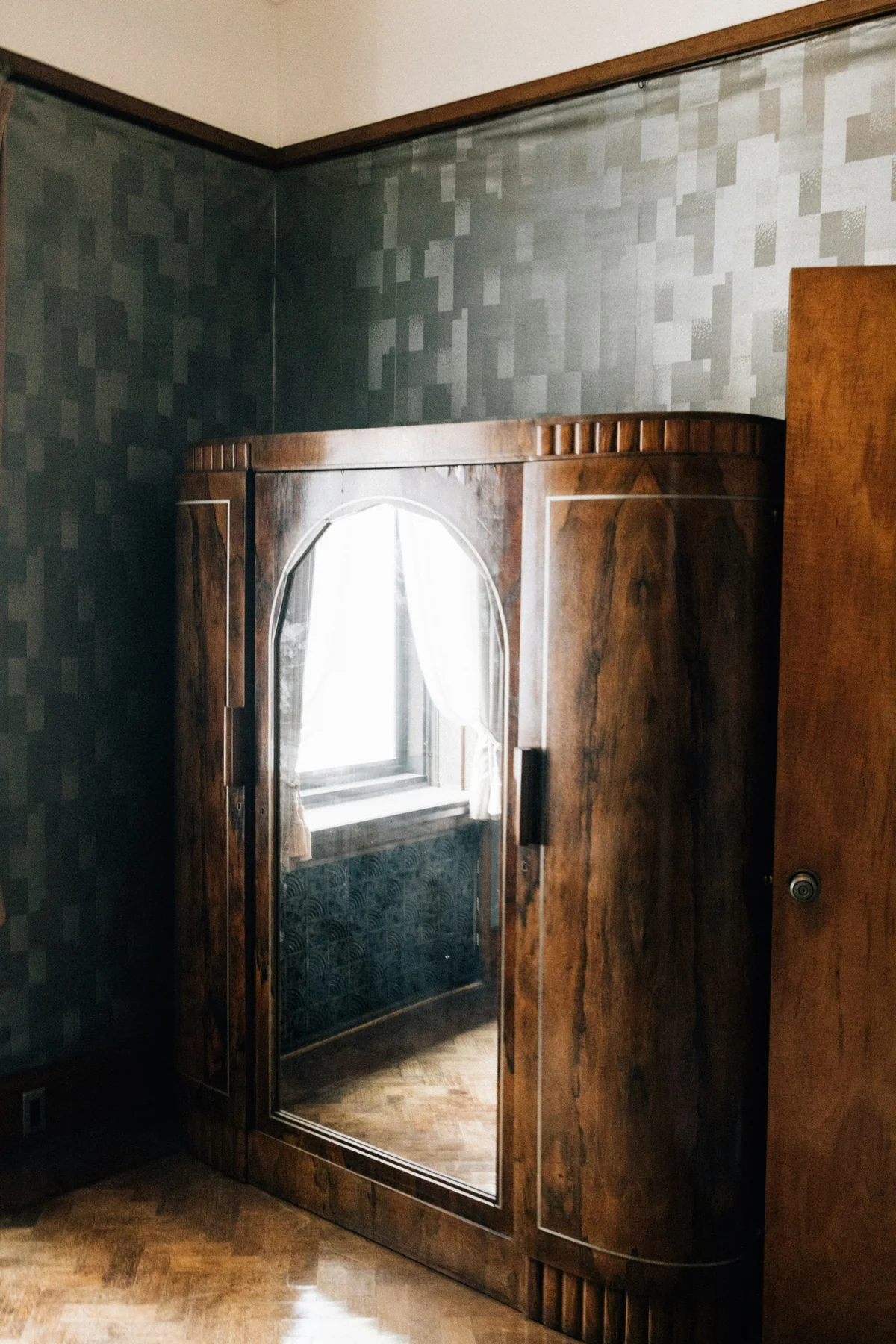
Start with three things from your wardrobe
Take a bulky jacket, your longest garment and a small run of everyday shirts. Use the hangers you intend to keep. These give you three different measurements: space across the dressed hanger, vertical drop and occupied rail length. If you share the furniture, include the other person’s largest items rather than measuring only your own.
Measure each garment hanging naturally. A coat’s shoulders and sleeves may extend beyond the empty hanger. For drop, record the distance from the point where the hanger rests on the rail to the lowest part of the garment. Keep that starting point consistent when comparing it with the wardrobe’s interior.
Write the measurements beside the actual items. “Winter coat: 50 cm across, 112 cm hanging drop” is a useful request. “Standard adult clothes” is not. You can now compare different listings without relying on a seller to guess what standard means in your home.
Check depth with the doors closed
Ask for clear internal depth at the hanging position, including the back of the shut door, hinges, catches and any moulding that intrudes. A thick back, raised door panel or protruding lock can reduce the space where a shoulder will sit. Measure the tightest relevant point rather than the most generous part of the case.
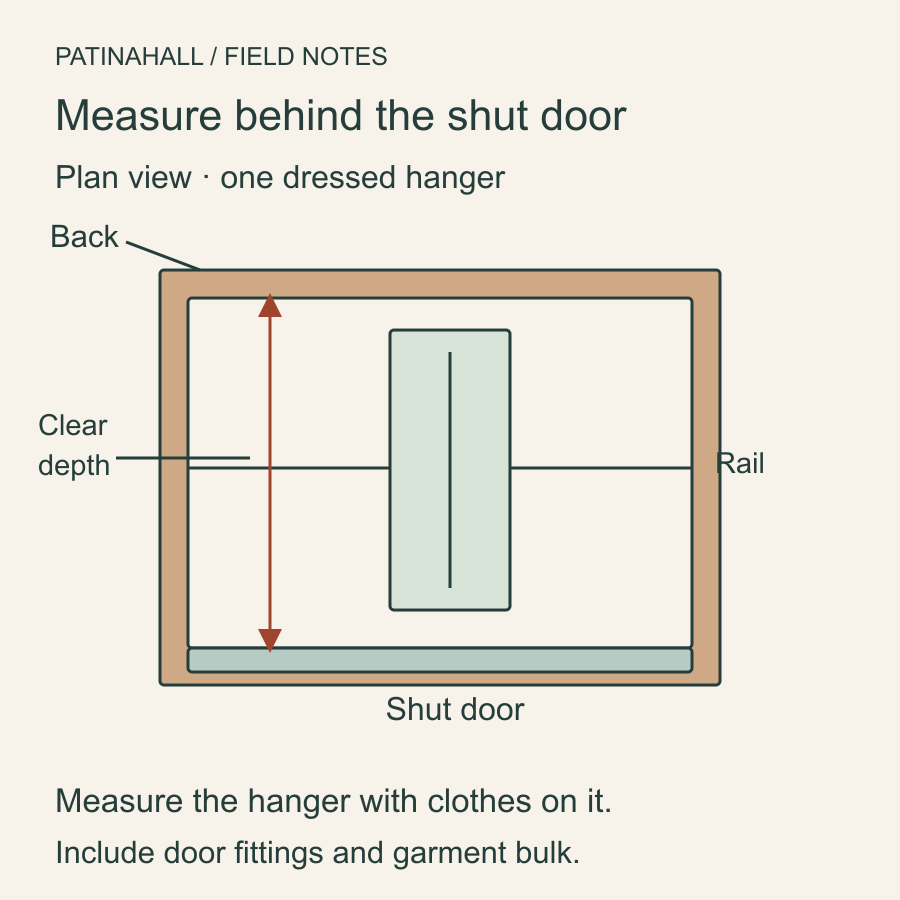
In a worked example, a coat on its hanger occupies 50 cm across its shoulders. The proposed wardrobe provides 47 cm between the inner back and the closed door. It does not fit squarely in that space, even if the advertised outside depth is 55 cm. Angling every hanger or pressing the door against the coat changes how you must use the wardrobe; do not treat that as an ordinary fit.
Rail position matters as well as total depth. A rail set too close to the back can push one shoulder into it while leaving unused space near the door. Ask for the rail centre’s distance from both obstructions. Where possible and agreed with the seller, try your own dressed hanger in the empty wardrobe and close the door gently without compressing it.
| Measurement | What it establishes |
|---|---|
| Outside depth, including projections | Room footprint and delivery dimensions |
| Clear depth behind the shut door | Space available for the dressed hanger |
| Rail centre to back and door | Whether that space is usable on both sides of the hanger |
If the seller can only photograph a tape measure, ask to see both endpoints and the exact place being measured. A wide-angle photograph of the open wardrobe cannot establish closed-door clearance. Keep any missing measurement explicit in your decision.
See which way the clothes will face
A shallow wardrobe can use a front-to-back rail so the hangers sit across the width and the clothes face the opening. IKEA’s HJÄLPA rail for a shallow PLATSA frame is a current example of that arrangement. It illustrates the geometry; it is not evidence that the fitting can be installed in an unrelated vintage case.[1]
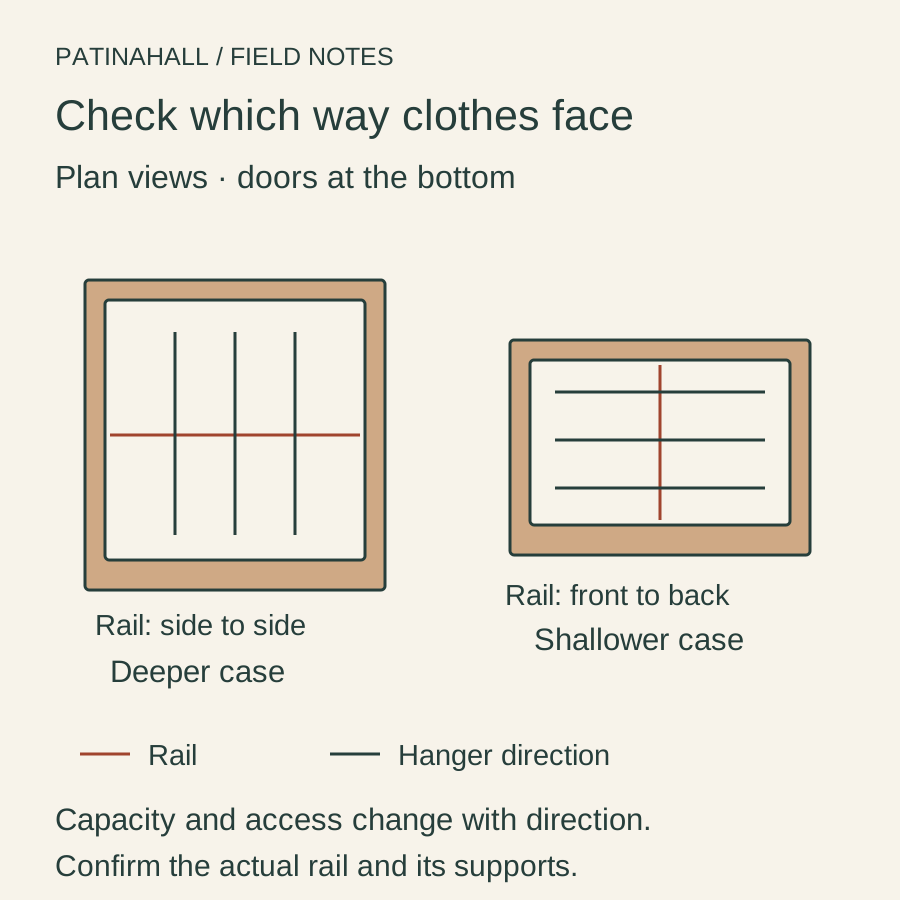
With a side-to-side rail, you browse garments along the width. With a front-to-back rail, the front garment can obscure those behind it; access depends on the opening and whether the rail is designed to pull out. Try the movement you will use every morning. A wardrobe that works well for a few guest coats may be awkward for a large daily rotation.
Ask whether the rail is original, replaced or newly added, and request views of both supports. A tidy new rail can be a practical improvement, but its appearance does not establish what it can carry. Have loose supports, movement or uncertain attachments assessed before loading. The capacity of a modern example cannot be transferred to the old furniture.
Give long clothes their own space
Measure from the rail’s hanging contact point to the nearest shelf, drawer top or base below. Compare this with the actual garment drop, leaving the room you need to keep hems clear and handle the clothes. Also check the space above the rail: the hanger must lift on and off without hitting a shelf.
For example, a dress with a 136 cm hanging drop cannot hang clear in a 130 cm bay. A taller exterior does not help if an internal drawer occupies the lower section. Look for another arrangement before deciding to remove a shelf or drawer; those parts may belong to the construction or to the character you liked in the first place.
Measure your everyday shirts as a natural run on a rail, with space to find and return one. Do not squeeze them into a compressed bundle for the estimate. Coats, suits and slim shirts occupy different lengths, so a seller’s “holds twenty garments” is less useful than the clear rail length and your own test.

A combination of one hanging bay and shelves can work beautifully if your clothes suit it. Folded knitwear, bags and long coats need not share the same geometry. Draw a simple allocation before buying, including things that will remain elsewhere. You are choosing a working storage arrangement, not proving that every possession fits in one old cupboard.
Make room for the doors and the arrival
Mark the wardrobe’s complete footprint in the bedroom, then the door swings and the space where you will stand. Include a projecting cornice, plinth and handles. Try the bedside route with the wardrobe doors open; a case that fits between two walls can still obstruct the place where you dress.
Ask exactly which sections can be separated for delivery and how that is known. Some old wardrobes were built to come apart; others were not. Request dimensions of the agreed transport pieces, including a mirrored door if a professional intends to remove it. Do not assume that a seller’s “dismantles” means flat panels or an easy staircase turn.
The Canadian Conservation Institute advises checking furniture for damage and loose joints before moving it. Have the seller and carrier agree handling of this particular wardrobe, including any removable elements. A previous repair or loose cornice can change where the piece can be supported.[3]
CPSC’s Anchor It! guidance calls for securing furniture following the manufacturer’s instructions. Include a suitable fixing plan for the wardrobe and the actual wall before use. If original instructions are missing, have an appropriate installer assess the case, attachment points and wall. Anchoring does not establish the strength of the hanging rail.[2]
For sticking doors, drawers, locks or signs of alteration, continue with our moving-parts inspection Guide. Persistent damp or odour deserves its own assessment before clothing goes inside.
Send a brief the seller can measure against
Message to copy
My largest dressed hanger needs [width], my longest garment drops [length] from the rail contact point, and my clothes occupy [rail length]. Please confirm the clear closed-door depth, rail position and direction, hanging clearance and usable rail length. Could you show the supports, base, back and known repairs, and explain which parts genuinely separate for delivery, with their dimensions? Please include any original assembly or fixing instructions.
Choose the wardrobe when clothes fit naturally, you can retrieve them easily and the furniture can reach and stand securely in its place. A narrower selection of clothes in a well-used vintage wardrobe can be more satisfying than a larger interior that makes every morning a struggle.