There are dismantlable examples, and important exceptions
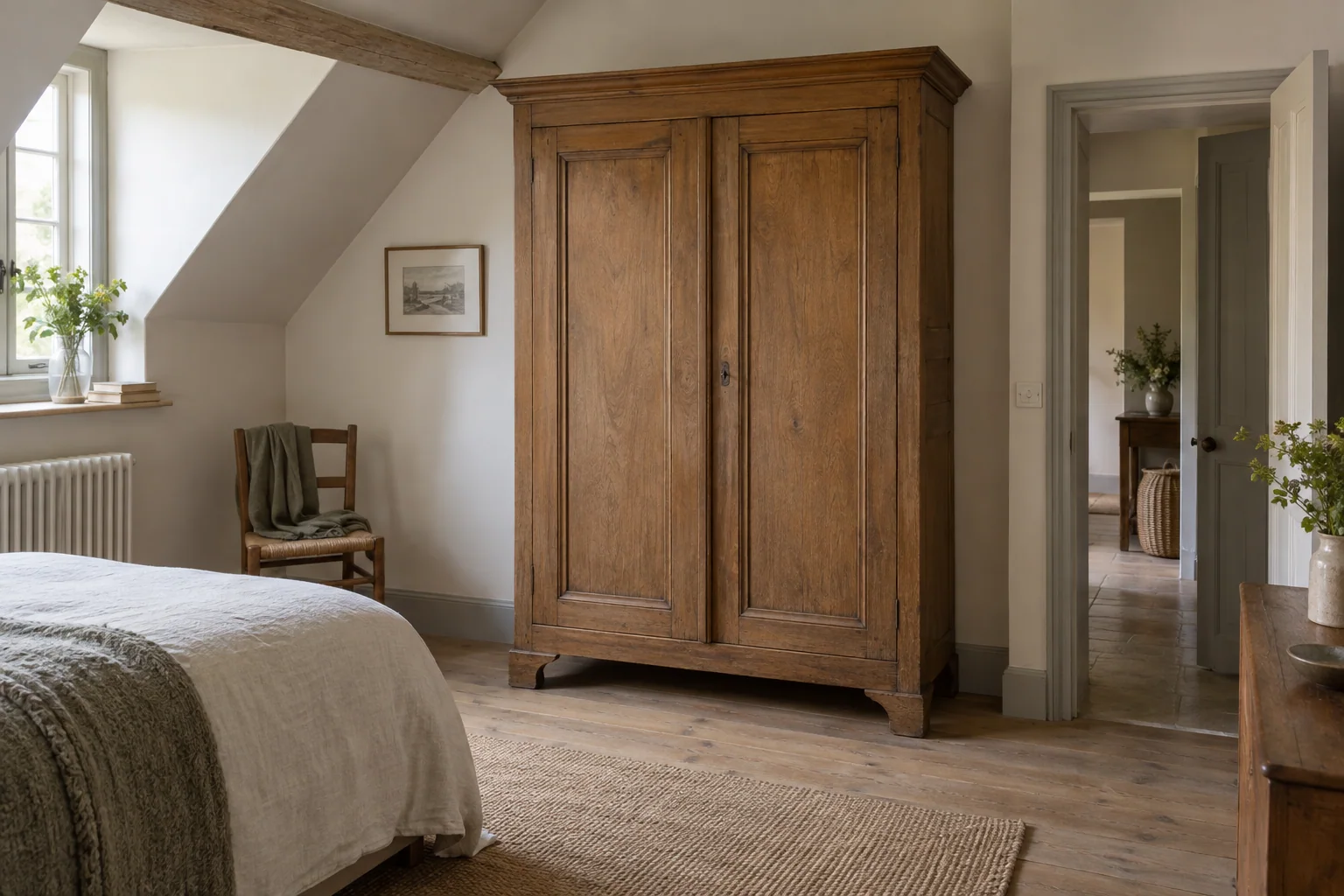
Great British Revivals describes a specific chestnut armoire supplied in loose panels, with removable dowels and interlocking joints. Its listing also records historical repairs. That is useful evidence of one dismantlable object, rather than permission to pull apart any apparently similar wardrobe.[1]
Ask the seller what is intended to separate: cornice, doors, sides, back, base, shelves or whole sections. Then ask when it was last taken apart and whether later glue, screws or repairs have changed the original arrangement. An old joint that was once removable may no longer be ready to separate without work.
Do not use visible pegs as an invitation to hammer them out. Have the person familiar with this wardrobe explain the process and take responsibility for it. The aim is a transport and assembly plan, not learning joinery on the day the van arrives.
Measure the route for the panels you will actually carry
Obtain length, width and depth for the largest rigid panel and every bulky section. A cornice may project farther than the case; a base with attached feet may be awkward in a different way. Numbered photographs help a mover understand which measurement belongs to which part.
| Set | What it answers |
|---|---|
| Complete wardrobe | Will it fit in its final position, with doors able to open? |
| Largest rigid parts | Can the mover negotiate doors, turns, stairs and landings? |
| Assembly space | Can the parts be handled and joined in the destination room? |
A doorway measurement alone will not settle a right-angle turn at the top of a staircase. Send the mover photographs and measured clearances for the full route. Include radiators, handrails and sloping ceilings that cannot simply be ignored on collection day.
A low ceiling can defeat a wardrobe that fits upright
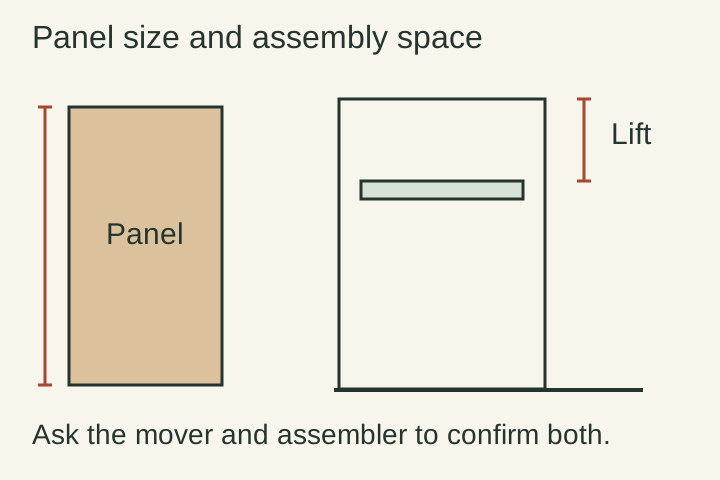
Ask how this particular armoire is assembled: standing in place, lying down, or in a sequence involving a raised cornice. Do not assume that an object slightly shorter than the ceiling can be built underneath it. Room for lifting a component or turning a section may be the limiting dimension.
This is especially worth resolving before paying for a panelled wardrobe intended for a loft bedroom. Have the assembler approve the working space as well as the finished position. If their method requires the wardrobe to be tilted upright, let them calculate the necessary clearance from the actual dimensions.
The Canadian Conservation Institute advises checking furniture for weakness before moving and supporting it at sound structural points. For a dismantled armoire, that makes the condition and handling of individual parts part of the transport brief.[2]
Make a parts list before anything leaves the seller
Record doors, side and back panels, base, top, cornice, shelves, rails and all intended connecting parts. Use the inventory appropriate to this wardrobe; it is not a universal armoire kit. Have loose hardware bagged and labelled by the person dismantling it, with the photographs retained by both sides.
Ask whether the delivery price includes dismantling, packing, carrying upstairs, reassembly and checking doors and shelves afterwards. A service that ends at the entrance with loose panels is materially different from an installed wardrobe. Resolve missing parts and existing joint repairs before booking either.
A clear purchase condition
Please confirm the dismantling arrangement, largest component dimensions, complete parts inventory and the space needed to rebuild it. I need the agreed delivery service to leave the wardrobe assembled and assessed for use in this room.
When those answers line up, a large armoire can be surprisingly adaptable. The reassuring feature is the understood construction and complete service, not the seller’s promise that it “comes to bits”.