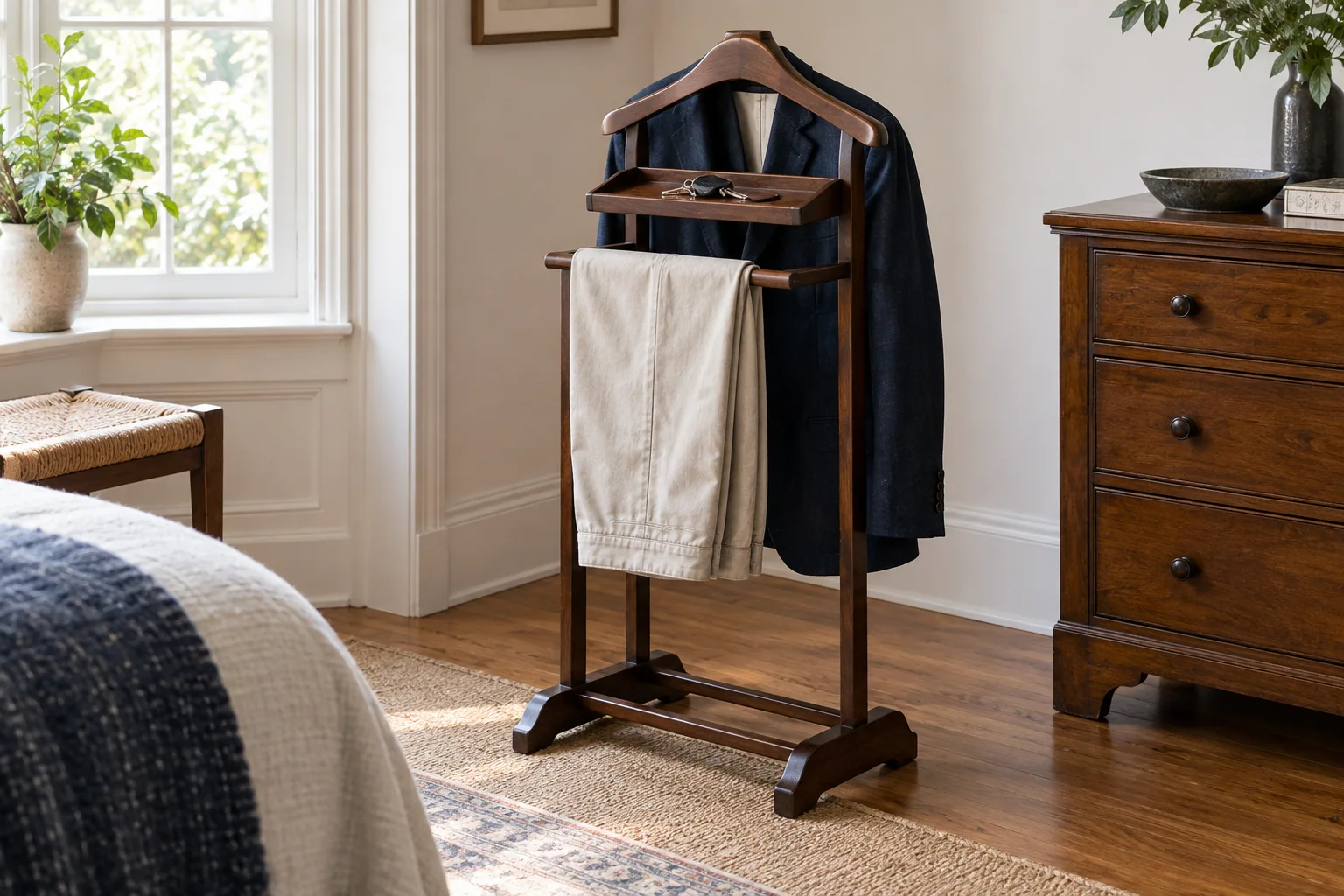
Give it a smaller job than a wardrobe
A valet can separate the things you plan to wear tomorrow: jacket or overshirt, trousers, perhaps a belt and a place for keys. That limited role is its strength. If you want to hang a week’s coats and several bags, a suitable coat stand or wardrobe is a more appropriate starting point.
Older examples vary. Sigmar describes a Fratelli Reguitti stand with an oval tray and extending brass pins associated with the trouser rack. That particular arrangement is a useful example of the form’s small specialised parts, not a specification for all stands carrying the name.[1]
Buy the features you will use. A small tray is convenient for glasses but less so if it sits exactly where your jacket collar needs to fall. Several extra hooks can add clutter without improving the daily routine.
The jacket tells you whether the hanger is right
Place your usual jacket on a sound stand with the seller’s agreement. Check where the shaped hanger supports the shoulders and whether the garment hangs freely. A hanger that is too broad, narrow or sharply shaped for your clothes may not be improved by the stand’s attractive timber.
| Part | Fit question |
|---|---|
| Jacket hanger | Does it support the garment comfortably at the shoulders? |
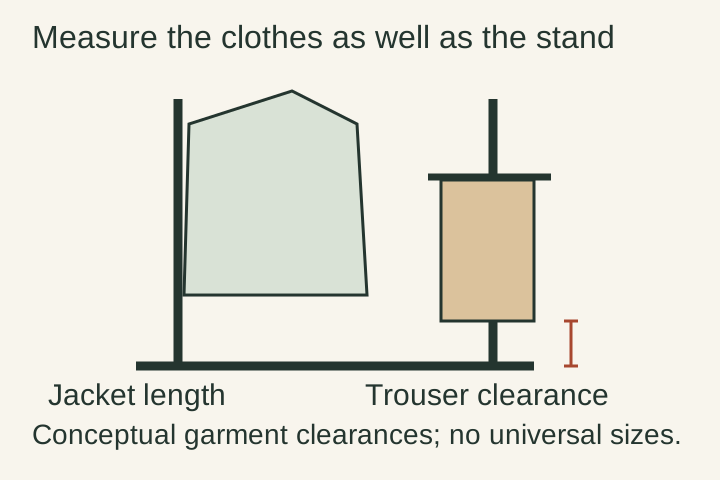
| Trouser rail | Can the trousers hang folded as intended without reaching the floor or lower parts? |
| Spacing between rails | Do the garments stay accessible without pressing awkwardly together? |
| Tray or small fittings | Can you reach them without dragging them across the clothes? |
Check hems against the actual floor height, including any castors or feet present. Measure the space occupied by the hanging garment rather than only the frame. A jacket’s sleeves may extend into the bedside passage even when the base looks reassuringly narrow.
Assess it with ordinary use in mind
Inspect the base, uprights, rails and their connections before loading the stand. Ask about loose joints, repaired feet, absent crosspieces and replaced wheels. A frame standing neatly when empty does not establish that it is ready for its intended use.
If it is sound, observe normal loading with the intended outfit rather than adding heavy bags to test the limit. Check whether removing a garment makes the stand move unexpectedly. An old valet is not a handrail for dressing or a support to lean on; a low rail should not be treated as a step.
For a wheeled example, identify the intended castors and how the stand is meant to remain in position during use. Mixed wheel heights or a missing wheel affect more than appearance. Have any correction assessed for the actual construction instead of buying a generic set solely because the stems fit.
The missing little fitting can be the awkward repair
A shaped tray, telescoping pin or special rail can be harder to replace than its size suggests. Photograph what is present and ask the seller to explain each feature. Do not pull out or force an unfamiliar fitting to discover its purpose. Include compatible replacements and fitting in the comparison before dismissing missing parts as trivial.
Keep maker and designer claims proportionate to the evidence. A stamped manufacturer name does not automatically establish every designer attribution found in advertisements. If you are buying for daily use, a plainly described unmarked stand may serve you perfectly well without a famous name attached.
The room test
Mark the loaded footprint beside the bed or wardrobe, leaving room to remove the clothes and walk past. Compare it with keeping a suitable hanger and a small tray in the storage you already have.
The worthwhile valet makes the next morning slightly easier and frees the chair for sitting. It does not need to look like a hotel dressing room, and it should not become a more elegant version of the same clothes pile.