
Start with the lived room, not a style label
List what already works, what feels unresolved and what the room must support on an ordinary day. A living room may need two people to talk comfortably, a clear route to the window, closed storage and a place to read. ‘More vintage’ does not answer any of those needs; a particular chair, cabinet, table or light might.
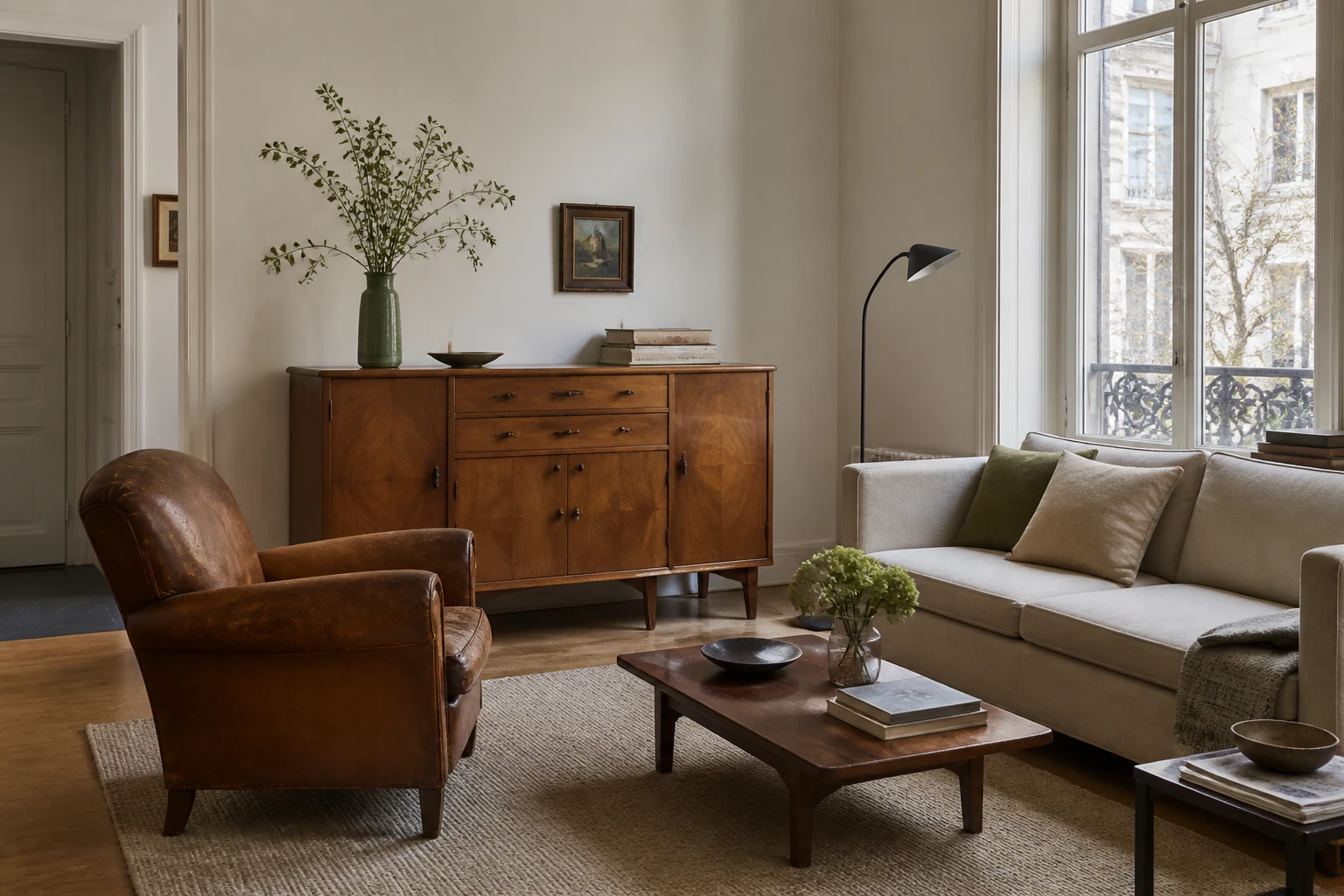
Write the composition brief
- ActivitiesWho sits, talks, reads, eats, works, watches, stores, walks and cleans in the room—and where each task happens.
- Fixed elementsDoors, windows, radiators, fireplaces, outlets, built-ins, floor changes and the sight lines used on arrival.
- Furniture stayingExact pieces that already earn their place, with dimensions, colours, materials, shapes and practical roles.
- Missing jobThe one function the purchase must add or improve rather than the category you feel expected to buy.
- Change toleranceWhat may move, be re-covered or be replaced—and which inherited, historic or useful elements should remain.
No percentage rule
A room does not need an approved ratio of vintage to modern
One large old cabinet may carry more history and visual presence than four small accessories. Count functions, relationships and consequences; do not buy filler to reach an old-to-new formula.
Choose one primary anchor
An anchor is the piece that first explains the room. It may be a generous vintage table around which contemporary chairs gather, a sculptural old armchair beside a quiet sofa, or a case piece whose useful storage gives a long wall purpose. The anchor need not be the oldest, rarest or most expensive object; it earns priority through the job it performs and the attention it can carry.
| Role | Useful question | Common mistake |
|---|---|---|
| Functional anchor | Does the room organise itself around this table, sofa, desk or storage piece? | Choosing presence before proving daily fit |
| Visual anchor | Does its scale, silhouette, colour or material deserve the first look from a main entrance? | Adding several competing statement pieces |
| Historic or personal anchor | Does its story matter enough that supporting pieces should stay quieter? | Making every later purchase imitate its period |
| Architectural anchor | Can it give a recess, window wall, fireplace zone or long blank wall a useful centre? | Blocking access, heat, light or a route for symmetry |
If the room already has a strong anchor, the vintage purchase may need to support rather than lead. A small side table, restrained dining chair set or quiet lamp can add age and texture without creating another centre of gravity.
Find one or two visual connectors
A connector is a quality that appears on both sides of the age difference. It creates enough kinship for the eye to move between pieces without disguising where they differ. Look at the room in broad families rather than trying to match a screen colour or wood species exactly.
| Connector | How it can travel | Do not force |
|---|---|---|
| Material temperature | Warm wood beside warm leather, parchment textile or aged brass; cool metal beside stone or charcoal | Every timber into the same stain |
| Line and form | A curved chair echoed by a rounded shade, bowl or sofa arm; a rectilinear case answered by quiet shelving | A room made entirely from one silhouette |
| Colour | One muted accent repeated in art, textile or a small object at different intensities | Re-covering a sound historic material for a perfect swatch match |
| Texture | Patinated leather beside wool, open-grained wood beside linen, polished metal beside smooth glass | Treating every old surface until it has the same sheen |
| Proportion or rhythm | Repeated low horizontals, slender legs or a measured sequence of vertical elements | Assuming visually similar proportions prove physical fit |
Colour boundary
A photograph is not a finish sample
Screens, seller lighting, reflections and old coatings alter colour. Use the listing to form a palette question, then compare a real sample or inspect in person when an exact relationship matters.
Preserve deliberate contrast
A vintage piece does not need to pass as contemporary to belong. Let one meaningful difference remain clear: aged beside crisp, handmade irregularity beside a precise plane, ornate detail beside a quiet silhouette, dark mass beside an open frame. The room feels deliberate when the contrast has a partner and enough space—not when the difference has been sanded, painted or accessorised away.
Make the contrast readable
- Change one variable at a timeIf period, colour, scale, pattern and finish all compete in one corner, simplify the supporting pieces before rejecting the anchor.
- Give detail a quiet neighbourCarving, lively grain or patterned upholstery is easier to read beside a calmer plane than another equally detailed object.
- Pair mass with opennessA visually solid chest can sit near a lighter-legged table or open chair, provided the physical balance and routes still work.
- Let age remain specificPatina can be the contrast. Do not spread artificial distressing across new objects to make the difference appear accidental.
Editing test
Remove the bridge before altering the vintage piece
If the mix feels forced, first remove a competing cushion, lamp, small table or accessory and look again. Composition is reversible; stripping, painting and reupholstery may not be.
Balance apparent weight and empty space
Visual weight is simply how strongly a piece seems to occupy attention. Size contributes, but so do darkness, solidity, pattern, sheen, height and detail. A compact dark cabinet can feel heavier than a larger pale sofa; an open metal chair can appear lighter than its footprint. Judge this from the positions where the room is actually seen.
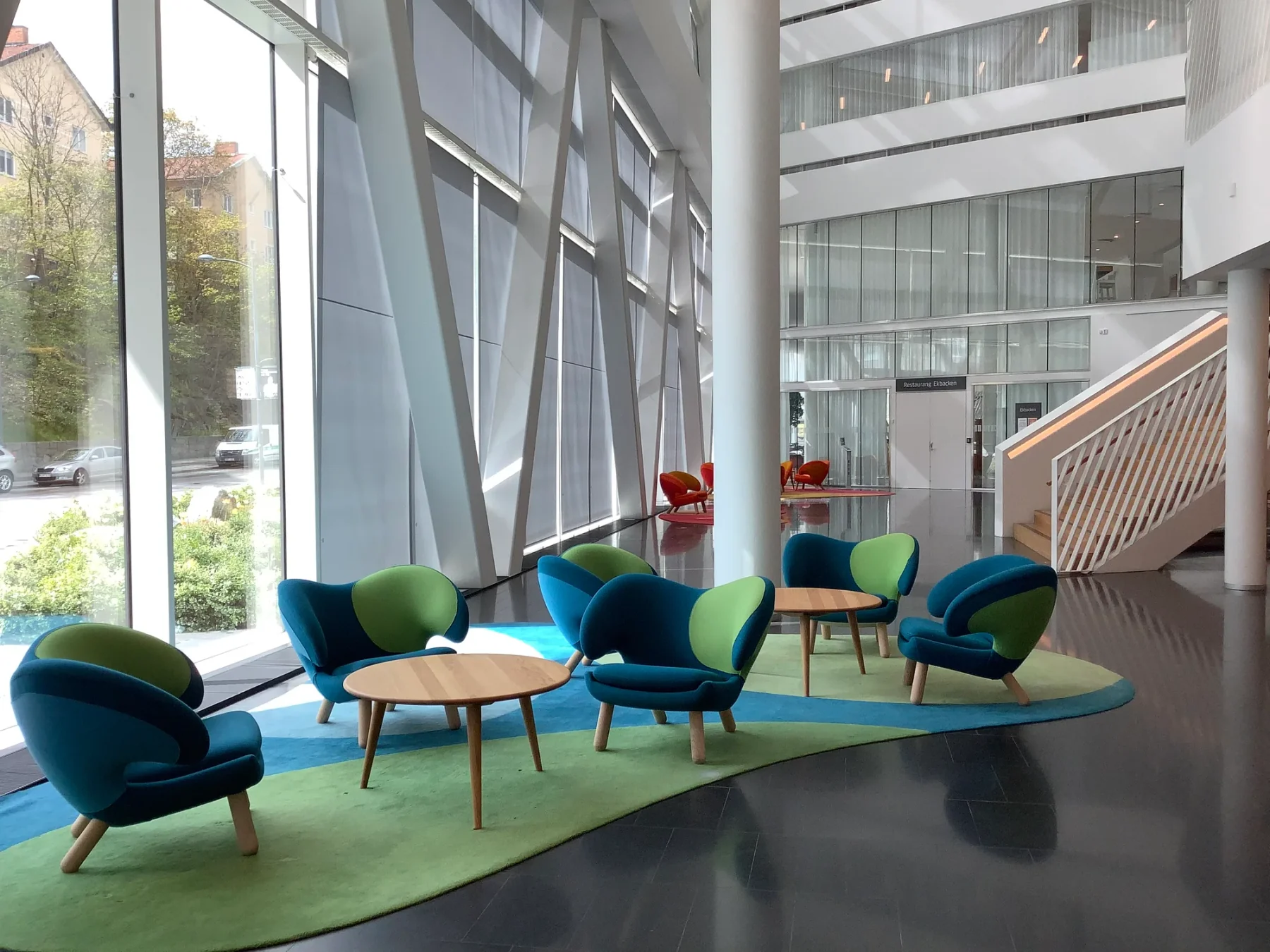
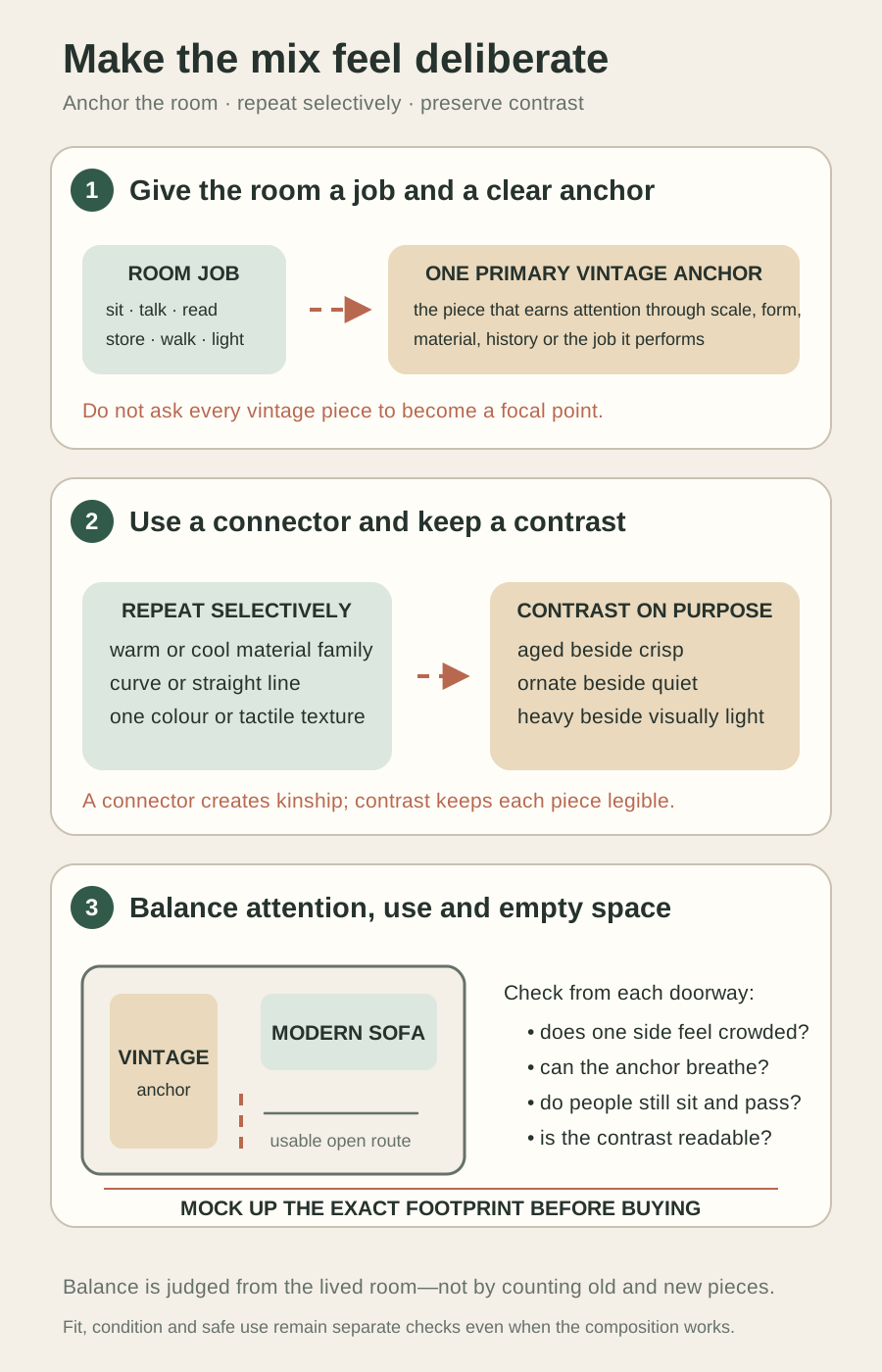
Review the whole field
- Main entrancesDoes one side become a wall of dark or detailed furniture while the other feels unresolved?
- Anchor spaceCan the complete silhouette be read, or do nearby objects make its edges and role disappear?
- Vertical distributionBalance tall case furniture, floor lights, art and low seating without filling every height band.
- Negative spaceKeep enough unoccupied wall, floor and tabletop for objects to remain distinct and for people to use the room.
- Night viewRepeat the reading under the lights actually used; glare and pools of darkness can change which piece dominates.
Keep composition, fit and condition as separate decisions
A piece can complete the room visually and still be wrong for its job. Record its maximum dimensions, occupied or open footprint, clearance, surface and base separately. Check the delivery route, intended users, stability, material condition and likely work just as carefully as you would for a less beautiful object.
| Pass | Question | Evidence |
|---|---|---|
| Composition | Does it lead, connect or support without crowding the room? | Room views, palette/material record and full-size mock-up |
| Function | Does the exact form do the missing job for the intended people? | Task rehearsal, useful dimensions and moving states |
| Condition | Are wear, repairs, material changes and unknowns acceptable? | Complete current condition record and professional scope where needed |
| Route | Can it arrive and occupy the position responsibly? | Protected envelope, every opening and turn, handling and placement plan |
Use the delivery-route Guide for building geometry, then the relevant table, seat, storage, lighting or condition Guide for the exact object. Style does not waive a physical test.
Rehearse the exact piece at full size
Make a simple room record in daylight and at night. Photograph from each normal entrance and seating position without using an extreme wide-angle view. Mark the candidate's complete base and maximum top or back on the floor and wall with removable paper or low-risk tape suited to the surface. Build the height with boxes or a light frame only when that can be done safely.
Live with the mock-up before committing
- Enter the roomNotice where the eye lands and whether the new mass hides the existing anchor, window, art or useful depth.
- Perform the taskSit, reach, open, walk, serve, store or switch on the room in the way the real piece must support.
- Open everythingAdd doors, drawers, leaves, recline, swivel, chair pull-back and the people using them to the footprint.
- Remove one neighbourTest whether the candidate needs a quieter supporting arrangement rather than another purchase.
- Photograph againCompare the main views at similar framing; a doorway photograph often reveals imbalance the shopping close-up concealed.
Photograph boundary
A listing room is not your room
Seller styling can suggest a relationship, but unknown lens, scale, lighting and neighbouring furniture cannot prove fit or composition at home. Use an image of your measured mock-up for the decision.
Edit the room without erasing the object
Use reversible changes first: move the rug, reduce small objects, shift art, repeat one restrained colour, change the lamp position or give a detailed piece a quieter background. These can clarify the relationship without requiring the vintage object to impersonate something newer.
| If the room feels | Try first | Pause before |
|---|---|---|
| Fragmented | Repeat one material temperature, curve, colour or texture in two or three places | Buying several matching accessories |
| Heavy on one side | Move a solid piece, reduce nearby detail or introduce open space | Adding another large object for symmetry |
| Too themed | Remove the weakest period imitation and keep the best exact vintage pieces | Distressing modern furniture to look old |
| Too cold around the old piece | Add tactile textile, warmer light or a related natural material | Oiling, staining or stripping an unknown finish |
| Colour-conflicted | Test a removable textile or paper sample in the real light | Re-covering sound historic upholstery from a screen image |
Before changing a vintage wooden surface, use the wood-care Guide. Before commissioning broader work merely for visual unity, use the restoration-budget Guide to define what would be changed, lost and paid for.
Buy in passes, not as a matching set
- First fill the missing practical job with the best exact piece that fits the room, route, condition and budget.
- Live with its scale, colour and attention under ordinary daylight and evening light before naming the next gap.
- Add a supporting piece only when it improves a real function, connector, contrast or balance that remains unresolved.
- Let useful objects acquired over time carry different dates; repetition can come from how they are arranged rather than where they were made.
- Stop when the room works. Empty space and an unfinished shopping list can be part of a complete composition.
Set boundary
Do not split a good set merely to manufacture variety
A coherent vintage pair or dining set may be exactly right for the job. Mix it with the wider room through placement, lighting, adjacent materials and quiet supporting pieces rather than forcing variation inside every furniture group.
When deciding whether a pair or set belongs together, use the pair-and-set Guide to compare each member, not the room photograph alone.
Send one request for the piece your room actually needs
Message to copy
Ask for room evidence, not a styled promise
Hello—I'm considering this piece as the [anchor/supporting piece] in a room used for [activities]. Could you confirm the maximum width, depth and height including every projection; the complete base and any open, extended or occupied footprint; materials and colour/finish as known; current wear, repairs and likely work; and the delivery configuration? Please send a square whole view from the front and both corners in neutral daylight, plus each side, back, top/base and one image with a reliable scale. I need to mock up its exact mass, silhouette and use beside furniture I already own, so please avoid a wide-angle crop or colour filter where possible. Thank you.
PatinaHall helps you ask for the exact record. The independent seller remains responsible for their description, sale, handoff, delivery and returns. Keep the seller's room view as context; make the purchase decision from the piece's evidence and your measured room.
Buy when the piece performs its job, has a clear role in the hierarchy, connects without imitation, preserves a useful contrast and fits the full room and route. Clarify when one dimension, material, colour or whole view would change the composition. Change the room plan when the object is right but a supporting item competes. Decline when the mix depends on crowding, an irreversible alteration you do not want, or a physical fit that styling cannot repair.