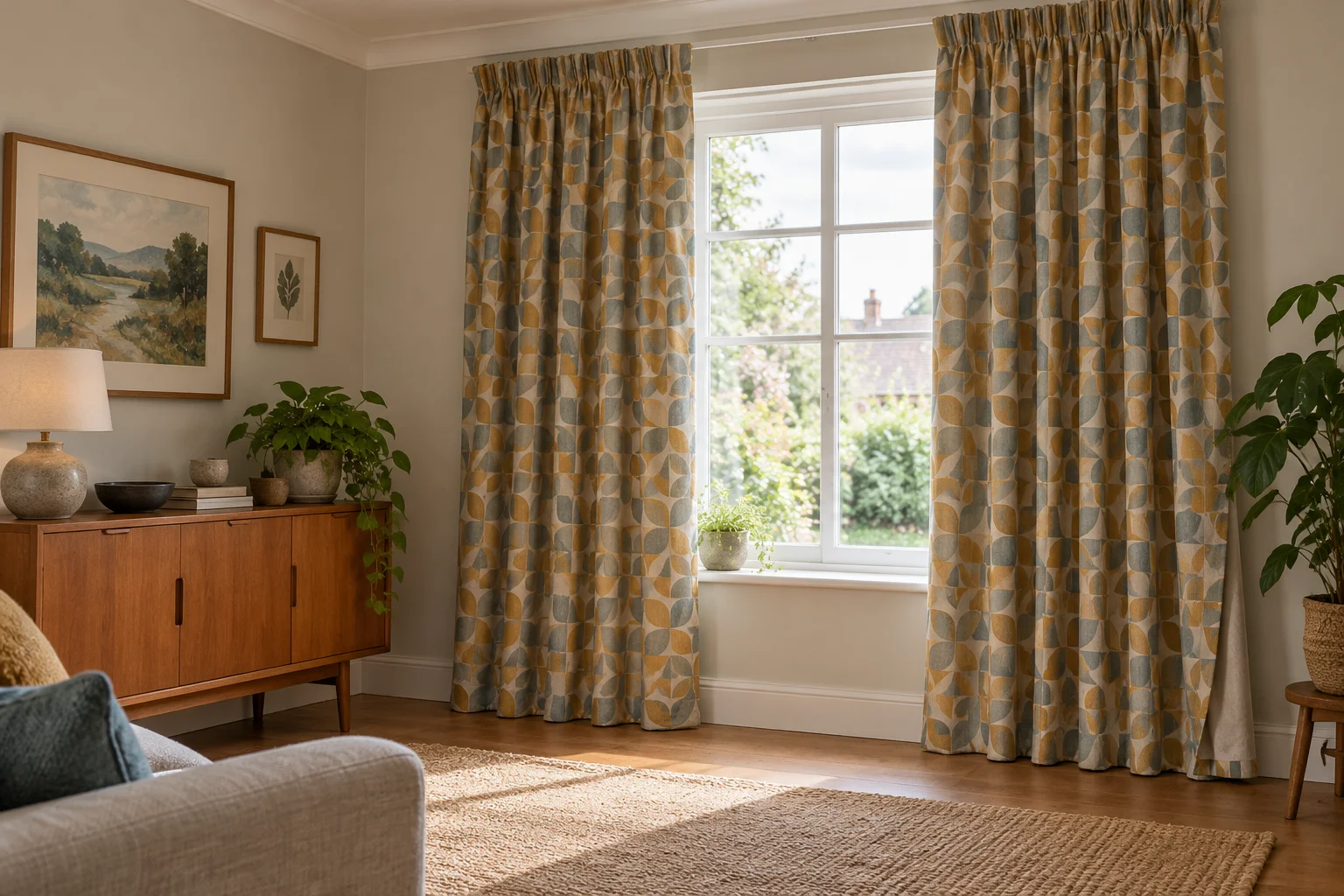
Measure the setup the curtains will hang from
John Lewis's measuring guidance starts with the fitted track or pole, excludes pole finials from its working width and distinguishes drop reference points by heading. Use that principle with the actual hardware and curtain type; a window-glass measurement alone cannot supply the finished curtain dimensions.[1]
Write the working span and desired finishing point on a sketch. Include the opening window, handle, sill, nearby furniture and any obstruction that matters when the curtains move. For a bay, curved track or unusual fitting, ask the curtain maker to confirm the reference points. If the hardware is not yet chosen, keep the measurements provisional until its position is settled.
Ask what the pair's width actually means
Request a full view of both panels, their fronts and backs, the heading, lower hem and labels. Have the seller identify each panel and record its dimensions without undoing stitching or pulling fragile material. Keep flat cloth width, fixed finished heading width and an adjustable gathered width separate. If the seller cannot establish one without disturbing the curtain, leave it unknown.
| Record for each panel | Question it answers |
|---|---|
| Heading and hardware relationship | How this curtain attaches and where its drop is measured |
| Width and measurement state | Whether the number describes flat cloth or the usable finished heading |
| Drop at both edges and middle | Whether the finished lower edge will reach the intended line |
| Lining and visible alterations | Which layers and previous changes affect the proposed reuse |
| Pattern direction and panel relationship | Whether the pair's design and orientation work together |
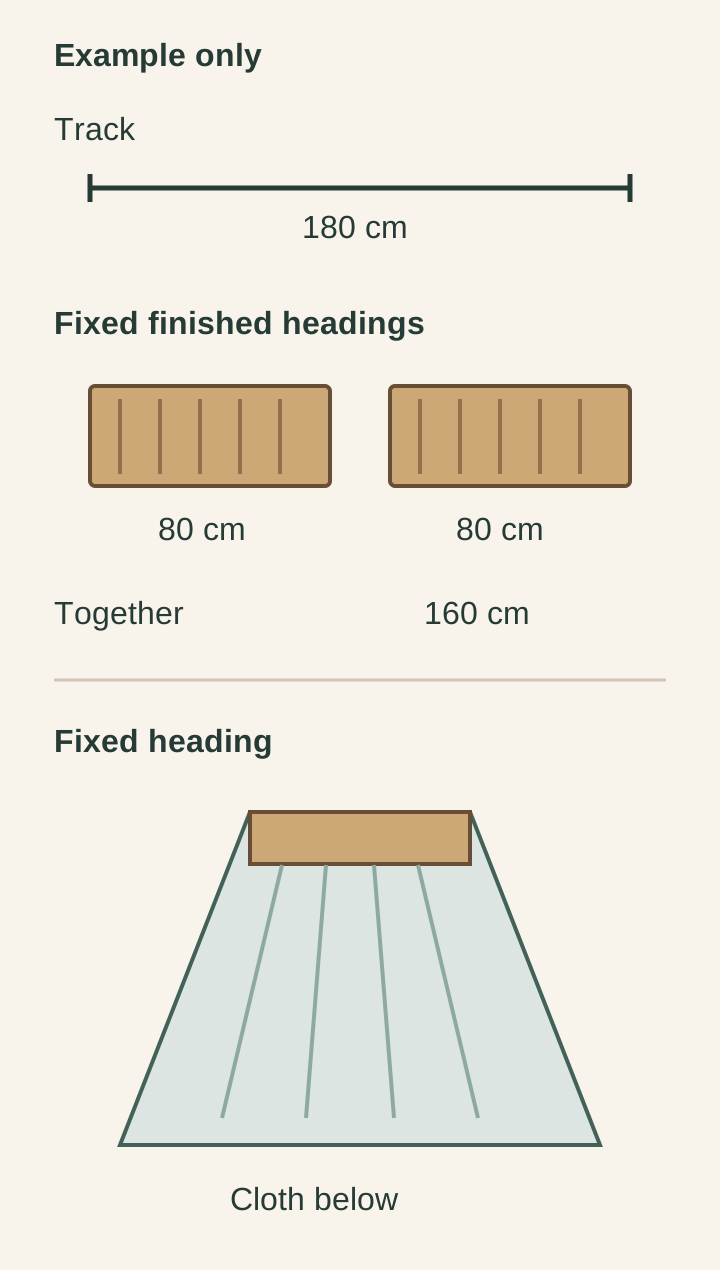
Here is a deliberately limited geometry example. A straight track has a working span of 180 cm. Two panels each have a fixed finished heading of 80 cm, giving 160 cm together. That does not cover the span, even before a curtain maker assesses the centre meeting and ends. Wider fabric below the pleats does not make the fixed heading longer. These numbers are assumptions for comparison, not a fullness or alteration specification.
Look at the fabric and lining together
Compare both panels in ordinary light, including edges that faced the window and areas previously hidden in folds. Ask about differences already visible, worn hems, earlier shortening and known cleaning. Colour differences may be acceptable to you; a seller's promise that cleaning will make the pair uniform is a separate, unproved outcome.
CCI explains that light exposure can fade textiles and make fibres brittle, and treats cleaning according to the textile's condition. Use that as a reason to assess the actual cloth before cleaning or alteration. Fragile or fragmenting material needs an appropriate textile specialist.[2]
Keep an attached label and any known fibre or cleaning record with the pair. A lining can have a different history and condition from the decorative face. Ask what the curtain maker would retain, replace or leave alone; do not wash an unidentified pair to discover its final size. Historic or particularly important cloth deserves a preservation discussion before it is cut.
Price the alteration you actually need
Shortening, changing a heading, replacing lining and joining widths are different jobs. Ask the maker to assess remaining cloth, seams, pattern and the required finished result together. A deep-looking hem is not a promise that an old fold will disappear when let down. Existing holes or fading can remain visible after a change, and the lining may not reach the new length.
Compare the purchase plus confirmed cleaning, alteration, suitable hooks or rings and delivery with a pair that already fits. Also consider how the curtains will stack when open: make room for the actual fabric beside the glass and furniture. A beautiful pair can be worth altering when the assessed cloth and result support the work; a low price alone does not provide the missing length.
Send the maker the pair and the window in one record
Before buying
Here are my track or pole, working span, hanging reference point and intended finished drop. The pair is shown front/back with headings, hems, lining, labels and each panel's measured state. Please confirm whether it can suit this setup, which cleaning or alterations are appropriate, the finished result and full cost, and any dimension or condition that needs examination first.
When the pair, hardware and assessed work agree, older curtains can give a room colour and texture without a furniture purchase. Keep the final dimensions and care advice with the pair. Those records also make a later move or another window easier to consider.