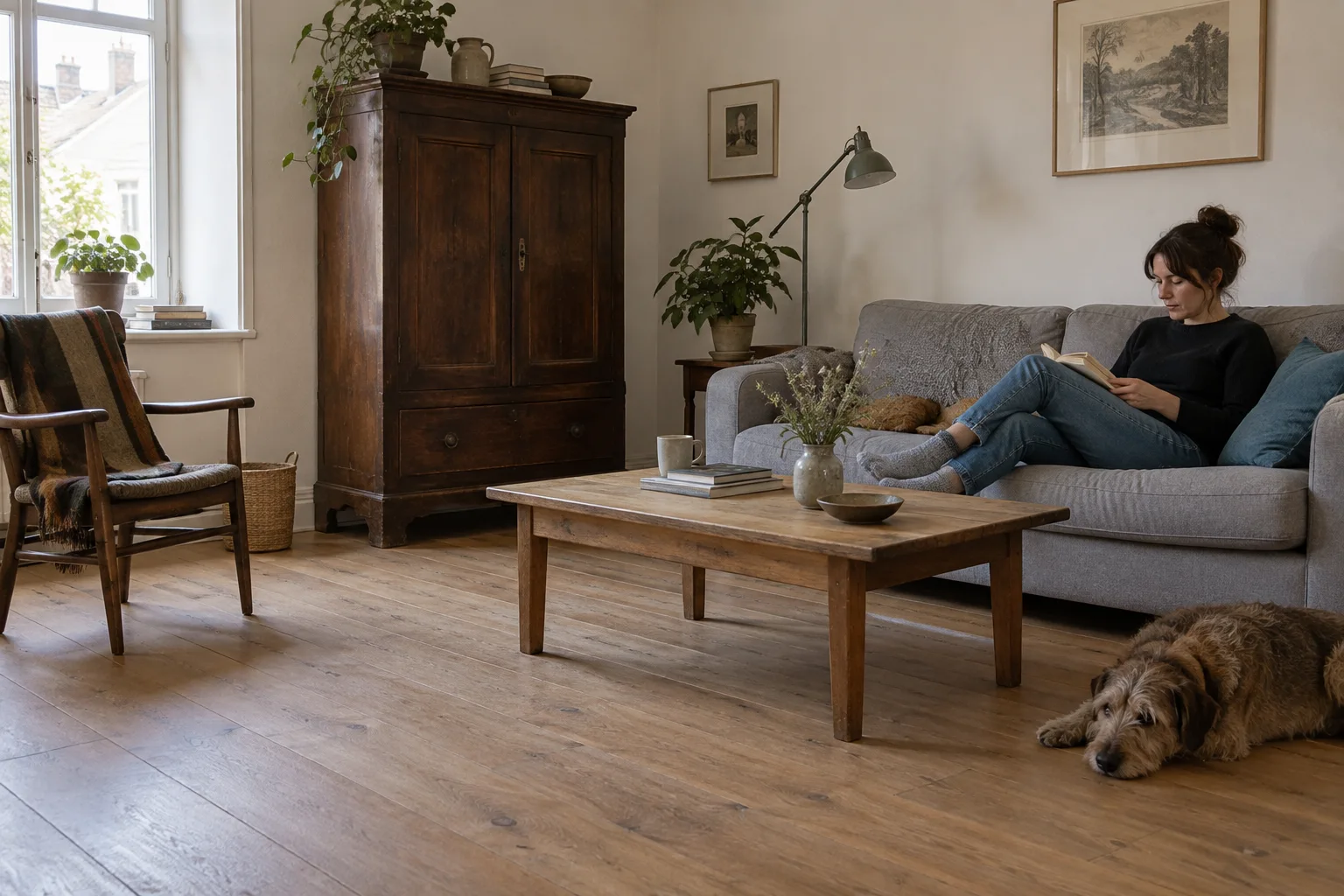
There is a history behind the shorthand
Designmuseum Danmark’s Learning from Japan exhibition documents the long influence of Japanese art and crafts on Danish design, including furniture, materials and interiors. That relationship is richer than a palette of pale beige. It gives a reason to look at older Danish furniture with fresh eyes; it does not make every simple wooden chair Japanese or every dark cabinet unsuitable.[1]
Choose what you value in the room: perhaps visible timber, economical shapes, a few well-used objects and less visual interruption. Those choices are specific enough to guide a purchase. They also let an ordinary unlabelled cabinet do the job that a fashionable keyword might otherwise make expensive.
A 3.6 × 4.4 metre room, with the cabinet staying
Consider this illustrative room, not a photographed completed project. There is a door on one short wall, a window opposite and an existing 150 cm-wide dark cabinet along a long wall. Two people need comfortable evening seating, a place for books and somewhere to put a cup. Keep the cabinet if its depth, doors and condition work.
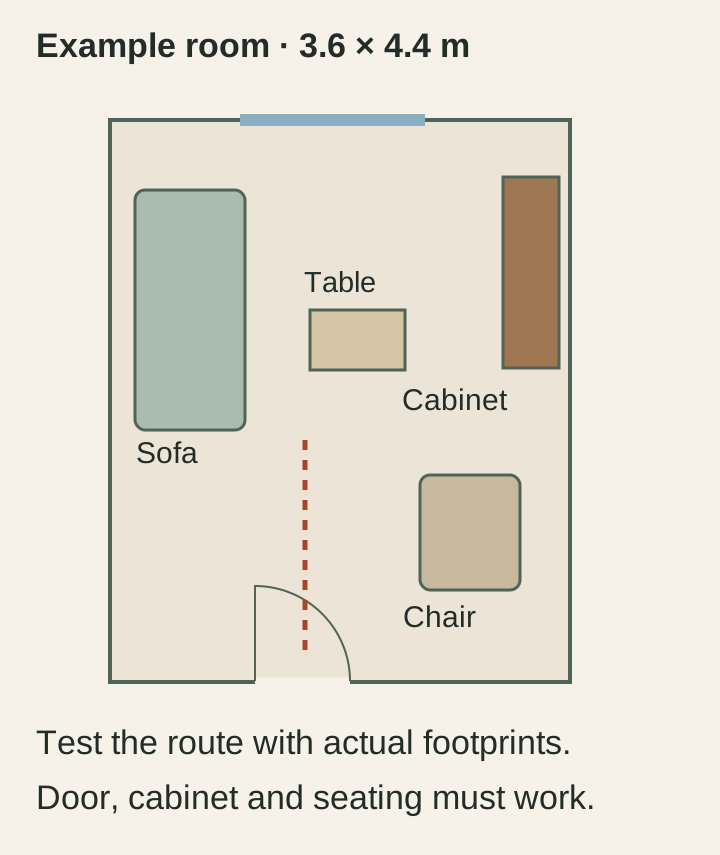
Choose a sofa after measuring the route from the door and the space needed to use the cabinet. Put a small movable table near the seated person instead of filling the centre with the largest coffee table that fits. Test the proposed circulation with cardboard footprints and real bodies. The diagram supplies a starting arrangement, not a universal clearance standard.
If the room also needs a desk, give that task an actual surface and light source. A serene photograph that omits the laptop, cables and paperwork has not solved the room you live in.
Let the dark cabinet remain dark
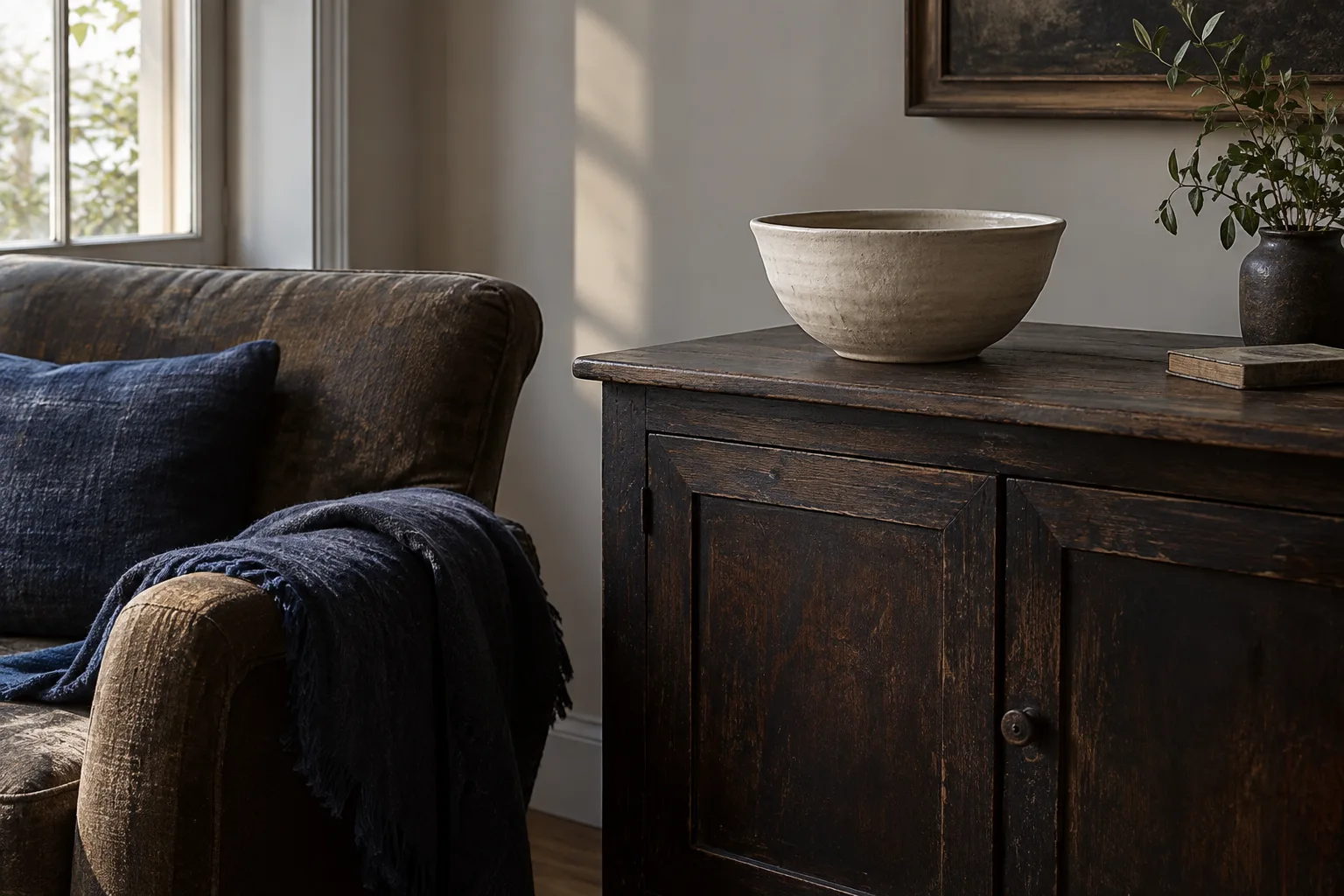
Try the cabinet against a lighter wall before considering refinishing. Its darker mass can give the room a clear anchor. A plainer pale table or an open wooden chair can sit alongside it without matching the stain exactly. Compare samples and photographs in your own daylight, especially where the floor already has a strong orange or red tone.
Use a small number of repeated decisions: perhaps dark cabinet and dark picture frame, a muted blue cushion and a nearby textile, then plain surfaces between them. Repetition helps the room feel considered. Repeating every material on every object makes shopping harder without necessarily making the room better.
A room needs more than a good silhouette
Try the seat height, back angle and arms of an older chair. A low sculptural seat that is difficult to get out of may be a beautiful object and the wrong everyday chair. Allow for the upholstery work it actually needs, then compare its complete cost with a usable alternative.
Light the activities: reading beside the chair, looking into the cabinet and moving through the room. Have older electrical fittings assessed for the intended use. The shape of a shade and the appearance of its cord do not settle electrical readiness.
Leave a usable surface empty. A shelf does not have to carry five vases to justify owning it. Before adding another object, move one thing already in the room and see whether the balance improves.
Use the next purchase to solve the remaining problem
A brief for the next piece
I am keeping [cabinet/sofa] in a room measuring [dimensions]. I need [seating/storage/light], with a maximum footprint of [width and depth]. Please confirm the complete dimensions, seat height if relevant, condition and any work needed. I will compare it against the room before arranging delivery.
Buy in a useful order: resolve seating, add the surface or storage you still need, then decide on light and textiles. A good room can emerge gradually. Its calm should come from fewer unresolved decisions, not from replacing everything old with something labelled “Japandi”.