Record ‘no useful mark found’ correctly
First follow the safe search sequence in the marks and labels Guide. Photograph the back, underside, drawer sides and backs, interior surfaces, loose components and hardware only where they are already accessible or can be shown safely by the seller. Preserve partial labels, numbers, assembly marks, retailer tags and repair notes even when none names a maker.
Close the mark check without overclaiming
- Surfaces checkedList every exterior, interior, rear, underside, drawer, cushion, leaf, shelf and loose component actually viewed.
- Areas inaccessibleRecord panels, linings, upholstery, wall-facing areas, heavy bases and components that were not safely available.
- Non-maker marksKeep retailer, importer, patent, inventory, owner, repairer, assembly and handwritten evidence with location context.
- Possible lossNote residue, holes, cleaner rectangles, renewed surfaces or repairs that may indicate a missing label without declaring what it was.
- Final wordingWrite ‘no useful maker's mark found in the areas inspected’ and name the date and inspection limit.
Mark boundary
Unmarked is an observation, not an identity
It does not prove age, obscurity, handmade production, a particular country or deliberate label removal. It only describes the result of the recorded inspection.
Build a fact sheet that survives a wrong name
Remove candidate names from the first page of your notes. Describe the functional form, complete profile, maximum and component dimensions, construction sequence, joints, supports, hardware, materials, finish, upholstery, moving parts and alterations. Separate direct observations from seller reports and your own inferences. This becomes the stable input for every search and comparison.
| Field | Record | Avoid |
|---|---|---|
| Form | Plain object type, silhouette, stance, open and closed states | A designer name used as the object type |
| Dimensions | Overall and component measurements with measurement points | Small, large or standard without numbers |
| Construction | Observed joins, fasteners, supports, back, base and interior | Handmade or machine-made from one rough surface |
| Materials | Observed layers and seller's exact qualified material claims | Wood or polymer species from colour alone |
| Hardware and mechanism | Count, position, dimensions, movement and signs of replacement | Original because the fittings look old |
| Changes | Repairs, filled holes, renewed surfaces, replacements and missing parts | All mixed evidence treated as proof of reproduction |
Use the full record sequence in How to identify vintage furniture and the photograph-request Guide. Good unmarked-furniture research depends more on complete rear, base and component evidence, not less.
Turn the fact sheet into several search routes
The Library of Congress trade-catalogue guide notes that multiple search strategies may be needed and identifies catalogues as sources for dates, prices, materials and specifications. Use that principle literally: change vocabulary, document type and field combinations instead of repeating one guessed maker name.[2]
| Route | Example query ingredients | What a useful result provides |
|---|---|---|
| Form and mechanism | Object type + unusual extension, folding, suspension or storage action | Model vocabulary, patents, manuals or catalogue families |
| Dimensions and component order | Exact width + door/drawer count + base or support form | A smaller set of plausible documented comparisons |
| Retail or distribution clue | Exact label wording + city + catalogue or furniture | Trading history, market, maker relationships or dated literature |
| Construction phrase | Observed joint, hardware or substrate + object type + region hypothesis | Technical vocabulary and period records to test |
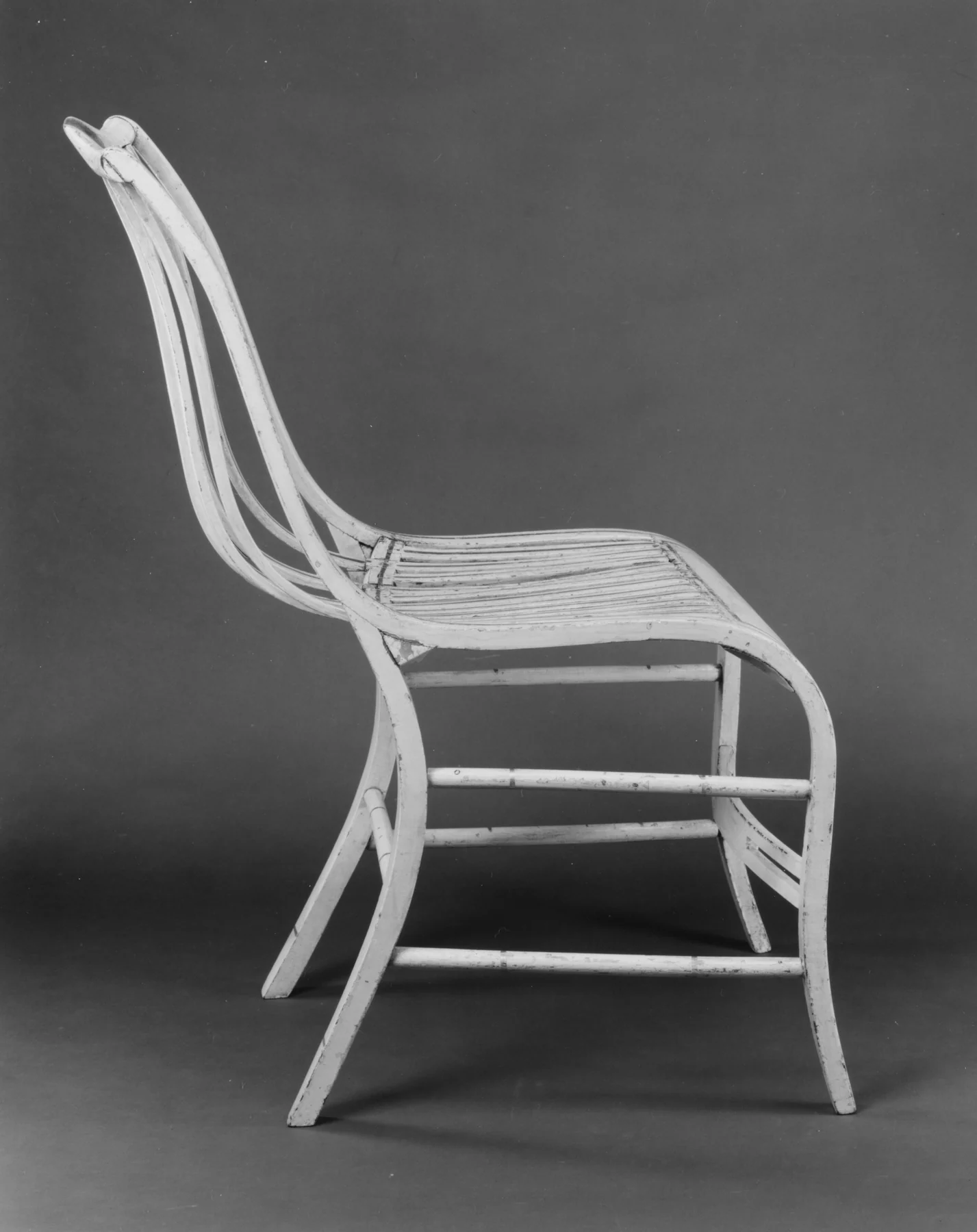
| Image lead | Whole view and one distinctive component | Candidate terms and records that must be verified independently |
Try synonyms in the language and market relevant to the possible source: sideboard, credenza, buffet or cabinet; lounge, easy or armchair; extension, draw-leaf or expanding table. Vocabulary can locate a document without deciding that the candidate is correct. Keep a search log so repeated copied claims do not begin to look independent.
Move from listings to documentary sources
Smithsonian Libraries and Archives describes trade literature as a collection used to research companies and industries, describe styles and document objects. Once a listing suggests a maker, retailer or model term, search for that maker's catalogues, price lists, advertisements, archive records and contemporary distribution evidence.[1]
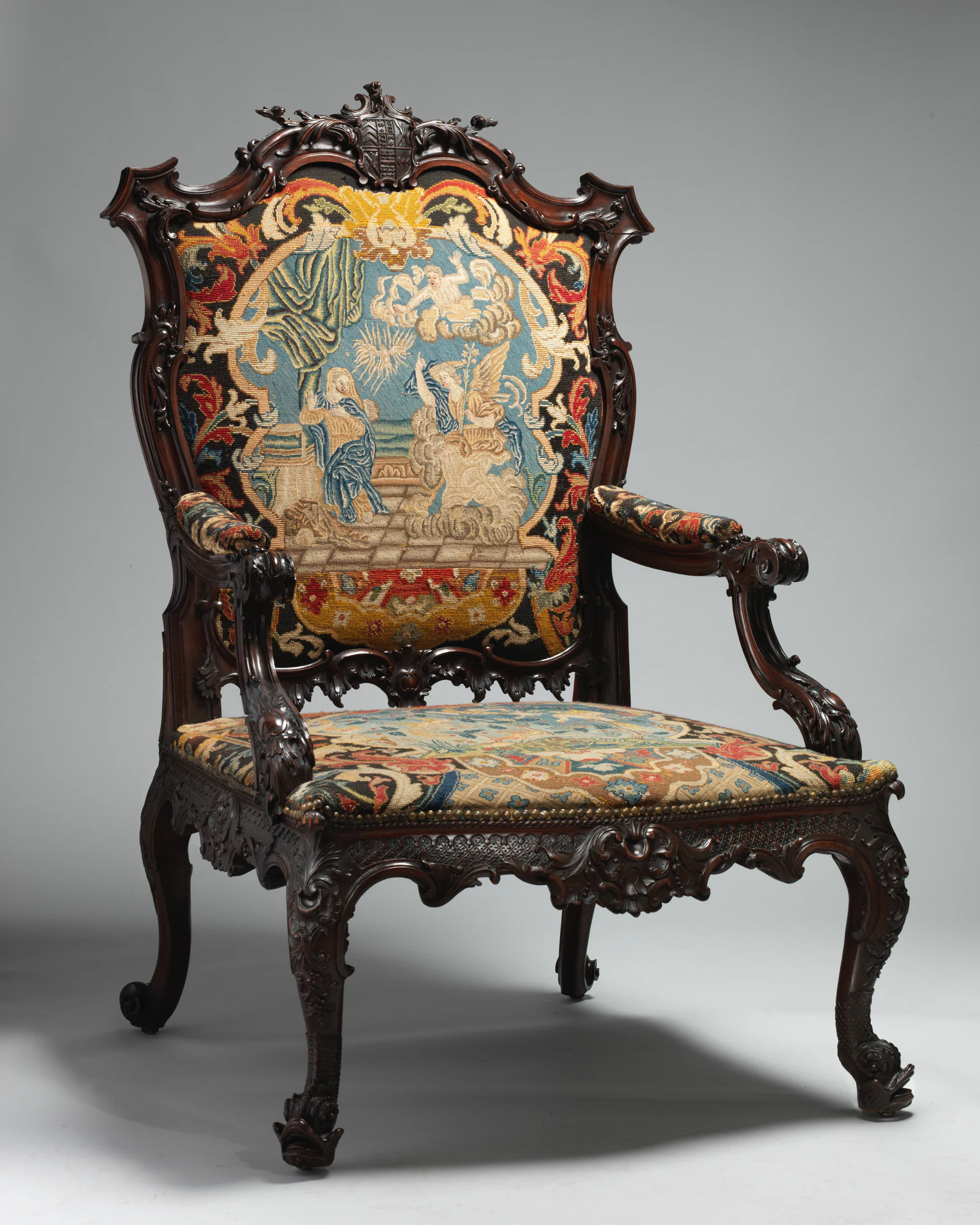
The Met records armchair 1974.325 with a qualified relationship—‘after a design by Thomas Chippendale’—alongside date, culture, materials, dimensions and an object number. The useful method is the field structure and qualification. That museum wording belongs only to its recorded chair and does not transfer to a similar unmarked chair.[4]
| Research stage | Useful role | Do not let it become |
|---|---|---|
| Marketplace or auction listing | Vocabulary, possible model, previous sale or document lead | Independent proof when listings repeat one another |
| Image search result | A path to an archive, catalogue, museum or producer page | Authentication by visual similarity |
| Institutional object record | Qualified comparison fields for one accessioned object | An identity transferred to your furniture |
| Maker or retailer trade literature | Contemporary model, dimensions, materials, price and offered date | Proof that every matching-looking object came from that source |
| Object-linked invoice or provenance record | A named event connected to the exact furniture | A broader maker or date claim than the document states |
Test the whole candidate and the conflicts
The Met's record for table 1986.38.1 discusses a revised attribution based on documentary evidence and comparison with related furniture. It illustrates why a candidate should remain revisable: stronger documents and better structural comparisons can overturn an established-sounding name.[3]
Require independent correspondences
- Whole proportionThe complete height, width, depth, stance and profile agree within a documented variant.
- Component structureBase, frame, case, doors, drawers, shell, supports or loose parts connect in the same order.
- DimensionsOverall and significant component measurements match the source rather than merely appearing close.
- DetailsHardware, edges, holes, joins and interior arrangement agree in number, position and scale.
- Period and marketThe materials, production, retailer, place and available dates form a coherent route.
- ContradictionsEvery different base, rear, dimension, fixing or finish is recorded and either documented as a variant or left unresolved.
Candidate boundary
Try to disprove your favourite match
Compare the least glamorous evidence—the rear, underside, interior, measurements and fasteners. If the candidate survives only when every conflict becomes a rare variant, replacement or camera distortion, it is not yet a supported attribution.
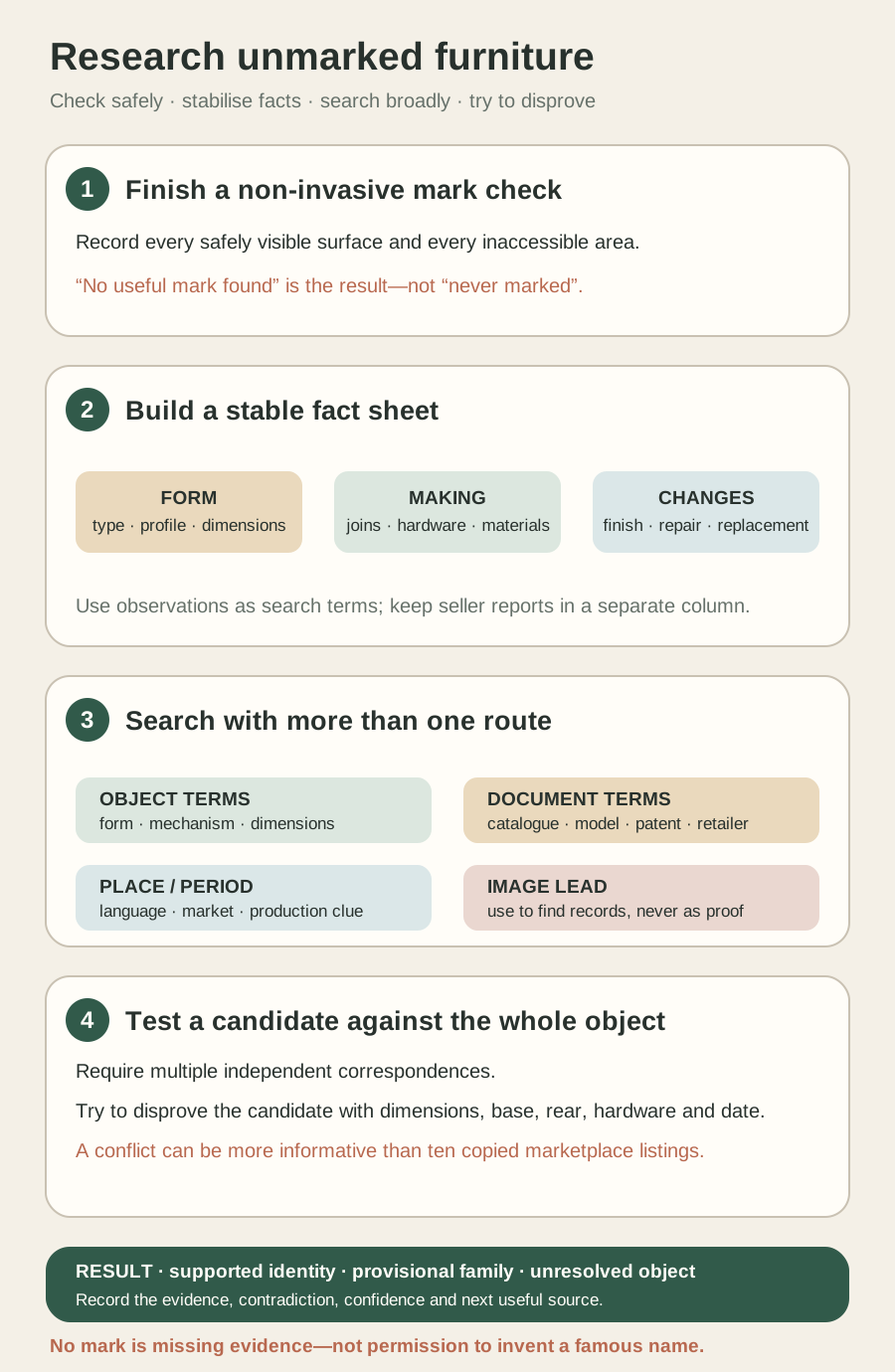
Use the unmarked-furniture research map
| Result | Evidence state | Responsible wording |
|---|---|---|
| Supported identity | Independent documentary and object fields coherently connect this example to the bounded claim | ‘Supported as [maker/model relationship], with [limits].’ |
| Provisional family | The object fits a documented group, region or workshop practice but not a specific identity | ‘Provisionally consistent with [family]; maker unresolved.’ |
| Candidate only | A visual or listing lead exists but lacks object-specific confirmation | ‘Candidate for further comparison; not attributed.’ |
| Unresolved | Current evidence cannot distinguish plausible sources | ‘Unmarked [plain description]; maker and model unresolved.’ |
Ask for a researchable seller packet
Message to copy
Ask for evidence when no useful mark is visible
Hello—could you confirm which surfaces and loose components were checked for marks and which areas were inaccessible? Please send complete front, side, rear, top and safely visible base views; open-state photographs; overall and component dimensions; and close and location views of joins, hardware, edges, drawer or frame construction, repairs, filled holes, replacements and any number, label residue or handwritten note. Please copy the exact maker, model, period, material and provenance claims and say what supports each. Please do not dismantle, scrape, clean, remove upholstery or alter the piece for my request. Thank you.
Ask the seller for earlier listings, invoices, ownership photographs, restoration records and the source of any verbal attribution. Record who supplied each item and when. An inherited story may be a valuable research lead while remaining seller-reported until an object-linked document supports it.
Make the unmarked-furniture decision
| Decision | Appropriate when | Record |
|---|---|---|
| Buy on the supported identity | The attribution is coherent and the price matches that evidence level | Evidence packet, claim boundary, contradictions and limits |
| Buy as an unmarked object | Use, condition and price work without a maker or model premium | Plain description and excluded attribution value |
| Specialist before purchase | A consequential attribution or material question needs direct examination or archive expertise | Named remit, candidate record, access and written limits |
| Decline | The price depends on an identity that remains a weak lead | Unresolved claim and the unsupported premium |
Read the exact seller language with the listing-claims Guide and compare the fallback object with evidence-matched prices. The absence of a mark can reduce certainty; it does not make a useful, well-made or desirable piece disappear.
The best conclusion may be ‘unmarked veneered sideboard, likely post-war, maker unresolved’. That is a successful research result when every term is supported and the unknown maker no longer controls the buying decision.