Preserve the complete claim before interpreting it
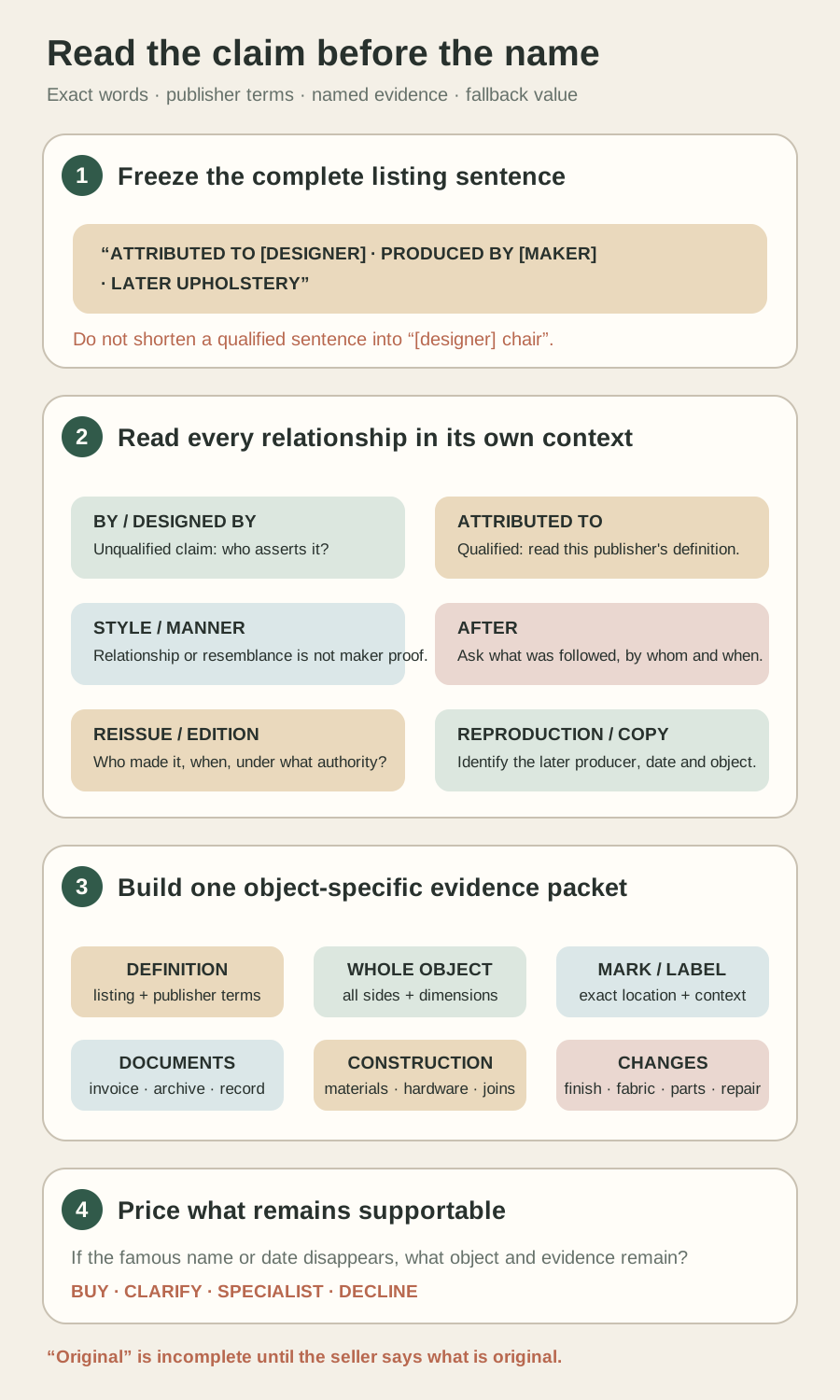
Start with a dated copy of the complete listing: page title, maker or designer heading, body description, image captions, footnotes, condition report and any linked catalogue glossary. Copy the exact sentence that connects a name, date, place or edition to the furniture. Do not convert ‘attributed to A, produced by B, later upholstery’ into ‘an A chair’ in your notes. The shortened version has lost both the qualification and two object histories.
Freeze the claim record
- Exact objectRecord the listing or lot identifier, current location, dimensions, included parts and the image set that belongs to it.
- Exact sentenceKeep every preposition, qualifier, question mark, bracket, date range and component-specific note in its original order.
- Exact speakerName the seller, auction house, catalogue author, previous owner or specialist responsible for the statement.
- Exact definitionSave the publisher's current cataloguing practice and sale terms when the wording is defined there.
- Exact timeRecord when the page and supporting documents were accessed; descriptions and amendments can change before a sale.
Reading rule
A stronger paraphrase is a new claim
If your note sounds more certain than the listing, return to the source. The buyer's task is to understand the offered relationship, not to promote it through shorthand.
Separate designer, maker and every other role
One piece can carry several legitimate names without every name describing authorship or manufacture. A designer may have established the form; a workshop or factory may have made this example; a retailer may have commissioned or sold it; another company may have produced a later edition; a restorer may have changed its surfaces or components. Put each claimed relationship on its own line before deciding whether the evidence is coherent.
| Claimed role | Question to answer | Evidence that may be relevant |
|---|---|---|
| Designer or architect | Who is claimed to have designed this model or element? | Archive, drawing, catalogue, model history or qualified specialist opinion |
| Maker or manufacturer | Who is claimed to have made this physical example? | Object-specific mark, production record, invoice, construction and documented chain |
| Workshop or studio | Does the wording claim manufacture, supervision, association or only a style? | Publisher definition, workshop records and object examination |
| Retailer or distributor | Does the label record sale, distribution, commissioning or manufacture? | Complete label context, catalogue and trading history |
| Licensor or current producer | Who authorised and made this later production, and when? | Producer record, model or serial information, dated invoice and current terminology |
| Restorer or upholsterer | Which components or surfaces changed, by whom and to what scope? | Invoice, materials, before-and-after images and current condition |
A retailer's label can be valuable evidence of distribution without proving who designed or constructed the piece. A famous designer's archive can establish a model without proving that this particular example came from the claimed production. Keep model history and object identity connected, but never collapse them.
Read qualified language under the publisher's own rules
Sotheby's furniture and decorative-arts glossary distinguishes a work named as by a designer or maker from one ‘attributed to’ that person and from an object ‘in the style of’ them. The page also places authorship, attribution, origin, date, age, provenance and condition within its stated opinion and sale framework. This is useful evidence of one major publisher's convention, not a universal dictionary for every listing.[1]
Christie's explanation of cataloguing practice likewise defines qualified relationships including ‘attributed to’, ‘manner of’ and ‘after’ within its own conditions. The differences reinforce the buyer method: locate the exact current glossary for the sale, keep the qualifier and ask what object-specific basis supports it.[2]
| Listing wording | Responsible reading | Next question |
|---|---|---|
| By / designed by / made by | An unqualified relationship claim whose scope still depends on the sentence and terms | Who asserts it, for which role, and what connects this object to that claim? |
| Attributed to | A qualified relationship with uncertainty defined by the publisher | What does this publisher mean, and which evidence prevents an unqualified claim? |
| In the style or manner of | A stated stylistic relationship or resemblance, not automatic authorship | Is any maker, production place or date separately claimed and evidenced? |
| After | A relationship to an earlier work or design whose exact meaning needs context | What was followed, who made this example and when? |
| Circa / period / later | A bounded or qualified date statement rather than one date for every component | What range is intended, and which finish, fabric, hardware or repair may be later? |
| Possibly / probably / believed to be | The sentence explicitly preserves uncertainty | What is observed, reported, inferred and still unknown? |
Terms boundary
The exact listing owns its vocabulary
Do not rank qualifiers from memory and then upgrade the furniture. Read the publisher's definitions, condition of sale and any amendment that apply to this object now.
Make ‘original’ a complete sentence
‘Original’ often sounds decisive because the missing noun is easy to supply unconsciously. Do not. Ask the seller to complete the phrase in plain language: original design, early or first-period production, original to this owner, original finish, original upholstery, original hardware, original label or all components present when this example left a named producer. Those are different claims with different evidence and different consequences.
| Incomplete phrase | Ask the seller to state | Keep separate |
|---|---|---|
| Original design | Which model or design is claimed, by whom and from which date? | Whether this physical example is from an early, later or unknown production |
| Original production | Which producer, production period and object-specific record support it? | Later replacement components and later finishes |
| Original finish | Which surfaces retain it and what examination or history supports that statement? | Touch-ups, cleaned areas, coatings, colour change and exposed substrate |
| Original upholstery | Does the claim concern cover fabric, filling, support, tacks or the complete assembly? | Repairs, new linings and materials hidden beneath the cover |
| Original hardware | Which pulls, hinges, locks, screws, keys or feet are claimed to belong? | Moved holes, mixed sets, replacements and restored parts |
| Original label or document | Is it physically attached to this object or independently traceable to it? | Whether its content proves designer, maker, date or merely sale and ownership |
A component can be old and still not be original to this object; a replacement can be appropriate and well documented; an original surface can be heavily altered by cleaning or repair. The buyer does not need to reward or reject the word. The buyer needs to know the exact surviving assembly and decide whether it suits the intended use, evidence standard and price.
Separate later production from authorship and authority
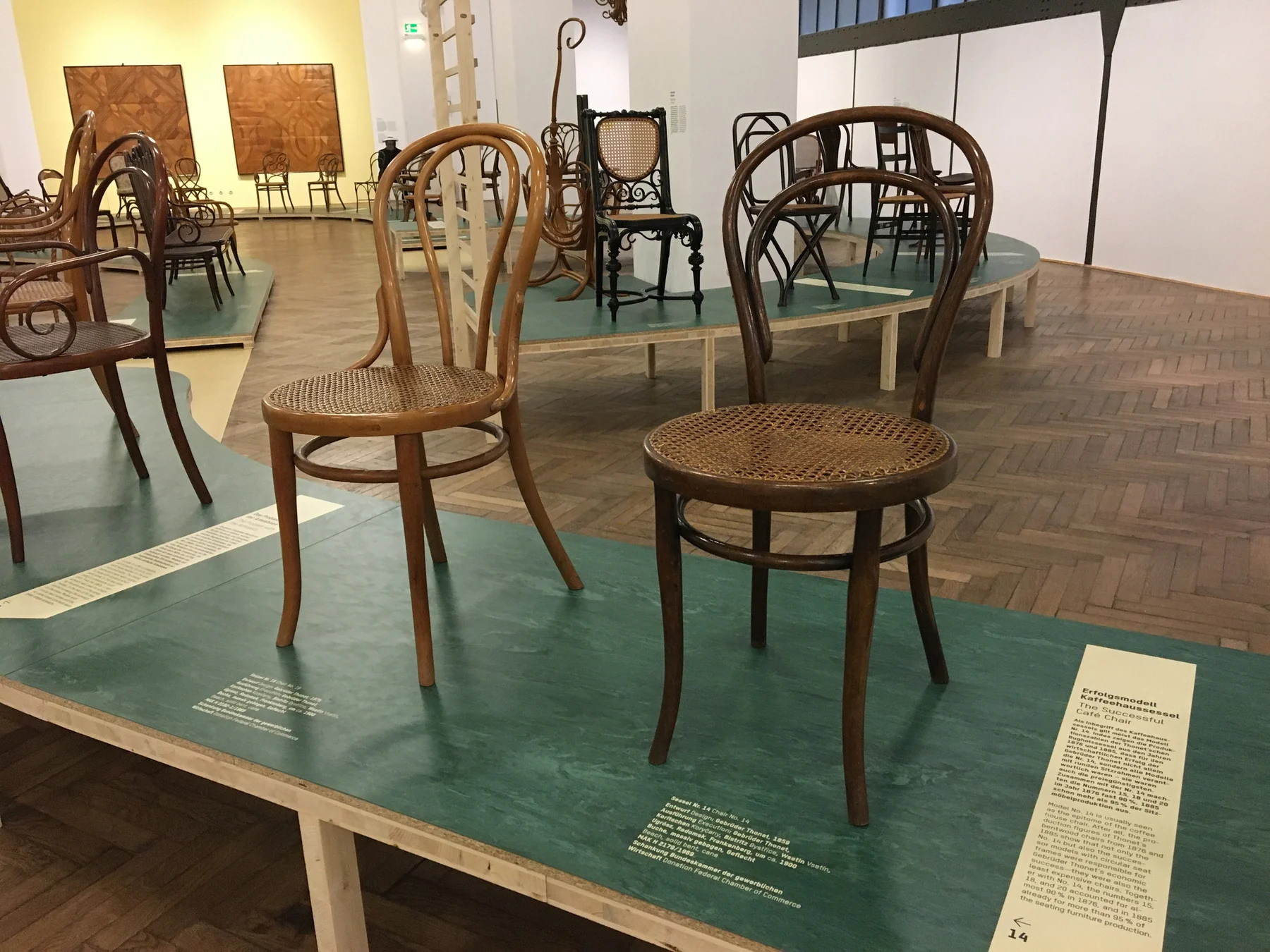
A design can remain connected to its designer while the physical object was made decades later. Terms such as reissue, new edition, authorised edition, licensed production, reproduction, replica and copy may describe different commercial and legal positions, but they are not self-proving labels and do not form a universal quality ladder. Ask for the exact producer, manufacture date or range, model identifier, materials, changes from earlier production and the basis of any authority or licence claim.
Complete a later-production record
- Named producerIdentify the company or workshop claimed to have made this example, not only the historical designer.
- Production dateRecord a supported year or range for this object rather than inheriting the design's first date.
- Model and editionAsk for the exact model name or number, size, finish, serial or edition field when the producer used one.
- Authority claimIf the listing says licensed or authorised, ask who granted what authority for which market and production.
- Material and construction changesKeep later dimensions, timber, upholstery, hardware, compliance changes and methods separate from the historical design.
- Current conditionA legitimate later production still needs its own condition, repair, use and price decision.
Rights boundary
Do not resolve a licence dispute from listing language
Manufacturer archives or the relevant rights holder may clarify a production claim. Where legality, misdescription or a consequential right depends on it, use qualified advice in the applicable jurisdiction.
Build one object-specific evidence packet
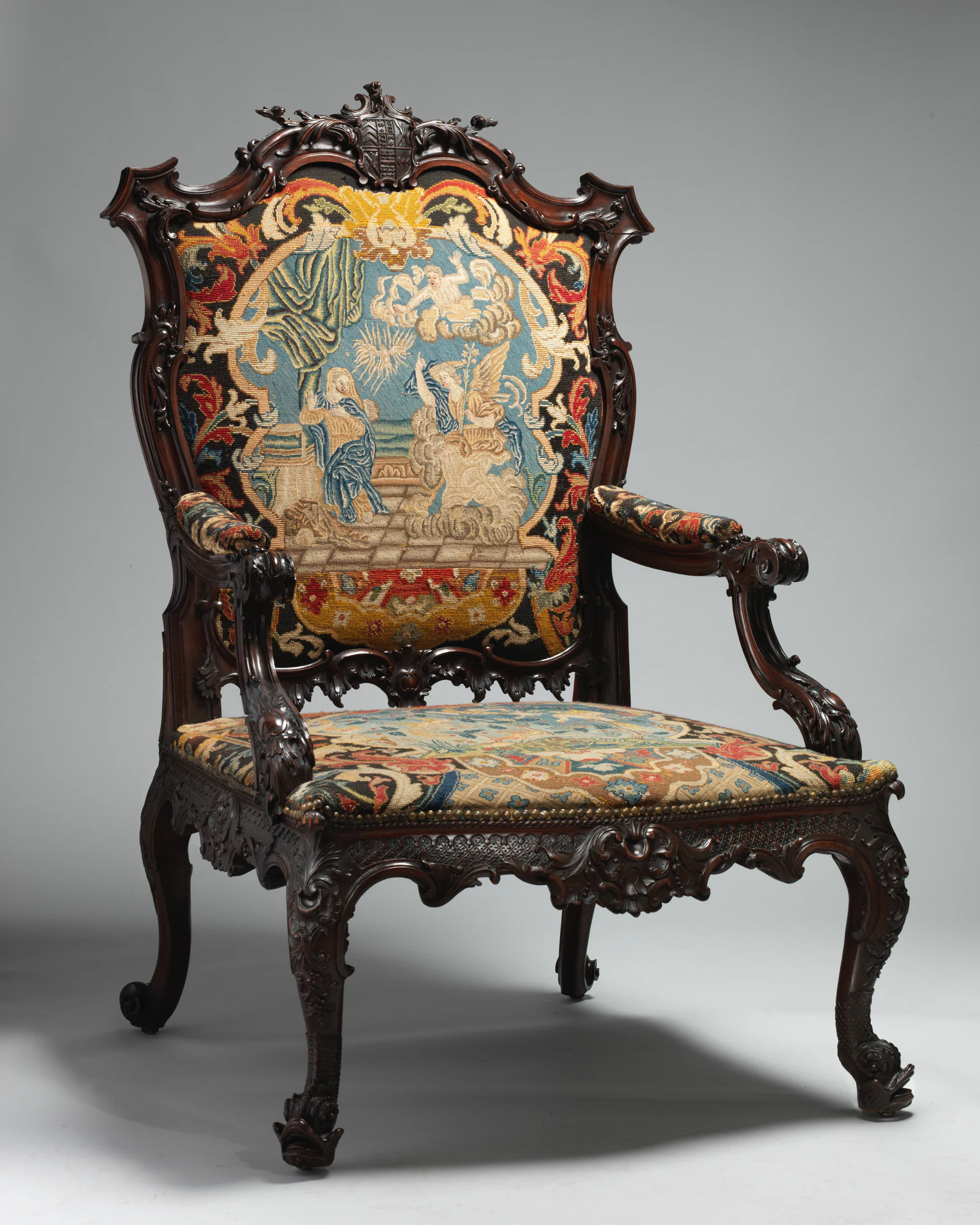
The Metropolitan Museum of Art records armchair 1974.325 as made around 1755 and ‘after a design by Thomas Chippendale’. The useful lesson is documentary: the qualified relationship, date, materials, dimensions, accession record and whole-object image belong together for that exact museum object. Its appearance cannot authenticate or date a similar chair offered elsewhere.[3]
Connect six evidence layers
- Listing and definitionKeep the exact sentence, publisher, date, glossary and any catalogue amendment together.
- Whole objectUse current front, rear, side, top, base and safely visible underside views plus exact dimensions and included parts.
- Marks and labelsRecord the mark's complete content, location, attachment, surrounding construction and relation to the whole piece.
- Documents and chainConnect invoices, archive records, old photographs and ownership statements to this object rather than a similar model.
- Construction consistencyCompare materials, dimensions, joinery, hardware and production features only within a credible model and period reference.
- Changes and conditionMap replaced, refinished, restored, reupholstered, missing and unknown components without letting age prove authorship.
Compare evidence without making one clue decide
Evidence becomes useful through agreement and traceability, not through quantity alone. A label and invoice that can be connected to the same dimensions, construction and ownership step may reinforce one another. Five copied dealer descriptions that repeat the same unsupported phrase do not become five independent sources. Record whether each fact is physically observed, seller-reported, document-supported, professionally assessed, inferred or unknown.
| Evidence | Useful connection | Failure to avoid |
|---|---|---|
| Mark or label | Location, attachment and content agree with the object and claimed production | Matching a logo image while ignoring a moved, replaced or unrelated label |
| Invoice or receipt | Description, dimensions, date, parties and surviving object form a traceable chain | Assuming a loose document belongs because its name is attractive |
| Archive or catalogue | The referenced model and production context match documented object features | Treating a model record as proof that this example is authentic |
| Construction | Relevant dimensions, materials, hardware and methods are coherent | Dating from one screw, joint, timber colour or online comparison |
| Ownership history | Named steps, dates and documents connect without impossible gaps | Letting a prestigious name replace the missing object connection |
| Specialist opinion | Scope, inspected evidence, uncertainty and author competence are stated | Converting an informal glance or seller's unnamed expert into a guarantee |
Use the marks-and-labels Guide to document a physical mark and the photograph Guide for the whole–context–detail record. Neither a close-up nor a confident sentence should float free of the complete object.
Price the supported fallback before the famous name
Run the purchase twice. First, price the strongest claim exactly as written and only with its present support. Then remove the consequential designer, maker, early date or authorised-production claim and price the remaining furniture by form, dimensions, materials, construction, condition, usefulness, rarity that can actually be observed and realistic alternatives. The gap is the amount of attribution risk in your decision.
| Evidence state | Responsible price basis | Next action |
|---|---|---|
| Claim and object evidence cohere | Comparable objects with the same relationship, production, condition and sale context | Retain the evidence and compare total commitment |
| Qualified attribution remains consequential | The object plus the exact uncertainty, not an unqualified named example | Obtain specialist review or reduce the accepted price |
| Name is unsupported but furniture is desirable | Form, quality, condition, use and genuinely comparable anonymous or later objects | Buy only if the fallback object justifies the total |
| Claim changes repeatedly | No premium for the unstable statement | Pause until one corrected written description is issued |
| Evidence cannot be obtained | The weakest supportable state with a bounded unknown allowance | Decline if the seller's price depends on certainty you do not have |
Build realistic alternatives with the price-comparison Guide. Match the price type, date, market, production, dimensions, condition, restoration and buyer costs; an asking price carrying the same famous name is not independent proof of either attribution or value.
Fallback test
Would you still want this furniture if the headline changed?
If the answer is no, the attribution evidence—not enthusiasm—must carry the purchase. If the answer is yes, price the useful and beautiful object that remains rather than paying for unsupported certainty.
Request the basis and make a bounded decision
Message to copy
Ask what every important word modifies
Hello—I'm considering this exact piece. Could you preserve the complete designer, maker, date, period and edition wording in your reply and identify who makes each claim? Please explain what ‘original’, ‘attributed to’, ‘in the style of’, ‘after’, ‘reissue’, ‘licensed’, ‘reproduction’ or any similar term means in this listing, and link the applicable glossary or terms. For each consequential claim, could you provide the object-specific basis: complete current photographs and dimensions, mark or label in location and context, invoice or archive record, ownership history, relevant construction evidence, and every known replaced, restored, refinished, reupholstered or missing component? Please separate what you observed, what a previous owner reported, what a named specialist assessed and what remains unknown. Thank you.
| Decision | Appropriate when | Record |
|---|---|---|
| Buy | The exact wording, object evidence, fallback value and total commitment are acceptable | Saved listing, definitions, evidence packet and accepted unknowns |
| Clarify | One role, qualifier, component, date or document connection could change price | One exact question and a corrected written answer |
| Specialist before purchase | Attribution, production, licence, important restoration or value consequence exceeds the seller record | Named remit, inspected evidence, confidence limits and written conclusion |
| Decline | The price needs an unsupported claim, wording keeps strengthening or evidence cannot be tied to the object | The unresolved relationship and the decision consequence, without declaring the object false |
Good listing language does not need to erase uncertainty. It tells the buyer exactly what relationship is asserted, where the confidence ends and which evidence belongs to the object. That makes a qualified but honest piece easier to value than one carried by a famous name and an unfinished adjective.