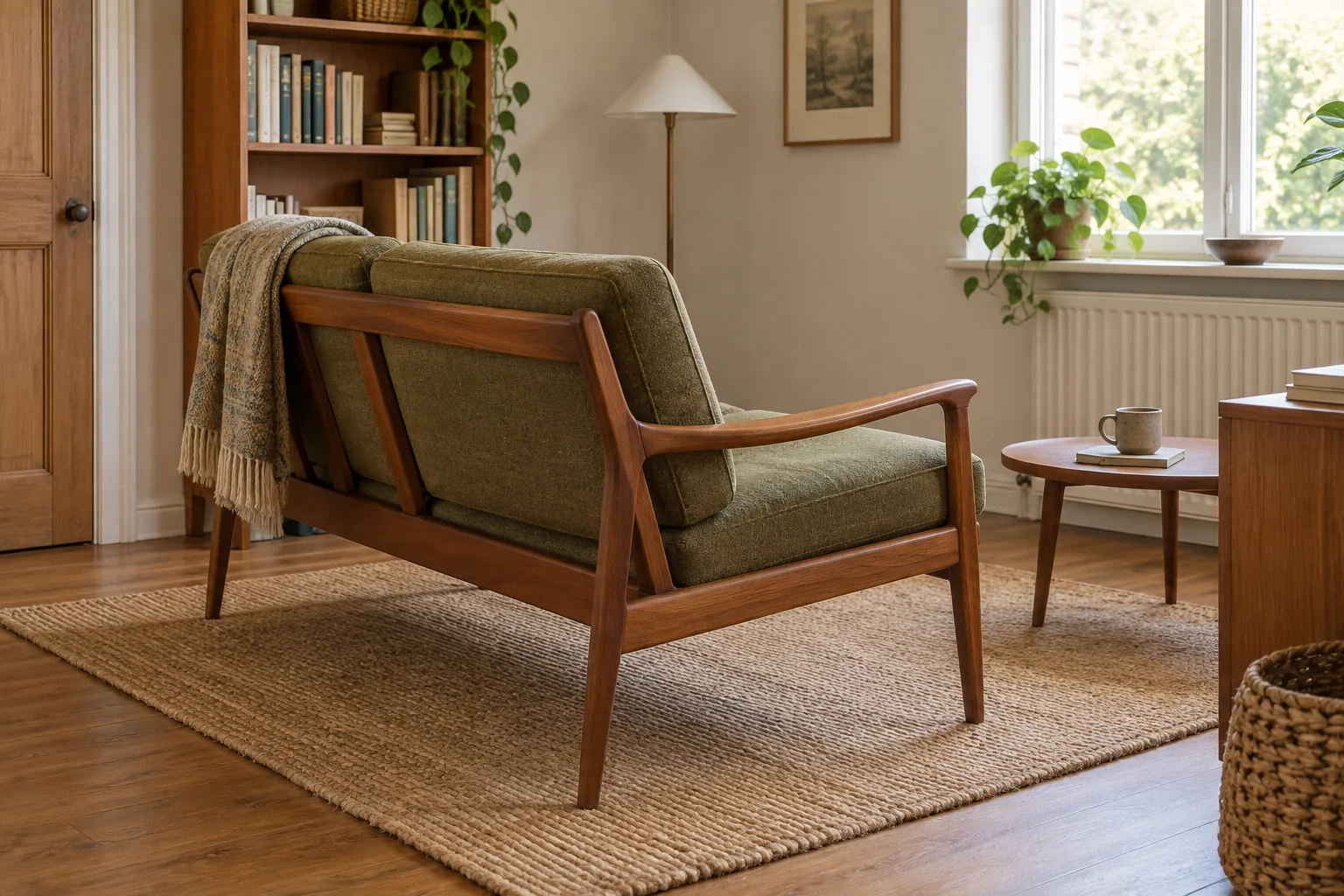
A Minerva group shows why configuration matters
One specialist listing attributes a Minerva group to Peter Hvidt and Orla Mølgaard-Nielsen for France & Daverkosen. It records a three-seat sofa at 190 × 77 × 79 cm and a two-seat sofa at 125 × 77 × 79 cm, alongside a separate table. These are dealer-recorded components of that offered group, not dimensions for every sofa carrying the manufacturer’s name.[1]
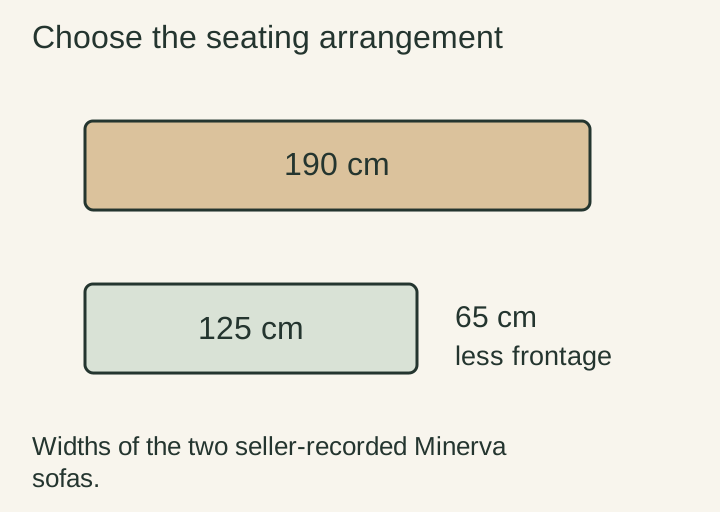
The difference is useful even before discussing attribution: 65 cm of extra frontage changes a room. Sketch each sofa with the coffee table, access route and the place where you want to sit. A matching group can be attractive without being the right complete purchase for your home.
Keep the maker, model and date claims separate in your notes. Ask which catalogue, label or other record supports each one. Do not treat an online page with a similar company name as proof that it documents the historic manufacturer or this particular sofa.
The frame deserves an uncluttered photograph
Ask to see removable cushions lifted away, the seat support, back and arm connections, and the underside. Have the seller identify replaced support material and any repaired joint. A long frame that has been strengthened underneath may look unchanged from the front.
Look closely at the places you will touch and load every day: arm ends, front rail and the junctions between legs and frame. Record movement, splits or mismatched repairs for a furniture professional. Do not use the arm as a handle to test whether a loose joint will survive.
If the sofa is going away from a wall, give the back as much attention as the front. Exposed slats, cane or rails, where present, become part of the room. A repair acceptable against the wall may be conspicuous in the position you have planned.
A cushion is part of the seating geometry
Try the sofa with its present cushions and describe the occupied seat height, usable depth and back support. A thick replacement back cushion can move you forward; a tired seat can lower you into the frame. Neither is answered by the catalogue’s overall height.
| Record | Why it matters |
|---|---|
| Bare seating support and its condition | Filling will not repair a failed support. |
| Present cushion dimensions and shape | A starting reference, not proof of the original pattern. |
| How you sit now | Shows whether depth, height or support is the real problem. |
| Desired appearance and material | Defines what should remain recognisable after work. |
Keep old covers and filling available for the upholsterer to assess before discarding them, provided they can be handled appropriately. They may help explain shape and previous work, but a stretched old cover is not automatically a reliable new pattern. Ask for the proposed finished profile as well as fabric samples.
Compare the frame price with a finished seat
Add support repairs, all seat and back cushions, fabric, labour and transport. A quote for new covers alone is not comparable with a complete rebuild. If a repairer cannot inspect the frame before purchase, make the uncertain part of the budget visible rather than burying it in a small contingency.
A useful enquiry
Please show the sofa without removable cushions, all maker evidence and previous repairs. I need a quotation covering the support and the complete cushion set, with the resulting seat height and depth discussed before work.
A good result keeps the pleasure of the exposed frame while making the sofa comfortable for your own evenings. Buy the particular seating arrangement you want to use, with a clear account of what is old, replaced and still unconfirmed.