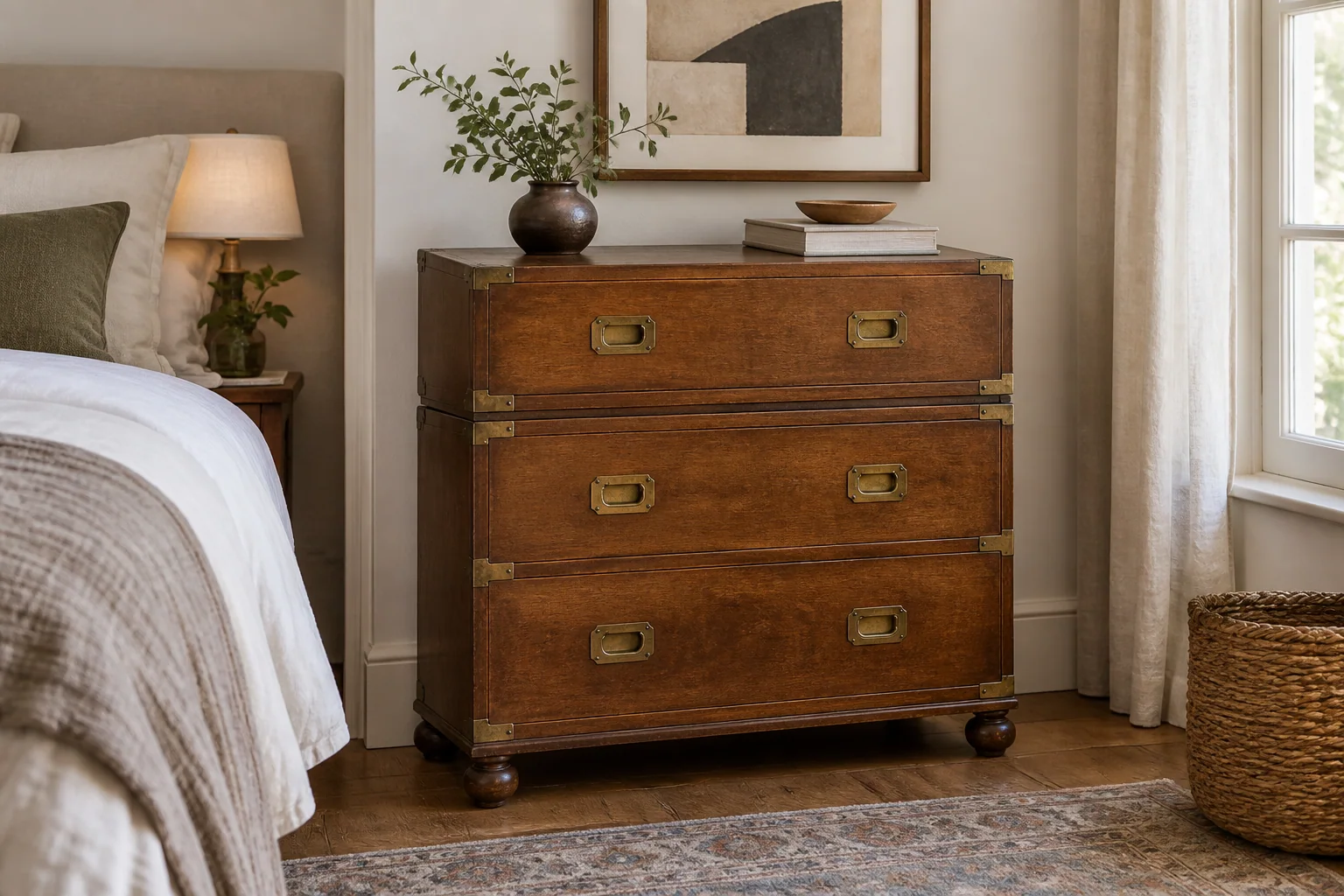
An appealing story needs an object to support it
A chest that divides into manageable sections offers an obvious advantage when moving. Christopher Clarke Antiques records one campaign chest as two parts with removable feet and locating fittings. The details of those fittings vary between examples; the specialist’s description is valuable because it concerns a particular object.[1]
That does not make every brass-bound chest a travel chest, or every two-part one a documented military possession. Keep four statements separate: it has a campaign appearance; its construction is intended to separate; a maker or period is supported; a particular ownership history is documented. A listing can reasonably establish the first two while leaving the others open.
Ask what evidence accompanies a historical claim. An old invoice, contemporary label or ownership document may provide a research lead. A seller repeating the same story as a previous advertisement does not add independent evidence.
What is included when the chest comes apart?
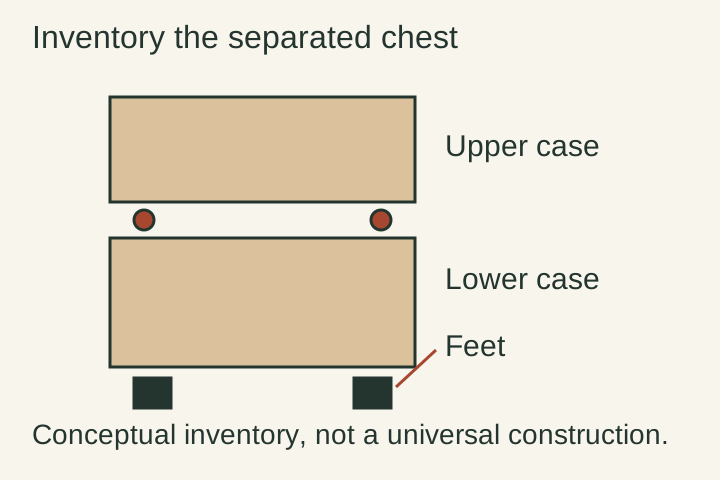
| Part | Question to resolve |
|---|---|
| Upper and lower cases | Do dimensions, joinery and contact surfaces make sense together? |
| Locating fittings | Which parts align or restrain the sections, and are they present? |
| Feet and their attachments | Are all required feet included and their connections sound? |
| Drawers and recessed pulls | Do they belong, operate normally and remain securely attached? |
Have the seller show the intended separation and reassembly, or supply photographs made during a previous move. Do not lift a case by a drawer pull or a decorative carrying-looking fitting without knowing that the construction supports it. A chest can be transportable without every visible handle being a lifting point.
If a foot is missing, obtain a quote for the actual attachment and finished height. A visually similar replacement may have an incompatible fixing or leave the chest uneven. Keep loose parts identified during transport; a small bag of fittings can determine whether the handsome cases become usable furniture again.
A neat horizontal join deserves a closer look
Compare the width and depth of both cases, the position of locating parts and the way the drawer fronts relate across the division. Differences are reasons to investigate, not automatic proof of a marriage. Repairs, replaced feet and later refinishing can change the appearance of a single chest.
Ask for photographs of the rear, underside and surfaces between the sections where they can be shown safely. These views may reveal repairs or alterations absent from the front. If the cases have been fastened together permanently, ask why and have the effect on future moving and repair assessed.
The purchase question is whether the complete assembly is sound and useful to you. The historical question is whether its parts and claimed history are supported. A good answer to one should not be used to skip the other.
Decide whether the split construction helps your home
Measure the drawers internally and check the complete height beside your bed or dressing area. Recessed hardware can be pleasant in a small room, but a relatively shallow drawer may not suit bulky knitwear. Try a realistic folded stack rather than treating every drawer as equivalent capacity.
In an illustrative comparison, a sound later chest with complete feet may be the easier daily purchase than an earlier chest with uncertain case alignment and missing fittings. The earlier object could still be a rewarding project if the repair scope and historical evidence justify its price.
A useful description to request
Please distinguish the supported maker, age and ownership claims from the campaign-style description. Show the separate cases, all feet and locating parts, and explain any changes that affect dismantling or use.
The romance of furniture that could travel is part of its charm. You can enjoy that idea while being precise about the chest that is actually coming through your door.