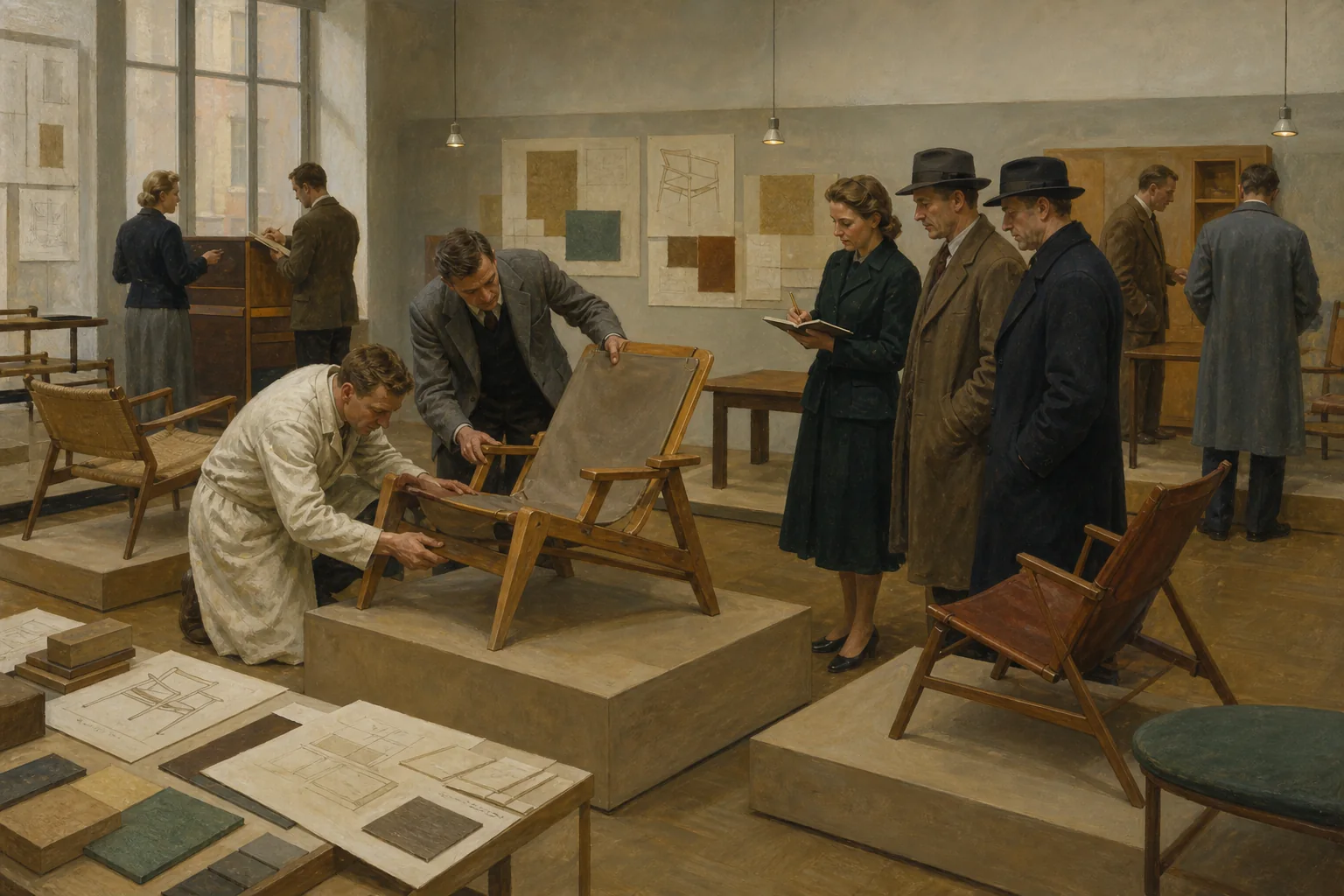
The short answer
The Furnituremakers Danish Control mark identifies a quality-control system, not a designer. Furn-tech, the organisation that continues the programme, describes it as a voluntary system established in 1959. Participating members could use its trademark after accepting requirements concerning furniture quality and production control.1
For a collector, a genuine mark fixed to an object can support that the piece was presented under the Danish control scheme. When it appears beside a maker's own mark, the combination may also help test a manufacturer attribution. The control mark does not, by itself, name the designer, identify the model or manufacturer, fix a production year, or prove that every component is original.
That distinction prevents a common research mistake. A label is evidence. It is not a complete attribution.
First separate the identities
Before searching for a logo, write down the identities you are actually trying to establish:
- Designer — the person or studio credited with the design.
- Manufacturer or cabinetmaker — the workshop or factory that made the object.
- Model — the design's number or documented name.
- Production date — when this particular example was made, which may be years after the design date.
- Seller, retailer or exporter — the business that handled the object, but did not necessarily design or manufacture it.
One label may answer one of these questions. It rarely answers all five. A later production piece can be a legitimate example of an earlier design; a retailer's label can document a route to market without identifying the factory; and a quality-control mark can say something about manufacture while saying nothing about authorship.
What the Danish Control mark can support
The control programme was created in 1959, according to Furn-tech, in response to quality concerns raised by American furniture dealers. Its work concerned materials, production processes and product quality, and participation was voluntary rather than automatic for every Danish furniture company. 1
This gives the mark a specific role in an evidence chain:
- it is consistent with the object having been presented under a Danish quality-control programme;
- the mark itself cannot predate the programme's creation, although that fact alone does not date the object;
- it may help connect an object to a participating manufacturer when a maker's own mark appears beside it;
- it gives the collector an exact phrase to compare with documented examples.
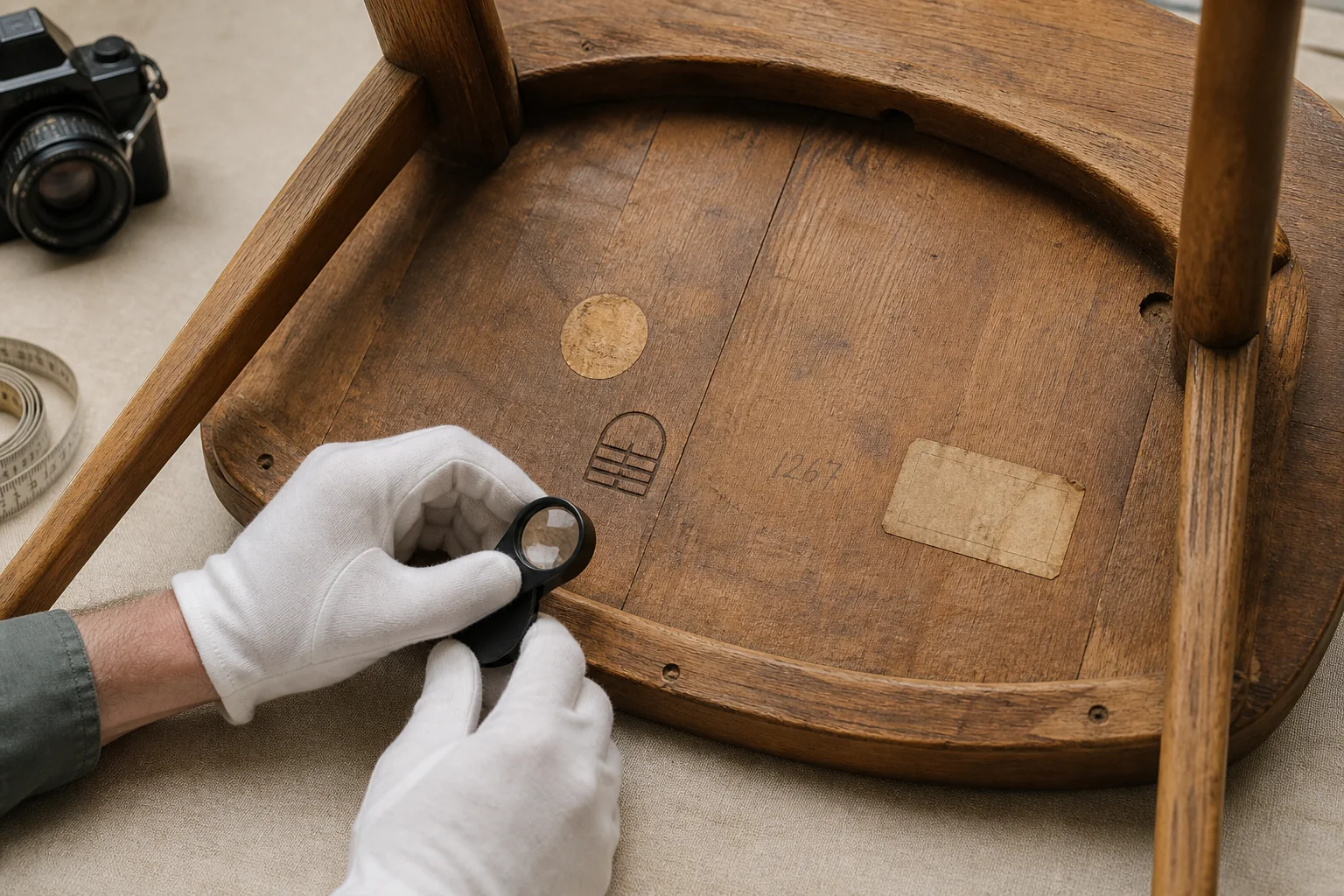
The wording itself matters. Record every visible line, the shape of the border, the printing method, the colour, and whether the mark is paper, foil, ink, a burned brand, or an inset disc. Do not "improve" a faint transcription. An uncertain letter should remain uncertain in your notes.
What it cannot prove
The Furnituremakers Danish Control mark is not a signature by Hans J. Wegner, Finn Juhl, Børge Mogensen, Arne Jacobsen, or any other designer. It is also not a model number. A generic control mark beside an unidentified chair does not turn that chair into a documented design.
It cannot establish all of the following on its own:
- who designed the furniture;
- which workshop made it, unless a separate maker identity is present;
- the exact year of manufacture;
- whether upholstery, hardware, finish, feet, drawers, or other parts were replaced;
- whether the label has always belonged to this object;
- whether the object matches the construction and dimensions of the claimed model.
The last two points are why label research cannot stop at a close-up. A mark must make sense with the whole object: its construction, materials, measurements, age, documented variants, and ownership history.
One object can carry several histories
A chair in the Museum of the Home provides a useful documented example. The museum records a Fritz Hansen maker's stamp, a Furnituremakers Danish Control label, a separate white paper label, and a temporary museum inventory label on the underside of the same seat. The object record distinguishes the designer, manufacturer, retailer, design year and approximate manufacture date rather than asking one label to do all the work. 2
This is the right way to look beneath a chair or inside a cabinet: not for one magic stamp, but for layers created at different moments.
Manufacturer's mark
A burned brand, ink stamp, metal badge or printed factory label may identify the maker. Photograph it square-on and then search the exact visible spelling. A maker can have several marks over time, so visual similarity is only a starting point.
Model and production codes
Numbers may identify a model, a batch, a finish, a factory order, or nothing useful outside the manufacturer's own system. Decode a number only when a maker catalogue, archive, museum record or reliable specialist source explains that numbering scheme. Do not convert a plausible-looking sequence into a date by intuition.
Retailer, distributor and export labels
These can be valuable provenance clues. They may indicate where the furniture was sold or exported, but they are not automatically the maker's label. Search the business independently and note whether the wording says manufactured by, made for, distributed by, imported by, or simply gives an address.
Inventory, moving and restoration labels
Auction-room stickers, household inventory numbers, shipping labels and restorer's notes belong to the object's later life. Keep them in the record. They may explain ownership or movement even when they contribute nothing to designer attribution.
Where to look without damaging the piece
Use a torch and a mirror before moving heavy furniture. If an object can be handled safely, common inspection areas include:
- beneath a chair seat and on the inner faces of seat rails;
- under a table top, around the apron, and beneath extension leaves;
- inside the top drawer, behind drawers, and on the cabinet back;
- under a cabinet base or plinth;
- beneath removable cushions and on original upholstery decking;
- around hardware, brackets and knock-down connections.
Do not scrape finish, remove upholstery, prise off a badge, or detach a paper label to obtain a better photograph. If a chair or table is unstable, the first task is safe handling, not attribution.
Build an evidence packet before searching
The most useful collector record is small and repeatable:
- Photograph the complete object from the front, side, back and underside.
- Photograph every mark in context, then take a straight close-up with a scale beside it.
- Record overall dimensions and the dimensions of distinctive parts.
- Photograph joinery, drawer construction, hardware, upholstery layers and repairs.
- Transcribe marks exactly, preserving uncertain characters.
- Record the seller's attribution and provenance as claims, not facts already proved.
- Keep the original files; do not rely only on cropped marketplace images.
This packet allows another researcher to disagree productively. It also stops the mark from becoming detached from the object it is supposed to identify.
Cross-check in the right order
Begin with the manufacturer if the maker's mark is legible. Look for a period catalogue, current manufacturer archive, museum collection record, or a documented exhibition catalogue. Then search by model number and dimensions, and only then compare small construction details.
Designmuseum Danmark's Furnitureindex is useful for finding Danish designers, furniture and interiors across more than 12,000 records. Treat it as a research index and continue to the underlying documentation where the attribution has financial or historical importance.3
Image matching can help produce hypotheses, but a repeated online attribution is not independent evidence when every listing copies the same earlier listing. Prefer sources that identify the designer, maker, model and date separately.
What an absent label means
Absence is not a verdict. The control system began in 1959, so earlier objects cannot be expected to carry its mark. Participation was voluntary, and paper or foil labels can be lost during use, refinishing or reupholstery. Some documented furniture is branded by its maker without the control label; other examples may have no surviving mark at all.
An absent label therefore lowers one kind of evidence. It does not prove that an object is a copy. Conversely, a surviving label raises a useful question; it does not settle every question.
Questions worth asking a seller
- Can you provide an uncropped photograph of the mark and the surrounding construction?
- Is there a separate manufacturer's mark or model number?
- What parts, finish or upholstery have been replaced?
- Are the stated date and designer supported by a catalogue, archive or invoice?
- Does the provenance apply to this exact object or only to the model?
- Can you provide dimensions and underside photographs before purchase?
A careful seller may answer "unknown" to some of these. That is more useful than certainty built from one round label.
Continue with exhibition records
Marks tell one part of the story. Period catalogues can connect a design to a named architect, cabinetmaker and exhibition year. The next article explains how collectors use the Copenhagen Cabinetmakers' Guild exhibition records without turning a model history into the provenance of a particular object.