Define the job before inspecting the material
Write down what the exact piece must do: display only, occasional guest seating, daily dining, a working chair, a child’s object, a light shade or another job. Record the user, frequency, expected load, moving and cleaning, sunlight and heat, and whether failure could injure someone or damage another object. The same visible change can be tolerable in a display object and unacceptable in a load-bearing seat. Do not let an attractive form decide the consequence for you.
Set the decision boundary
- UseName the exact task, user and frequency; ‘a chair’ is not enough to distinguish display from daily seating.
- Load and movementRecord whether the piece must carry a person or object, flex in ordinary operation, swivel, stack, fold or be moved often.
- EnvironmentDescribe direct sun, radiators, warm glazing, damp, cleaning products, pets, children and contact with other surfaces.
- Failure consequenceState what happens if a shell, insert, base, fixing, shade or surface fails during the intended use.
- Accepted ageSeparate colour variation, scratches and an old visible repair you can accept from changes that affect the job.
Use boundary
Do not use price as a strength test
A high estimate, famous design, seller assurance or low price cannot establish that an ageing shell and its connections can safely perform your intended job.
Preserve the material and production claim
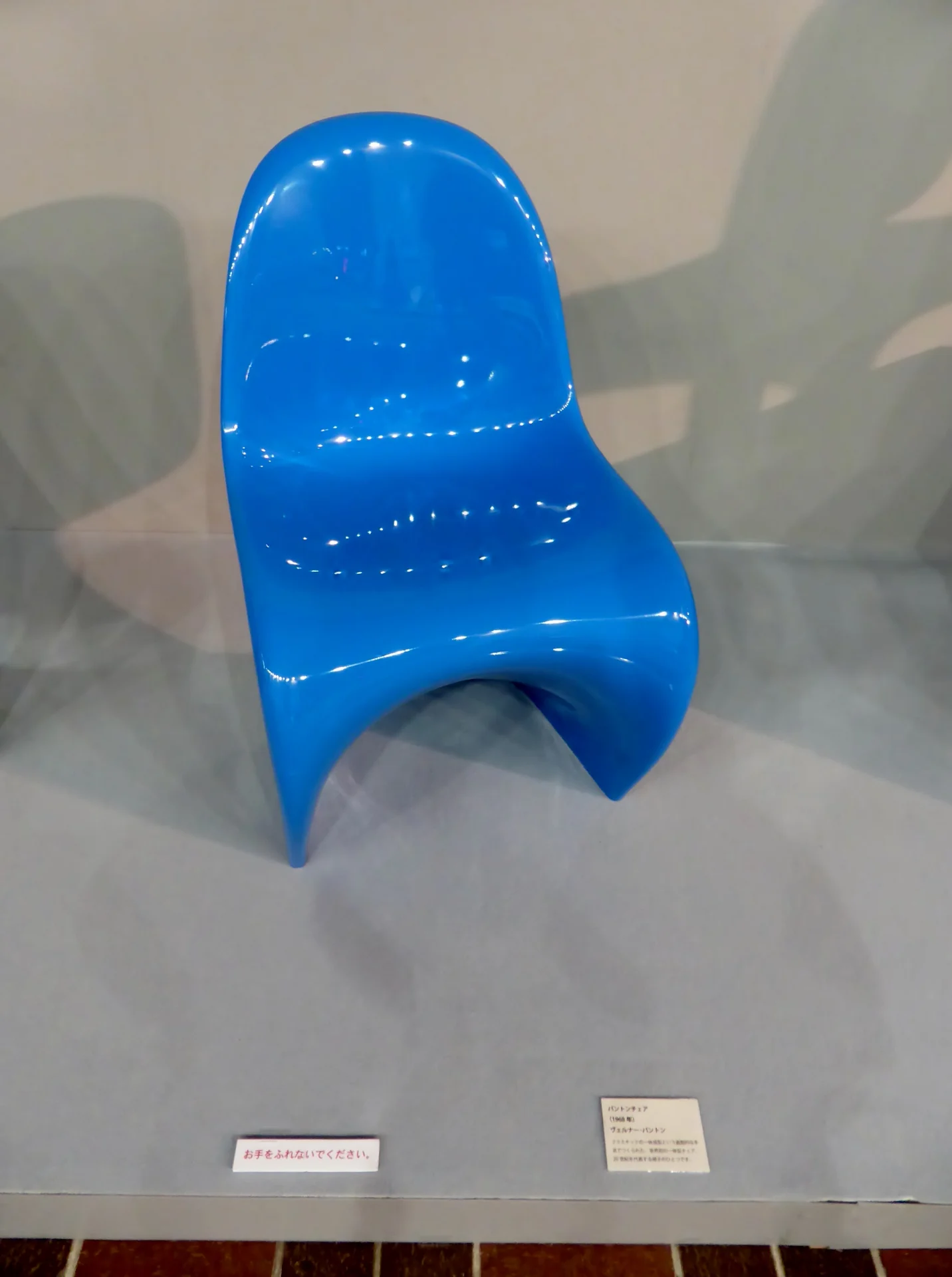
Vitra’s history of the Panton Chair documents a glass-fibre-reinforced polyester pilot series, rigid polyurethane production from 1968, a later thermoplastic version that suffered ageing and weathering problems and was discontinued in 1979, and polypropylene production from 1999. This is a useful warning against material identification by silhouette: one documented design can span several materially different generations.[3]
Read the documented changes in context in the Panton Chair Furniture Library story. Its history belongs to that design; the inspection method here still begins again with the exact object for sale.
Copy the complete seller wording before shortening it. ‘Plastic’, ‘fibreglass’, ‘acrylic’, ‘Perspex’, ‘Lucite’, ‘polyurethane’, ‘ABS’ and ‘polypropylene’ are not interchangeable, and a trade name may describe a family, a component or a seller’s shorthand. Ask which exact part the term covers, who supplied the identification, and whether a label, invoice, catalogue, manufacturer record or previous treatment document connects it to this object.
| Record type | What belongs there | What it cannot become |
|---|---|---|
| Observation | Blue moulded shell; glossy face; dull underside; hairline beside the fixing | A polymer name, cause, strength or date |
| Seller report | ‘Polypropylene’; bought in 2004; repaired before current ownership | A verified fact unless the evidence supports it |
| Documentary evidence | Complete label, dated invoice, catalogue or manufacturer record linked to this model and component | Automatic proof that every part is original or sound |
| Buyer inference | The sheltered underside appears less faded than the exposed face | A diagnosis of ultraviolet damage or remaining life |
| Professional assessment | Named examiner, method, access, findings and limits | A broader conclusion than the examiner accepted |
Inventory the shell, base, joints and finish
Give every component a stable identifier before describing condition. A one-piece appearance may conceal joined mouldings, embedded reinforcement, threaded inserts or a separate surface layer. Photograph the complete front, rear, sides, top and base; add the safely visible underside and every transition where the load moves from one material or thickness into another. Do not dismantle the piece to complete the inventory.
| Component | Record | Decision-changing unknown |
|---|---|---|
| Shell or body | Number of visible parts, seams, thickness changes, edges and openings | Whether a crack or distortion crosses a load path |
| Base or support | Material claim, stance, feet, levelling and attachment to the body | Whether instability comes from the floor, a missing foot, fixing or structure |
| Joints and inserts | Visible fasteners, embedded plates, holes, collars and local cracking | Concealed reinforcement and the extent of movement or corrosion |
| Finish or surface layer | Colour, gloss, translucency, texture, coating edges and later paint | Whether a layer is original, compatible, active or concealing repair |
| Upholstery or padding | Cover, foam, adhesive, attachment and accessible backing | Hidden shell condition and degraded foam or adhesive |
| Labels and marks | Whole mark, location, attachment and surrounding surface | Whether it belongs to this component and production period |
Use the furniture-photography Guide for a whole-to-detail image sequence and the marks and labels Guide for object-specific mark evidence. Neither turns a moulded resemblance into an identification.
Compare whole, stressed and sheltered zones
The Canadian Conservation Institute advises treating plastics as fragile and paying particular attention to cracks and crazing, especially near joints, paint and labels. Its guidance also cautions against flexing and vibration. For a buyer, that supports a visual comparison rather than a stress test; it does not certify a particular piece for use.[2]

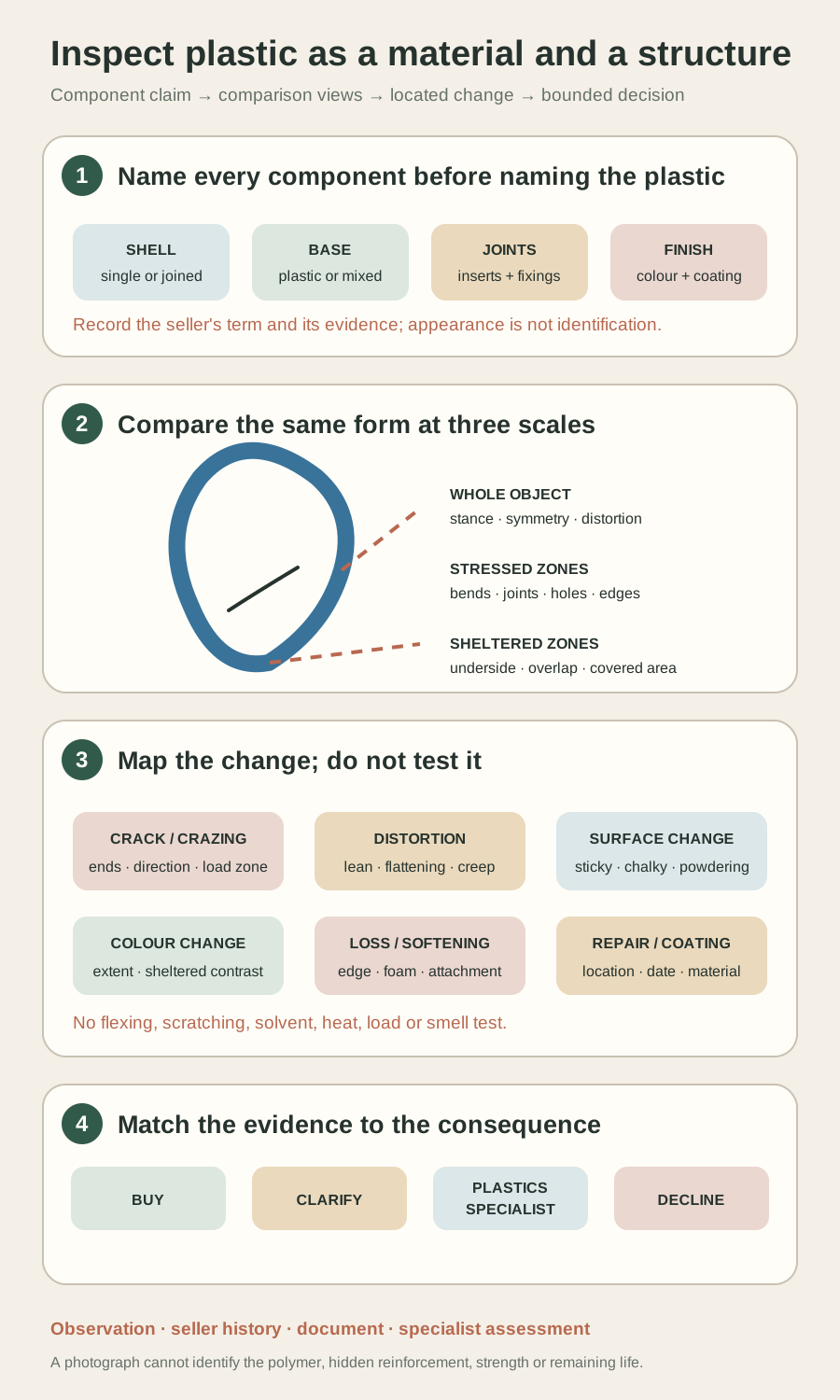
Repeat the same comparisons
- Whole formRecord stance, lean, symmetry, flattening, sag and how the piece meets a level floor without loading it.
- Bends and thickness changesFollow moulded curves, sharp transitions and thin edges where stress may concentrate in ordinary use.
- Joints, holes and insertsUse diffuse and raking light to locate radial cracks, whitening, crushing, gaps, corrosion staining and previous work.
- Sheltered comparisonsCompare the underside, an overlap, the area beneath a cushion and other naturally covered surfaces without lifting bonded material.
- Repeated componentsCompare left with right, matching feet, several chairs or repeated fixings while preserving the identity of each view.
Map the change without naming the cause
Canadian Conservation Institute guidance notes that plastics and rubbers can deteriorate in very different and sometimes unpredictable ways, including brittleness, cracking, shrinkage, chalking, dusting and sticky surfaces. These are condition words a buyer can record. They are not a visual recipe for polymer identification or a diagnosis of why the change occurred.[1]
| Visible or reported change | Record without intervention | Keep unresolved |
|---|---|---|
| Crack or crazing | Ends, direction, branching, width reference and relation to bend, edge, hole, insert or load path | Depth, cause, progression and remaining capacity |
| Distortion | Lean, sag, flattening, twist, contact with the floor and comparison with a matching side | Original form, cause and reversibility |
| Sticky or glossy deposit | Exact area, sheen, adhered dust, transfer already visible and seller’s history | Composition and whether the material or a later product is changing |
| Chalky or powdering surface | Distribution, colour, loose material already present and exposed-versus-sheltered contrast | Cause, safe cleaning and depth of deterioration |
| Colour or translucency change | Boundary, gradient, spotting and comparison under neutral light | Whether change is material, coating, soil, heat or light related |
| Loss, softening or exposed core | Size, edge, debris already detached and relationship to use or attachment | Internal extent and safe consolidation or replacement |
| Repair or coating | Location, edge, colour, texture, fastener, seller date and available record | Material compatibility, hidden preparation and structural performance |
Language boundary
‘Consistent with’ is still an inference
It is reasonable to say that one face is more yellow, one fixing has radial cracks or a surface is tacky. It is not reasonable to turn those observations into an exact polymer, exposure history, repair prescription or remaining-life claim without the evidence and competence to do so.
Ask for history and previous work
Seller history matters because cleaning, heat, direct sun, storage, impacts, repeated loading and earlier repairs may change both the condition and the safe next question. Ask for dates and documents, but label every answer as reported unless it is independently supported. ‘Always indoors’ may be useful history; it does not erase a crack you can see or prove what happened before the seller owned the piece.
Request a bounded history
- Ownership and storageAsk when the seller acquired the piece and where it was kept, including direct sun, warm glazing, heaters, damp spaces and seasonal storage.
- Use and movementAsk whether it was used for seating or display, stacked, folded, transported often, dropped or subjected to a known overload.
- Cleaning and productsRequest named products, method and dates for polishes, solvents, adhesives, paint, stain removal and abrasive cleaning.
- Change over timeAsk when cracks, distortion, stickiness, powder, colour change or odour were noticed and whether dated earlier photographs exist.
- Repair and replacementRequest provider, date, materials, invoice and before-and-after views for filling, bonding, reinforcement, refinishing and replaced parts.
Compare the report with the mapped object. A dated photograph showing that the end of a crack has moved is evidence of change; a memory that it ‘has always looked like that’ is not the same record. An invoice may document a material and method, but only when it can be matched to the exact component and visible work.
Stop before testing, cleaning or repair
The Canadian Conservation Institute warns that abrasive cleaning can scratch plastic and that a solvent can cause stress cracking in a susceptible polymer; degraded sticky surfaces can also attract and bind dirt. The transferable buyer lesson is restraint: an unknown surface should not become a cleaning trial during inspection.[2]
Do not ask the object to prove itself
- No flex or load testDo not bend an edge, spread a base, bounce, rock, sit or add weight to see whether a crack moves.
- No scratch, flame or heat testDamage and fumes are not acceptable identification tools, and the result would not establish the whole construction.
- No solvent or cleaner spotWater, alcohol, acetone, adhesive remover, polish and household cleaner can alter an unknown polymer, coating or repair.
- No close smell testRecord an odour noticed at ordinary distance and stop if there is irritation, visible deposit or unknown exudation; do not inhale deliberately.
- No dismantling or hidden probeDo not remove a base, fixing, upholstery, cap or label simply to discover reinforcement or condition.
| Question | Appropriate assessment | Useful remit |
|---|---|---|
| What material or surface is present? | Plastics or furniture conservator, material specialist or documented manufacturer authority | Component, identification method, confidence and limitations |
| Can this repaired or cracked part carry the intended load? | Competent furniture or structural repair professional familiar with the construction | Exact use, load path, access, repair record and written limits |
| Is a sticky, powdering or odorous surface safe to handle? | Appropriate conservation or occupational/material-safety professional | Observed area, exposure circumstance and handling question without buyer sampling |
| How should it be cleaned or treated? | Material-appropriate conservator after examination | Known material, surface, previous products, intended appearance and maintenance limit |
Request the record and make a bounded decision
Message to copy
Ask for a complete plastic-furniture record
Hello—I’m considering this exact piece for [display / occasional / daily use]. Could you copy the complete material, maker, model and date claims and say what evidence supports each one? Please identify the shell, base, joints, inserts, finish, upholstery and labels, then send complete front, rear, side, top, base and safely visible underside views. Could you add whole, area and close photographs with a non-contact scale for every crack, crazed area, distortion, sticky, chalky or powdering surface, colour change, loss, exposed core, repair and replaced part, including its nearest bend, edge, hole, fixing or sheltered comparison? Please describe known use, loading, heat, sun, damp, storage, cleaning, impact and repair history, with dates, products, invoices and earlier photographs where available. Please do not flex, load, sit on, scratch, heat, smell closely, clean, solvent-test, dismantle or repair the piece for my request, and mark every unknown explicitly. Thank you.
| Decision | Appropriate when | Record |
|---|---|---|
| Buy | The component map, intended use, visible condition, accepted wear and documented work support a tolerable commitment | Evidence set, accepted unknowns, use limit and care or transport boundary |
| Clarify | One missing face, sheltered comparison, component claim, crack endpoint or history item could change the decision | One exact follow-up tied to the component identifier |
| Specialist before purchase | A load path, progressive change, sticky or powdering surface, concealed reinforcement or repair is consequential | Named remit, access, evidence, method limits and written conclusion |
| Decline | Safe evidence, suitable use, specialist access or a tolerable condition and repair range is unavailable | The unresolved fact and consequence without inventing a diagnosis |
Vintage plastic furniture can preserve an extraordinary line, colour and manufacturing history. The aim is not to reject every scratch, fade or old repair. It is to keep the object’s appearance, the seller’s words, the documentary record and any professional conclusion in their proper places—then buy only when those places support the job you expect the furniture to do.