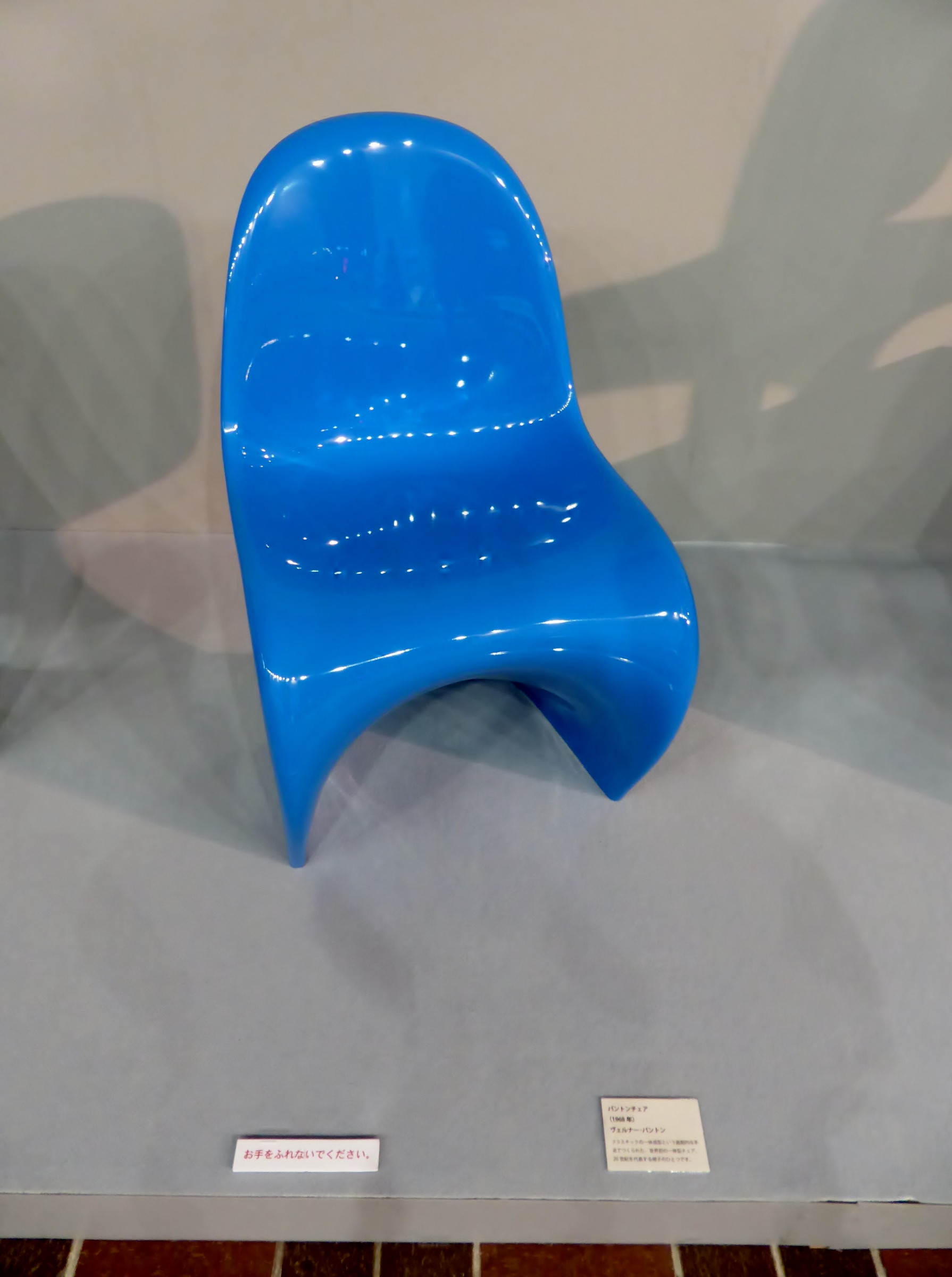
The curve carries the whole chair
The Panton Chair removes the visual hand-off between back, seat and base. One surface descends from the shoulders, hollows for the body, then rolls forward and under until it meets the floor. There are no rear legs. The lower curve must support the upper one as a cantilever, so the silhouette is also a diagram of how the chair stands.
That continuity is why the chair can look inevitable in a photograph. The Design Museum calls it the first cantilevered chair made from a single piece of plastic and connects its sleek form to the technical optimism of the 1960s. Yet the museum's date range, 1968–1999, already hints that the recognisable outline did not belong to one settled material object.4
The idea arrived before the process
Panton was pursuing a plastic cantilever in the late 1950s, years before Vitra accepted the project. According to Vitra's manufacturer account, the company and designer began collaborating in 1963. The difficulty was not merely drawing the curve. It was reconciling that curve with the strength, thickness, moulding and finishing limits of contemporary plastics.1
Vitra describes ten manually laminated, glass-fibre-reinforced polyester prototypes behind the final form. Prototype here did not mean a cosmetic trial of an already solved product. Each one tested whether an uninterrupted shell could carry a seated body without gaining supports that would break Panton's central idea.
The dates need the same care. Vitra labels the design 1959, while MoMA records its design as 1959–60. MoMA's illustrated object is a separate example made in 2004 from fibre-reinforced plastic and synthetic polymer paint. A design date can identify the enduring idea; it cannot date every chair that follows it. 3
The 1967 pilot was not mass production
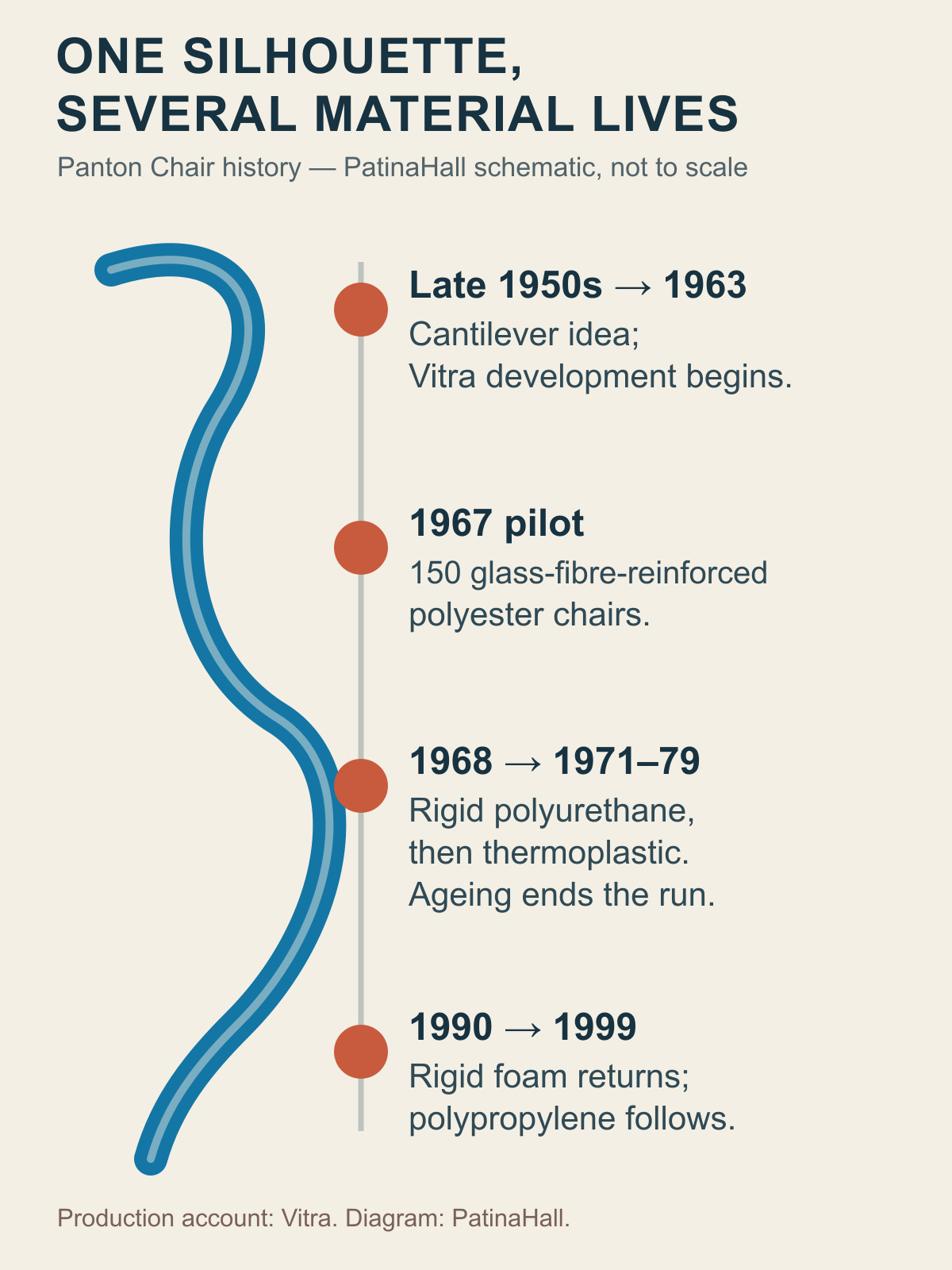
The famous first presentation in 1967 began with a pilot of only 150 chairs. Vitra says they were cold-pressed in glass-fibre-reinforced polyester. The method achieved the one-piece cantilever, but it remained costly and complex; demand could not be met simply by repeating it faster. 1
That distinction changes the usual story. The chair was technically real in 1967, but its industrial proposition was still unsettled. The pilot proved that the shape could exist. It did not yet prove that the shape could be made in quantity with an acceptable balance of labour, surface, strength and cost.
In 1968, tests with rigid polyurethane foam led to series production using a moulding process. Output could increase, although Vitra still records time-consuming manual finishing. The seamless object was not produced by a seamless process.
The material changed the silhouette
Vitra and Panton kept searching for a process with less finishing. A new thermoplastic offered injection moulding, but the available technology could not vary material thickness where the chair's forces demanded it. The design therefore acquired visible ridges in the transition between base and seat. 1
Those ridges are not decorative punctuation added to an otherwise unchanged icon. They record a negotiation between form, tool and material. The sweeping profile remained legible, but the surface had to confess what the new process could not yet do.
The current distinction between products preserves another material fork. Vitra describes the Panton Chair Classic as rigid polyurethane foam with a glossy lacquered surface, while the later polypropylene chair has a matt finish. The family resemblance is immediate; the substance, finish and slight flexibility are not interchangeable.2
Failure belongs to the design history
The thermoplastic solution did more than alter the chair's surface. Vitra says the material proved less resistant to ageing and weathering than expected. Chairs broke, the quality problem threatened the manufacturer's reputation and production stopped in 1979.1
That episode resists the clean mythology of an icon perfected at first launch. Industrial design continues after a photograph, a prize or a magazine debut. The chair must survive bodies, time and environments. When it did not, the failure exposed a gap between the promise of injection moulding and the performance of that particular material version.
Nor should the failure be projected backward onto every Panton Chair. It belongs to a documented production phase. The pilot polyester, rigid polyurethane, ageing thermoplastic and later polypropylene versions share a design history without sharing one risk profile.
A design can outlive its first substance
Interest in the chair survived the discontinuation. Vitra resumed production in 1990 using rigid polyurethane foam again, accepting its more complex finishing in exchange for greater resistance to breakage. In 1999, after further development with Panton, it presented a polypropylene version. 1
The return clarifies what remained constant. It was not the 1967 material, the 1968 method or the ridged thermoplastic surface. It was the ambition to make back, seat and support read as one continuous plastic cantilever. Materials were replaced in order to keep testing that ambition.
This is also the limit of the documentary photograph. A later blue chair can show the curve with great clarity, but appearance alone cannot assign it to a production phase or prove its formulation. The permanent design and the dated physical example must remain separate. That separation does not weaken the Panton Chair's identity. It explains how the identity endured.
