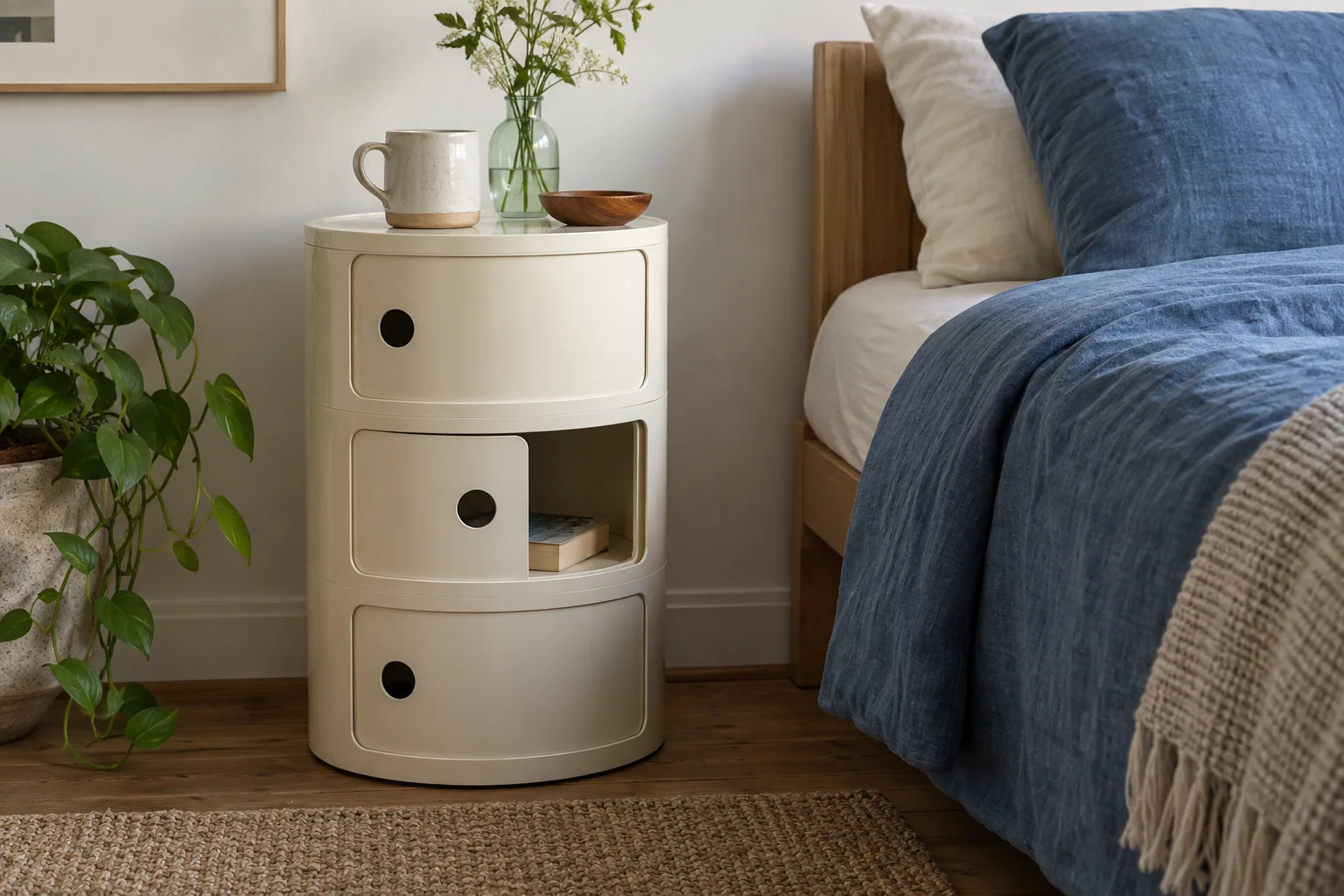
The family name covers more than one storage arrangement
Kartell dates the Componibili family to 1967. Its current Classic page describes round storage with a 32 cm diameter, offered in specified configurations. That contemporary reference does not establish the dimensions, material or modular connections of every older piece.[1]
Ask for an overall view, underside information and photographs showing the joins between sections. Have the seller explain whether the object comprises separate modules, a fixed assembly or a mixture of parts. Do not start pulling tiers apart because the name suggests modularity.
A small bedside unit and a larger modular stack may solve quite different storage problems. Identify the object first, then compare it with documented information for the appropriate version rather than the first current product page returned by a search.
Bring the book you want to keep beside the bed
Measure internal height, clear floor space and the door opening. Then try the objects you plan to store: a paperback, glasses case, charging accessory or small box. A rectangle can fit within a circle on paper yet be awkward to angle through a narrow opening in daily use.
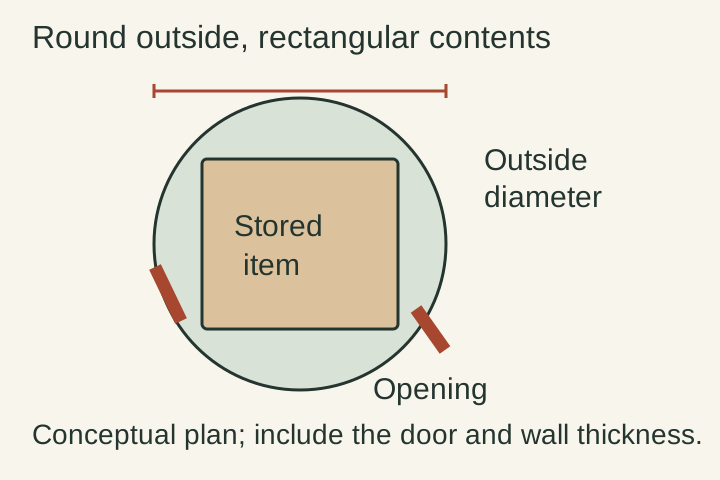
| Check | Why outside diameter is insufficient |
|---|---|
| Internal floor space | Walls and the curved plan reduce the useful rectangle. |
| Clear height | The compartment must hold the actual object, including its box. |
| Opening and door travel | You need a comfortable route to put it in and take it out. |
For a bedside position, check the top height against your mattress as well as the floor footprint. Keep enough space to reach the finger opening and slide the door. A unit trapped between a bed and a wall can be technically accessible but frustrating every evening.
Work every door without forcing the curve
Have the seller open and close each door through its normal travel. Look for sticking, scraping, a door leaving its track or a finger opening damaged by repeated pulling. Ask whether dirt, damage or an incompatible replacement has been identified; do not assume that every stiff door merely needs lubrication.
Examine visible edges, corners, joins and the underside for cracks, distortion and previous repairs. Avoid bending an edge or flexing a door to test whether the plastic is brittle. If a part is damaged, identify its version and a viable replacement before treating it as an easy missing piece.
Matching colour is not enough to establish compatibility. Ask for dimensions, material information and the particular connection or track profile needed. Confirm the availability of a suitable door or closing component before buying an incomplete stack.
Choose a finish you are willing to keep
Photograph the object in neutral daylight, including areas normally hidden by a door or adjoining part when these can be shown without dismantling. This helps you understand the colour difference you are buying. It does not identify the cause or prove that a surface treatment will reverse it.
If an old white unit has mellowed to cream and you enjoy that appearance, it may sit happily with timber and linen. If you require a bright, even white, a different example is a clearer purchase. Do not price the project around an unverified peroxide, abrasive or solvent recipe.
Ask the manufacturer or a plastics conservator about the identified material before attempting treatment. Paint or aggressive cleaning can change the surface and complicate later work; neither should be treated as a default cure for age.
The complete purchase
Confirm the included modules or fixed unit, every door, top and base component, normal operation and the actual colour. Add any identified replacements and delivery before comparing with a complete example.
The useful old piece is the one you enjoy opening as well as looking at. Its familiar round outline should make a small daily task easier, rather than become a permanent search for a matching door.