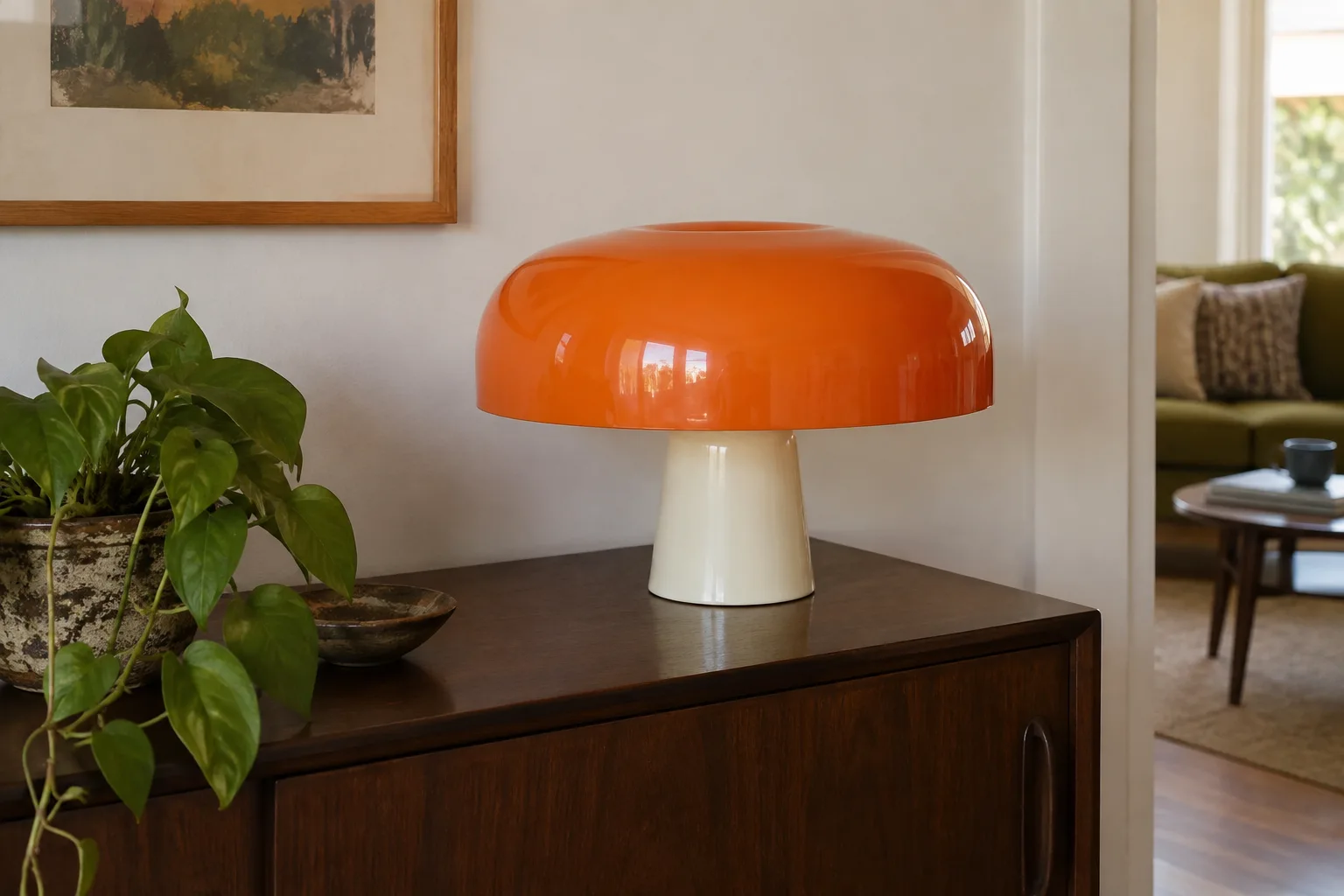
Start with the whole name and the whole lamp
Save the exact wording of the listing and photograph every readable label in its location. Does the seller name a model, designer, maker or simply a style? Preserve the spelling and any code rather than tidying an uncertain attribution into something more impressive.
iGuzzini traces its beginnings to Harvey Creazioni in Recanati in 1959. That history helps explain why a buyer may encounter different company names in research; it does not turn every lamp advertised as “Guzzini” into one maker’s documented product. Match the named lamp to a specific source.[1]
Ask for the front, side, back, base and a safe lower view of the shade. A single lit photograph is particularly unhelpful for judging its rim, supports and colour. Do not ask the seller to remove electrical covers or force old plastic apart.
A worked comparison: Clan is a design date and a reissue
iGuzzini’s current Clan table/floor page gives the historical design as 1968 and the reissue as 2023. For the current product it describes a thermoformed PMMA diffuser, PVC base and chrome-plated steel upper ring, with a diffuser that can be directed on the base. These specifications belong to that current record; they are not a blanket specification for every historical Clan.[2]
| Observation or claim | What the record supports | What remains open |
|---|---|---|
| Listing says “1968 Clan” | 1968 is the design year stated on the current page. | The manufacturing period of the offered lamp. |
| Lamp resembles the current product | There is a candidate design to compare. | Whether it is an older example, a reissue or a mixed assembly. |
| A replacement shade looks the right size | Its dimensions can be compared with the actual lamp. | Mounting, material, weight, clearances and version-specific suitability. |
The useful conclusion may be “a later authorised example of a 1968 design”. That is a perfectly coherent object to buy. It becomes a problem when the price or description depends on a historical production claim the evidence does not support.
Look at the shade with the lamp switched off
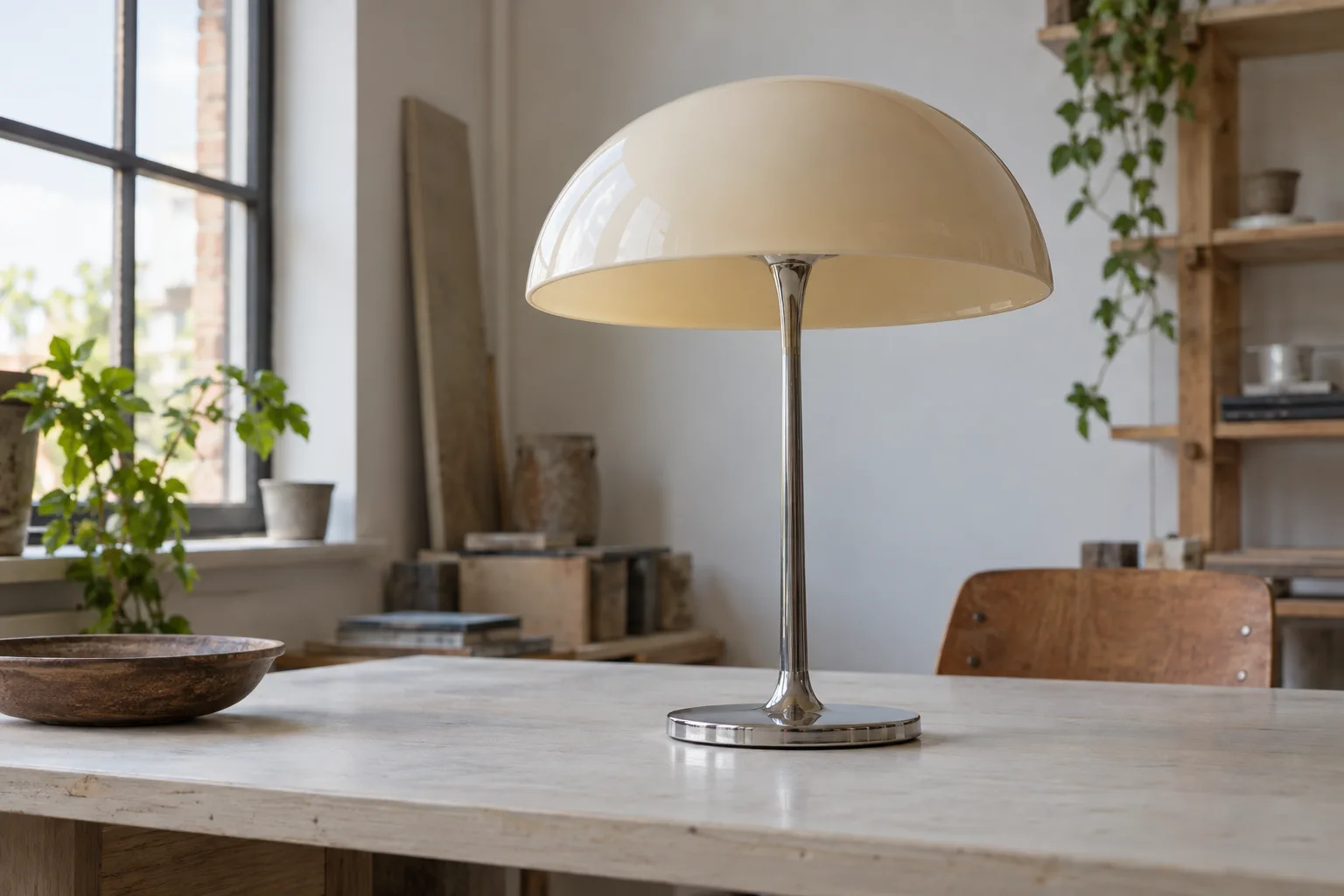
Ask about cracks around the attachment, chips along the edge, distortion, colour differences and previous gluing. Request the seller’s account of repairs and replacements alongside clear daylight views. A glowing shade can hide details that become obvious when it is unlit.
Do not flex the rim to see whether it is brittle. Do not assume yellowing is either desirable ageing or evidence of one particular plastic. Colour alone cannot establish the polymer or its condition. If a material question controls cleaning or replacement, have it resolved before a product touches the surface.
A substituted shade is not automatically a reason to decline. It changes the object you are buying. Ask for the replacement’s source, date and compatibility evidence, and decide whether you want a documented mixed lamp at the proposed price. “Fits” should mean more than “balances on top”.
A cheap base needs a real shade plan
For an incomplete lamp, send the actual dimensions and attachment photographs to the maker or a specialist familiar with that model. Ask whether the part is available for this generation, what is included and whether a sample or in-person assessment is needed. A current catalogue page is not an offer to supply a component for an older version.
Include the complete bill: shade, correct retaining components, professional electrical assessment, any accepted repairs, packing and delivery. A fabricated replacement may be a reasonable functional choice, but its cost and effect on the description need agreement. Leave the proposed purchase conditional when the shade is the unresolved part.
Finish the enquiry with servicing and packing
Keep attribution and electrical readiness as separate questions. Ask a qualified professional about the actual lamp’s suitability for your destination, light source and intended use. Do not transfer a modern product’s ratings or approvals onto an older example because the silhouettes match.
Agree how the shade will be protected and whether the seller’s safe packing procedure keeps it attached or separates it. The fragile part should not become a load-bearing spacer inside the box. Keep the pre-packing photographs and the component list with the purchase record.
Message to the seller
Could you send the complete lamp in daylight, the shade rim and support area, the base and all labels in context? What evidence supports the model and manufacturing period, and which shade, fittings or electrical parts have been replaced? Please confirm known repairs, any version-specific replacement source, the service record and how the shade will be packed.
Choose the lamp whose version, assembly and likely work you understand. The name is the beginning of the enquiry; the complete light is what comes home.