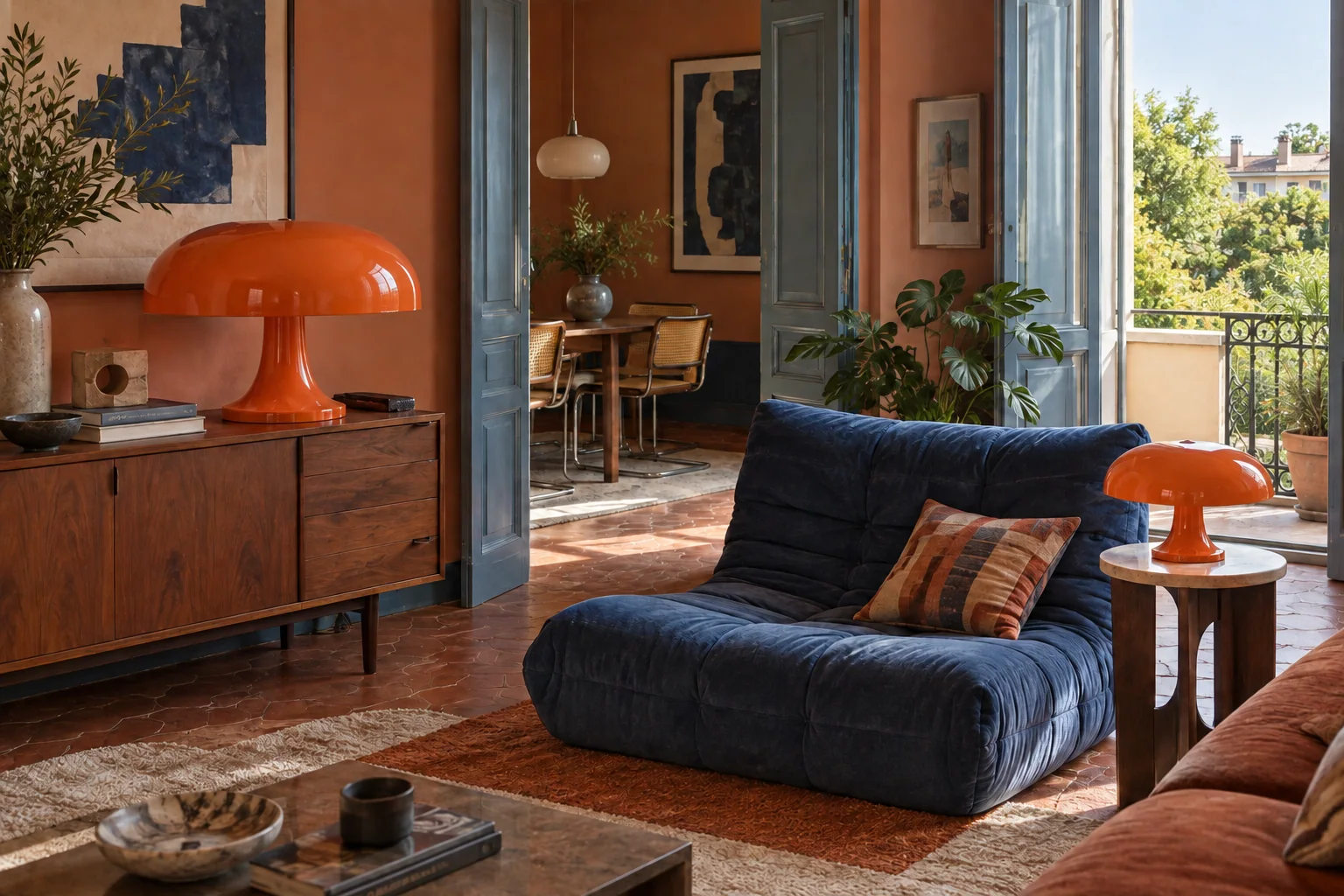
The larger dome needs a larger place
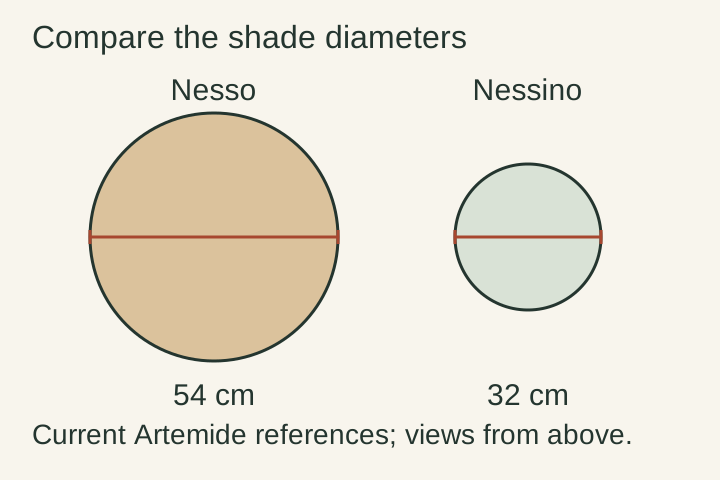
Current Artemide technical documents give Nesso a shade diameter of 54 cm and height of 34 cm. The current Nessino reference gives 32 cm and 22.3 cm. Use those figures to distinguish the documented products, then measure the actual older lamp: they are not a date stamp or a guarantee about every edition.[1]
| Model | Shade diameter | Overall height |
|---|---|---|
| Nesso | 54 | 34 |
| Nessino | 32 | 22.3 |
The diameter difference is 22 cm. If centred in the same place, the larger dome reaches 11 cm farther in every direction. That can put its edge into a curtain, doorway or the space above a bedside book even when the foot fits comfortably on the furniture.[2]
Use the outline, not a catalogue room
Cut or mark the measured shade footprint on a room plan and check the objects around it. On a narrow sideboard, a broad shade may project beyond the front edge; on a bedside table it may crowd your hand as you reach for a glass. Allow access to the switch and a sensible cable route as well as a place for the base.
If the lamp is cleared for use, look at it from the seated or lying position in which you will see it. A pleasant glowing object and a useful reading light are different requirements. Ask for a room photograph taken at that height if you are buying remotely, while remembering that camera exposure can make a lamp appear brighter or softer than it is.
Nessino may be the more useful scale for a small room without being a lesser purchase. The larger Nesso earns its space when you want the broad dome to be a substantial part of the composition.
Orange is a colour, not a production record
Ask for the complete underside information, any label and the lamp’s ownership or purchase records. Compare those with documentation for the proposed edition. Avoid attaching the design’s original date to an object merely because it has the expected outline.
A replaced electrical part or missing label does not settle authenticity by itself. Record what is present and what has changed. If you are paying a premium for an early example, the supporting history must do more work than the word “vintage” in a title.
Do not transfer a current material or electrical specification to an unidentified older lamp. Product families develop, markets differ and individual lamps get repaired. A source that identifies today’s Nesso cannot describe every object made under that name.
Look along the whole rim
Ask for the shade from above and below, with side light across the rim and around its attachment. Chips, cracks, distortion and old adhesive repairs are different from ordinary surface marks. A uniform orange photograph can conceal a damaged edge, so request the less flattering angles too.
Do not attempt to restore the colour with bleach, solvent or abrasive polish before the material and finish are understood. A replacement shade also needs confirmation for the exact lamp; a similar dome may have the wrong attachment or heat requirements.
| Decision | Evidence needed |
|---|---|
| Right size for the room | Measured shade, base and overall height. |
| Supported edition and age | Identification, whole-object comparison and records. |
| Acceptable physical condition | Complete shade, rim and attachment views. |
| Ready for daily lighting | Appropriate electrical assessment and correct light-source instructions. |
Ask for scale and condition in one message
Message to adapt
Please confirm the shade diameter and overall height, and send the underside information, whole lamp, rim and attachment photographs. What supports the model and production-period description? Have the shade or electrical parts been replaced, and what service work remains before use?
Choose the lamp whose dome belongs on your furniture. Its colour can be the first thing you love; its scale is what determines whether you keep enjoying it once it is home.