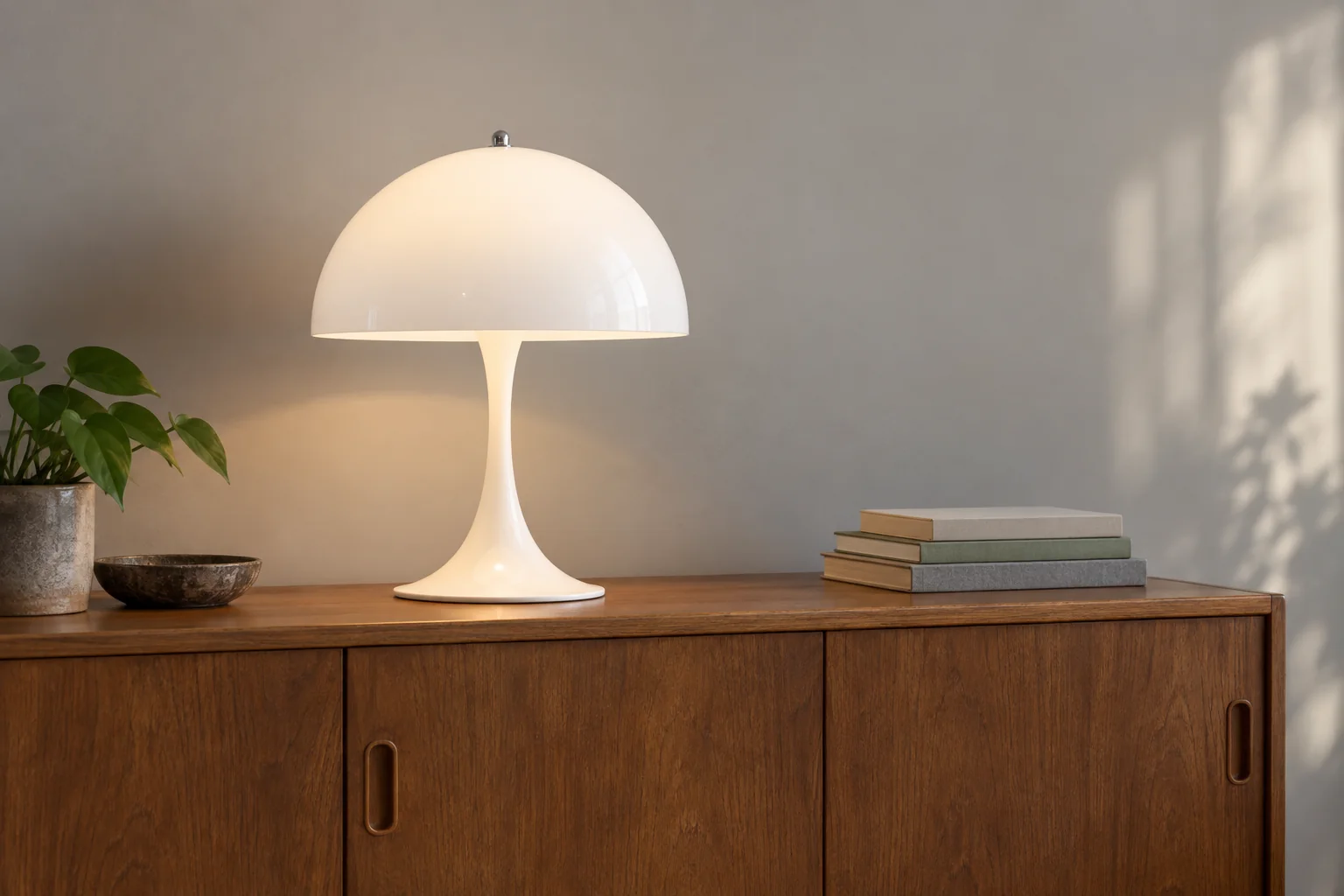
“Panthella table lamp” leaves several questions unanswered
A listing may show the white dome you recognise without making its size obvious. A tightly cropped image removes the surrounding furniture that would give scale. The first useful request is therefore simple: ask for the widest shade diameter, total height and a photograph of the entire lamp beside a ruler or tape, with its base fully visible.
Ask which model and production period the seller is claiming, then request the identifying labels and any purchase or service records. Treat the age of the design separately from the age of the lamp. A familiar design in later production can be an entirely legitimate second-hand purchase; the problem is an unsupported older date used to justify the price.
Be precise about the version you want to use. This guide concentrates on table lamps for a sideboard, bedside or seating area. A small portable lamp, a floor lamp and a larger mains-powered table version are different purchases, even if all are listed under the same family name. Confirm the power arrangement and the country for which the offered lamp was supplied.
A useful reply from a seller connects the model description, measurements and photographs to one item. If a listing uses a current manufacturer image alongside photographs of the used lamp, ask which details come from the actual object. The product image can help explain a design, but it cannot show missing parts or condition.
The dome is the measurement you notice in a room
For two current references, Louis Poulsen lists the Panthella 400 Table at 400 mm wide and 550 mm high; a published 320 Table specification gives 320 mm by 438 mm. The smaller reference is therefore 8 cm narrower and 11.2 cm lower. These figures help you compare scale, but an older lamp still needs its own measurements.[1][2]
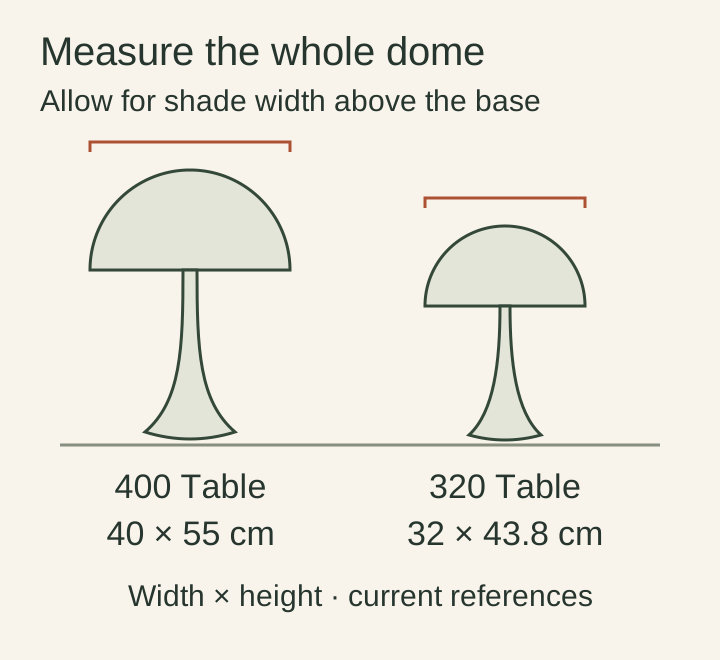
Try a paper circle the width of the proposed shade on your furniture. It gives a quick sense of the area occupied above the base. For example, a 40 cm circle centred on a 45 cm-wide surface leaves only 2.5 cm on either side in plan. That arithmetic is a space test, not a recommended safety clearance: the lamp’s stability, instructions and the route beside it still matter.
Check the depth as well. If the dome reaches towards the wall, the lamp may have to sit further forward than its base suggests. Under a shelf, compare the full height and the room needed to handle the lamp. Beside a bed, leave practical space for the things you put down each evening; a lamp that uses nearly the entire top may suit a different table.
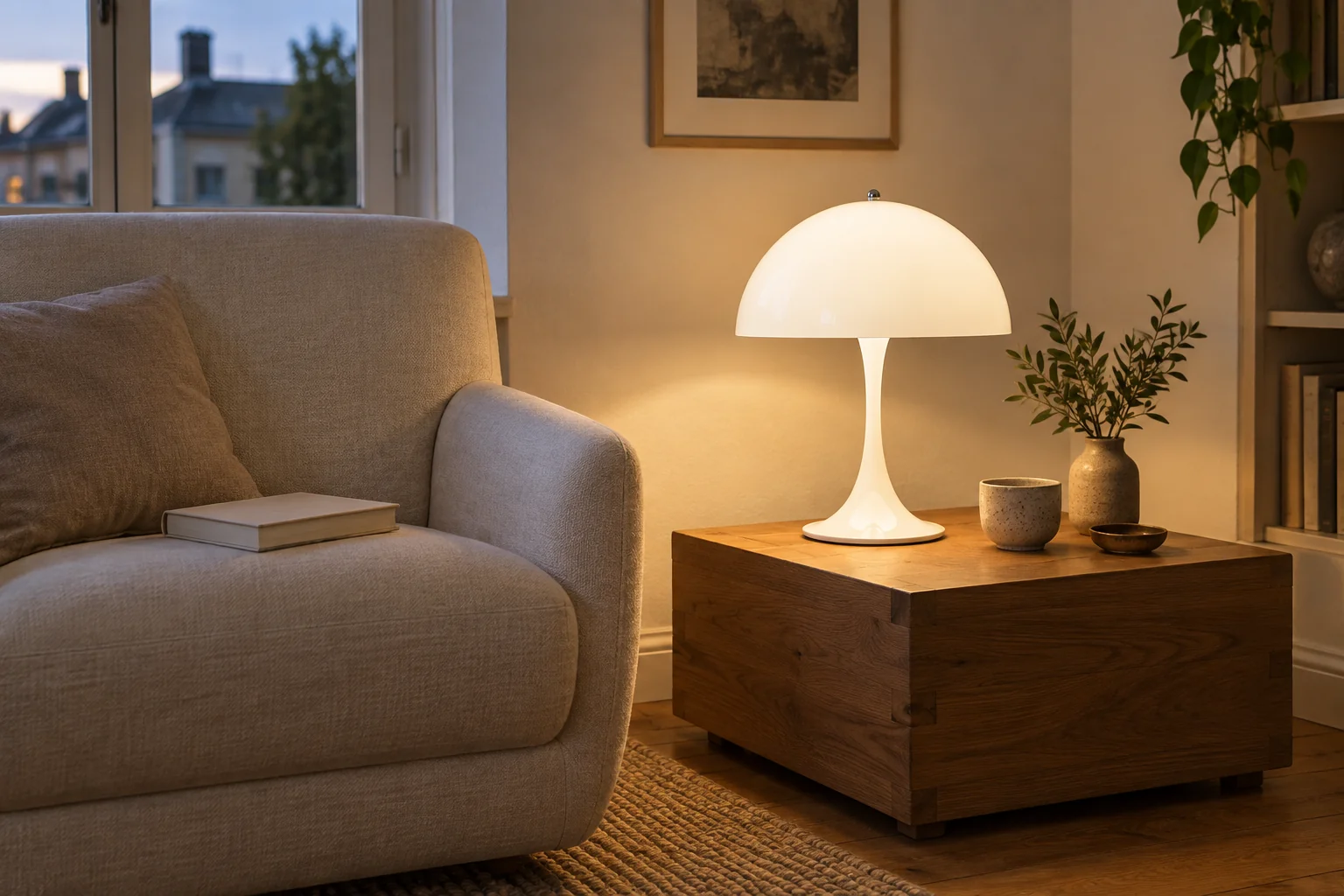
From a sofa, consider both the glow and the work you want the light to do. A broad illuminated shade can contribute to a comfortable corner, but it does not establish that the position provides enough light for reading. Try your usual seating height and page position with an electrically checked lamp before choosing it as your only reading light.
Ask to see the shade when it is not glowing
A lit photograph is useful for atmosphere, but it can obscure the edge and surface. Request unlit daylight views of the dome from several sides, the lower rim and the top fixing area. Look for chips, cracks, pronounced scratches, uneven colour and signs of earlier adhesive work. If a reflection is ambiguous, ask for another angle rather than deciding from a single bright streak.
Find out whether the shade is original to the offered example or a replacement, and whether there is a receipt or part reference. A properly compatible replacement may be a sensible practical advantage. It is still a change to record if you are comparing the lamp with an example sold for its original components.
Avoid buying a yellowed or scratched shade on the assumption that it can easily be polished or bleached back to new. The treatment depends on the actual material, surface and damage. Ask the manufacturer or a suitable specialist about that exact part before assigning a restoration cost. A damaged fixing area also needs assessment before the lamp is handled or used.
Keep electrical condition separate from how attractive the glow looks. Do not ask a seller to energise suspect wiring for a better photograph. Request the scope and date of any professional work, and arrange the appropriate inspection for your country and lamp before use. The vintage lighting inspection guide covers that handoff.
A shade of the right diameter is only the start
Louis Poulsen’s current 400 parts list separately names the top nut, shade holder, diffuser, bayonet base and shade. Several entries carry a V2 designation: the diffuser is listed as 5744167479 and the opal-white shade as 5744167505. A list containing versioned components is a reason to confirm the assembly, rather than assuming every part described as “Panthella 400” is interchangeable.[1]
| Offered condition | What needs confirming |
|---|---|
| Shade missing or replaced | Exact shade part and compatibility with the lamp’s holder and fixing arrangement. |
| Diffuser or holder missing | Which version is present, what else must be supplied, and who will fit the complete assembly. |
| Top fitting incomplete | The correct fitting and the condition of the surfaces it secures. |
| Several parts loose in a box | An identified complete assembly, not a promise that the pieces should fit together. |
Send a supplier the full-lamp photographs, label, dimensions and views of the existing fittings that can be taken safely without dismantling. Ask for written confirmation of compatible part numbers, availability and the total supplied-and-fitted cost where fitting is needed. If the supplier needs to inspect the lamp first, include that uncertainty in your purchase decision.
The distinction is particularly useful when two incomplete lamps tempt you to make one complete example. They may be different versions, and a visually convincing combination may still leave an unresolved fixing or electrical arrangement. Get the proposed combination assessed before buying the second lamp as a donor.
Compare what you will actually have at the end
For each offer, write a short completion note: purchase price, confirmed missing components, service, delivery and the remaining unknowns. Compare that with the price and documented condition of a complete alternative. If the replacement shade has not been identified or found, leave the cost unresolved; putting a hopeful number in the total does not make the part available.
Discuss transport before payment. Ask how the broad shade, its fittings and the base will be protected, who is responsible for packing, and whether a competent packer needs to separate any components. Do not improvise dismantling from a photograph. Request a condition record before packing so that a later crack or missing fitting can be discussed against something concrete.
A useful supplier enquiry
I am considering this used Panthella. Here are the measurements, label and photographs of its shade assembly. Which replacement parts are compatible with this version, what else is needed to complete it, and what would supply and professional fitting cost?
A complete, well-described lamp of a later date may offer more pleasure in daily use than a cheaper early claim with an unavailable shade. If you specifically want an older example, you can still choose it for that reason. Make sure its history is supported, its remaining work is understood and its broad dome belongs comfortably in the place you have chosen.