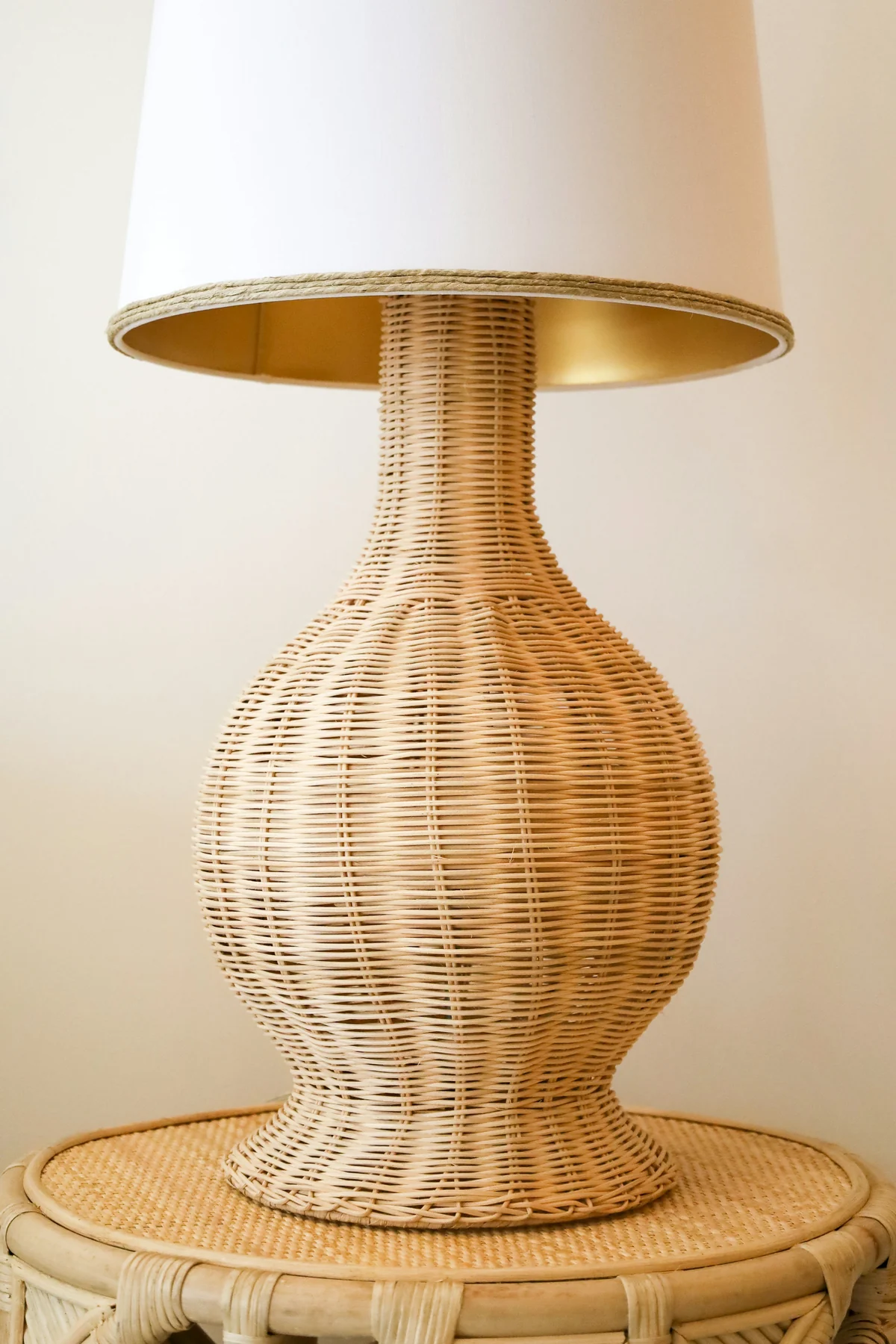
Look underneath before choosing a shape
Start with the lamp unplugged and cool. Photograph the whole base, the holder and any separate support, plus the inside of the current shade if it is accessible without dismantling. Keep retaining rings, carriers and decorative finials in the picture. “Standard fitting” is too vague when a lamp and a shade may come from different countries or periods.
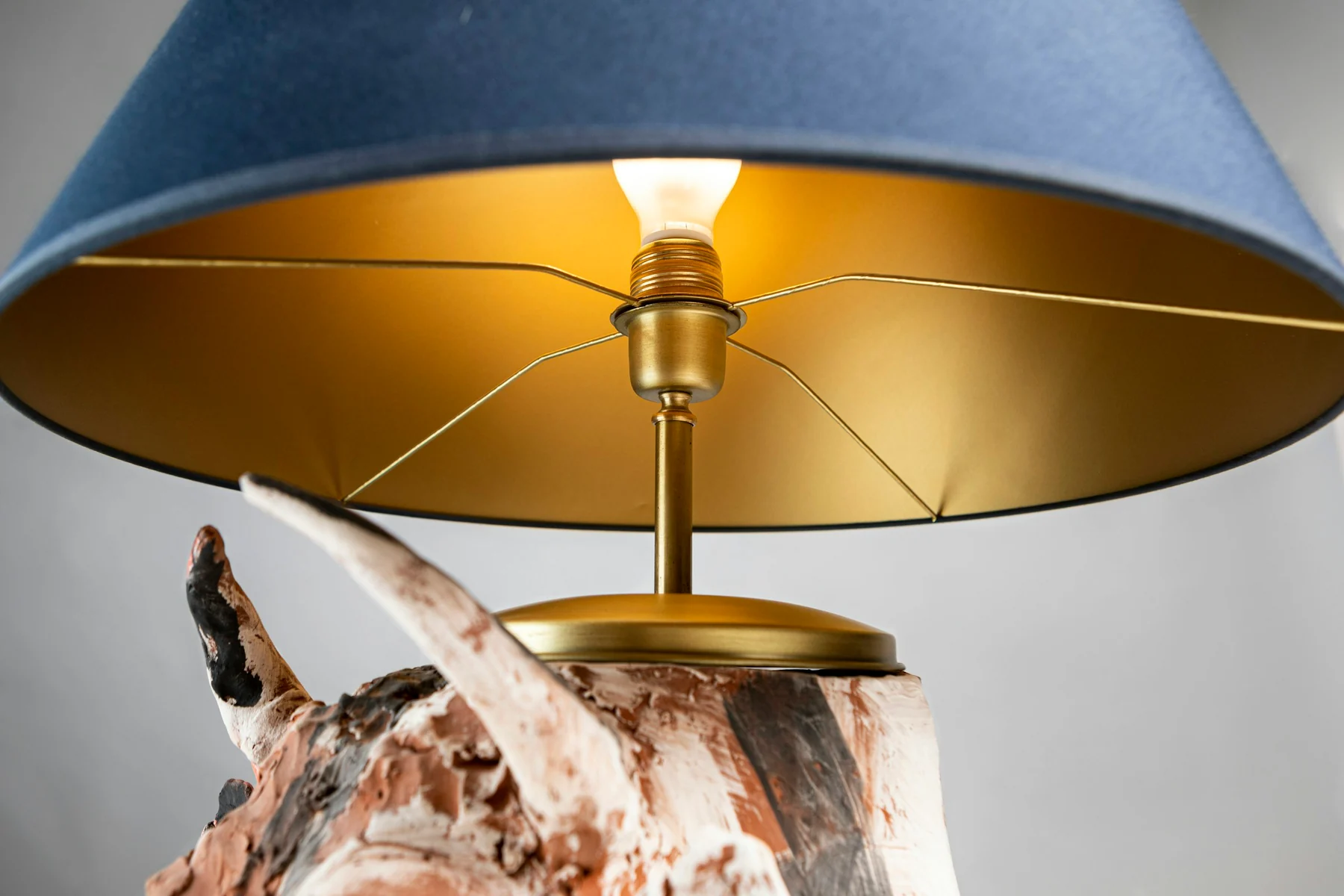
Lamps Plus distinguishes spider, uno and clip-on shade fittings. A spider shade is supported at the top of a harp; an uno arrangement locates around the holder; a clip-on shade uses a fitting intended to grip a compatible bulb. These names help you ask the next question, but dimensions and the exact construction still need checking.[1]
| Support you can see | What needs confirmation |
|---|---|
| A ring around the lamp holder | Ring diameter, retaining arrangement and any specified reducer |
| A harp or separate carrier rising above the bulb | How the shade attaches at its top and the support height |
| A clip inside a small shade | The shade’s specified bulb shape, size and weight compatibility |
| A glass gallery, unusual bracket or missing part | The exact lamp and shade system; specialist identification may be needed |
Pooky, for example, describes base-fitted ES gimbal rings with BC reducers on its UK shades, and distinguishes those from pendant arrangements. That is useful supplier information, not a promise that its shades fit every old lamp. Send the actual photographs and measurements before ordering.[2]
A ring that almost fits is a reason to ask, not to bend it wider. Do not cut the frame, balance a shade on the bulb or add an improvised adaptor. If a support needs changing, have the lamp specialist confirm a complete compatible arrangement. This Guide concerns removable shades for table and floor lamps; suspended or integrated shade systems need their own instructions.
Measure the shade body, then the mounting position
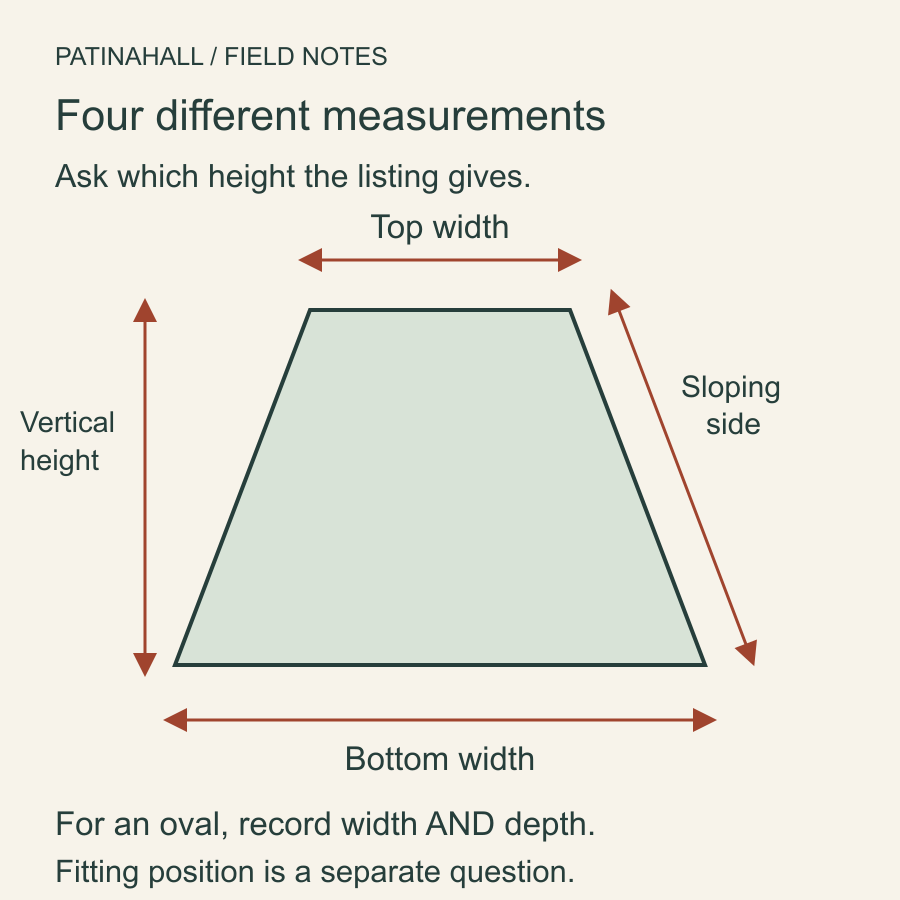
For a round shade, record the top diameter, bottom diameter and vertical height. A tapered shade also has a longer measurement along its slope; ask which one the listing calls “height”. For an oval or rectangle, record both width and depth at the top and bottom. Measure to the actual edges, including any projecting trim that affects the fit.
Next, record where the fitting sits inside the shade. Two shades with identical outer dimensions can sit at different heights on the same support. Measure the vertical distance from the mounting point to the lower rim, and ask the supplier how its quoted fitting recess is defined.
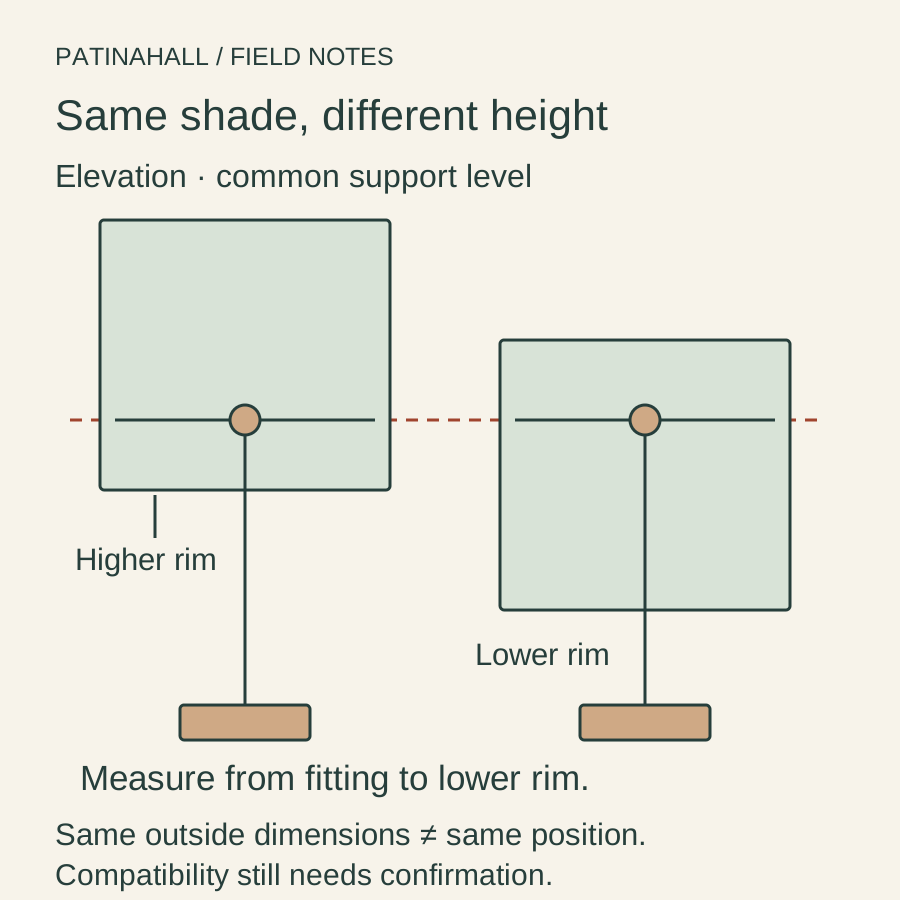
For a simple example, suppose the shade’s support point will be 50 cm above the tabletop. A lower rim 4 cm below that point sits at 46 cm. A shade whose rim is 10 cm below it sits at 40 cm. That 6 cm change can alter the view of the holder and the space around the lamp. This calculation establishes position, not hardware compatibility or safe bulb clearance.
Use proportions to shortlist, then look at the whole lamp
Pooky suggests a shade’s lower diameter close to the height of the lamp base as a starting proportion, with adjustment for tall narrow or short broad bases. Treat that as one supplier’s visual rule of thumb. It is useful for finding two or three candidates, not for rejecting a combination that works better in your room.[3]
Measure the base consistently, noting whether you included the holder or carrier. Then compare the shade with the base’s visual weight. A broad ceramic body and a slender brass stem of equal height may need different shapes. A flared shade exposes more of its base; a straight drum can feel more substantial even at the same lower diameter.
Use a paper outline held beside the unplugged lamp to judge the silhouette, or compare correctly scaled front photographs. Keep the paper away from the fitting and remove it before any powered use. This is a way to compare size, not a homemade shade or a trial of heat clearance.
If you like an old base with a new shade, the materials need not match literally. A restrained shade can leave a carved or patterned base easy to see; a patterned shade can become the focus above a quieter base. Compare them with the lamp’s actual table and nearby furniture, since an isolated product image removes that context.
Check the rim from your chair and the wall behind it
Place a compatible candidate where the lamp will live, initially unplugged. Sit where you read, then stand and walk past. Look for an exposed bulb position, an awkward view of the hardware or a shade that obstructs the view across a small table. The useful viewpoint is the reader’s seat, not just eye level in a shop.
A round shade may be too deep beside a wall even when its front view looks balanced. An oval can give width with less front-to-back projection, but the fitting orientation must allow it to face the right way. Check the whole outline against a headboard, picture frame, curtain and the route of anyone passing the lamp.
Decide what the lamp should do. For reading, compare light on the page; for background light, look at the room and the shade itself. Ask to see the exact material lit and unlit with the intended compatible bulb. A dense lining and a translucent fabric can behave differently despite having the same outside colour. A seller’s brightened photograph cannot settle glare or light output.
Check the old shade without confusing it with the electrics
A little fading can belong comfortably with an old base. Ask about tears, brittle lining, loose seams, detached trim, a distorted frame and discolouration near the bulb. An uneven rim might be a soft fabric shape or a bent support; photographs from above, below and the side help distinguish what needs explaining.
Electrical Safety First advises using the correct bulb type and staying within the lamp’s power rating; it also warns about the unknown history of second-hand lamps. Keep a vintage lamp with uncertain or altered electrics unplugged until a qualified professional has assessed it for local use. Choosing a new shade does not resolve that uncertainty.[4]
Have the supplier or lamp specialist confirm the bulb, shade and support together, including any shade-specific limits and required clearance. Do not assume that a physically smaller or lower-power LED automatically makes every old fitting suitable. Follow the complete lamp and shade instructions, keeping the assembly clear of curtains, bedding and other nearby materials.
If the lamp’s present condition is still unclear, start with our vintage-lighting inspection Guide before arranging a powered demonstration.
Send a fitting brief instead of guessing from the title
Message to copy
I am choosing a shade for this [table/floor] lamp. Attached are whole-lamp and support photographs. The base is [height and width], the support is [type and dimensions], and the available space is [width × depth]. Please confirm the compatible fitting, top/bottom dimensions, vertical height, fitting-to-rim distance and bulb/clearance requirements. I want it for [reading/background light]; could you show the exact shade lit and unlit on a suitable lamp?
Buy when the support is confirmed, the shade sits where you expect and the light suits the task. A replacement shade can make a familiar base feel completely different. The successful choice is the one you enjoy both across the room and from the chair beside it.