What a published workshop price tells you
Vintage Asylum in Haarlem publishes indicative restoration prices, including standard materials and VAT. Checked on 8 September 2026, they provide a useful local example of how the type of lamp and the type of work change the charge. They are that workshop’s indications, not a European average or an accepted quote for your lamp.[1]
| Work | Published price including VAT |
|---|---|
| Rewire a pendant lamp | €25 |
| Rewire a floor or table lamp | €50–100 |
| Respray a pendant lamp | €75 |
| Other work | €75 per hour |
The page includes standard cord in black or white, holders, plugs and small fixings within its material scope; other cord colours are to be supplied by the customer. It does not itemise every assessment, testing, packing or installation condition. Confirm those with the workshop rather than treating an unlisted detail as either included or unnecessary.[1]
The published €25 pendant rewire and €75 respray add up to €100 for those two published work categories. That arithmetic does not buy a new shade, confirm an electrical assessment or arrange someone to hang the light in your home. Ask what the final agreed scope contains.
If you have not yet assessed the proposed purchase and its complete parts, start with the vintage lighting inspection Guide. The task here is commissioning the work once the lamp is a serious candidate.
Give the repairer a specific job
Say where the lamp will be used and whether it is a portable table or floor light, or a fixed wall or ceiling fitting. Include the destination country, any known previous electrical work, the shade and the intended light source. The appropriate professional should decide the technical solution for that assembly.
Send a whole-lamp photograph, externally visible labels, the included shade and fittings, and a description of known problems. Leave uncertain lighting unpowered and do not open it to obtain a better photograph. Ask whether the workshop needs the complete lamp in person before it can move from an indication to an agreed price.
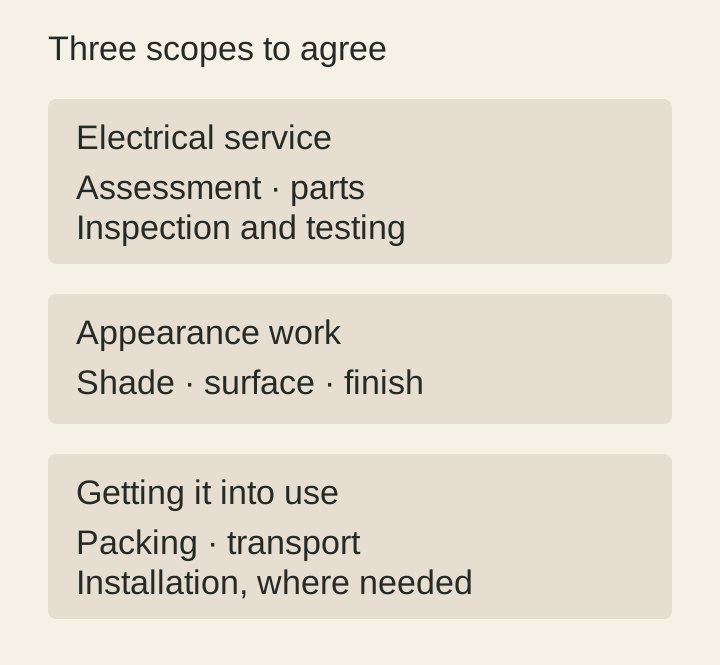
The written quote should identify the lamp and describe the agreed components, labour and final checks. Ask what an initial examination costs, whether that charge is credited against repair, and when the workshop will contact you if hidden problems change the scope. Those are questions to agree, not fees to presume every repairer charges.
For a table lamp, settle cord length and switch position in the brief. For a pendant, settle the intended drop and whether the canopy, suspension parts and building connection are included. A workshop can repair the object while another professional owns installation; make the handover explicit.
Say which character you want to keep
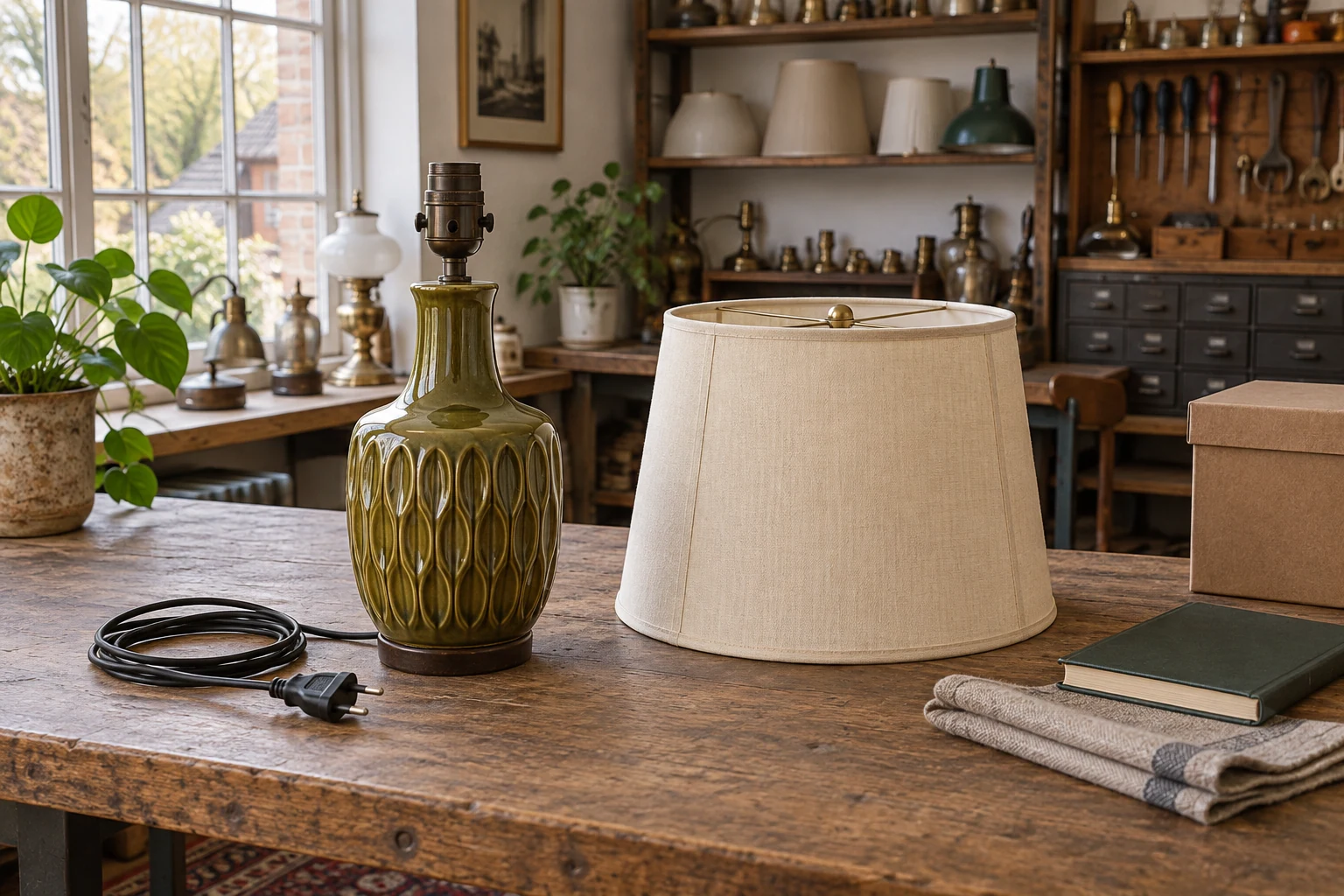
Name the external qualities that made you choose the lamp: an old painted colour, a glazed ceramic body, a metal surface with wear, or a shade whose shape you like. “Restore it” can mean different things to different people. Electrical work and a complete cosmetic refinish should not be silently treated as the same commission.
Oud & R-style in Arnhem describes electrical replacement, mechanical repairs and shade re-covering as services it discusses with customers. Its process begins with a photograph or visit and a price indication. That is a useful reminder to describe the shade and body separately, even when one workshop can handle both.[2]
Ask the repairer to explain any proposed alteration that would change the appearance or remove old material. Agree which replaced non-electrical parts you want returned for the object’s record. Retaining the character of a lamp does not require keeping an electrical component the professional judges unsuitable for use.
If a shade must change, ask for its shape, material and fitting arrangement to be agreed before it is made. A similar-looking replacement is not automatically suitable for the intended holder and light source. The person responsible for the finished assembly should resolve that relationship.
Ask what will be checked and recorded
In its UK guidance on portable appliance testing, HSE explains that visual inspection and testing find different kinds of defect: neither can simply replace the other. It also says that combined inspection and testing need appropriate knowledge, equipment and interpretation. This is a useful principle for evaluating a service description, not a test procedure for the buyer.[3]
Ask who will inspect and test the completed lamp, what record you will receive and whether that record identifies this item and the work done. If a seller supplies an old test label, pass it on as part of the history. Do not treat the label alone as approval for the current assembly, a later modification or use in another country.
For a fixed light, distinguish the workshop’s checks from the inspection and connection at your building. Also confirm the permitted light-source specification and any use restrictions the professional gives you. Keep those instructions with the service record instead of relying on a verbal “all done”.
Compare the cost at your door
Consider a deliberately hypothetical table-lamp purchase: €120 for the lamp, an agreed €85 workshop service and €35 transport make €240. Those assumed amounts include tax and cover no new shade or fixed installation. If the required shade then adds €90, the comparison becomes €330. Use actual written amounts in your own calculation.
Compare that finished total with a serviced lamp whose appearance and documented scope you also like. The project can still be worth choosing for a particular ceramic body or family history. The point of the budget is to choose knowingly, not to demand that every repair beat the cheapest replacement.
Before handover, confirm how the shade and fragile body will travel, who is responsible for any fixed disconnection or installation, and what happens if assessment shows the lamp should remain out of use. A clear stop-and-contact point is more useful than an open-ended promise to make anything work.
A message for the repairer
I would like this [table / floor / pendant / wall] lamp assessed for use in [country and room]. Here are whole views, external markings, the included shade and known repair history. Please separate assessment, agreed parts and labour, final inspection/testing, shade or finish changes, tax, transport and any installation. What record and use instructions will I receive, and when will you contact me before additional work?