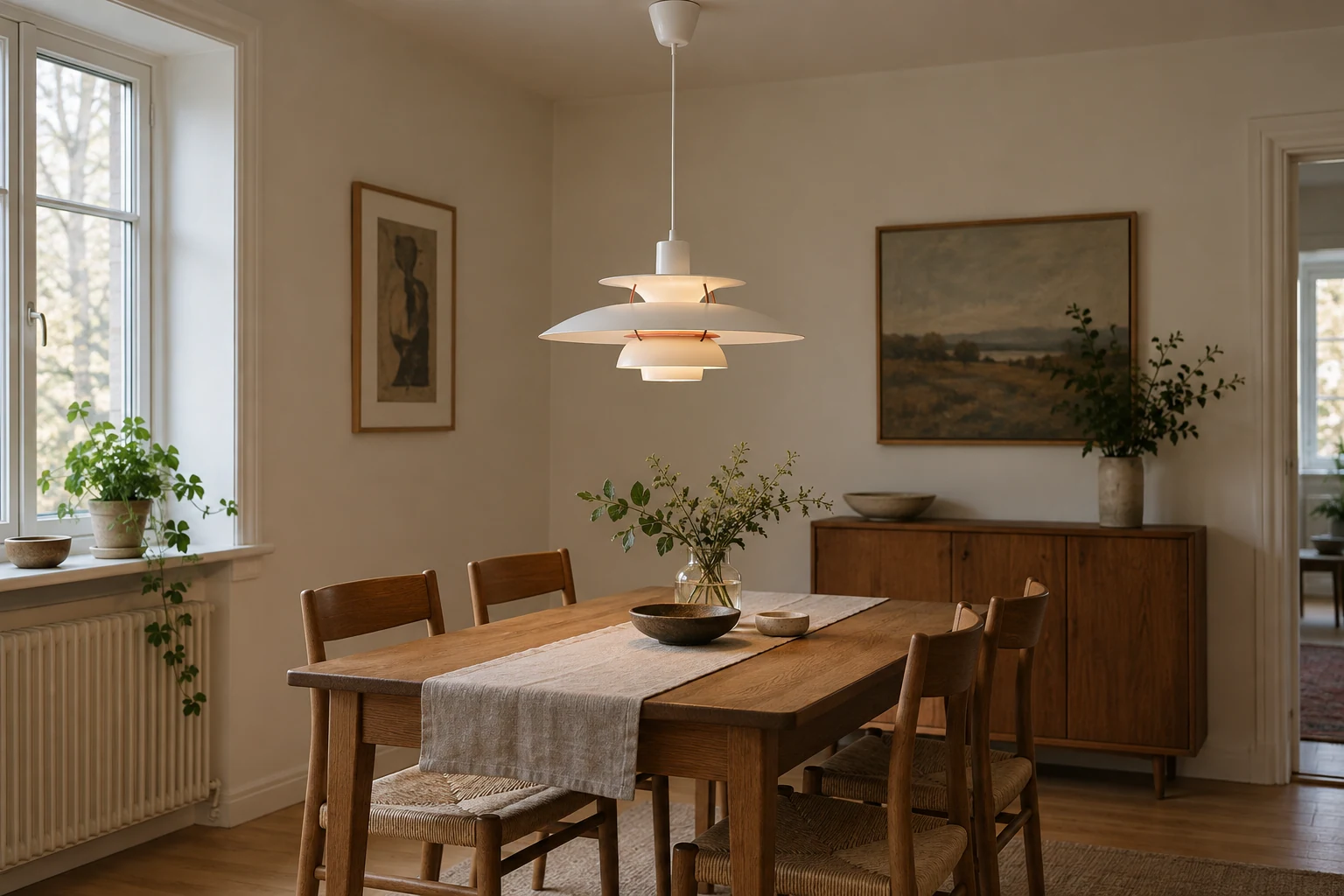
A 1958 design does not date this lamp
Poul Henningsen designed the PH 5 in 1958. Its layered form is still recognisable in current production, which is precisely why “designed in 1958” tells you little about the age of the pendant for sale. Ask for the source of the seller’s production date, any purchase history and identifying details photographed in place.[1]
The current full-size PH 5 is listed with a 500 mm diameter. Louis Poulsen introduced the smaller PH 5 Mini in 2017, with an approximately 300 mm top shade. A smaller lamp in a flattering photograph can be easy to mistake for the larger one when there is no scale beside it.[2]
Measure the offered shade rather than estimating from a room photograph. Record the exact model wording, finish and known changes. If the description contains another PH model number, follow that model’s documentation instead of treating every layered pendant as a PH 5.
Decide why you want an older example. A documented earlier finish may matter to you as an object with history; a later used lamp may deliver the form you like with a clearer service record. Compare those offers on their own terms rather than allowing the design date to become an unearned age premium.
Compare the whole shade stack
Ask for an upright whole view, a level side view and a view from beneath, all of the same lamp. Follow the shade edges around the assembly. Note a local dent, an uneven gap or a shade that sits off centre, then ask what is known about it. A top-down beauty shot can miss these relationships.
The current PH 5 specification includes a frosted-glass diffuser. That does not make a present-day underside photograph a universal completeness test for vintage examples. The maker’s spare-parts listings distinguish assemblies and offer an electrical assembly specifically described for older versions, with a customer-service check. Identify the version before ordering by appearance.[1]
| View or record | Question it should answer |
|---|---|
| Level whole view | Are the shades and their supports in the expected relationship, with any dents or bends clearly located? |
| Underside and identifying details | Which version is being offered, and which lower components does that version require? |
| Canopy, suspension and service record | What is included for installation, what has been replaced, and what still needs professional assessment? |
Separate a paint chip from a damaged support or an altered assembly. The first may be wear you enjoy; the others can change the work needed. Do not ask the seller to bend a shade back into shape or open the fitting just to improve the listing photograph. A specialist should assess consequential deformation.
Original paint, a repaint or Retake?
An older painted lamp may have scratches and uneven colour. A repainted one may look fresher while having lost some of the surface history you wanted. Ask who carried out the work, what was changed and whether there are photographs from before it. “Restored” is a description to unpack, not a single condition grade.
Louis Poulsen’s PH 5 Retake gives a useful third case. The manufacturer removes the old paint from selected used or imperfect PH 5 lamps and supplies them with a raw finish that retains individual marks. This is a documented refurbishment route, with its own finish description. An unpainted lamp offered elsewhere is not automatically a Retake example.[3]
If you like raw metal, ask for the evidence of that treatment and the applicable care instructions. If you want an earlier painted finish, a documented repaint may still be the wrong choice for you even when the work is good. Choose the surface you want to own and maintain, then pay for the claim the records support.
Measure the space above the table
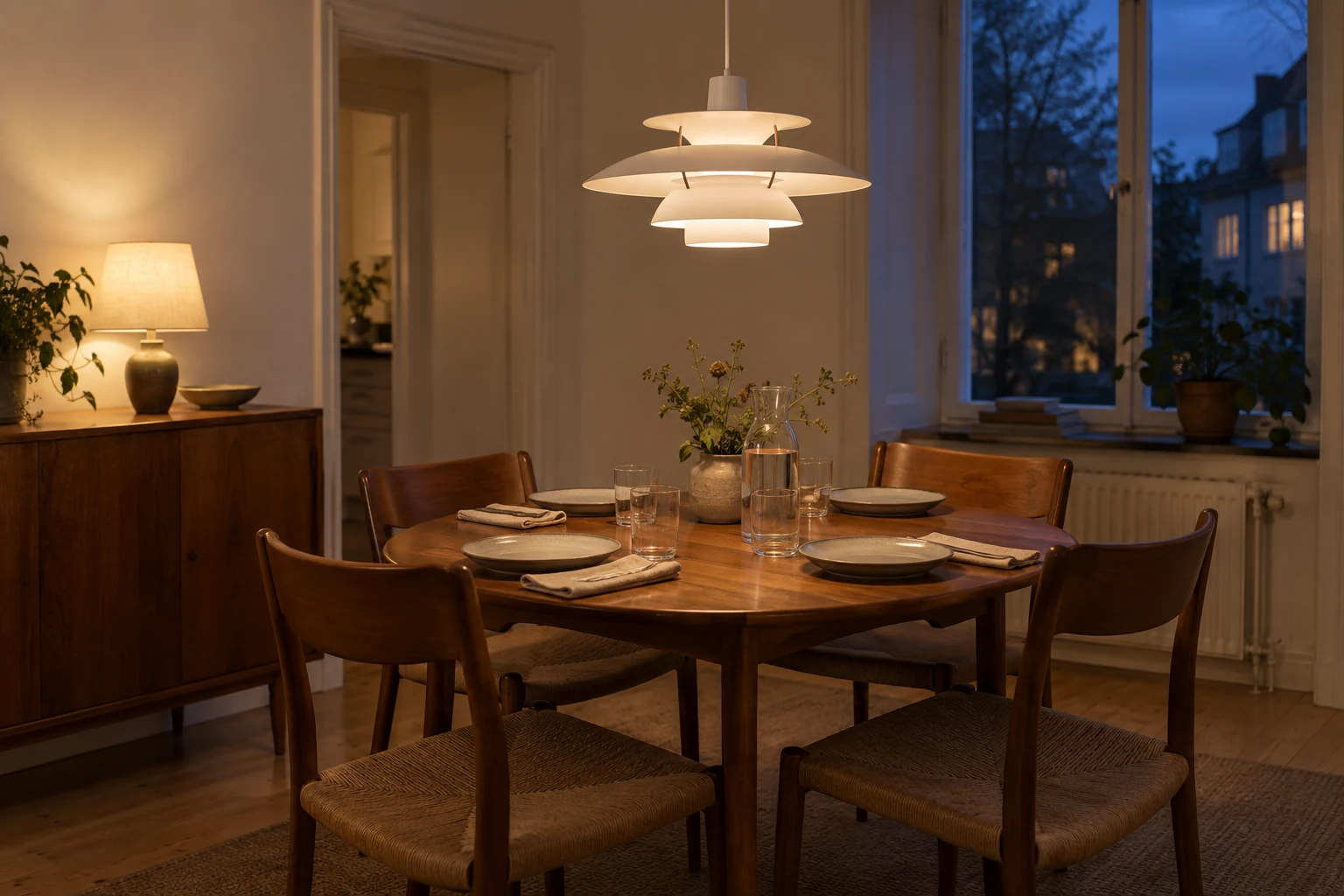
A pendant belongs to the room as well as the table. Measure the ceiling-to-table height, the desired bottom-of-shade position and the actual shade envelope. Include the canopy and suspension in the total drop. The length of loose cable photographed on a floor is not the installed drop.
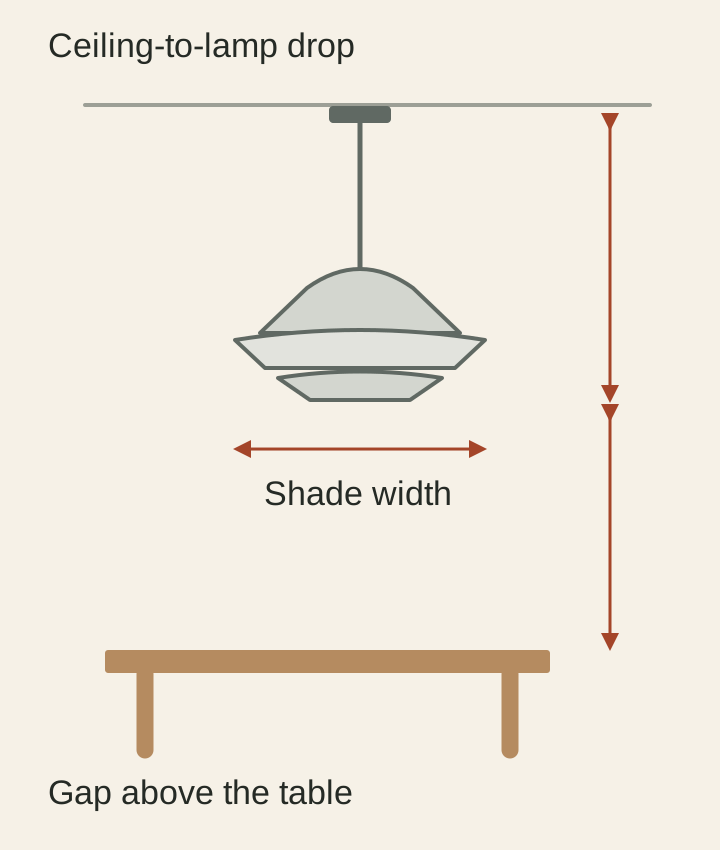
Sit at the table and look across it. Then stand, serve a meal and move the chairs as you normally would. Consider whether the proposed position obscures the person opposite, feels crowded against the tabletop or puts the shade in the path of ordinary movement. Ask the installer to confirm the final placement and suspension.
Treat a pleasant photograph of a lit lamp as a room impression. It cannot prove the performance of a different bulb, altered shade stack or different room. If the lamp has been assessed as suitable for use, a demonstration in a relevant setting can help you judge the result; do not energise uncertain wiring to obtain one.
A new cord is not the whole service
Ask a qualified lighting professional in the country of use to assess the exact lamp, identify the compatible service parts and scope the installation. Give them the version evidence and the complete photographs. A claim that it “works” is not a description of the condition of every connection or the suitability of the suspension.
Have the proposal distinguish replacement components, electrical work, any shade or support work, and installation. Check whether collection, packing and return delivery are included. A missing original component may have a different sourcing problem from a current electrical part, even when both appear under “needs restoration”.
Use the vintage-lighting inspection Guide for the wider electrical and destination-country questions. The PH 5 purchase adds the version-specific task: deciding which shade assembly and service parts belong to this particular lamp.
Compare the full delivered and installed cost with an alternative that already has documented work. There is no need to reject honest age, but leave unresolved parts and labour visible in the calculation. A low asking price cannot tell you whether the remaining work is small.
Choose the lamp with a complete next step
The strongest offer gives you a coherent model description, a complete record of what is included and a realistic route to using it above your table. That can be a worn older lamp with good history, a carefully serviced one or a later used example. The useful distinction is how clearly you understand the lamp and its remaining work.
A message for the seller
Could you confirm the exact PH model and measured shade diameter, and send level side, underside and whole suspension views? Please show identifying details in place and list any missing, repainted or replaced parts. What supports the production-date claim, and who last serviced it, when and for which country? I will have the lamp and its installation assessed locally before use.