The best place to begin is a house
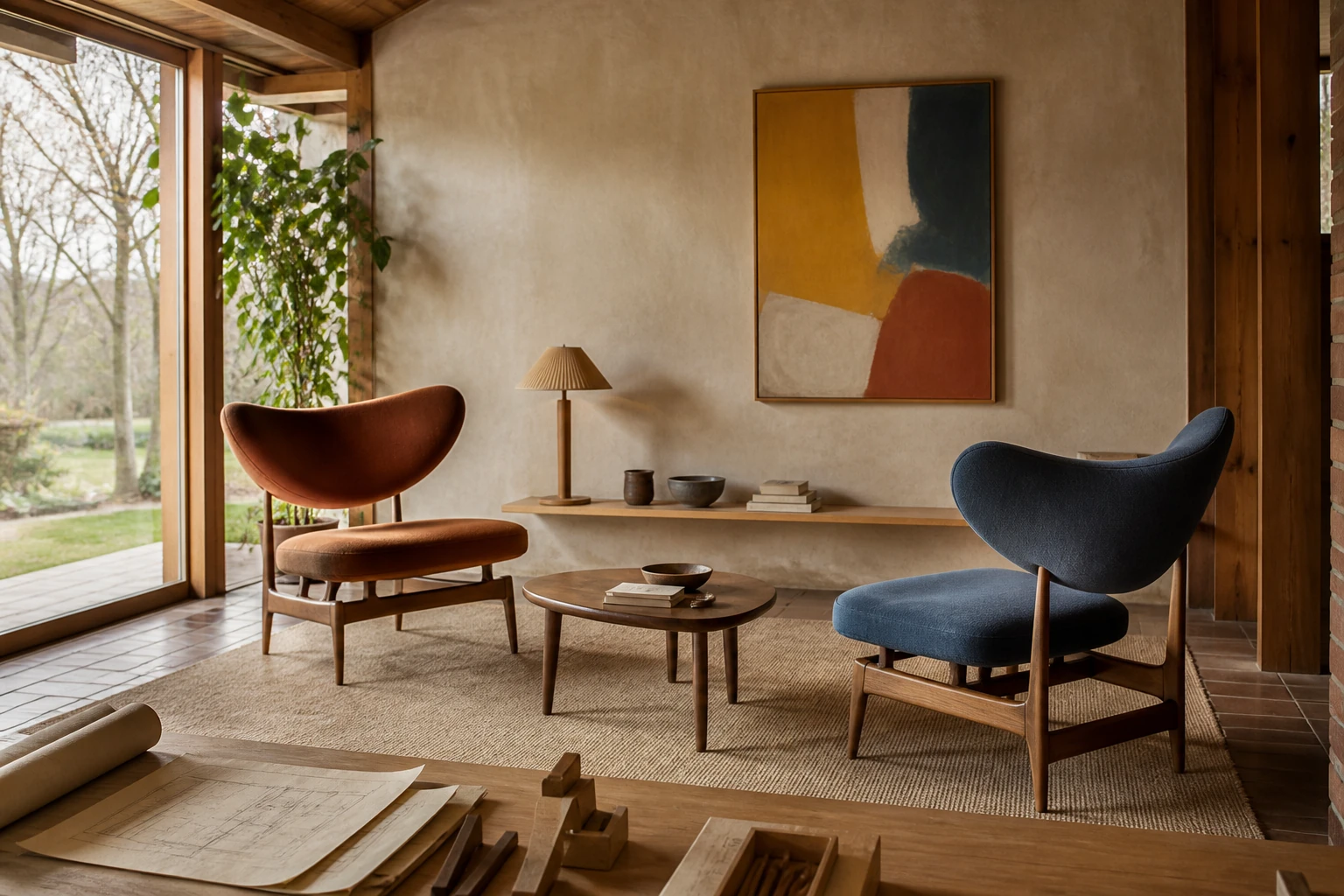
Walk into Finn Juhl's house in Ordrup and the furniture does not wait in a line to be inspected. A chair turns towards a view. A table holds its place between people. Paintings bring strong blocks of colour into rooms shaped by timber, brick, plaster and daylight. The objects have individual identities, but they also depend on where Juhl placed them.
Juhl designed and furnished the house when he was thirty. Ordrupgaard dates its completion to 1942 and describes it as a particularly successful Danish functional-style single-family house. The museum also presents it as a modernist Gesamtkunstwerk: architecture, design and art brought into one whole.1
That German word can sound grand for a modest home. Its useful meaning is simple: no part has to tell the entire story alone. The window changes how the chair is read. The height of a chair changes how a painting meets a seated person. A clear route through the room changes whether sculptural furniture feels generous or obstructive.
This is the first clue to Juhl's method. He was not adding attractive chairs to a completed box. He was arranging relationships among body, object, art and room.
An architect entered furniture through an exhibition
Juhl studied architecture and worked for Vilhelm Lauritzen's office until 1945, when he opened his own studio. The current House of Finn Juhl timeline records that he did not complete his formal studies because practice occupied so much of his time.2 The missing diploma is less important than the architectural habit he carried into furniture: thinking in sections, levels, movement and connected parts.
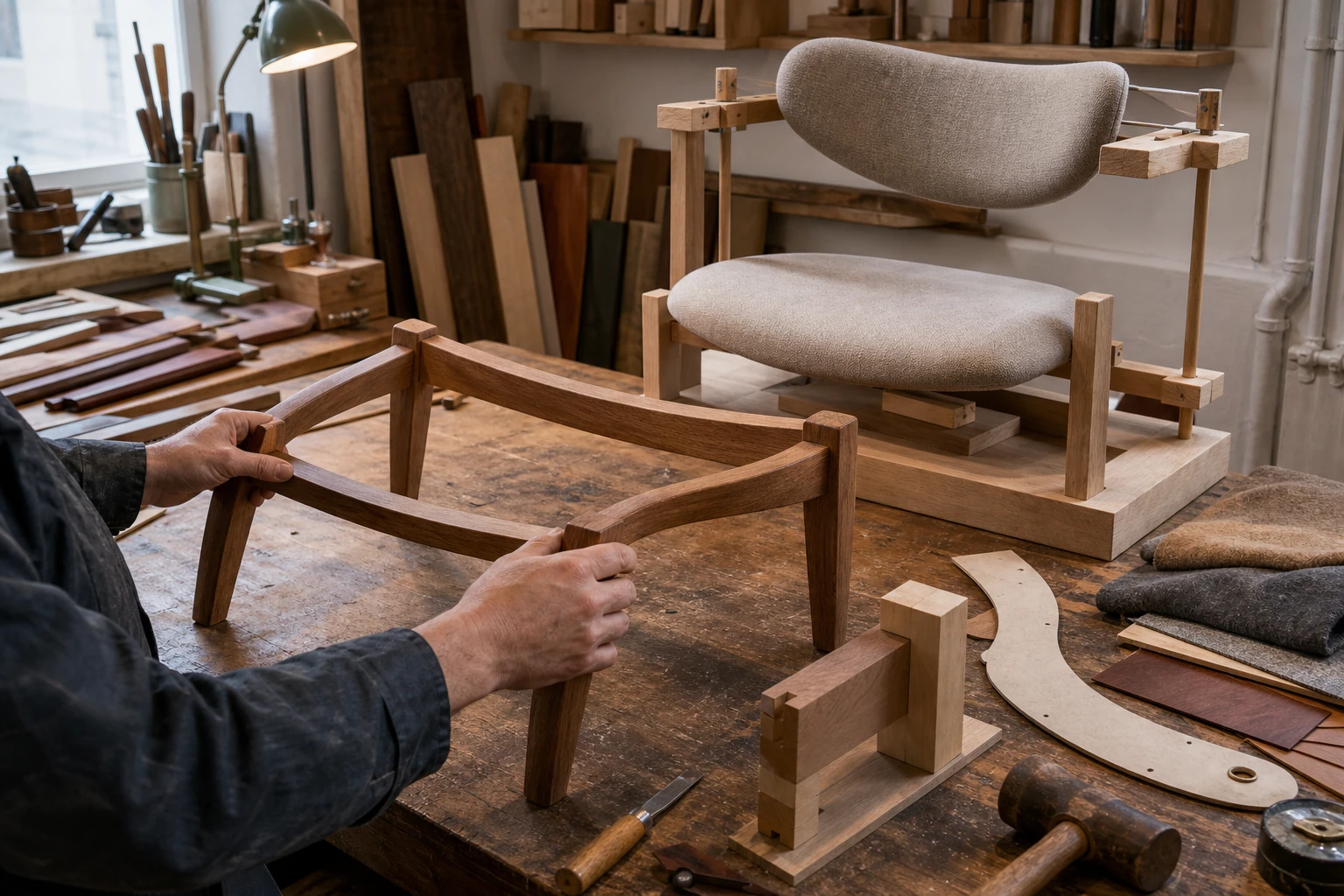
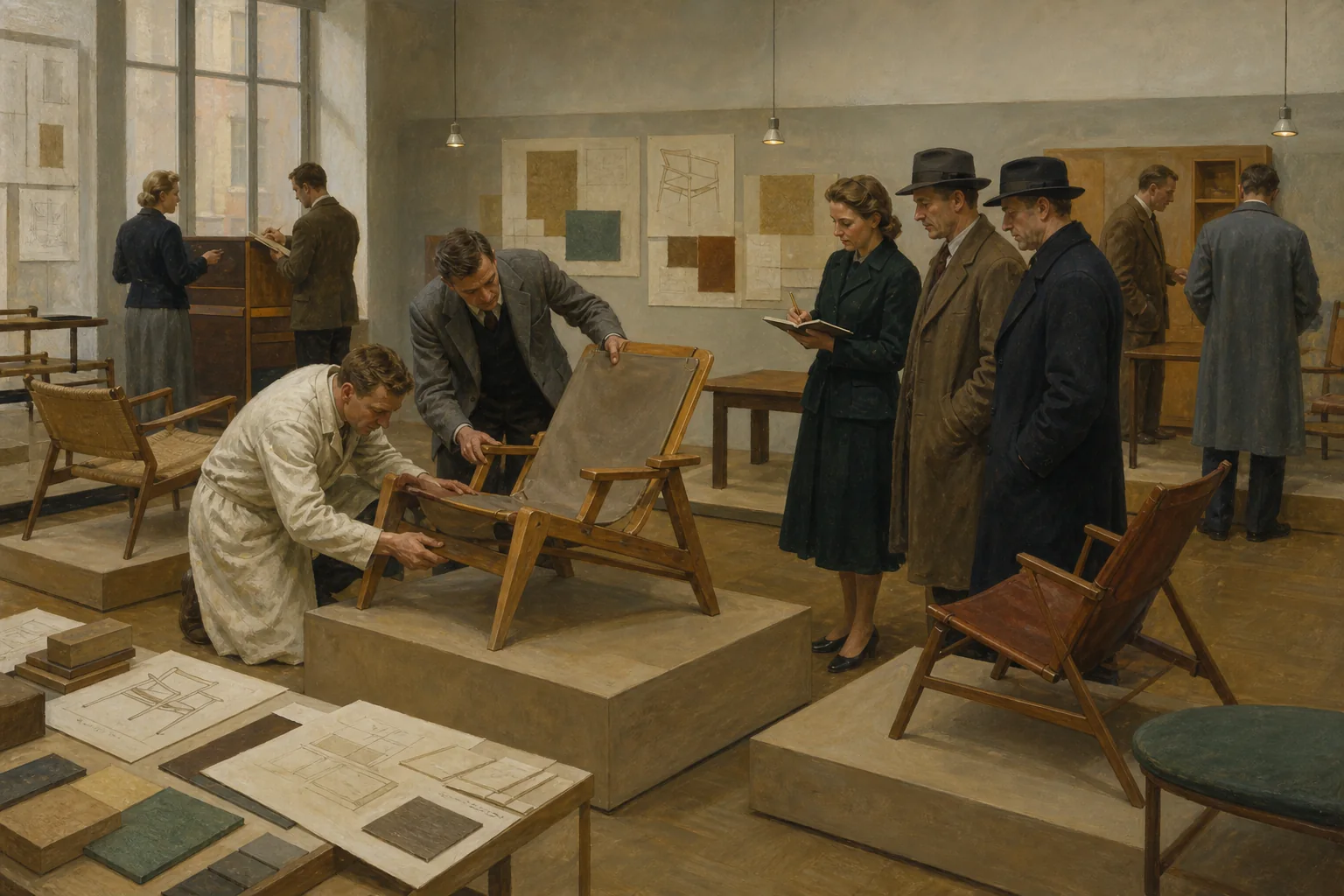
In 1937 he made his Cabinetmakers' Guild Exhibition debut with master cabinetmaker Niels Vodder. Their collaboration continued for more than twenty years according to the same rightsholder account.2 The annual exhibition gave an architect and a workshop a temporary room in which to test an idea at full scale. A drawing had to become stable furniture, and the furniture had to hold its own beside the work of other designers and cabinetmakers.
Designmuseum Danmark remembers their exhibition stand as unlike the others. The museum's paper collection contains Juhl's watercolours and drawings for several works associated with this period, including the Chieftain and Egyptian chairs and the Butterfly table.3 Those papers matter because they show imagination before it becomes an object. Vodder's role matters because an exhibition visitor could not sit on a watercolour.
The connected article Niels Vodder: where Finn Juhl's drawings met the bench follows that second half of the story: the maker who had to give difficult lines a convincing structure.
A chair could be read as two systems
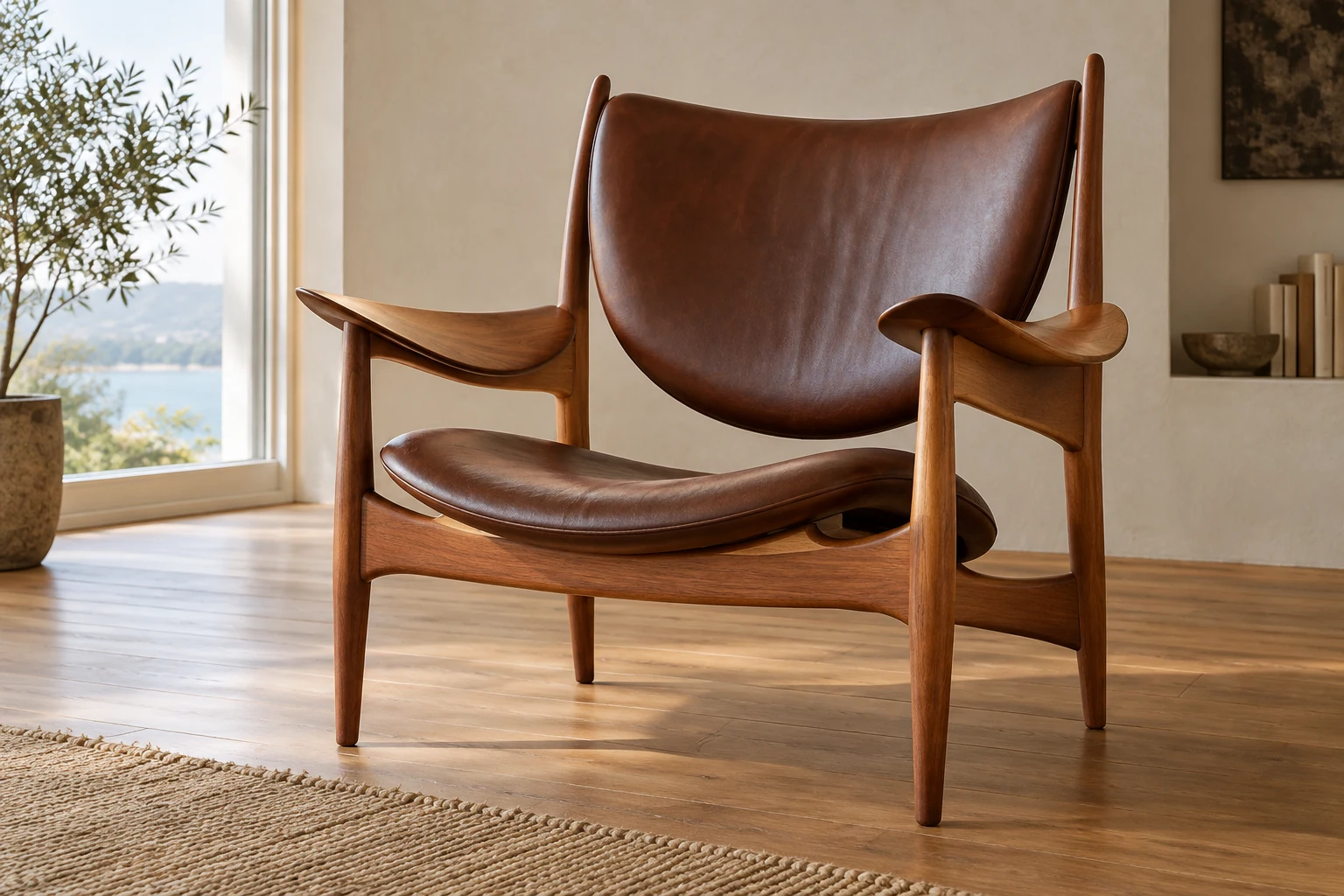
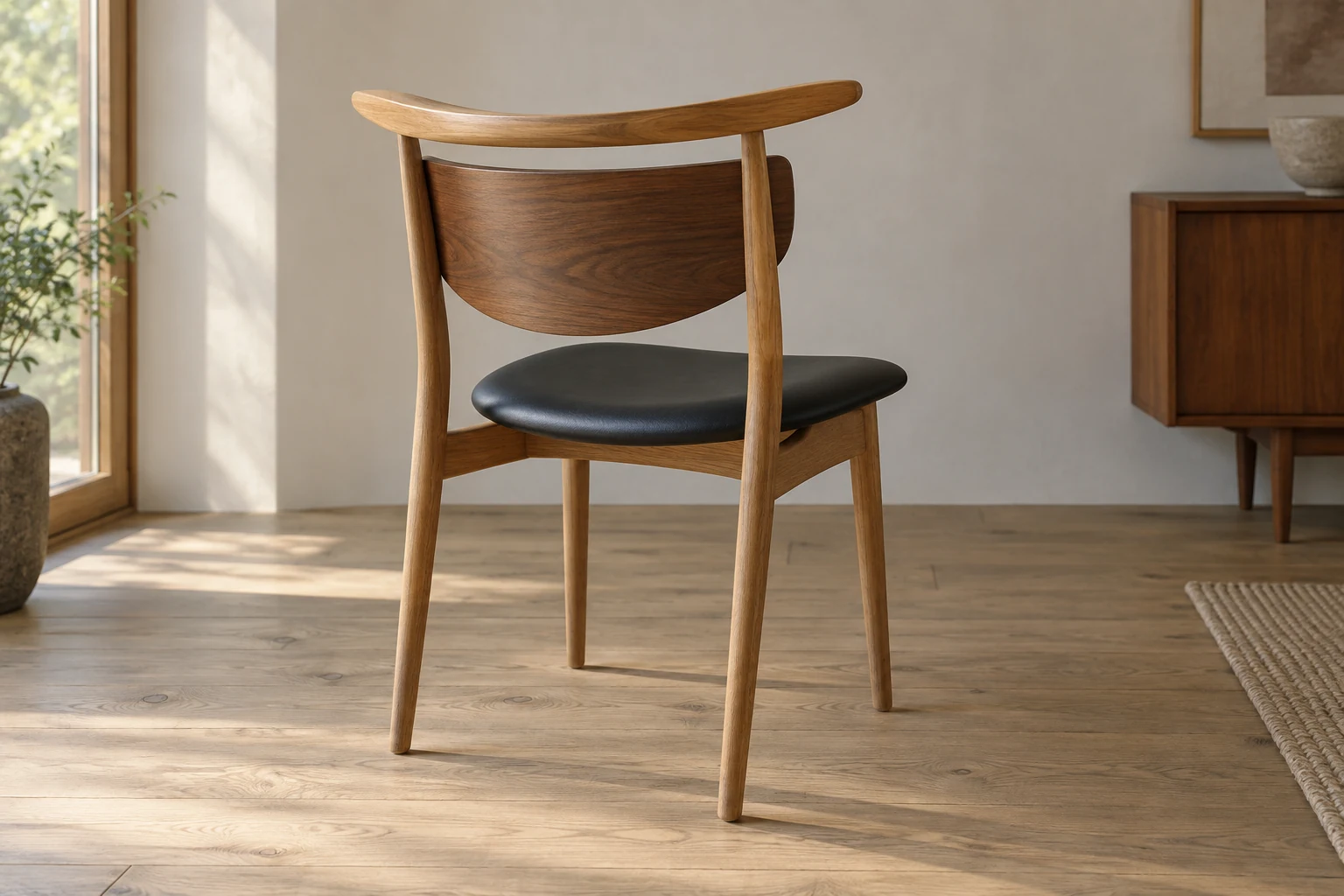
One documented chair makes Juhl's architectural thinking unusually clear. MoMA records Model 45 as a 1945 armchair in teak and wool, manufactured by Niels Vodder.5 Its collection label does more than name a date and material. MoMA explains that the seat and back are visually separated from the load-bearing wooden frame.6
Look at that idea as if it were a tiny building.
- One system carries the load into the floor.
- Another system receives the body.
- Small connections make the two act together.
- The gap between them lets each remain visible.
The result is sometimes described as floating furniture. Floating does not mean unsupported. The visual lightness depends on exact support: the frame must resist movement, the seat must meet it at controlled points and the back must accept pressure without becoming a heavy wall.
This distinction also changes the experience of the sitter. Upholstery is not forced to pretend that it is timber, and timber does not have to become a solid box around soft surfaces. Each material can do a more legible job.
Juhl did not apply one construction formula to every object. Model 45 is useful because it lets a beginner see a recurring question: can the part that carries a person appear distinct from the part that carries the chair?
Small series gave experiments somewhere to become real
The most inventive silhouette still has to survive grain direction, joints, upholstery, repeated use and the judgement of the person making it. Nationalmuseum describes Juhl's furniture as usually produced in small artisanal series with Vodder. It also notes that Juhl later helped transfer the detail and joining knowledge of small-scale furniture into work intended for larger production.4
That movement from small series to industry is central to Danish Modern. A cabinetmaker's workshop could test an unfamiliar meeting between parts with close attention. A larger producer could make furniture available beyond the exhibition, but only after materials, dimensions and operations had been made repeatable.
The two scales should not be confused. A rare exhibition version and a later industrial version may share a design idea while differing in maker, construction, material and purpose. Nor should the small workshop be treated as a magical place where drawings arrived fully solved. The sources do not record every discussion at Vodder's bench. What they establish is a sustained collaboration and a group of museum objects for which designer and maker are both named.
That is a more useful story than the myth of the solitary genius. Juhl's imagination gave the partnership direction. Skilled making gave the imagination consequences.
The room crossed the Atlantic
By the early 1950s, Juhl was working at a scale far larger than a chair or house. Denmark commissioned him to design the Trusteeship Council Chamber at the new United Nations headquarters in New York. The UN describes a complete interior: ceiling, curtains, wall panels, carpet, lamps and chairs were considered together.7
The room makes his earlier lessons public. Delegates sit in a horseshoe so members meet on the same level. Ash-lined walls help the acoustics. Colour appears in the ceiling, carpet and other fittings rather than being applied as one decorative afterthought.7
This was not simply Danish furniture exported to a prestigious address. It was an architectural argument about how people should see, hear and speak to one another. The chamber's use has changed over time, and later renovation introduced new furniture, but the original commission still demonstrates how Juhl could carry one habit of thought across scales: separate the parts, understand their jobs and compose them into an experience.
MoMA's record of Model 45 supplies another part of the American story. Its extended exhibition label credits curator Edgar Kaufmann Jr. with introducing Juhl to American readers and later commissioning him to design the setting for MoMA's 1951 Good Design exhibition.6 Again, the assignment was not just one chair. It included the environment in which people would meet modern objects.
What to carry into the next room
Juhl's work is not best understood as a list of curved shapes to recognise. Ask a small set of connected questions instead:
- What carries the weight, and what meets the body?
- Which material is allowed to do which job?
- Who worked out how the drawing could be made?
- How does the object change the room around it?
- Does colour organise the space or merely decorate a surface?
These questions do not authenticate a chair. They make looking more precise. They also explain why Juhl belongs in a wider account of Danish Modern: the international reputation grew not from one pale-wood look, but from designers, makers, institutions and manufacturers turning ideas about modern life into usable things.
Continue with Niels Vodder to see why Juhl's early furniture needs a maker history beside the designer portrait. The guide to the Copenhagen Cabinetmakers' Guild Exhibitions explains how to use those exhibition records without confusing a documented model with the history of a particular object.