Look for the chair under the upholstery
The Pelican Chair seems to have swallowed the usual diagram of a chair. Its seat lies low inside a curved body; broad sides reach forward; the back joins them without advertising a separate timber scaffold. This article is really about how upholstery can stop dressing a frame and become the visible body of the furniture—a small room organised around one person.
Tokyo Metropolitan Art Museum dates Finn Juhl's Pelican Chair to 1940 in its exhibition on Juhl and Danish chairs.1 House of Finn Juhl likewise places its debut at the 1940 Copenhagen Cabinetmakers' Guild Exhibition.3 The date matters because this is not a soft-edged afterthought to a mature style. It is an early experiment whose visible form refused to explain itself through the familiar sequence of legs, seat rails, arms and back posts.
The sides make a small room
Call the projecting forms armrests and some of their effect disappears. They do provide a place beside the sitter, but they also turn inward like two short walls. Together with the curved back, they establish a boundary around the upper body. The seat is not simply below that boundary; it is nested within it.
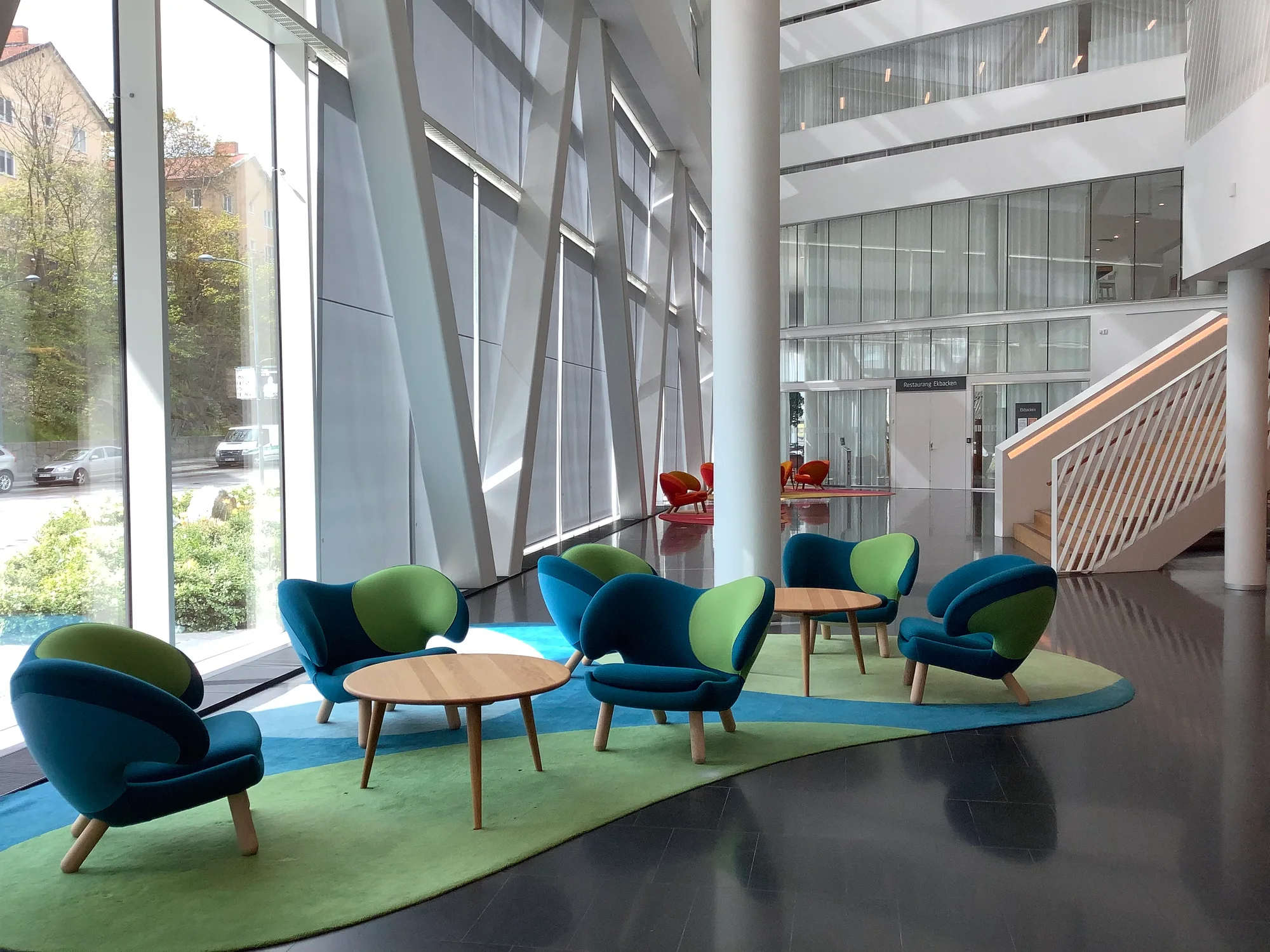
Sinikka Halme's 2020 lobby photograph is especially useful because several chairs appear from different angles.4 From the front, the sides resemble broad wings. In profile, their forward reach becomes clear. From the rear, the upholstery reads as one continuous volume while the small timber legs retreat beneath it. No single silhouette has to do all the explanatory work.
The result is generous without being conventionally grand. The chair stays low, and its enclosing gestures happen around rather than above the sitter. It does not confer the upright authority of a throne. It makes a private interior at living-room height.
A 1940 provocation
The Cabinetmakers' Guild Exhibition could join an architect's speculative drawing with the knowledge of a working cabinetmaker. Pelican used that setting to present a chair whose craft was less immediately legible than exposed joinery. The shape looked continuous, rounded and bodily at a moment when a visitor might reasonably expect Danish cabinetmaking to show more timber.
House of Finn Juhl's present account says the response was hostile. It reports comparisons to a “punctured tennis ball” and a “tired walrus”. 3 The phrases are memorable—and short enough to have followed the chair for decades—but they mostly record the discomfort of first looking. Neither description explains how the low seat, projecting sides and continuous upholstery organise a body.
There is also a trap in telling the story as triumph over foolish critics. A strange new chair can genuinely be difficult to read, and no surviving review needs to be mocked into submission. Pelican's better answer is the object itself: its once-provocative outline now gives us a precise way to discuss enclosure, concealment and the social distance made by furniture.
Two examples, then a sixty-one-year pause
The current rightsholder says two Pelican Chairs were shown in 1940 and that the design was not put into production until 2001. 3 That chronology deserves more than a quick “ahead of its time”. It separates an exhibition proposition from a continuing commercial model.
Two examples can establish a design without establishing a production run. Likewise, a 2001 relaunch can make the form available without turning a later chair into one of the two exhibition objects. The gap is part of the design's history: for roughly six decades, Pelican existed through those early chairs, images and professional memory rather than an uninterrupted stream of new examples.
The pause also keeps our language honest. We can say that Finn Juhl designed and exhibited the chair in 1940. We can report House of Finn Juhl's production date of 2001. We cannot fill the years between them with imaginary editions simply because the outline remained recognisable.
A museum record keeps the materials honest
Tokyo Metropolitan Art Museum's bilingual worklist gives Pelican record 2-11 a compact but valuable set of facts. It dates the design to 1940, lists Niels Vodder and Onecollection/House of Finn Juhl in the maker information, records beech and fabric, and gives dimensions of 870 × 780 × 720 millimetres with a seat height of 380 millimetres. 2
That one row should not be stretched into a universal specification. It is a record for the chair in the exhibition worklist, and its maker information places a historic cabinetmaker beside the current production name. It does not tell us that Vodder made the later lobby chairs, that every Pelican hides the same timber, or that any fabric seen today is original.
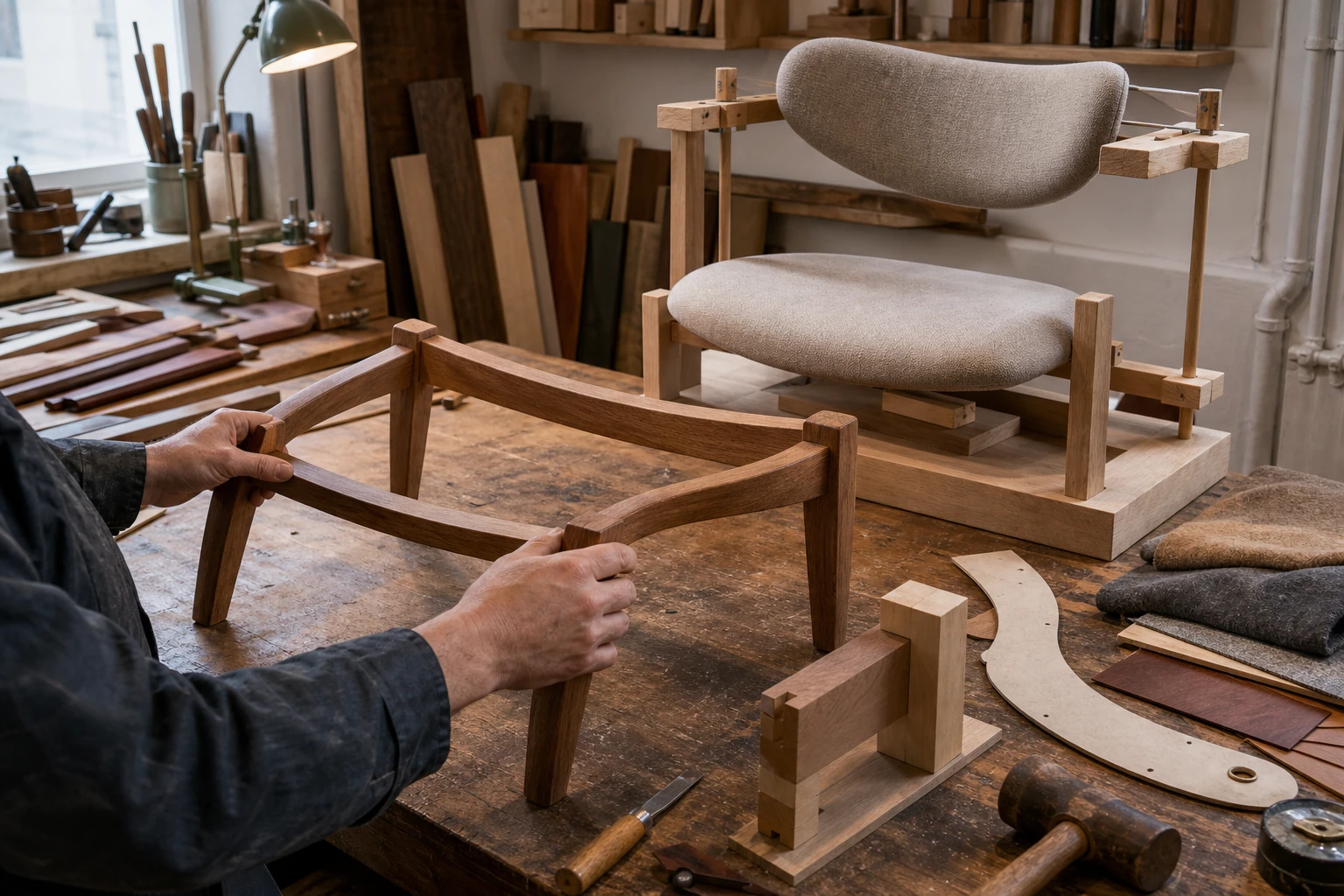
Yet the material entry changes how we look. Beech belongs to a structure that the finished chair largely withholds from view; fabric belongs to the surface that supplies almost all of its visible identity. Craft has not vanished. Its hierarchy has been inverted. The supporting work is internal, while upholstery draws the public shape.
The nickname is the least interesting animal
The name Pelican is irresistible. Broad sides can suggest wings; the curved front can suggest a beak or breast; a group of blue-green chairs can look as if an unusually stylish flock has occupied reception. The resemblance helps memory, but it can make looking stop too soon.
An animal metaphor treats the outline as a picture. A furniture reading asks what the outline does. The sides screen peripheral space. The back joins them into an enclosure. The low centre changes the sitter's level. Small legs hold that upholstered body clear of the floor just enough to prevent it becoming a fixed booth. Each observation brings the chair back from mascot to spatial instrument.
This is also where Pelican differs from Juhl's later Chieftain Chair. Chieftain keeps carrying timber and carried upholstery visibly separate. Pelican lets the upholstery take command of the silhouette and asks the frame to work more quietly inside.
Later chairs, useful evidence
Halme photographed the chairs at Swedbank's Sundbyberg headquarters and released the image under CC BY-SA 4.0; PatinaHall's WebP adaptation remains under the same licence.4 The setting is not the 1940 Guild Exhibition, and the file record does not authenticate or date the individual chairs.
What it does provide is rare visual efficiency. Front, side and rear views share one frame. Repetition reveals that the chair's character survives more than one upholstery colour and more than one viewing angle. The photograph is excellent evidence for form, carefully limited evidence for object history.
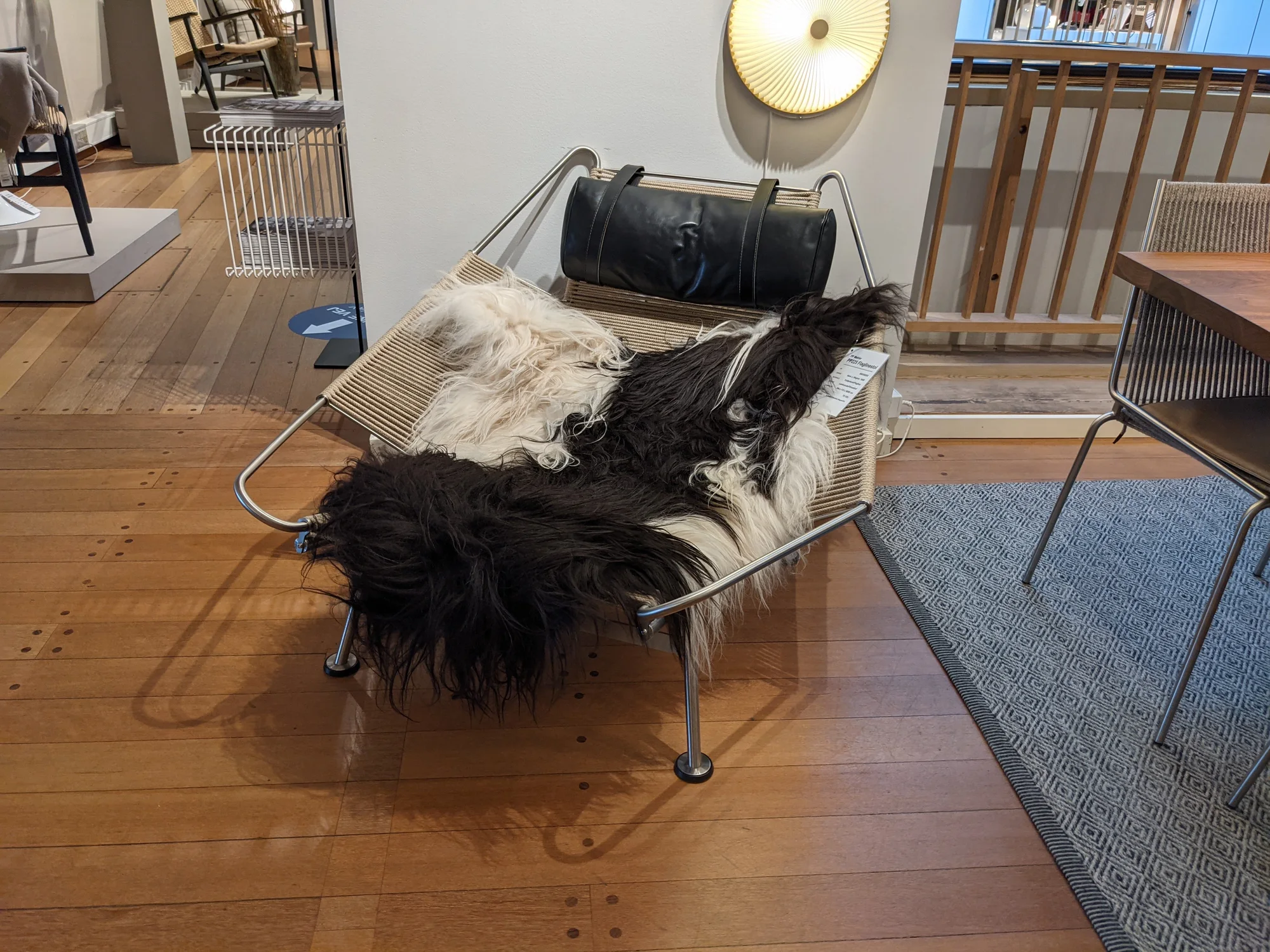
For a design that takes the opposite route, look at Hans J. Wegner's Flag Halyard Chair. Wegner turns frame and line into the spectacle; Juhl lets a soft body occupy the foreground. Pelican has not abolished structure. It has made concealment an active design decision—and given upholstery the last word.